




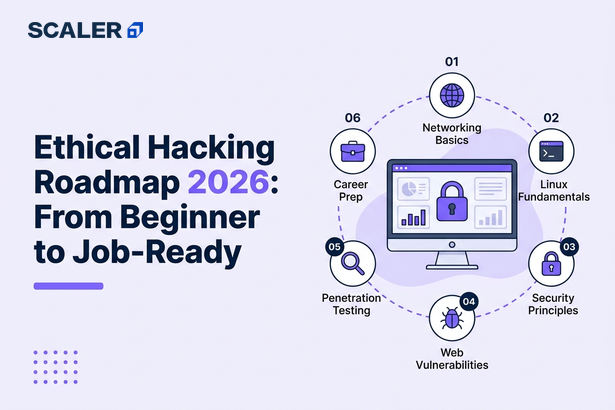
Asking ten potential ethical hackers about the first steps they should take will reveal that most of them would suggest starting with using certain tools such as Burp Suite, Metasploit, or Nmap. However, those tools are only useful when you understand the systems they are designed to assess. Without understanding how networking, Linux, or web application technologies work, using any security tools will be nothing more than pushing buttons and analyzing results.
That’s why ethical hacking is best learned in phases rather than by jumping straight into tools.
Normally, security specialists begin by learning networking, operating systems, and scripting, then proceed to reconnaissance, vulnerability testing, exploiting, and finally to security testing itself. This ethical hacking roadmap follows the same progression.
What Is Ethical Hacking (and What It Is Not)?
Ethical hacking, at the core, involves identifying the vulnerabilities present in the system/application/network with the permission of the owner of the system. It is the process of finding out vulnerabilities before the malicious actors make use of them. Hence, it forms an integral part of the cybersecurity strategy.
However, there is a fine line between ethical hacking and other activities that need permission from the system owner. Using the same tools and techniques in unauthorized penetration testing makes the act unethical. This means that it depends upon the permission, scope, and purpose of the action rather than the tool or the technique being used.
Before the process of testing starts, there must be a set of clear rules of engagement that define the scope of the testing, actions that can and cannot be done in testing. Responsible disclosure, legalities, and scope formation are the principles of ethical hacking that you should keep in mind during the course.
Transform Your Career
Choose from our industry-leading programs designed for career success
Modern Software and AI Engineering Program
Master full-stack development with AI integration


 +1000 more
AI Forward Deployed Engineer with Specialisation in AI applications
Build and deploy AI solutions for real-world business problems
+1000 more
Modern Data Science and ML with specialisation in AI
Advanced data science techniques with AI specialization
+1000 more
Advanced AIML with Specialisation in Agentic AI
Deep dive into AIML with focus on Agentic systems
+1000 more
DevOps, Cloud & AI Platform Engineering
Build and manage AI-powered cloud infrastructure
+1000 more
AI Engineering Advanced Certification by IIT-Roorkee
Premier AI engineering certification from IIT-Roorkee

You can start with a Cyber Security Tutorial for free.
For more structured guidance, check out: Modern Software & AI Engineering Course.
Ethical Hacking Roadmap 2026 at a Glance (Phase Overview)
If you're wondering how to become an ethical hacker, the first step is to follow a structured learning path and build your study plan. And many security experts have always followed the same order of networking and operating systems, then reconnaissance, vulnerabilities assessment, and finally exploitation.
The guide below will provide an outline of the tools and practice areas for each stage.
The following roadmap provides an overview of the skills, tools, and practice environments you should focus on at each stage.
| Phase | Key Skills | Tools to Learn | Practice Environment |
| Phase 1: Foundations | Networking, TCP/IP, Ports, Protocols, Windows & Linux Basics | Wireshark, Packet Tracer | Home Lab, Networking Simulators |
| Phase 2: Linux & Scripting | Linux Administration, Bash, Python | Kali Linux, Bash, Python | Virtual Machines |
| Phase 3: Reconnaissance & Scanning | Footprinting, Enumeration, Vulnerability Discovery | Nmap, Whois, DNS Tools | Authorized Labs |
| Phase 4: Exploitation | Web Security, SQL Injection, XSS, Network Exploitation | Burp Suite, Metasploit | Vulnerable Test Environments |
| Phase 5: Practice & Validation | Penetration Testing Workflow, Reporting | Various Security Tools | CTFs, Labs, Bug Bounty Programs |
| Phase 6: Career Development | Certifications, Documentation, Interview Preparation | CEH, OSCP, Security Platforms | Real-World Projects & Portfolio Building |
While the timeline may vary depending on your background, the sequence remains largely the same: build strong fundamentals first, then develop practical security skills through hands-on practice and authorized testing environments.
Must Read: Cyber-Security Roadmap 2026: From Non-Tech to Specialist
You can think of this as a practical penetration testing roadmap that takes you from fundamentals to real-world security assessments.
Start your learning journey today with Free Programming and Coding Courses Online for free.
Phase 1: Foundations Networking & Operating Systems
Many aspiring ethical hackers want to start with tools and exploits, but security testing becomes much easier when you understand how systems communicate and operate. That's why networking for ethical hacking is often the first skill experienced professionals recommend learning.
At this stage, focus on understanding:
- TCP/IP and the OSI Model
- IP Addressing and Subnetting
- Common Protocols (HTTP, HTTPS, DNS, DHCP, FTP, SSH)
- Ports and Services
- Basic Network Troubleshooting
- Windows Fundamentals
- Linux Fundamentals
- File Systems, Processes, and User Permissions
It is not about remembering all protocols and commands. Rather, it is about knowing answers to such questions as: how does a browser connect to a website? What happens when there is a DNS query? What is the service running on that particular port? Such questions lay down the basics of scanning, enumeration, exploitation, and many other hacking operations.
These foundational concepts are among the most important ethical hacker skills you'll build throughout your cybersecurity journey.
Phase 2: Linux & Scripting (Kali, Bash, Python)
Most security tools run on Linux, which is why learning Linux early can make the rest of your journey significantly easier. For Kali Linux for beginners, your focus should be on working smoothly with the command line, file systems, permissions, and basic system administration tasks.
Key skills to learn in this phase include:
- Linux Command Line Basics
- File and Directory Management
- User and Permission Management
- Package Installation and Updates
- Bash Scripting Fundamentals
- Python Basics
- File Handling and Automation
- Working with APIs and Logs
Most newcomers spend many hours browsing through tools that can perform actions that would take just a few lines of script in Bash or Python. The learning of the basics of scripting early on is worthwhile since you are going to need it all along your way in cybersecurity, regardless of whether you analyze logs, parse data obtained during a scan, or develop some automation processes.
Before moving on, be sure to have enough practice working from the command line without relying on a graphical interface.
Read More: What is the Career Path for Cyber Security?
Phase 3: Reconnaissance & Scanning Tools
Before assessing a system for vulnerabilities, you first need to understand the systems, services, and technologies that are present. Reconnaissance is the process by which information is collected about a target, and scanning enables one to find out all active hosts and ports, services running on those systems, and possibly other vulnerabilities. The reconnaissance and scanning phase is crucial for any professional penetration test.
Key concepts and tools to learn include:
- Footprinting and Information Gathering
- DNS Enumeration
- Network Discovery
- Port Scanning
- Service Enumeration
- Operating System Fingerprinting
- Vulnerability Scanning Basics
- Nmap Scanning
- Whois and DNS Lookup Tools
It's important to remember that scanning systems without permission can be both unethical and illegal. Always practice in authorized environments such as home labs, training platforms, or systems that explicitly allow security testing. The goal of this phase is to learn how to map and understand a target environment before attempting any form of security assessment.
You can explore Nmap and network scanning concepts in more detail: Modern Software & AI Engineering Course.

Free Courses by top Scaler instructors
Phase 4: Exploitation Web & Network Attacks
Once you understand how to discover systems and services, the next step is learning how vulnerabilities are identified and validated during a security assessment. This phase introduces some of the most common issues encountered in web applications and networks, along with the penetration testing tools used by security professionals to assess them.
Key topics to learn include:
- OWASP Top 10 Security Risks
- SQL Injection (SQLi)
- Cross-Site Scripting (XSS)
- Authentication and Session Management Issues
- Security Misconfigurations
- Basic Network Exploitation Concepts
- Vulnerability Validation and Reporting
- Burp Suite
- Metasploit Framework
Our aim is not to hack into any random system but to learn about vulnerabilities, how to detect them, and how to remediate them. You should always try in your laboratory environment, an application purposely vulnerable to testing, or places where you are explicitly authorized for security testing.
While advancing in the field, you need to work on creating methodologies and not just on tools. Security professionals use various tools like Burp Suite and Metasploit, but the knowledge of the vulnerability itself is much more valuable than just learning the tools themselves.
If you are looking for mentorship and guidance through your learning journey, then you can check out the Modern Software & AI Engineering Course.
Phase 5: Practice Labs, CTFs & Bug Bounties
At some point, reading about vulnerabilities is no longer enough. You need hands-on practice. Hacking is an applied science, and only by applying yourself and getting hands-on practice will you be able to learn how to use networking, Linux, reconnaissance, and exploitation together.
Some of the best ways to practice legally include:
- Guided Cybersecurity Labs
- Capture The Flag (CTF) Challenges
- Vulnerable Applications and Virtual Machines
- Home Lab Environments
- Bug Bounty Programs with Clearly Defined Scope
For beginners, CTFs provide a structured way to practice networking, Linux, web security, and cryptography concepts. The aim is not to solve the toughest problems right away, but rather to create a certain method for problem-solving and research.
In terms of practice, a useful approach would be to allocate some time weekly to study some concepts, work out problems, keep notes, and go through walk-throughs where needed. Practical work is usually much more beneficial than tool learning.
If you're looking for hands-on practice ideas, explore these cybersecurity projects: Top Cybersecurity Projects
Certifications: CEH, OSCP & Beyond
While certifications do not make up for a lack of hands-on expertise, having the proper certification can prove to be beneficial by validating one’s knowledge and commitment to cybersecurity. What certification one should pursue depends on their existing skill set and experience.
There are many ethical hacking certifications available today, but the right choice depends on your current skill level, career goals, and hands-on experience.
The following certification ladder can serve as a general progression path:
| Level | Certification | Best For |
| Beginner | Security+ | Understanding core cybersecurity concepts and terminology |
| Beginner - Intermediate | CEH (Certified Ethical Hacker) | Learning ethical hacking concepts, tools, and methodologies |
| Intermediate | PNPT | Developing practical penetration testing and reporting skills |
| Intermediate–Advanced | OSCP | Demonstrating hands-on penetration testing capabilities |
| Advanced | CISSP, Specialized Security Certifications | Security leadership, architecture, and advanced security domains |
While CEH is more useful for people who want an introduction to ethical hacking concepts as a beginner, OSCP is generally acquired by those who have some experience in dealing with Linux operating systems, networking, web security, and hands-on labs. No matter what type of certification you choose, practical skills and projects are crucial for your future career.
If you need to assess different certifications in the field of ethical hacking, you should pay attention to the skills that you are going to get from them, not just accumulate certifications.
Read more: Cyber Security Course Fees 2026 - Scaler
Career Path & Salary for Ethical Hackers in India
Skills acquired from ethical hacking have many job options in consulting firms, product firms, banks, governmental bodies, startups focusing on security, and many more. As your experience grows, you move beyond detecting flaws to conducting security assessments for the betterment of the organization's security posture.
This is what the career progression may look like:
| Experience Level | Common Roles |
| Entry Level | Security Analyst, SOC Analyst, Junior Penetration Tester |
| Mid Level | Penetration Tester, Security Consultant, Vulnerability Assessment Engineer |
| Senior Level | Red Team Operator, Security Engineer, Application Security Engineer |
| Advanced | Security Architect, Red Team Lead, Cybersecurity Manager |
As they gain experience, many professionals also move into areas such as application security, cloud security, security engineering, and red team operations.
An ethical hacker's salary depends on several criteria, such as skills, certifications, hands-on experience, and other similar criteria in India. Those who are at the entry level are mostly offered security analyst or penetration testing junior jobs, and professionals who have high-level knowledge about offensive security and cloud security may occupy more specialized and senior positions.
With the increasing significance of cybersecurity for many companies, those who have great networking, Linux, penetration testing, and security assessment skills will be able to find job offers in many industries.
Read More: What is the Career Path for Cyber Security?
Scaler Placement Report and Statistics
Scaler learners achieved 2.5x salary growth with average post-Scaler CTC reaching ₹23L.
 Google
 Amazon
 Microsoft
 Flipkart
 Adobe
1200+ more
Adobe
1200+ more
How to Get Your First Ethical Hacking Job
Getting started in cybersecurity may seem difficult in the beginning when you don’t have any experience in security. Employers generally value demonstrated skills and hands-on experience more than certifications alone. Building a strong portfolio is one of the most effective ways to showcase your capabilities and progress along your ethical hacking career path.
Some ways to showcase your skills include:
- Documenting home lab projects and security assessments
- Publishing CTF write-ups and learning notes
- Maintaining a GitHub repository for scripts and automation tools
- Participating in bug bounty programs within the authorized scope
- Earning relevant certifications
- Contributing to cybersecurity communities and discussions
In applying for entry-level jobs, expect to talk about how you approached an issue, which tools you used, and how you got your results. It turns out that recruiters are often more interested in your problem-solving skills and real-life experience than your bookish knowledge.
A combination of good basics, hands-on projects, continual education, and practice could do a great deal to help you secure your first job in the field of cyber security as a security analyst, junior penetration tester, or vulnerability assessment engineer.
Learn More: Cyber-Security Roadmap 2026: From Non-Tech to Specialist
Scaler Alumni and Their Success Stories
Read These Important Roadmaps: More Paths to Career Success
FAQs
Q1. How long does it take to become an ethical hacker?
That really depends on you. If you have previous exposure to networking or IT, then it could take you anywhere between 6 and 12 months; otherwise, it could take you 12 to 24 months.
Q2. Is ethical hacking legal?
Yes, but only when performed with explicit permission and within an approved scope. Testing systems without authorization can be illegal.
Q3. Do I need to know programming for ethical hacking?
Not initially, but learning Bash and Python will make automation, scripting, and security testing much easier.
Q4. Which certification should I take first, CEH or OSCP?
CEH is generally more beginner-friendly, while OSCP is more hands-on and challenging. Many learners start with foundational knowledge before pursuing OSCP.
Q5. Can I become an ethical hacker without a degree?
Yes. Practical skills, certifications, labs, projects, and proof of hands-on experience often matter more than a specific degree.
Q6. Where can I practise hacking legally?
Use home labs, CTF platforms, vulnerable applications, training environments, and bug bounty programs that explicitly allow security testing.
