




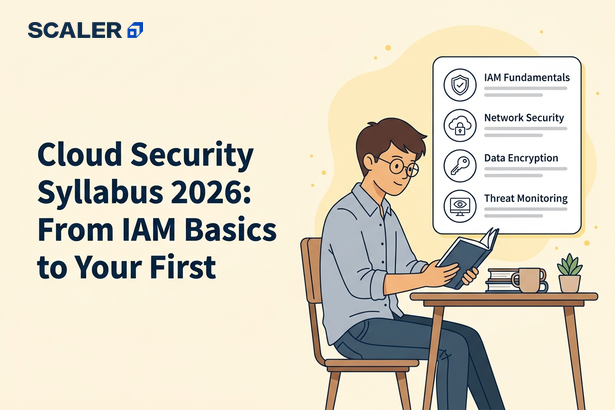
“The cloud provider handles security” is the sentence that gets companies breached. AWS, Azure, and GCP secure the infrastructure underneath you, physical data centers, hypervisors, the network backbone. Everything you configure on top, IAM policies, S3 bucket permissions, security groups, is entirely on you. That distinction alone is reason enough why cloud security is its own discipline, not a subsection of either cloud computing or traditional cyber security.
This is the syllabus in build order: foundations, IAM, network security, data protection, compliance, DevSecOps, then a certification map and hands-on labs that prove you can secure something rather than just describe it.
If you’d rather work through this with structured mentorship instead of stitching it together from documentation, Scaler’s Academy programs cover cloud and security fundamentals with real project feedback.
What Is Cloud Security? (And Why It’s a Distinct Skill)
Cloud security is the practice of protecting cloud-based infrastructure, applications, and data from threats, misconfigurations, and unauthorized access, within the operating model cloud platforms impose: shared responsibility, API-driven infrastructure, and resources that can be spun up or torn down in seconds.
The shared responsibility model is the single most important concept here, worth getting precisely right. The cloud provider secures the infrastructure (physical security, hypervisor, network hardware). The customer secures everything configured on top: identity policies, encryption choices, network rules, application code. Per the Cloud Security Alliance, the world’s leading organization focused specifically on cloud, AI, and Zero Trust security credentialing, this divide is exactly why cloud security demands its own body of knowledge distinct from general IT security.
Traditional security assumed a perimeter you could defend physically. Cloud environments don’t really have that in the same sense, which is most of why zero trust and identity-centric security have become central rather than optional add-ons. The Scaler Cloud Computing Syllabus is a useful companion if cloud fundamentals themselves are still new ground.
Transform Your Career
Choose from our industry-leading programs designed for career success
Modern Software and AI Engineering Program
Master full-stack development with AI integration


 +1000 more
AI Forward Deployed Engineer with Specialisation in AI applications
Build and deploy AI solutions for real-world business problems
+1000 more
Modern Data Science and ML with specialisation in AI
Advanced data science techniques with AI specialization
+1000 more
Advanced AIML with Specialisation in Agentic AI
Deep dive into AIML with focus on Agentic systems
+1000 more
DevOps, Cloud & AI Platform Engineering
Build and manage AI-powered cloud infrastructure
+1000 more
AI Engineering Advanced Certification by IIT-Roorkee
Premier AI engineering certification from IIT-Roorkee

Cloud Security Syllabus 2026 at a Glance
The full module list, up front, so you know exactly what’s ahead.
| Module | Core Topics | Tools | Outcome |
| 1. Cloud & Security Foundations | Cloud models, CIA triad, shared responsibility model | AWS/Azure/GCP free tiers | Understand what you’re securing and who’s responsible for what |
| 2. IAM | Authentication, authorization, least privilege, MFA, roles and policies | AWS IAM, Azure AD, GCP IAM | Design access controls that don’t accidentally grant the internet admin rights |
| 3. Network Security | VPCs, firewalls, security groups, segmentation, zero trust | Security groups, NACLs, VPNs | Build a network that fails closed, not open |
| 4. Data Security & Encryption | Encryption at rest/in transit, key management, classification | KMS, TLS, backup tooling | Protect data so a breach exposes nothing usable |
| 5. Compliance, Governance & Risk | GDPR, ISO 27001, SOC 2, audits | GRC platforms, CSA CCM | Map technical controls to the regulations that actually require them |
| 6. DevSecOps & Cloud-Native Security | CI/CD security, container/Kubernetes security, IaC scanning, SIEM | Docker, Kubernetes, Snyk, SIEM tools | Catch vulnerabilities before they ship, not after |
| 7. Tools & Certifications | Mapping skills to AWS Security Specialty, CCSK, CCSP | Cert prep platforms | Choose and pursue the right credential for your goal |
| 8. Projects & Labs | Secure a cloud deployment, design an IAM policy, harden a VPC | Everything above, combined | Proof you can secure a real environment, not just describe one |
For more on how this slots into the broader cyber security field, the Scaler Cyber Security Course Syllabus is a solid companion.
Module 1: Cloud & Security Foundations
Skip this and you’ll spend your first few months on the job nodding along about “shared responsibility” without actually being able to draw the line yourself. Worth the few hours it takes to get genuinely solid.
Topics
• Cloud service models: IaaS, PaaS, SaaS, and how the security responsibility line shifts depending on which one you’re using
• The CIA triad: confidentiality, integrity, availability, the three properties essentially every security control exists to protect in some combination
• The shared responsibility model in detail: provider secures “security of the cloud,” customer secures “security in the cloud”
• Cloud-specific risks: misconfiguration (the leading cause of cloud breaches by a wide margin), insecure APIs, and insufficient identity controls
Scaler’s free AWS Course and the Cloud Computing hub cover the ground this module assumes.
Module 2: Identity & Access Management (IAM)
If cloud security has a single most important module, this is it. The overwhelming majority of cloud breaches trace back to identity failures somewhere in the chain: an overprivileged role, a leaked key, a missing MFA requirement on an account that absolutely needed one.
Topics
• Authentication vs authorization: authentication confirms who you are, authorization determines what you’re allowed to do once you’re in
• Principle of least privilege: granting only the access genuinely needed, nothing more, even when broader access would be more convenient
• Multi-Factor Authentication (MFA): a second verification layer that single-handedly blocks a huge share of credential-based attacks
• Roles, policies, and groups: structuring access at the role level rather than hardcoding permissions per user, which scales and audits far better
• Federated identity and single sign-on: authenticating through a central identity provider rather than juggling separate credentials per service
As of January 2025, AWS reports more than 1.42 million active certifications held globally, a sense of how seriously the industry treats validated cloud skills, IAM chief among them. The Scaler AWS Tutorial covers IAM in depth, and AWS’s certification page has current exam details.

Module 3: Network Security in the Cloud
Networking in the cloud isn’t the same beast as networking in a traditional data center, even though the vocabulary carries over. The perimeter you used to defend with a physical firewall now lives almost entirely in configuration, which means a single misclick in a security group rule can do what used to require physical access to a server room.
Topics
• VPCs (Virtual Private Clouds): isolated network environments within a cloud provider, the foundational building block for almost everything else in this module
• Security groups and firewalls: stateful, instance-level traffic rules that control what can talk to what, the first thing an auditor checks when something goes wrong
• Network segmentation: splitting a network into smaller, isolated zones so a breach in one segment doesn’t automatically grant access to everything else
• Zero trust architecture: never automatically trusting traffic just because it originated inside your network perimeter, verifying every request regardless of origin
• VPNs and private connectivity: securely connecting on-premises infrastructure to cloud environments without exposing that traffic to the open internet
For the broader cloud fundamentals this networking module assumes, the Scaler Cloud Computing hub and full course catalogue are useful references.
Module 4: Data Security & Encryption
Data is, ultimately, the thing all of this exists to protect. Compute and network security matter because they’re the paths an attacker takes to get to the data; this module is about making sure that even if they get there, what they find is useless to them.
Topics
• Encryption at rest: protecting stored data so a stolen disk or compromised bucket doesn’t hand over readable information
• Encryption in transit: protecting data as it moves between systems, typically via TLS, so traffic can’t be intercepted mid-flight
• Key management: who controls the encryption keys and how they’re rotated, since encryption is only as strong as the key management behind it
• Data classification: knowing what’s sensitive (PII, financial records, health data) versus what isn’t shapes where the heaviest controls actually need to go
• Backup and recovery: ensuring backups are encrypted, access-controlled, and actually tested for restoration, not just assumed to work
This module connects directly into the next one, since most compliance frameworks specifically mandate encryption and key management practices rather than leaving them as best-practice suggestions. The Scaler Cyber Security Course Syllabus covers the broader cryptography fundamentals this module builds on.
Module 5: Compliance, Governance & Risk
The unglamorous module, and also the one that decides whether a company can legally operate in certain markets at all. Compliance isn’t paperwork bolted on after the fact, it’s frequently the reason specific technical controls exist in the first place.
Topics
• GDPR: the EU’s data protection regulation, relevant to any organization handling EU residents’ data regardless of where the company is based
• ISO 27001: an international standard for information security management systems, widely used as a baseline auditors and clients recognize
• SOC 2: a US-centric audit framework, particularly common for SaaS and cloud providers demonstrating security controls to enterprise customers
• Governance, Risk, and Compliance (GRC) frameworks: mapping business risk to specific controls, then proving those controls actually work, not just documenting them
• Audit readiness: maintaining evidence continuously rather than scrambling the week before an auditor shows up

Free Courses by top Scaler instructors
Per NIST’s own Cloud Computing Reference Architecture, establishing clear governance structures across cloud actors is treated as foundational to managing risk, not an afterthought layered on top of the technical work. The Cloud Security Alliance maintains the Cloud Controls Matrix specifically as a cybersecurity control framework for cloud computing, mapped against major standards (cloudsecurityalliance.org). The Scaler Cyber Security hub is a useful companion for the broader context here.
Module 6: DevSecOps & Cloud-Native Security
Security used to be the team that showed up right before launch and said no to everything. DevSecOps kills that model, building security checks directly into the development pipeline so problems get caught while they’re cheap to fix, not after they’re already in production.
Topics
• Security in CI/CD: automated scanning at each build and deployment stage, so a vulnerable dependency or exposed secret gets flagged before it ships, not after a customer finds it
• Container security: scanning Docker images for known vulnerabilities and ensuring containers run with minimal privileges
• Kubernetes security: role-based access control within clusters and network policies between pods, given the genuinely large attack surface a misconfigured cluster presents
• Infrastructure as Code (IaC) scanning: checking Terraform or CloudFormation templates for misconfigurations before deployment, since fixing an issue in code review is far cheaper than fixing it live
• SIEM (Security Information and Event Management): centralizing and correlating logs across an environment to actually detect suspicious activity
Scaler’s Docker Tutorial is a useful foundation before container security makes full sense, and the full course catalogue covers related DevOps fundamentals this module assumes.
Module 7: Tools & Certifications Map
Certifications in this field genuinely matter for hiring, more so than in some other corners of tech, mostly because cloud security mistakes are expensive and employers want external validation before handing someone the keys.
| Certification | Issuing Body | Best For | Focus |
| AWS Certified Security – Specialty | AWS | AWS-focused cloud security roles | Deep, AWS-specific security implementation and incident response |
| CCSK (Certificate of Cloud Security Knowledge) | Cloud Security Alliance | Vendor-neutral foundational cloud security knowledge | Broad cloud security concepts across providers, not tied to one platform |
| CCSP (Certified Cloud Security Professional) | (ISC)² | Experienced security professionals moving into cloud | Comprehensive, architecture-level cloud security, requires prior experience |
| CCZT (Certificate of Competence in Zero Trust) | Cloud Security Alliance | Specializing specifically in zero trust architecture | Zero trust principles and implementation, a more focused, newer credential |
A sensible default: start with CCSK if you want vendor-neutral foundational credibility, then specialize into a specific cloud provider’s security certification once you know which platform you’re actually working with day to day. CCSP suits people who already have a few years of broader security experience, since the exam assumes that background going in.
The Scaler Cloud Computing Roadmap maps out the broader learning sequence this certification path sits inside.
Scaler Placement Report and Statistics
Scaler learners achieved 2.5x salary growth with average post-Scaler CTC reaching ₹23L.
 Google
 Amazon
 Microsoft
 Flipkart
 Adobe
1200+ more
Adobe
1200+ more
Module 8: Cloud Security Projects & Labs
Nobody gets hired into a cloud security role because they can define the shared responsibility model in an interview. They get hired because they've actually secured something, broken it on purpose to find the failure mode, and fixed it properly.
Lab 1: IAM policy design
Build a least-privilege IAM policy for a hypothetical application (say, a backend service that only needs read access to one S3 bucket and write access to a single database table). Then find ways the policy could still be exploited if written more loosely, and document why your version closes those gaps.
Lab 2: Secure a VPC from scratch
Design a VPC with public and private subnets, proper security group rules, and a NAT gateway so private resources can reach the internet without being directly exposed to it. This proves Module 3 concretely, not just conceptually.
Lab 3: Encrypt and classify a dataset
Take a sample dataset, classify it by sensitivity level, and apply appropriate encryption at rest and in transit for each tier. Document your key management approach and justify why each tier got the protection level it did.
Lab 4: Harden a CI/CD pipeline
Add automated vulnerability and IaC scanning to a sample pipeline, catching at least one deliberately planted vulnerability before it would have shipped. This proves Module 6 and is increasingly the kind of project interviewers ask about.
Document your reasoning for each lab, not just the configuration, since interviewers in this field probe “why did you choose this” far more than “did it technically work.” Scaler's free AWS Course is a reasonable environment to build these labs in, and the Cloud Computing Roadmap has more project ideas at each stage.
Cloud Security Career Path, Roles & Salary in India
Demand here is less about hype and more about plain necessity. Every company that moves to the cloud needs someone who actually understands how to secure that environment.
| Role | Typical Annual Salary (India) | Focus |
| Cloud Security Analyst (entry, 0–2 yrs) | ₹6–11 LPA | Monitoring, basic IAM and network security tasks, heavy on Modules 1–3 |
| Cloud Security Engineer (mid, 3–6 yrs) | ₹12–22 LPA | Designing and implementing security controls across cloud environments, Modules 2–6 |
| Senior Cloud Security Engineer / Architect (7+ yrs) | ₹22–40+ LPA | Architecture decisions, compliance ownership, leading incident response, all modules combined |
| Cloud Security roles at fintech/regulated industries | Often 15–25% above the ranges above | Heavier compliance burden (Module 5) typically commands a premium |
Demand context worth knowing: as cloud adoption keeps expanding across every industry, the attack surface that needs securing expands right alongside it, which is most of why cloud security roles have stayed consistently in demand even through broader tech hiring slowdowns. The Cloud Security Alliance's own research consistently flags misconfiguration and identity failures as leading causes of cloud breaches, which tracks directly with why Modules 1 and 2 carry the weight they do.
A typical progression: Cloud Security Analyst → Cloud Security Engineer → Senior Engineer or Architect → Head of Cloud Security or CISO-track roles. Plenty of people also move sideways into DevSecOps Engineer or Compliance/GRC Specialist roles depending on whether they lean toward technical implementation or governance as they grow.
If you're coming from a general cyber security background, the Scaler Cyber Security Roadmap covers the transition context, and the Cloud Security Alliance (cloudsecurityalliance.org) remains the most authoritative source for current cloud-specific threat research.
Scaler Alumni and Their Success Stories
The FAQs
How long does it take to learn cloud security?
With existing cloud or security knowledge, 4 to 6 months of focused study covering Modules 1 through 7 is realistic. Starting from zero on both, expect closer to 8 months, since cloud literacy itself needs time to settle before the security-specific modules make full sense.
Do I need cyber security knowledge before cloud security?
It helps, though it's not strictly mandatory. Recommended order: basic security concepts first if you have zero background at all, then cloud fundamentals, then this syllabus's security-specific modules. Coming from a strong cloud background without security experience is also a perfectly workable starting point.
Which certification is best for cloud security?
Depends on your starting point. CCSK from the Cloud Security Alliance is the best vendor-neutral starting credential. AWS Certified Security - Specialty (or the Azure/GCP equivalent) makes sense once you know your platform. CCSP suits people with several years of broader security experience already. No single “best,” only best-for-your-situation.
Is coding required for cloud security?
Not heavily for most roles, but some scripting helps. Python for automating checks and parsing logs, plus familiarity with Infrastructure as Code for Module 6. You don't need to be a software engineer, but basic automation ability is an increasingly real expectation.
Is cloud security a good career in 2026?
Yes! The plus point? The demand isn't slowing. Cloud adoption keeps growing across every industry, and each new deployment is another surface that needs securing. Misconfiguration and identity failures remain the leading causes of cloud breaches, which keeps skilled cloud security professionals consistently in demand.
What is the shared responsibility model?
The division of security duties between a cloud provider and its customers. The provider secures the underlying infrastructure, physical data centers, hypervisors, the global network. The customer secures everything configured on top: identity policies, encryption choices, network rules, application-level security. Misjudging where that line falls, usually assuming the provider covers more than they actually do, is one of the most common and costly mistakes in cloud security.
