


Artificial Intelligence - Boon or Bane? The Short Answer
Artificial Intelligence - Boon or Bane? The Short Answer
Artificial intelligence is neither purely a boon nor purely a bane. It is a powerful tool whose impact depends on how we build, govern, and use it. Used well, it saves lives and time; used carelessly, it can spread misinformation, deepen bias, and cost jobs.
This page gives you the strongest arguments on both sides, an honest verdict, and points you can use in an essay, debate, or speech.
What Do We Mean by "AI as a Boon or a Bane"?
AI is software that learns patterns from data to make decisions or generate content. Think ChatGPT writing an essay, recommendation feeds showing you videos, self-driving cars navigating traffic, or algorithms detecting cancer in medical scans.
The "boon or bane" question exists because the same technology does both. A model that reads X-rays faster than a radiologist saves lives. The same underlying capability, pointed at surveillance cameras, enables mass monitoring. A chatbot that tutors a student also helps that student cheat.
The frame we will return to throughout: the tool is neutral; the outcome depends on use and governance.
Why AI Is Called a Boon (The Benefits)
Productivity and Automation
AI takes over repetitive, time-consuming work data entry, scheduling, drafting emails, quality checks, customer queries so people focus on higher-value tasks. Customer-support bots handle routine questions 24/7. Code assistants write boilerplate. Document summarisers condense hours of reading into minutes.
For concrete examples of AI already making work faster and smarter, see our guide on real-world applications of machine learning.
Build an AI-First Career, Master the Complete Skillset
Choose from our industry-leading programs designed for career success
Modern Software and AI Engineering Program
Master full-stack development with AI integration


 +1000 more
Modern Data Science and ML with specialisation in AI
Advanced data science techniques with AI specialization
+1000 moreAdvanced AIML with Specialisation in Agentic AI
Deep dive into AIML with focus on Agentic systems
+1000 moreDevOps, Cloud & AI Platform Engineering
Build and manage AI-powered cloud infrastructure
+1000 moreAI Engineering Advanced Certification by IIT-Roorkee
Premier AI engineering certification from IIT-Roorkee

AI Forward Deployed Engineer Program
Full-stack engineering, production AI and client-facing consulting
+1000 moreHealthcare and Saving Lives
AI models can match or assist specialists in reading medical images: detecting tumours in X-rays, identifying diabetic retinopathy in eye scans, flagging anomalies in pathology slides. Drug discovery that used to take a decade is being compressed into months. Personalised treatment plans based on a patient's genetics are becoming possible. The WHO has published guidance on AI in health that confirms both the promise and the need for safety standards.
Education and Accessibility
Personalised learning that adapts to a student's pace: if you are struggling with algebra, the AI gives you more practice; if you are ahead, it moves faster. Real-time translation breaks language barriers. Speech-to-text, screen readers, and assistive tools give people with disabilities more independence and access to information.
Scientific Discovery and Problem-Solving
AI compressed protein-structure prediction from years of lab work to hours. Climate models that would take supercomputers months now run faster with AI acceleration. Materials research, drug interactions, astronomical data analysis AI compresses years of work into months, letting scientists focus on the questions instead of the computation.
Why AI Is Called a Bane (The Risks)
This section gets the same weight and specificity as the benefits. Evenhandedness matters.
Job Displacement
Automation replaces routine roles: data entry, basic customer service, assembly-line quality checks, some financial analysis. This is real and it is happening now. The honest framing: some jobs shrink, new ones appear, but the transition is painful for the people in between. The answer is not "AI will not take jobs" it is reskilling and support for the workers affected. For a look at the other side of that coin, see the new job opportunities AI is creating.
Bias and Fairness
AI learns from historical data. If that data contains bias in hiring decisions, lending patterns, policing records the AI inherits and scales it. A biased hiring algorithm rejects qualified candidates at scale. A biased lending model denies loans to entire demographics. The harm is not theoretical; it is documented.
Privacy and Surveillance
Facial recognition tracks people in public spaces. Data harvesting builds detailed profiles of individuals without meaningful consent. AI-powered profiling can predict behaviour, preferences, and vulnerabilities. The counterweight is regulation: India's Digital Personal Data Protection Act (DPDP framework) and Europe's GDPR are attempts to set boundaries, but enforcement lags behind the technology.
Misinformation and Deepfakes
Generative AI can fabricate convincing fake images, audio, and video. Deepfakes of public figures saying things they never said. AI-generated articles flooding the internet with plausible falsehoods. Chatbots confidently stating false information as fact. This is one of the most cited banes right now, and it deserves real space: the ability to generate convincing misinformation at scale is a genuine threat to trust in information.
Over-Reliance and Loss of Skills
Leaning on AI for thinking, writing, and decisions can erode our own judgement. Students who copy AI-generated answers learn less. Professionals who let AI make decisions without questioning them lose the ability to evaluate those decisions themselves. The tool becomes a crutch.
Security and Other Costs
AI-powered cyberattacks are more sophisticated than traditional ones. Autonomous weapons raise ethical questions the world has not answered. And the energy and water footprint of training large AI models is significant: training a single large language model can emit as much carbon as several cars over their entire lifetimes.
How Scaler Transformed Careers in Different Fields
Scaler learners achieved 2.5x salary growth with average post-Scaler CTC reaching ₹23L.
 Google
 Amazon
 Microsoft
 Flipkart
 Adobe1200+ more
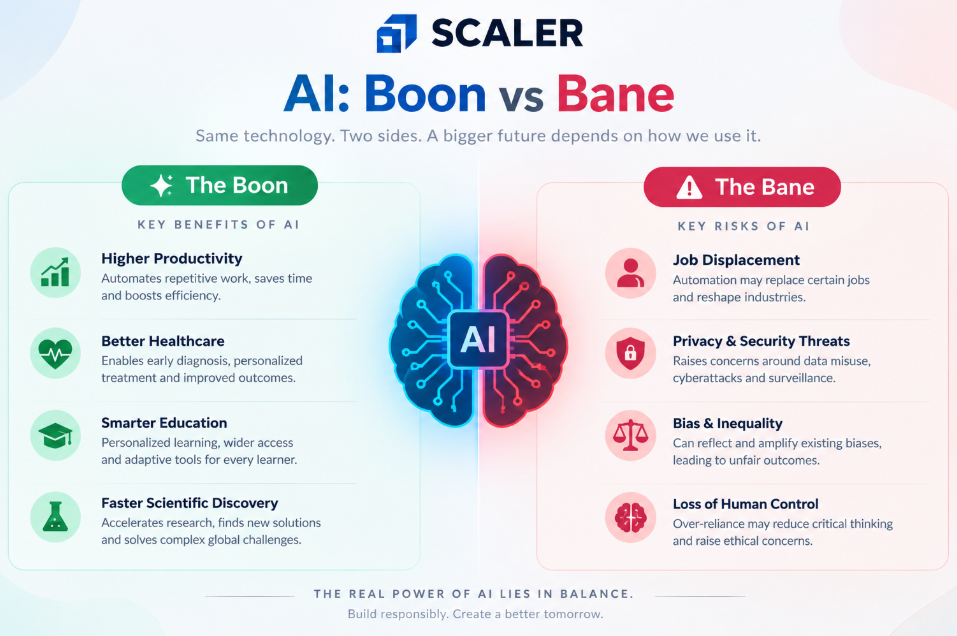
Boon vs Bane at a Glance
| Boon (Benefit) | Bane (Risk) |
|---|---|
| Productivity: automates repetitive work, saves time | Job displacement: routine roles shrink, transition is painful |
| Healthcare: faster diagnosis, drug discovery, personalised treatment | Bias: AI inherits and scales human bias from historical data |
| Education: personalised learning, accessibility tools | Privacy: facial recognition, data harvesting, profiling |
| Discovery: compresses years of research into months | Misinformation: deepfakes, fake content at scale |
| 24/7 availability: works tirelessly, no breaks | Over-reliance: erodes human judgement and skills |
| Democratises expertise: makes specialist knowledge accessible | Security: AI-powered cyberattacks, autonomous weapons, energy cost |
Conclusion
The technology itself is neutral. The same capability is a boon or a bane depending on intent, governance, and human oversight.
A model that reads X-rays saves lives in a hospital and enables surveillance in the wrong hands. An algorithm that personalises learning for a student also personalises propaganda for a voter. The tool does not choose; the user and the system around the user choose.
Three levers decide which way it goes:
Governance and regulation. Rules that set boundaries on what AI can and cannot do. UNESCO's Recommendation on the Ethics of AI (unesco.org/en/artificial-intelligence/recommendation-ethics) provides the global framework. India's DPDP Act sets data-protection standards. Regulation is not about stopping AI; it is about steering it.
Transparency and fairness in how AI is built. If we cannot see how a model makes decisions, we cannot catch the bias. Open-source models, explainable AI, and auditing requirements are the mechanisms.
Keeping a human in the loop for high-stakes decisions. AI should assist, not replace, human judgement in decisions that affect lives: medical diagnoses, criminal sentencing, hiring, lending. The human makes the final call; the AI provides the analysis. For a deeper look at what AI still cannot do, see how AI compares with human intelligence.
The reasoned verdict: AI is a boon when guided by ethics, regulation, and human judgement, and a bane when deployed without them. So the responsibility sits with us, not the machine.
Video: Artificial Intelligence Threats and Opportunities Explained in Detail a balanced look at both sides of the AI debate.
![AI Threats and Opportunities Explained]
AI Boon or Bane Points for Your Essay, Debate, or Speech
If you are writing an essay, preparing for a debate, or giving a speech, here are crisp, quotable points for both sides.
Strong Points FOR AI (The Boon Side)
- AI automates repetitive work, freeing humans for creative and strategic tasks.
- AI-powered diagnostics detect diseases earlier and more accurately than traditional methods.
- Personalised learning adapts to each student's pace, making quality education more accessible.
- AI accelerates scientific discovery: protein folding, climate modelling, drug research.
- AI works 24/7 without fatigue, providing consistent, tireless support.
- AI democratises expertise: specialist knowledge becomes accessible to everyone, not just those who can afford it.
Strong Points AGAINST AI (The Bane Side)
- AI displaces routine jobs, and the transition period harms workers who need reskilling.
- AI inherits and scales human bias from historical data, leading to unfair outcomes.
- Facial recognition and data profiling threaten privacy and enable mass surveillance.
- Deepfakes and AI-generated misinformation erode trust in information.
- Over-reliance on AI erodes human judgement, critical thinking, and essential skills.
- AI-powered cyberattacks are more sophisticated, and training large models consumes significant energy.
Turn Learning into Career Growth
How to Structure Your Essay or Speech
A simple four-part skeleton:
- Introduction: Define AI briefly. State the question: is it a boon or a bane?
- Arguments for (boon): Pick 2-3 points. Use a real example in each paragraph.
- Arguments against (bane): Pick 2-3 points. Same weight and specificity as the boon side.
- Balanced conclusion: The verdict. AI is a boon when guided by ethics and governance, a bane when deployed without them. The responsibility is ours.
Keep it evenhanded. Do not write 500 words on the benefits and 100 on the risks. Give both sides their strongest case.
Real Examples of AI as Both a Boon and a Bane
Every example is the same tool pointed in two directions.
Facial recognition. Finds missing children, identifies criminals, secures devices. Also enables mass surveillance, tracks protestors, and misidentifies people (especially people of colour) at higher rates.
Generative AI (ChatGPT and similar). Tutors students, assists writers, summarises research, makes expertise accessible. Also floods the web with misinformation, helps students cheat, and generates deepfakes.
Self-driving cars. Potentially fewer human-error crashes (which cause 94% of accidents). Also raises accountability questions (who is responsible when a self-driving car kills?), threatens driving jobs, and struggles with edge cases.
Social-media algorithms. Show you relevant content, connect you with communities. Also create addiction, amplify echo chambers, and prioritise engagement over truth.
The pattern: every example is the same capability, the same algorithm, the same tool. The difference is how it is deployed, who controls it, and what guardrails exist.

FAQs
Is artificial intelligence a boon or a bane?
Both. AI is a neutral tool whose impact depends on how it is used and governed. Used with ethics, regulation, and human oversight, it is a boon: saving lives, accelerating discovery, making education accessible. Deployed carelessly, it is a bane: spreading misinformation, deepening bias, threatening privacy. The responsibility sits with us, not the machine.
What are the main advantages and disadvantages of AI?
Advantages: productivity and automation, faster healthcare diagnosis, personalised education, scientific discovery, 24/7 availability, democratised expertise. Disadvantages: job displacement, algorithmic bias, privacy and surveillance, misinformation and deepfakes, over-reliance, security and energy costs. Both sides are real; the outcome depends on governance.
Is AI good or bad for society?
It depends on how society governs it. With strong regulation, transparency, and human oversight, AI is a net positive: it saves time, lives, and expands access to knowledge. Without those guardrails, it can deepen inequality, spread falsehoods, and erode privacy. The technology is neutral; the governance decides the outcome.
Will AI take away human jobs?
Some jobs will shrink or disappear, especially routine, repetitive roles. New jobs will appear: AI trainers, prompt engineers, ethics reviewers, AI-maintenance roles. The real issue is the transition: the workers displaced need reskilling and support. It is not a total job apocalypse, but it is not painless either.
What are the biggest risks of artificial intelligence?
The most cited risks: algorithmic bias (AI scaling human prejudice), privacy erosion (facial recognition, data profiling), misinformation and deepfakes (convincing fake content at scale), over-reliance (eroding human judgement), and security threats (AI-powered cyberattacks, autonomous weapons). Each is real and documented, not hypothetical.
How can we make AI more of a boon than a bane?
Three levers:
(1) governance and regulation rules that set boundaries on what AI can do;
(2) transparency and fairness open-source models, explainable AI, auditing requirements;
(3) human oversight keeping humans in the loop for high-stakes decisions. The goal is not to stop AI; it is to steer it.
How do I write an essay on AI boon or bane?
Use a four-part structure: introduction (define AI, state the question), arguments for (2-3 benefits with real examples), arguments against (2-3 risks with real examples), and balanced conclusion (AI is a boon when governed well, a bane when not). Keep both sides equal in weight. Use a real example in each paragraph. See the "points for your essay" section above for quotable arguments.
Curious enough to move from debating AI to actually understanding it? Start with a free AI course with certificate and learn how these tools really work.




