


What is Azure ExpressRoute?
Overview
Azure ExpressRoute is a service that, in collaboration with a connectivity provider, enables the establishment of a dedicated and private connection to extend your on-premises networks into the Microsoft Cloud environment. So, Azure ExpressRoute functions similarly to configuring a VPN connection, bridging the gap between your network and the Microsoft Cloud. It offers various connection types, including point-to-point Ethernet networks, any-to-any IPVPN networks, and virtual cross-connections accessible through a co-location facility.
Features of Azure ExpressRoute
The features offered by the azure expressroute are as follows:
-
Redundancy:
Each ExpressRoute circuit includes dual connections to two Microsoft Enterprise edge routers, either from the connectivity provider or the customer's network edge, ensuring backup and reliability.
-
Global Connectivity:
With ExpressRoute Premium, customers can extend their connectivity across geopolitical boundaries, facilitating international connections.
-
Local Connectivity:
ExpressRoute Local offers a cost-effective solution by bringing data to an ExpressRoute location near the desired Azure region, reducing data transfer costs.
-
Connectivity to Cloud Services:
ExpressRoute allows customers to access a range of Microsoft services, including Microsoft Azure, Microsoft Office 365, and Microsoft Dynamics 365.
-
Connectivity to Geopolitical Regions:
Customers can establish connections to Microsoft within one of the provider's peering locations and then access regions located within the same geopolitical region.
-
Bandwidth Options:
Customers have a variety of bandwidth options to choose from, ranging from 50Mbps to 10 Gbps, providing flexibility to meet their specific needs.
-
Cross On-Premises Connectivity:
Azure ExpressRoute Global Reach enables organizations to exchange data across their on-premises points by connecting their ExpressRoute circuits, promoting efficient data sharing.
-
Connectivity to Global Network:
ExpressRoute Direct allows customers to establish direct connections to Microsoft's global network at peering locations worldwide, ensuring high-performance networking.
-
Dynamic Bandwidth Scaling:
Customers can dynamically increase the circuit's bandwidth for existing connections, adapting to changing requirements and ensuring scalability.
Benefits of Express Route
The various advantages provided by the Azure ExpressRoute and these are as follows:
-
Improved Security:
ExpressRoute provides robust multi-layer security measures to safeguard your resources. Additionally, it ensures that connections are not routed through the public internet, reducing exposure to potential security threats and vulnerabilities.
-
Low Latency:
ExpressRoute connections offer reduced latency compared to connections via the public internet, which proves advantageous for applications demanding swift response times. Each ExpressRoute connection comprises two connections, each equipped with two MSEEs (Microsoft Enterprise Edge Routers) situated at one of the ExpressRoute sites. Users also have the option to opt out of redundant connections, although the connectivity providers themselves employ redundant devices. This measure ensures that the connection to Microsoft remains redundant and reliable.
-
Reliability:
ExpressRoute circuits are designed for high availability and redundancy. Each connection consists of dual links to Microsoft's edge routers, ensuring continuity of service even in case of a failure in one link.
-
Cost Efficient:
ExpressRoute can help reduce data transfer costs, especially when transferring large volumes of data, as it bypasses the public internet and its associated data transfer fees.
-
Better compliance and control:
Azure ExpressRoute offers organizations the ability to meet compliance standards that may be challenging to achieve using a public internet connection. By utilizing ExpressRoute, organizations will have more control over their network infrastructure, allowing them to tailor it to their precise needs and compliance specifications.
-
Scalability:
ExpressRoute offers bandwidth options ranging from 50 Mbps to 10 Gbps, enabling organizations to scale their network connectivity as their needs grow.
-
Quality of Service (QoS):
You can prioritize and manage network traffic using Quality of Service (QoS) settings, ensuring critical applications receive the necessary network resources.
-
Integration with on-premises resources:
ExpressRoute streamlines the integration of Azure services with an organization's on-premises resources. It empowers the expansion and interconnection of existing data centers via Azure ExpressRoute. This facilitates a seamless blend of on-premises infrastructure with Azure's cloud services, simplifying hybrid cloud management and enhancing data transfer efficiency. This approach optimizes operations, allowing businesses to harness the benefits of both on-premises and cloud resources while maintaining control and flexibility.
Azure ExpressRoute Connectivity Options
The Azure ExpressRoute provides the following connectivity options.
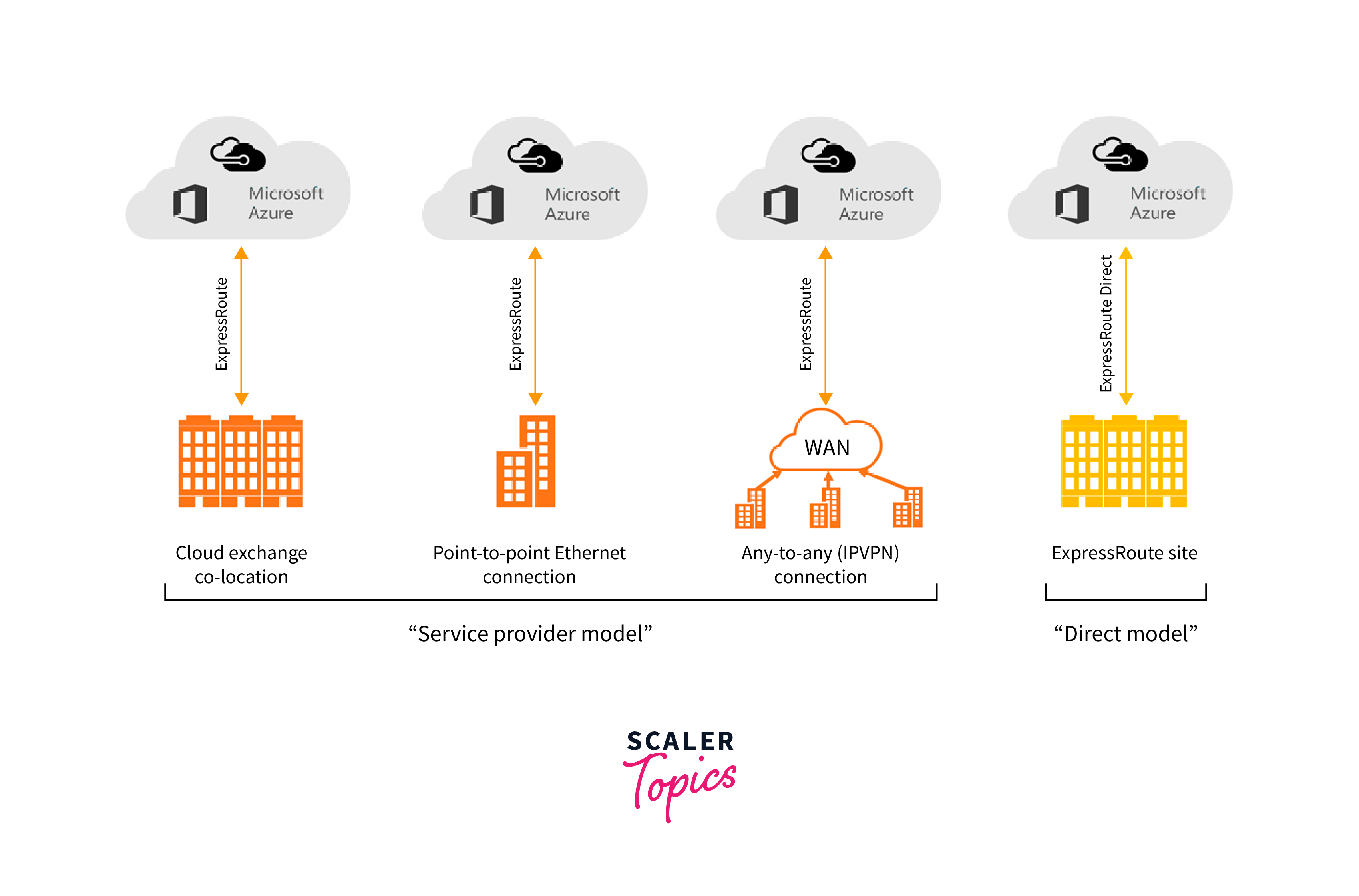
Point-to-Point Network Model
In this model, an organization creates a private and exclusive link between two specific locations, for instance, connecting their on-premises data center with a designated Azure region. This dedicated connection serves as a secure conduit for the seamless exchange of data between these two endpoints. What sets this arrangement apart is its isolation: the connection is entirely reserved for the organization's use and is not shared with any other external entities or businesses. This exclusive nature of the connection ensures a high level of data privacy, security, and control. It enables the organization to enjoy a direct, efficient, and reliable channel for data transfer, free from the potential congestion and security concerns associated with public internet connections.
Any-to-Any Network Model
In this model, an organization sets up a connection to a pivotal exchange point, like a network exchange or an internet exchange. This model enables organizations to connect with different partners and providers, allowing them to exchange data with a wide range of partners. This approach fosters a robust and versatile network environment, facilitating data exchange with a wide range of partners, thereby promoting enhanced connectivity and collaboration opportunities.
Virtual Cross-Connection Network Model
The Virtual Cross-Connection Network Model closely resembles the any-to-any model. However, it introduces the concept of virtual cross-connections, which are logical links that empower organizations to establish connections with various networks and services without the necessity of physical cabling.
ExpressRoute Direct Connection
This model revolves around establishing a dedicated, private link between an organization's on-premises resources and Azure. This direct connection, often facilitated through means like leased lines or private circuits, remains entirely reserved for the organization's use and isn't shared with any other entities.
It's a preferred choice for organizations that necessitate substantial data transfers between their on-premises infrastructure and Azure, as it ensures robust, high-bandwidth, and low-latency connectivity to efficiently handle the exchange of large data volumes.
Azure ExpressRoute Setup
- Log in to the Azure portal using your Azure login credentials and search for ExpressRoute on the search tab.
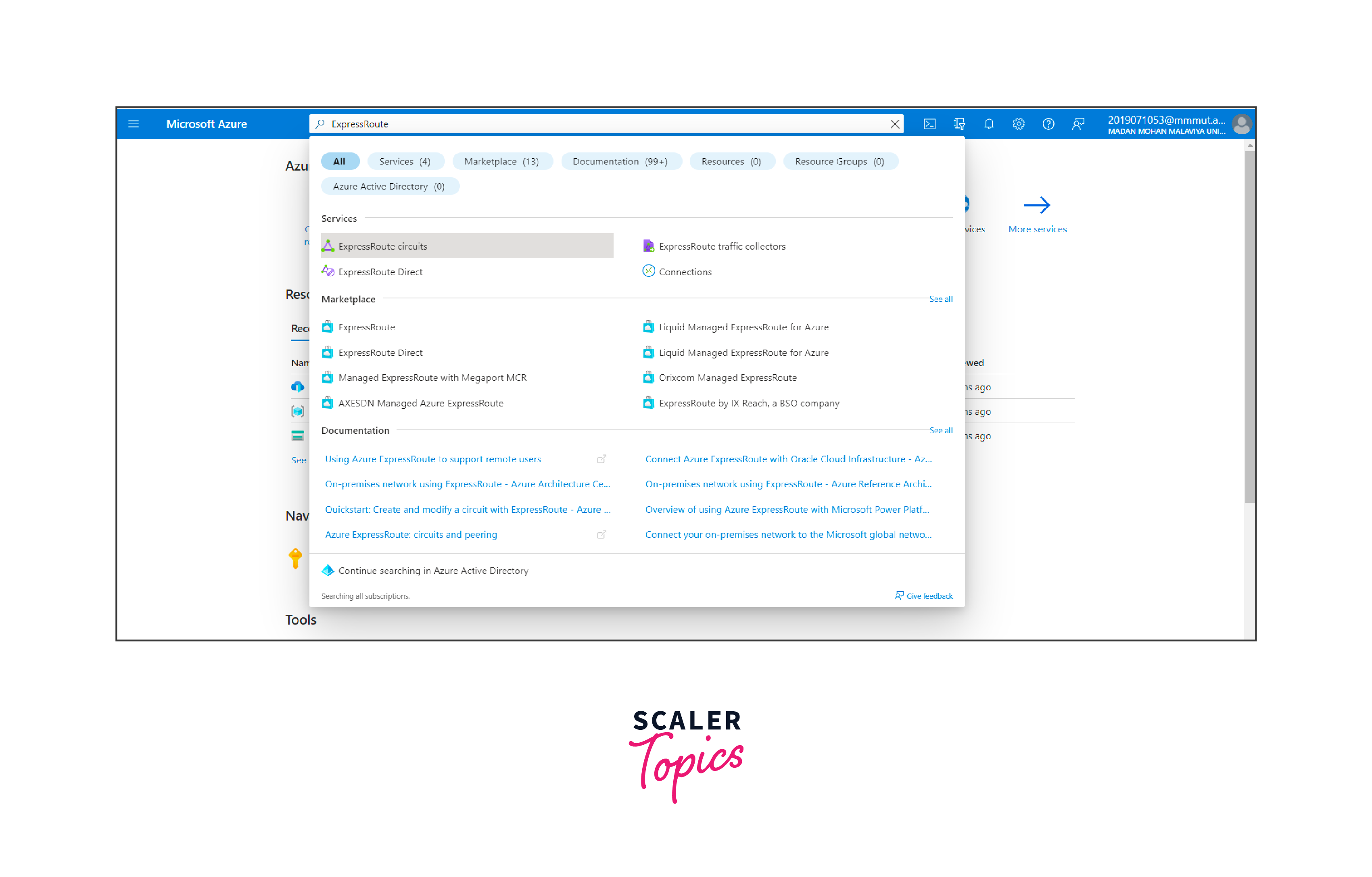
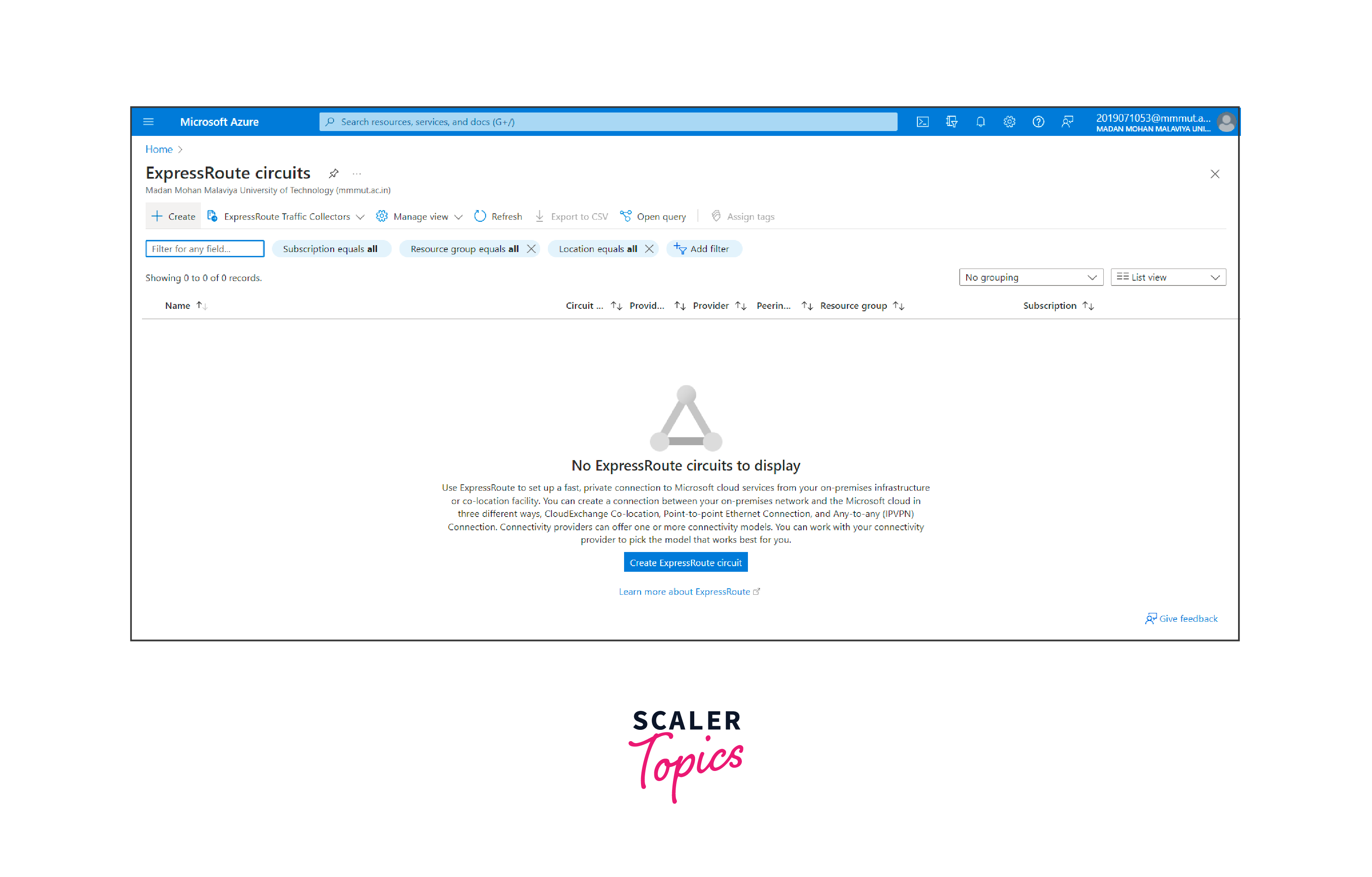
- Click on the ExpressRoute Circuit from the search result and then click on Create.
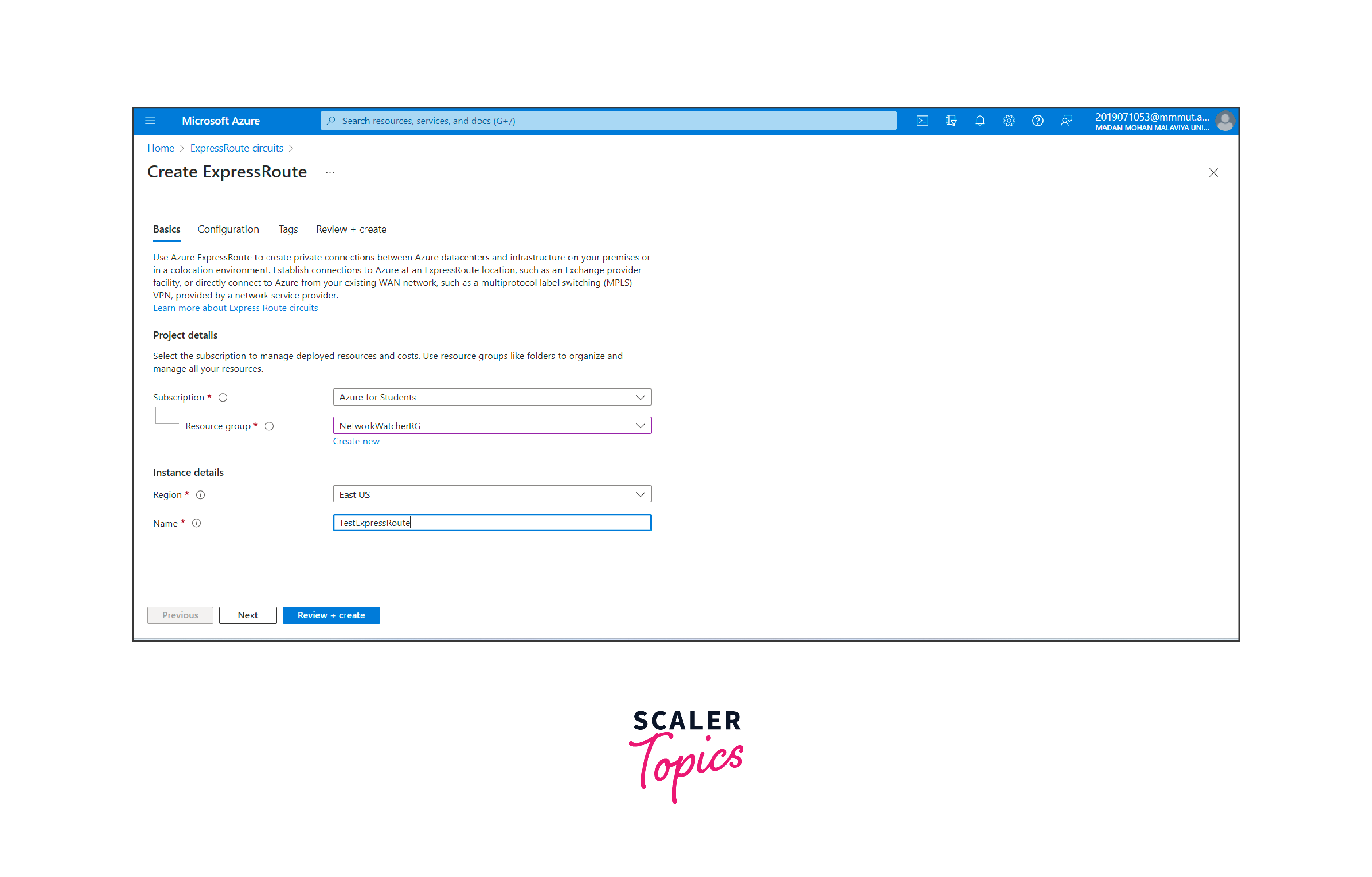
- Now fill in the basic details such as Instance Name and Resource Group.
- Now, move to the Configuration tab and update the settings according to your needs. Here, we are keeping it to the default.
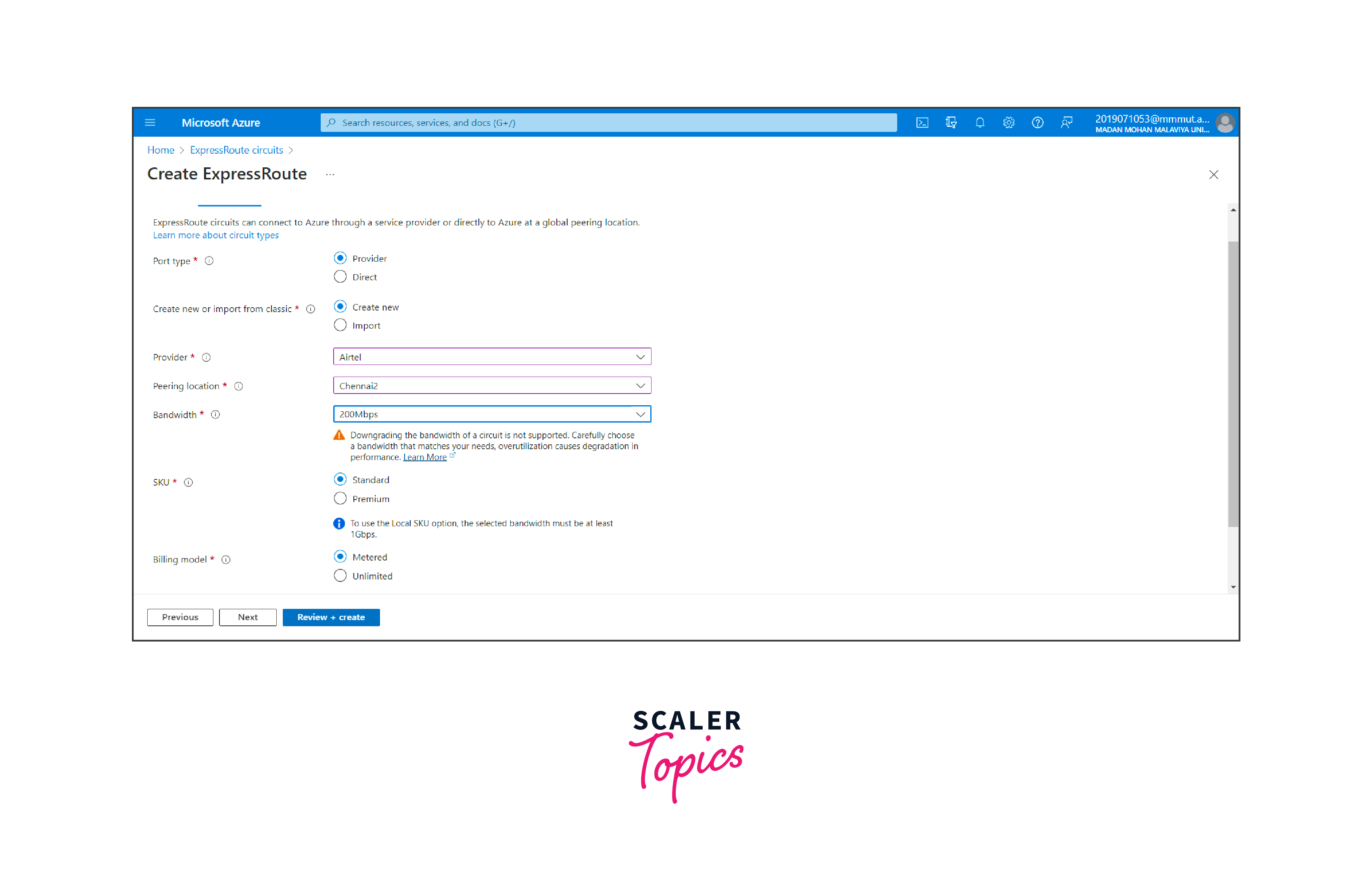
- Now Click on Review and Create and review all the details carefully before creating it.
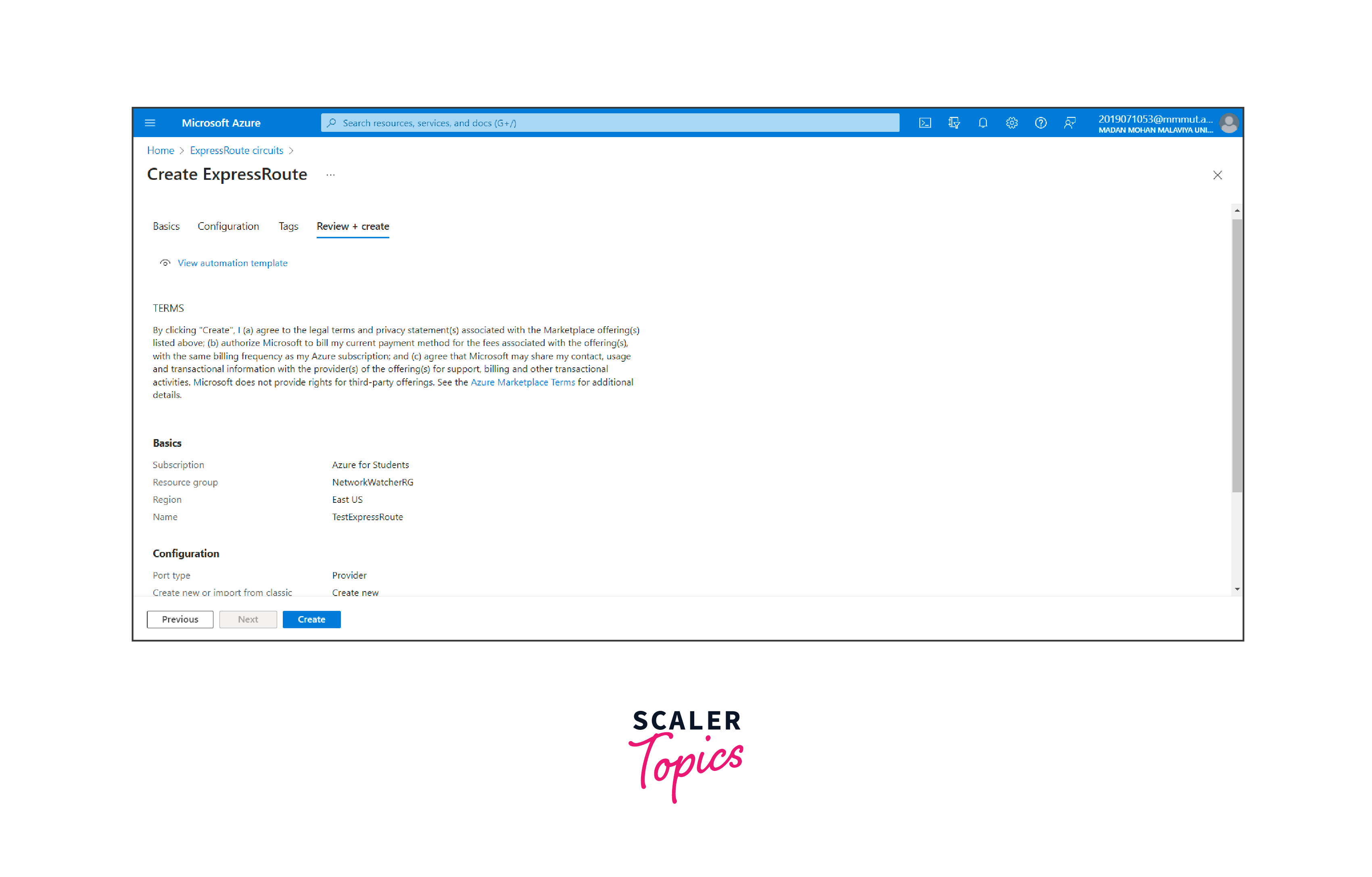
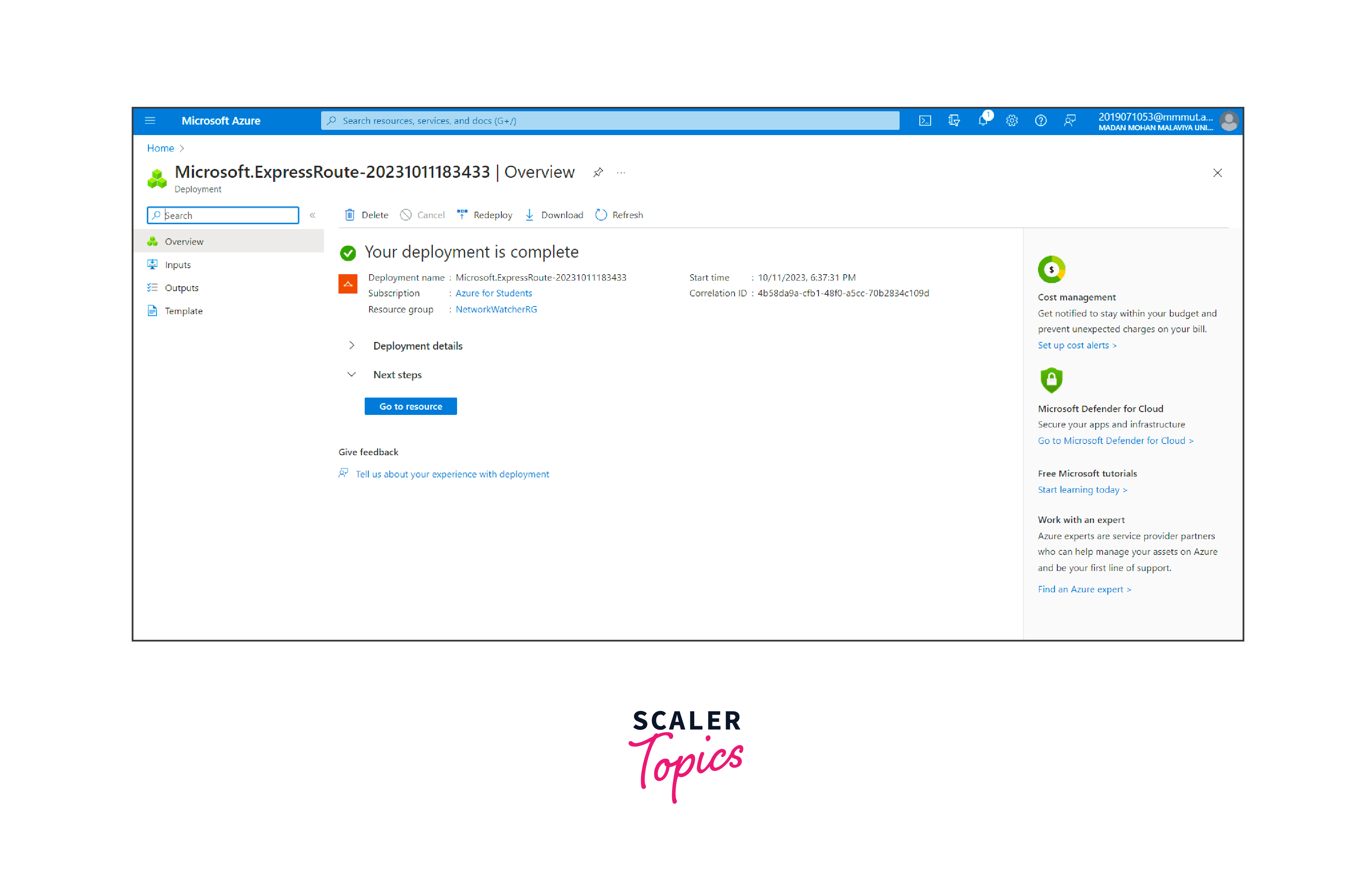
- Finally hit on Create button. After a successful deployment, you can connect your on-premises data center to the ExpressRoute you created.
Azure ExpressRoute Pricing
ExpressRoute offers both metered and unlimited data plans with varying pricing structures. In the unlimited plan, outbound data transfers are free, and in both plans, inbound data transfers incur no charges. However, the pricing differs across various zones.
For Zone 1, which encompasses regions like the US, Canada, and parts of Europe, the metered data plan's pricing is determined by circuit bandwidth. It ranges from 55 dollars per month for a 50 Mbps connection in the local tier to 6,400 dollars per month for a 10 Gbps connection in the premium tier.
In the unlimited plan, data costs apply only for bandwidth exceeding 1 Gbps, with prices ranging from 1,200 dollars per month for a 1 Gbps connection in the local tier to 54,300 dollars per month for a 10 Gbps connection in the premium tier.
Outbound data transfer rates for the metered plan are as follows:
| Serial No | Zone | Price ($/GB) |
|---|---|---|
| 1. | Zone 1 | |
| 2. | Zone 2 | |
| 3. | Zone 3 | |
| 4. | Zone 4 |
For Zone 2, which encompasses regions like East Asia, Central India, East Japan, South India, West India, and the US, the pricing within the metered data plan is determined by the circuit's bandwidth. This pricing structure ranges from ₹3,962.49 per month for a 50 Mbps connection in the local tier to ₹4,61,089.664 per month for a 10 Gbps connection in the premium tier.
In the unlimited plan, data charges are incurred only for bandwidth exceeding 1 Gbps, with prices ranging from ₹1,15,272.416 per month for a 1 Gbps connection in the local tier to ₹61,23,847.1 per month for a 10 Gbps connection in the premium tier.
The outbound data transfer rates for the metered plan are as follows:
| Serial No | Zone | Price (₹/GB) |
|---|---|---|
| 1. | Zone 1 | |
| 2. | Zone 2 | |
| 3. | Zone 3 | |
| 4. | Zone 4 |
To learn more about the AzureExpress Route price page as the pricing for various add-ons and direct connections changes with zones.
Conclusion
-
Azure ExpressRoute is a Microsoft Azure service that provides a dedicated, private, and high-performance network connection between an organization's on-premises data centers or network infrastructure and Microsoft Azure's data centers.
-
Azure ExpessRoute offers a more reliable and predictable network connection compared to using the public internet.
-
Redundancy, global connectivity, local connectivity, connectivity to cloud services, connectivity to geopolitical regions, cross on-premises connectivity, and dynamic scaling of bandwidth are the features offered by the Azure ExpressRoute.
-
Improved security, low latency, reliability, cost efficiency, better compliance and control, high scalability, and Qos are the advantages provided by Azure ExpressRoute.
-
The Azure ExpressRoute provides the following connectivity options.
- Point-to-Point Network Model
- Any-to-Any Network Model
- Virtual Cross-Connection Network Model
- ExpressRoute Direct Connection
-
ExpressRoute offers both metered and unlimited data plans with varying pricing structures. In the unlimited plan, outbound data transfers are free, and in both plans, inbound data transfers incur no charges. However, the pricing differs across various zones.