


Challenges in Distributed Systems
Overview
As time flows, the amount of data for processing is also getting larger and a traditional system cannot process a large amount of data. Therefore, we use distributed systems that are easily scalable to process a large amount of data with less time, but multiple challenges of distributed systems may affect the processing of data.
Introduction
The field of big data analytics is highly dependent on distributed systems as it provides an efficient way of processing a large amount of data without the need for a large number of computing resources in a single system. Big data frameworks like Hadoop also use distributed systems under the hood to process data. Distributed systems are also used in various fields like blockchain, web servers, etc. There are multiple challenges of a distributed system as the architecture is very complex and prone to failure. Multiple approaches have been made to address the challenges of a distributed system and we will know about these approaches in a later part of the article.
Build an AI-First Career, Master the Complete Skillset
Choose from our industry-leading programs designed for career success
Modern Software and AI Engineering Program
Master full-stack development with AI integration


 +1000 more
Modern Data Science and ML with specialisation in AI
Advanced data science techniques with AI specialization
+1000 moreAdvanced AIML with Specialisation in Agentic AI
Deep dive into AIML with focus on Agentic systems
+1000 moreDevOps, Cloud & AI Platform Engineering
Build and manage AI-powered cloud infrastructure
+1000 moreAI Engineering Advanced Certification by IIT-Roorkee
Premier AI engineering certification from IIT-Roorkee

AI Forward Deployed Engineer Program
Full-stack engineering, production AI and client-facing consulting
+1000 moreWhat is a Distributed System?
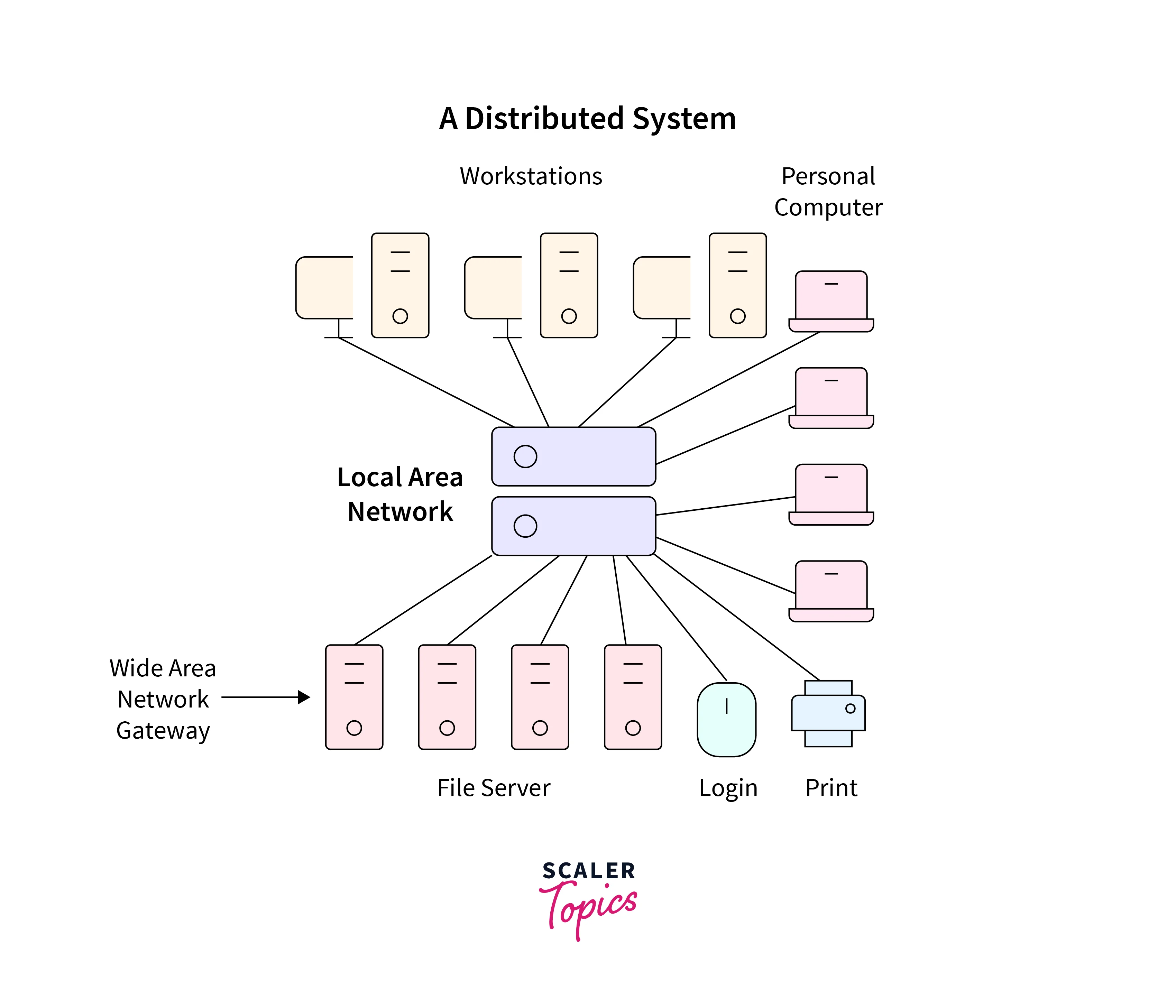
- A distributed system is a collection of independent computers or digital devices that communicate and coordinate their actions by passing messages over a network.
- These computers work together as a single system to achieve a common goal, such as processing large amounts of data, providing a web service, or managing a complex application.
- In a distributed system, each computer, also called a node, performs a specific task or set of tasks and communicates with other nodes to share information for the coordination of actions.
- One of the advantages of these nodes is that they can be located in different geographic locations with different hardware configurations and operating systems. This provides flexibility in the usage of the system.
- Distributed systems face many challenges like fault tolerance, scalability, and availability. These challenges can be addressed by providing a design that includes standby servers and replicating data and services across multiple nodes.
- Designing and managing distributed systems is complex, and requires careful consideration of factors such as network latency, security, consistency, and concurrency control.
Benefits
Some of the benefits of a distributed system are mentioned below.
Resiliency
Resiliency is the ability to function continuously in the event of unexpected failures. We can use strategies like redundancy, load balancing, fault tolerance, monitoring, and security to achieve resiliency in distributed systems. A resilient system will be continuously monitored, and automatic recovery mechanisms are in place to recover data in case of failure. Implementing robust security measures is also necessary to protect against security threats.
Note:
Load balancing is a strategy in which data is distributed across multiple nodes to keep each node working at the optimal capacity.
Redundancy is the replication of a node to another node. In the cases when a node fails, another node will start working in place of the failed node.
Resource/Data Sharing
Sharing resources and data is essential in distributed systems as multiple systems communicate through sharing of data. This can be achieved through methods such as Remote Procedure Calls (RPC), message passing, Distributed File System(DFS), data replication, and Peer-to-Peer(P2P) sharing. Careful design and implementation are necessary to ensure security, consistency, and reliability in sharing of data between nodes.
Speed
Distributed systems achieve high-speed processing due to sharing of work compared to traditional systems. The speed of distributed system may depend on network speed, processing speed, speed of distribution of load to nodes (load balancing), speed to get the data, and algorithm design.
Scalability
Scalability in distributed systems refers to its ability to handle more work or data without compromising performance or reliability. It can be achieved through vertical or horizontal scaling,
- Vertical scaling involves adding more resources to a single machine.
- Horizontal scaling refers to adding more machines to distribute the workload.
Effective load balancing, data partitioning, fault tolerance, data communication, and architecture are essential for achieving scalability in distributed systems.
How Scaler Transformed Careers in Different Fields
Scaler learners achieved 2.5x salary growth with average post-Scaler CTC reaching ₹23L.
 Google
 Amazon
 Microsoft
 Flipkart
 Adobe1200+ more
Distributed Systems: Challenges/Failures
There are also multiple challenges of distributed systems that determine the performance of the overall system.
Heterogeneity
Heterogeneity is one of the challenges of a distributed system that refers to differences in hardware, software, or network configurations among nodes. This can present challenges for communication and coordination. Techniques for managing heterogeneity include middleware, virtualization, standardization, and service-oriented architecture. These approaches can help build robust and scalable systems that accommodate diverse configurations.
Note: Service-oriented architecture (SOA) is an approach used to create a modular and reusable system with well-defined functionality.
Scalability
Scalability is one of the challenges in distributed systems. As distributed systems grow in size and complexity, it becomes increasingly difficult to maintain their performance and availability. The major challenges are security, maintaining consistency of data in every system, network latency between systems, resource allocation, or proper node balancing across multiple nodes.
Turn Learning into Career Growth
Openness
Openness in distributed systems refers to achieving a standard between different systems that use different standards, protocols, and data formats. It is crucial to ensure that different systems can communicate and exchange data seamlessly without the need for extensive manual intervention. It is also important to maintain the correct amount of transparency and security in such systems.
Transparency
Transparency refers to the level of abstraction present in the system to hide complex information from the user. It is essential to ensure that failures are transparent to users and do not affect the overall system's performance. Systems with different hardware and software configurations provide to be a challenge for Transparency. Security is also a concern to maintain transparency in distributed systems.
Concurrency
Concurrency is the ability to process data parallelly on different nodes of the system. One of the primary challenges of concurrency in distributed systems is the issue of race conditions. Problems like communication and synchronization between nodes also pose a challenge. When a node fails, the fault tolerance mechanism must ensure synchronization.
Note: A race condition occurs when two or more processes access or modify shared resources simultaneously. Concurrency control mechanisms have to be used to control such race conditions.
Security
The distributed and heterogeneous nature of the distributed system makes security a major challenge for data processing systems. The system must ensure confidentiality from unauthorized access as data is transmitted across multiple nodes. Various methods like Digital signatures, Checksums, and Hash functions should be used to verify the integrity of data as data is being modified by multiple systems. Authentication mechanisms are also challenging as users and processes may be located on different nodes.
Failure Handling
One of the primary challenges of failure handling in distributed systems is identifying and diagnosing failures as failure can occur at any node. Logging mechanisms should be implemented to identify the failed nodes. Techniques like redundancy, replication, and checkpoints should be used to ensure the continuous working of the system in case of a node failure. Data recovery should be implemented with techniques like Rollback to recover data in the event of a failure.
Conclusion
- Big data analytics is highly dependent on distributed systems.
- A distributed system is a collection of independent computers that are used to perform a single work.
- Distributed systems provide multiple benefits like resiliency, data sharing, speed, and reliability.
- Challenges like Heterogeneity, Scalability, Openness, Concurrency, Security, and Failure handling must be considered before setting up a distributed architecture.
- There are various mechanisms like middleware, virtualization, concurrency control, and signatures that can be used to overcome the challenges of distributed systems.




