


Characteristics and Functions of Data Warehouse
Overview
Data warehouses are purpose-built repositories that store and unify vast data from diverse sources, optimized for analytics. They offer a reliable single truth source by integrating data and supporting informed decision-making. With powerful query capabilities, they reveal trends and anomalies, serving as strategic insight engines for data-driven choices, making them vital tools beyond mere storage.
Pre-Requisite
Let's look at the fundamental elements that compose the characteristics of a data warehouse.
-
Data Collection plan:
Gather data from diverse sources, such as transactional databases, spreadsheets, and external feeds.
-
Data Integration Tools:
To cleanse, convert, and combine fragmented data into a unified structure within the warehouse, powerful ETL (Extract, convert, Load) technologies are required.
-
Scalable Infrastructure:
A solid IT infrastructure with enough storage and processing capability is essential to meet expanding data quantities and analytical needs.
Characteristics of a Data Warehouse
Let us dive into each characteristic of data warehouse one by one.
Build an AI-First Career, Master the Complete Skillset
Choose from our industry-leading programs designed for career success
Modern Software and AI Engineering Program
Master full-stack development with AI integration


 +1000 more
Modern Data Science and ML with specialisation in AI
Advanced data science techniques with AI specialization
+1000 moreAdvanced AIML with Specialisation in Agentic AI
Deep dive into AIML with focus on Agentic systems
+1000 moreDevOps, Cloud & AI Platform Engineering
Build and manage AI-powered cloud infrastructure
+1000 moreAI Engineering Advanced Certification by IIT-Roorkee
Premier AI engineering certification from IIT-Roorkee

AI Forward Deployed Engineer Program
Full-stack engineering, production AI and client-facing consulting
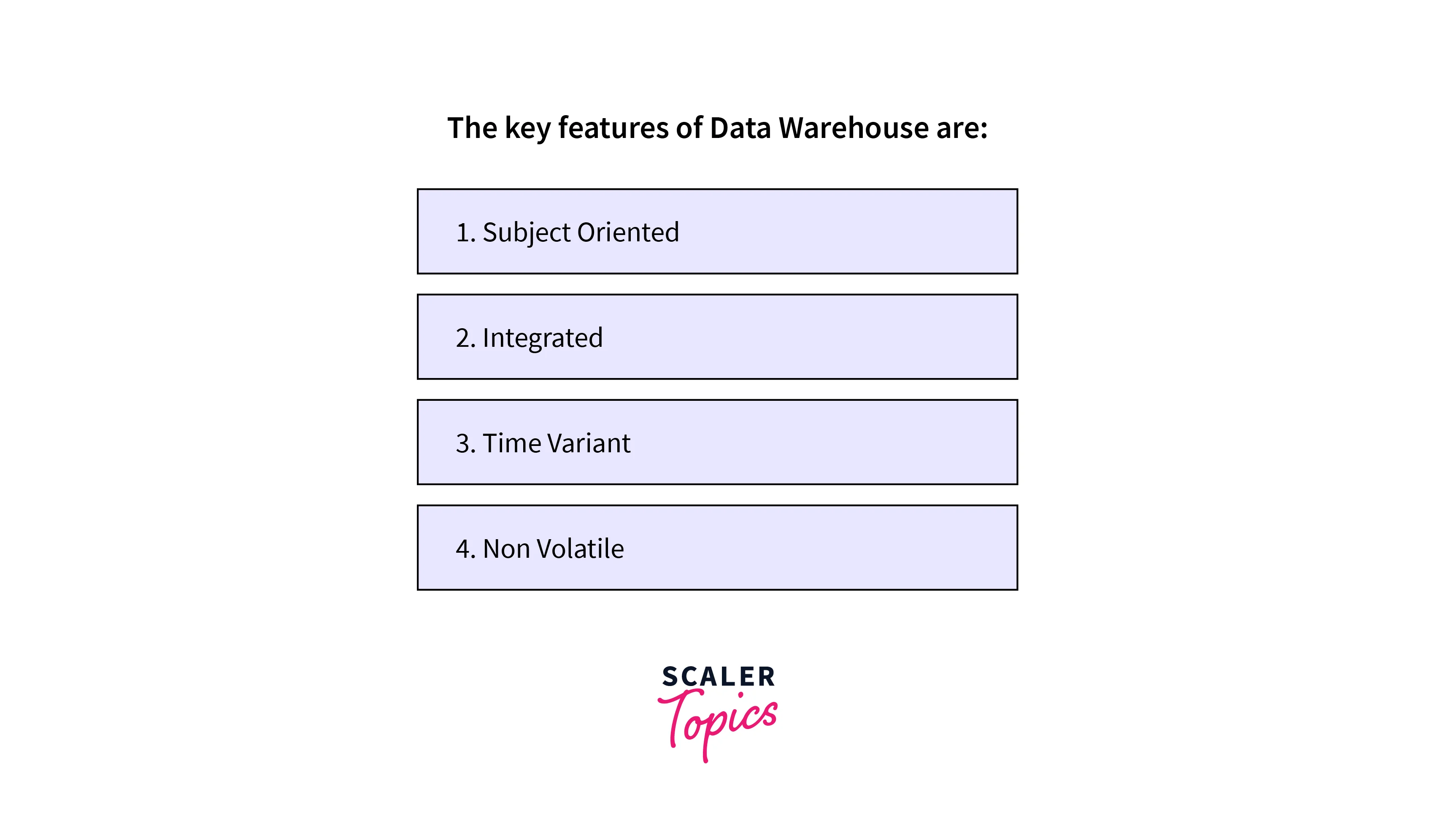
+1000 moreSubject-Oriented
A data warehouse is naturally subject-oriented, organized around certain issues or themes rather than a jumble of unconnected data. This customized strategy allows firms to concentrate on crucial areas like sales, inventory, or customer behavior, making complicated inquiries more efficient and productive.
Integrated
A data warehouse collects information from various sources, including dissimilar systems, databases, or even external partners. It unifies this disparate data. Integration here creates a cohesive data environment, where each element contributes substantially to the bigger picture, surpassing mere data collection.
Variable Time
A data warehouse is time-variant, which means it tracks changes throughout time rather than just the most recent data snapshot. Historical data is at home here, allowing organizations to analyze trends, measure performance, and reveal patterns across time. The data warehouse records everything that happened yesterday, last month, or last year.
Non-Volatile
A data warehouse stands out as non-volatile, where updates and changes are frequent. Data entering the warehouse becomes part of the record and is resistant to change due to day-to-day activities. This immutability is a goldmine for auditing, compliance, and keeping a reliable record of what happened and when.
Types of Data Operations Done in the Data Warehouse
After learning about the characteristics of a data warehouse, let us see the types of data operations done in it. These data warehouses are powered by two essential sorts of operations: data loading and data access.
Data Loading
This first phase is importing data from numerous sources into the data warehouse. Data from diverse sources including databases, spreadsheets, and external systems is extracted, transformed, and loaded into a warehouse to ensure compatibility and consistency.
Data Access
Once the data has been safely stored in the warehouse, the emphasis moves to extracting useful insights. The process of searching and getting specific information for analysis is known as data access. Users may retrieve the necessary data using specialized querying languages, allowing informed decision-making.
How Scaler Transformed Careers in Different Fields
Scaler learners achieved 2.5x salary growth with average post-Scaler CTC reaching ₹23L.
 Google
 Amazon
 Microsoft
 Flipkart
 Adobe1200+ more
Functions of Data Warehouse
After learning about the characteristics of a data warehouse, let us see the various functions of it. A data warehouse is a central hub for managing and analyzing data to facilitate effective decision-making.
A basic overview of the data warehouse looks like:
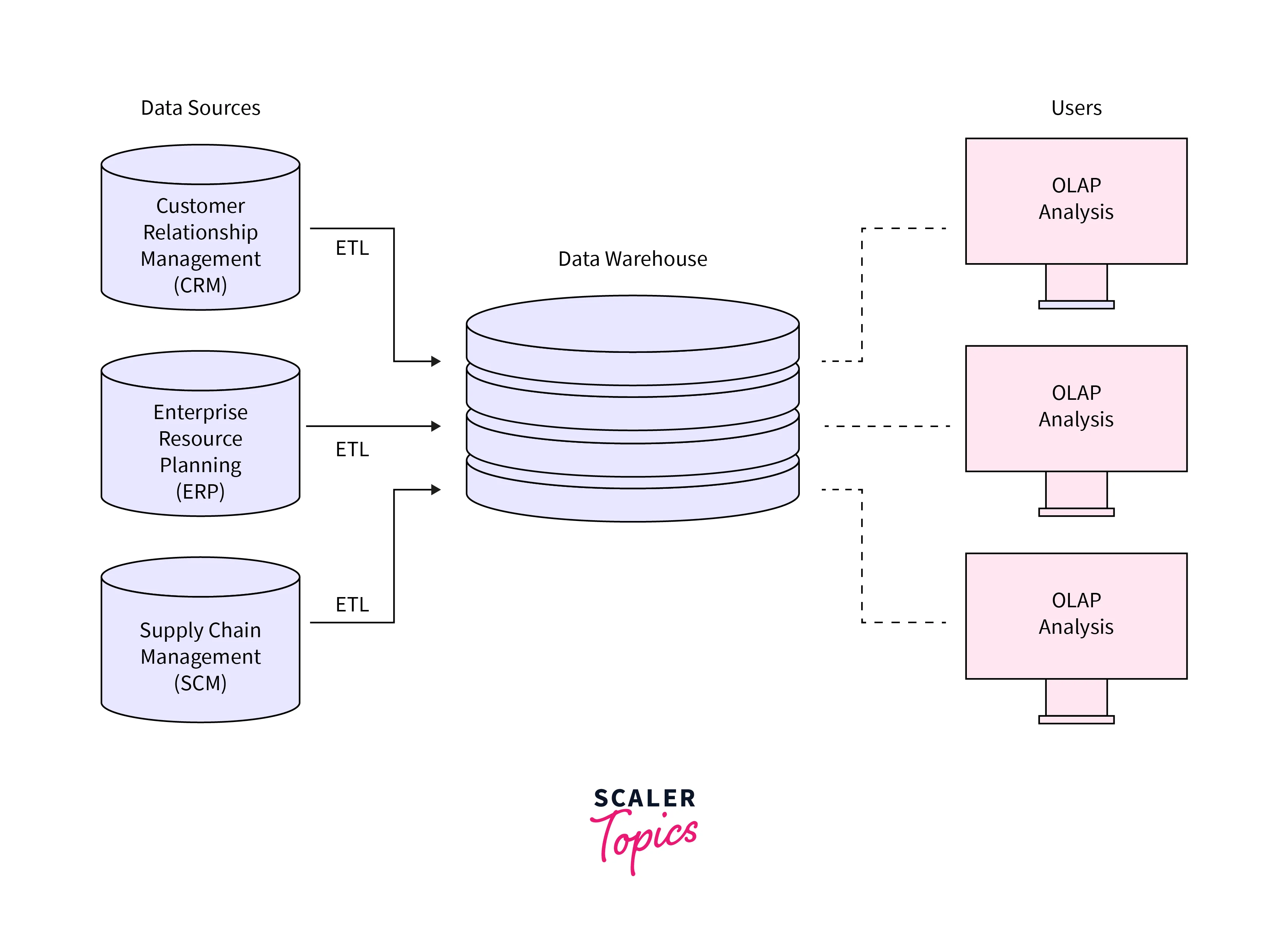
Let's look at these functions in simpler terms:
Data Consolidation
We are bringing data from numerous sources together in one location. This consolidation aids in preventing data silos and allows for a single picture of information.
Data Cleaning
Data accuracy and integrity are ensured through finding and correcting mistakes, inconsistencies, and duplication. Clean data is required for accurate analysis.
Data Integration
We are merging data from several sources, such as databases or spreadsheets, into a unified format to ensure compatibility and consistency.
Turn Learning into Career Growth
Data Storage
We provide a safe and organized environment for storing massive amounts of history and current data for quick retrieval and analysis.
Data Transformation
To enable relevant insights, it converts raw data into an analysis-ready structure, including standardizing units, formats, and more.
Data Analysis
Querying, aggregation, and statistical processes provide in-depth evaluation of data. This function is crucial to gaining insights from acquired data.
Data Reporting
It is developing well-organized and intelligible reports and dashboards that provide insights to stakeholders and assist in strategic decision-making.
Data Mining
We are exploring data to uncover patterns, trends, and connections that might not be obvious initially, revealing hidden insights.
Performance Optimization
They are improving the speed and efficiency of data retrieval and analysis, ensuring that consumers have quick access to the required information.
Conclusion
- Data warehouses are purpose-built repositories that store and unify vast data from diverse sources, optimized for analytics.
- Data warehouses are subject-specific, responding to the analytical demands of a given topic or business sector.
- Data warehouses facilitate the investigation of trends and changes over time by storing historical data recordings.
- Data warehouses restructure, cleanse, and standardize data to improve its quality and usefulness through consistent analysis.
- Data warehouses enable users to derive insights and support strategic choices by providing strong querying and reporting capabilities.




