Chart on Artificial Intelligence: The AI Landscape Explained Visually
This chart on artificial intelligence maps the whole field at a glance: the family tree (AI, machine learning, deep learning, generative AI), the six branches researchers work in, the types by capability and functionality, and the key milestones from 1950 to today. Each chart below is original, labelled, and free to reference in your assignments, presentations, and study notes (credit the source and link back). The rest of this page explains what each chart means in plain English, so a first-year student can understand it and a teacher can trust it.
If you want to go deeper into the main approaches to artificial intelligence, including symbolic, connectionist, and evolutionary methods, that guide covers them in detail.
The One Chart That Maps All of Artificial Intelligence
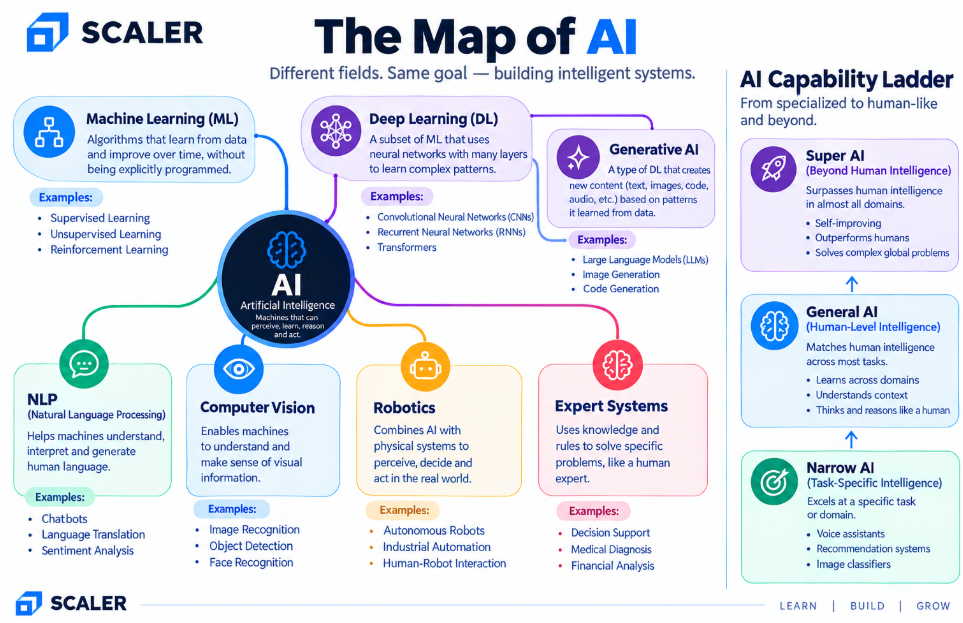
This is the master infographic: one visual that shows how the entire AI landscape fits together. The family tree sits at the centre, with the six branches fanning outward and the types of AI shown as a progression on the side.
How to read it: Start at the centre (Artificial Intelligence). Follow the tree downward through Machine Learning, then Deep Learning, then Generative AI. The branches (NLP, computer vision, robotics, expert systems) show the subfields where AI is applied. The capability ladder on the right shows how AI systems are classified by how smart they are.
This chart on artificial intelligence is designed to be screenshotted, printed, or dropped into a slide. If you use it, please credit this page as the source.
AI vs Machine Learning vs Deep Learning (The Family Tree)
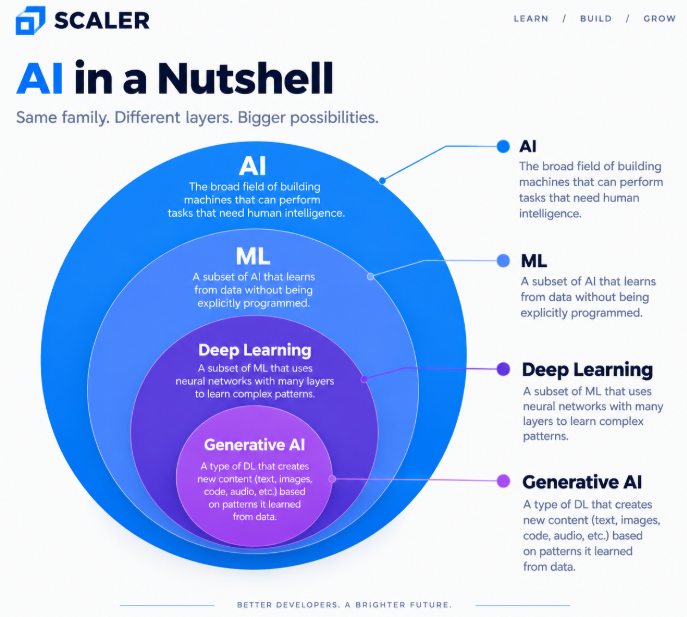
This is the chart most people come looking for, and the one most often drawn wrong online. Here is the correct nesting.
Artificial intelligence is the broadest concept: any technique that enables machines to mimic human intelligence. Machine learning is a subset of AI: systems that learn patterns from data rather than following hand-coded rules. Deep learning is a subset of machine learning: it uses layered neural networks to learn complex representations automatically. Generative AI (the technology behind ChatGPT, image generators, and code assistants) sits inside deep learning.
Yes, deep learning is part of artificial intelligence. Deep learning is a subset of machine learning, which is itself a subset of AI. They are nested, not separate categories.
Video explainer: If you prefer watching over reading, this short video walks through the same hierarchy:
For a deeper comparison, see how AI, ML, and deep learning actually differ.
Build an AI-First Career, Master the Complete Skillset
Choose from our industry-leading programs designed for career success
Modern Software and AI Engineering Program
Master full-stack development with AI integration


 +1000 more
Modern Data Science and ML with specialisation in AI
Advanced data science techniques with AI specialization
+1000 moreAdvanced AIML with Specialisation in Agentic AI
Deep dive into AIML with focus on Agentic systems
+1000 moreDevOps, Cloud & AI Platform Engineering
Build and manage AI-powered cloud infrastructure
+1000 moreAI Engineering Advanced Certification by IIT-Roorkee
Premier AI engineering certification from IIT-Roorkee

AI Forward Deployed Engineer Program
Full-stack engineering, production AI and client-facing consulting
+1000 moreWhat Are the Branches of Artificial Intelligence?
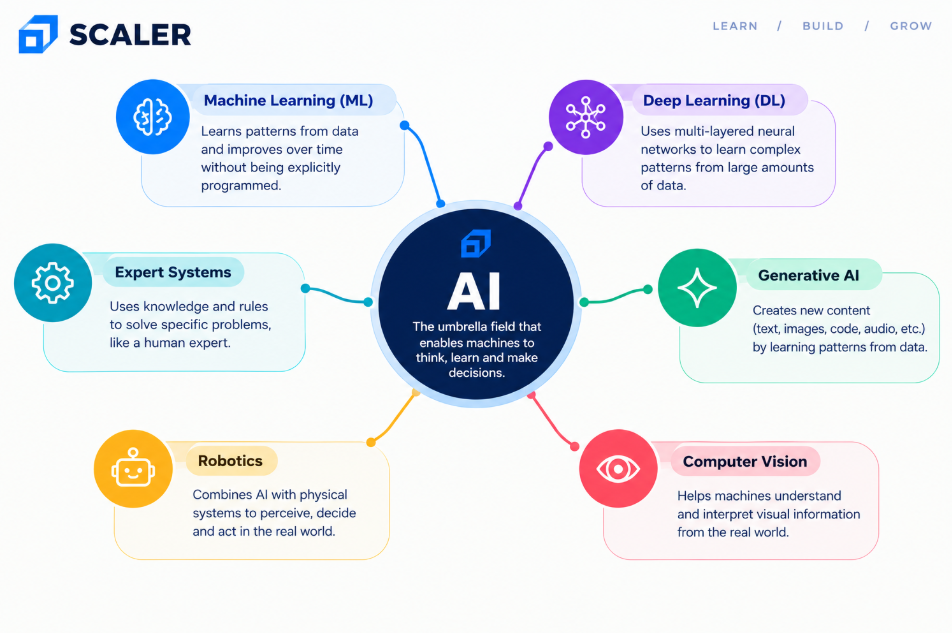
Branches are the subfields of AI: the areas researchers and engineers actually work in. This is different from "types of AI" (covered next), which classifies systems by how smart they are. Students most often confuse branches with types, so here is the distinction: branches answer "what area of AI is this?" while types answer "how capable is this AI system?"
Machine Learning
Systems that learn patterns from data and improve with experience. The three main approaches are supervised learning (learning from labelled examples), unsupervised learning (finding hidden patterns in unlabelled data), and reinforcement learning (learning by trial and reward). ML is the engine behind most AI you use daily: spam filters, recommendation systems, fraud detection. For a full breakdown, see the types of machine learning.
Deep Learning and Neural Networks
Layered neural networks with many hidden layers that can learn complex representations from raw data. Deep learning powers image recognition, speech recognition, language translation, and generative AI. It requires large datasets and significant compute, but it automates the feature extraction that traditional ML does by hand.
Natural Language Processing (NLP)
Machines understanding, interpreting, and generating human language. NLP is the branch behind chatbots, translation tools, sentiment analysis, voice assistants, and large language models like ChatGPT.
Computer Vision
Machines interpreting images and video: object detection, facial recognition, medical imaging, autonomous driving perception. Computer vision is one of the most commercially successful branches of AI.
Robotics
AI that senses and acts in the physical world. Robotics combines perception, planning, and control. Industrial robots, autonomous vehicles, surgical robots, and warehouse automation all live here.
Expert Systems
Rule-based systems that encode human domain expertise into if-then rules. Expert systems were the dominant form of AI before machine learning. They are still used in medical diagnosis, troubleshooting, and compliance checking.
What Are the Types of Artificial Intelligence?
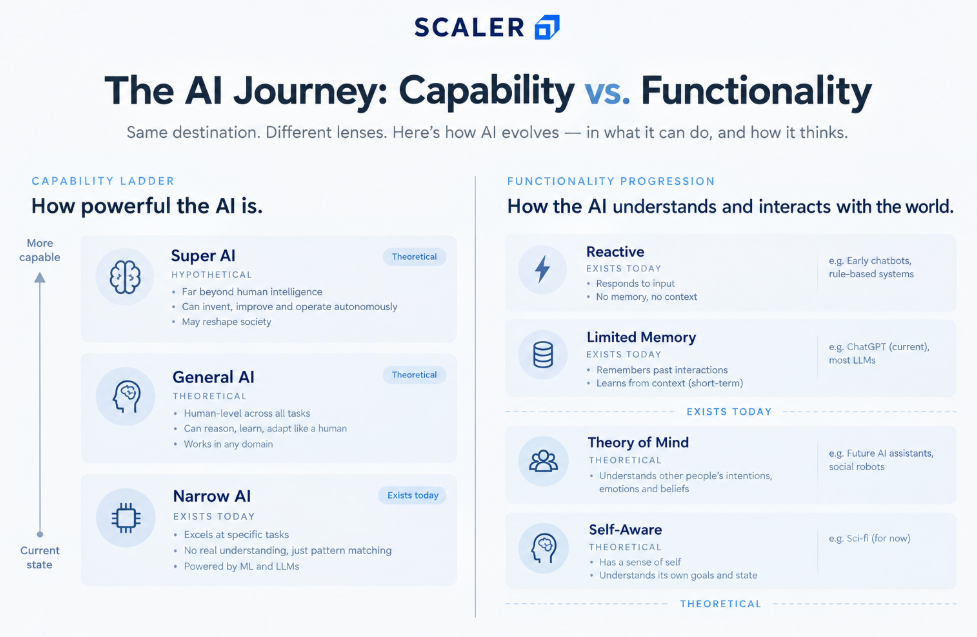
Types classify AI by how capable it is, not by what subfield it belongs to. There are two standard classification systems.
How Scaler Transformed Careers in Different Fields
Scaler learners achieved 2.5x salary growth with average post-Scaler CTC reaching ₹23L.
 Google
 Amazon
 Microsoft
 Flipkart
 Adobe1200+ more
Types by Capability: Narrow AI, General AI, Super AI
- Narrow AI (Weak AI): Designed for one specific task. Every AI system that exists today is narrow AI: Siri, Google Maps, spam filters, ChatGPT, self-driving cars. They excel at their assigned task but cannot transfer that ability to unrelated problems.
- General AI (AGI): A system that matches human cognitive ability across all domains: reasoning, learning, planning, understanding language, and adapting to new situations. AGI does not exist yet. It remains a research goal, not a product.
- Super AI: A hypothetical system that surpasses human intelligence in every dimension. Super AI is a thought experiment, not an engineering target. No credible timeline exists for its development.
Types by Functionality: Reactive, Limited Memory, Theory of Mind, Self-Aware
- Reactive Machines: No memory. They respond to the current input only. IBM's Deep Blue (the chess computer that beat Garry Kasparov in 1997) is a classic example.
- Limited Memory: Can use past data for a short time. Self-driving cars, chatbots, and most modern AI systems fall here. They remember recent inputs but do not build a persistent model of the world.
- Theory of Mind: AI that understands human emotions, beliefs, and intentions. This does not exist yet. It is a research aspiration.
- Self-Aware AI: AI with consciousness and self-understanding. This is purely hypothetical. No current system comes close.
- Only the first two types (reactive and limited memory) exist today. General AI, super AI, theory of mind, and self-aware AI are still theoretical.
For more on how AI compares with human intelligence, including where machines outperform us and where they do not, see the linked comparison.
A Short History of AI (The Timeline Chart)
The field of artificial intelligence has a longer history than most people realise. Here are the milestones that shaped it.
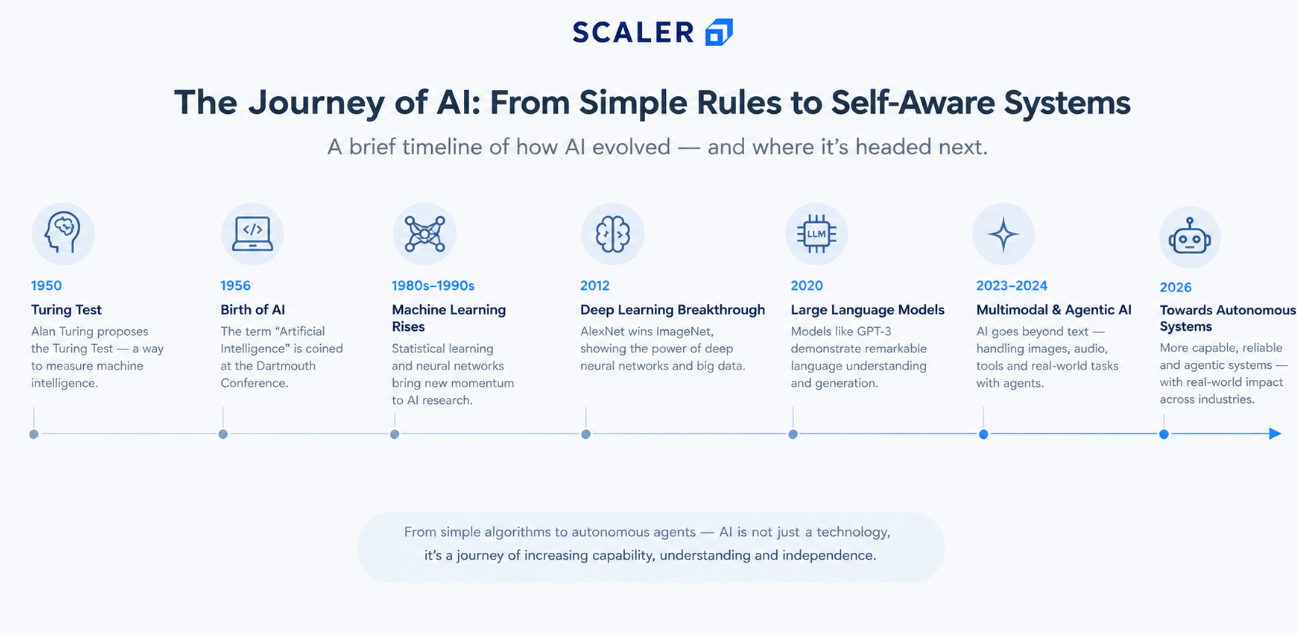
| Year | Milestone |
|---|---|
| 1950 | Alan Turing publishes "Computing Machinery and Intelligence", proposing the Turing Test: can a machine fool a human into thinking it is also human? |
| 1956 | The Dartmouth Conference: John McCarthy, Marvin Minsky, and colleagues coin the term "artificial intelligence" and establish it as a research field. |
| 1974-1993 | The AI Winters: periods of reduced funding and interest as early promises outpace results. |
| 1997 | IBM's Deep Blue defeats world chess champion Garry Kasparov, demonstrating narrow AI's power in a bounded domain. |
| 2012 | Deep learning breakthrough: AlexNet wins the ImageNet competition, proving that deep neural networks can dramatically outperform traditional approaches on image recognition. |
| 2017 | The "Attention Is All You Need" paper introduces the Transformer architecture, the foundation for modern large language models. For a technical breakdown, see how the Transformer's attention mechanism works. |
| 2022 | ChatGPT launches, bringing generative AI into mainstream use and sparking the current wave of AI adoption. |
The pace of progress since 2012 has been faster than any previous period in AI history. The Stanford AI Index tracks this progress annually with rigorous, globally sourced data.
Where Is AI Used? (The Applications Map)
AI is not a future technology. It is already embedded in the tools and services you use every day.
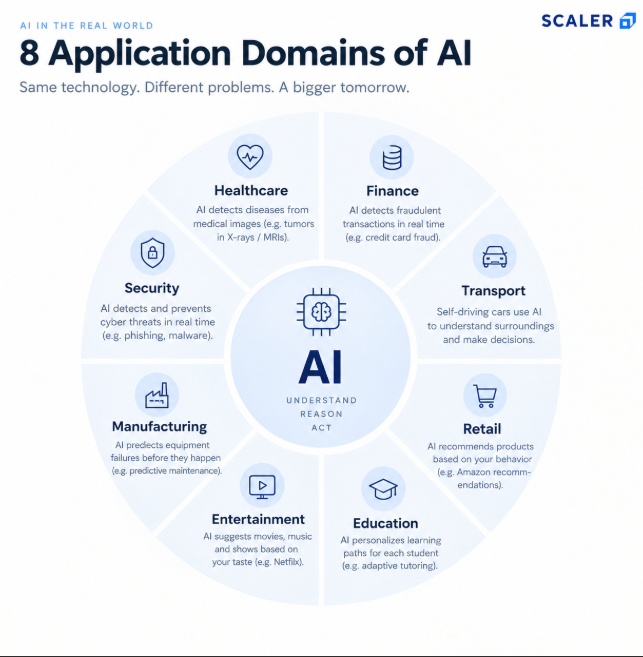
| Domain | Example |
|---|---|
| Healthcare | Medical imaging analysis, drug discovery, diagnostic support |
| Finance | Fraud detection, algorithmic trading, credit scoring |
| Transport | Self-driving vehicles, route optimisation, traffic prediction |
| Retail and E-commerce | Product recommendations, demand forecasting, dynamic pricing |
| Education | Personalised learning, automated grading, intelligent tutoring |
| Entertainment | Streaming recommendations (Netflix, Spotify), game AI, content generation |
| Manufacturing | Predictive maintenance, quality control, supply chain optimisation |
| Security | Threat detection, surveillance analysis, biometric authentication |
For a balanced view of what AI brings and what it costs, see the advantages and disadvantages of AI.
Turn Learning into Career Growth
How to Use These AI Charts (For Students, Teachers, and Projects)
These charts are free to reference in assignments, presentations, study notes, and classroom materials. If you use them, please credit this page and link back to the source URL. That is how we keep them free and updated.
Which chart fits your need:
- "Explain AI vs ML vs deep learning" - Use the nested family tree chart.
- "What are the subfields of AI?" - Use the branches chart.
- "Give a history of AI" - Use the timeline chart.
- "What are the types of AI?" - Use the capability and functionality charts.
- "Show where AI is used" - Use the applications map.
- "Map the whole field" - Use the hero infographic at the top.
New to AI and want to go from this map to actually understanding it? Start with a free AI course with a certificate - a structured, beginner-friendly path through the fundamentals you have just seen charted.
FAQs
What is the difference between AI, machine learning, and deep learning?
AI is the broadest concept: any technique that lets machines mimic human intelligence. Machine learning is a subset of AI where systems learn from data. Deep learning is a subset of ML that uses multi-layered neural networks. They are nested: AI contains ML, which contains deep learning.
What are the branches of artificial intelligence?
The six main branches are machine learning, deep learning and neural networks, natural language processing (NLP), computer vision, robotics, and expert systems. Each represents a distinct area where AI research and application are active.
What are the 4 types of AI by functionality?
Reactive machines (no memory), limited memory (uses recent data), theory of mind (understands human emotions, does not exist yet), and self-aware AI (conscious, hypothetical). Only reactive and limited memory types exist today.
What are the 3 types of AI by capability?
Narrow AI (task-specific, the only kind that exists today), general AI or AGI (human-level across all domains, still theoretical), and super AI (beyond human, purely hypothetical).
Is deep learning part of artificial intelligence?
Yes. Deep learning is a subset of machine learning, which is a subset of artificial intelligence. The relationship is nested: AI is the broadest category, ML sits inside it, and deep learning sits inside ML.
Who coined the term "artificial intelligence"?
John McCarthy coined the term at the Dartmouth Summer Research Project in 1956. The original proposal, authored by McCarthy, Minsky, Rochester, and Shannon, laid out the founding vision for the field.
Can I use these AI charts in my school or college project?
Yes. These charts are designed for students and teachers. Reference them in your assignment, credit the source, and link back to this page. That keeps them free and updated.