


KDD in Data Mining: Process, Steps, Techniques & Applications
Overview
KDD stands for Knowledge Discovery in Databases, which is the process of extracting useful knowledge from large amounts of data. It is an area of interest to researchers and professionals in various fields, such as artificial intelligence, machine learning, pattern recognition, databases, statistics, and data visualization. Data mining is a key component of the KDD process.
What is KDD in Data Mining?
KDD (Knowledge Discovery in Databases) is the overall process of discovering useful, valid, and understandable knowledge from large and complex datasets. It is a broad, interdisciplinary field that draws on artificial intelligence, machine learning, statistics, pattern recognition, databases, and data visualization.
The term itself has a precise origin. Gregory Piatetsky-Shapiro coined "knowledge discovery in databases" for the first KDD workshop in 1989, and it became the preferred term in the AI and machine learning communities.
The classic, most cited definition of the field comes from Fayyad, Piatetsky-Shapiro, and Smyth in their 1996 paper From Data Mining to Knowledge Discovery in Databases: KDD is "the nontrivial process of identifying valid, novel, potentially useful, and ultimately understandable patterns in data." (Fayyad et al., AI Magazine, 1996)
Let us unpack that definition, because every word matters:
- Nontrivial: KDD is not a simple lookup or report. It involves real computation and discovery.
- Valid: The discovered patterns must hold up on new data, not just by chance.
- Novel: The patterns should be new and non obvious, not things you already knew.
- Potentially useful: They should lead to some action or decision.
- Understandable: A human must be able to interpret and explain the result.
Here is the single most important distinction to remember: data mining is a subset of KDD. Data mining is the step where algorithms find patterns in prepared data. KDD is the whole pipeline before, around, and after that step: selecting data, cleaning it, transforming it, mining it, evaluating the results, and turning them into knowledge that a business can actually use.
The KDD Process: Steps in Data Mining
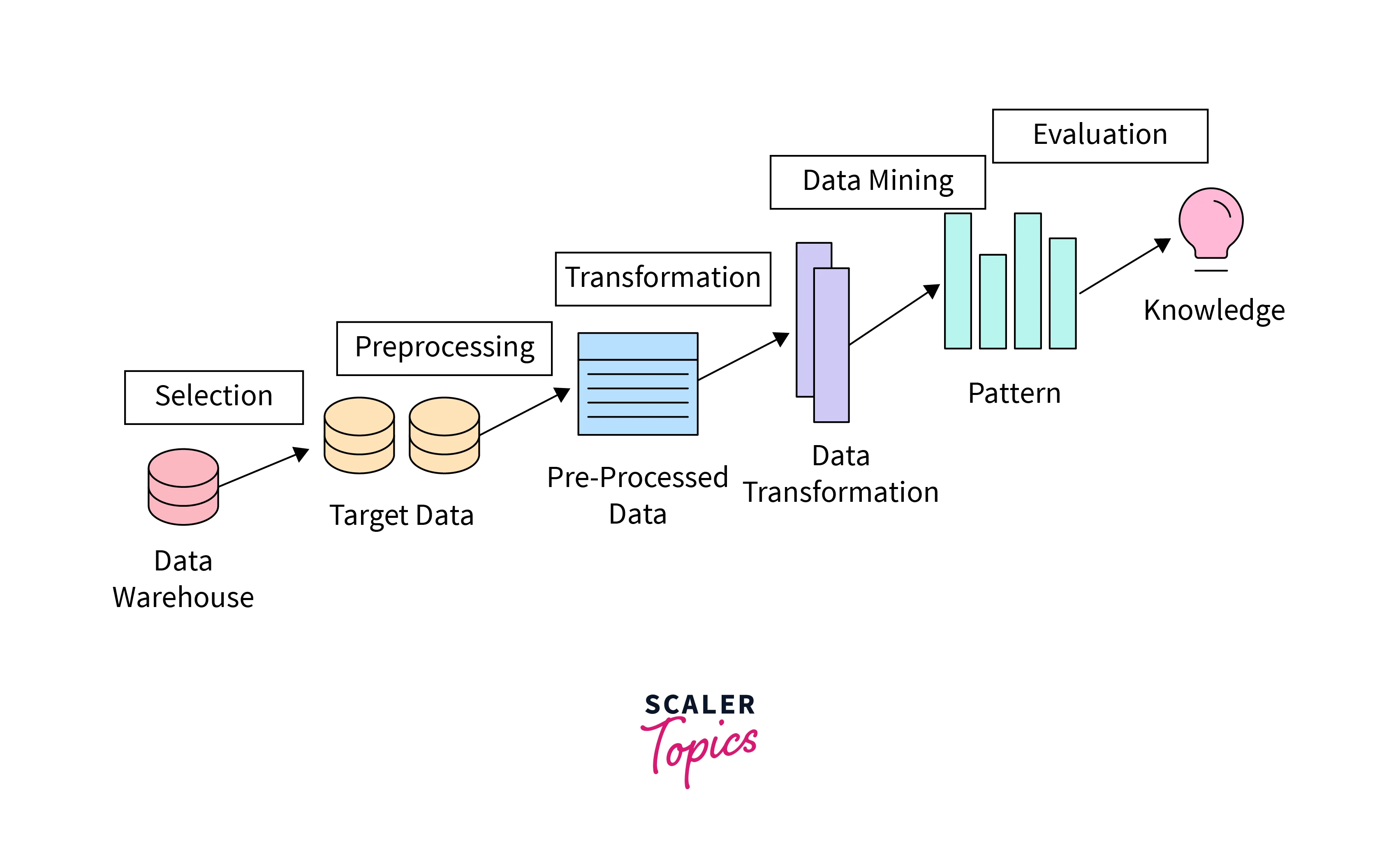
The KDD process is an iterative, multi-step journey from raw data to actionable knowledge. Different references list the steps in slightly different ways, but they all describe the same pipeline. The classic formulation has five stages: selection, preprocessing, transformation, data mining, and interpretation/evaluation.
A more detailed, widely used breakdown expands this into seven steps, which is the version we will walk through now:
- Data Selection
- Data Preprocessing
- Data Transformation
- Data Mining
- Pattern Evaluation
- Knowledge Representation
- Deployment
Step 1: Data Selection
Before any analysis can happen, you must decide which data matters. This means understanding the business problem first, then choosing the relevant data sources such as databases, data warehouses, or live data streams, and selecting the fields or records that are relevant to the goal.
Selecting the wrong data, or too much irrelevant data, wastes effort and can drown the analysis in noise. A focused dataset is the foundation of everything that follows.
Build an AI-First Career, Master the Complete Skillset
Choose from our industry-leading programs designed for career success
Modern Software and AI Engineering Program
Master full-stack development with AI integration


 +1000 more
Modern Data Science and ML with specialisation in AI
Advanced data science techniques with AI specialization
+1000 moreAdvanced AIML with Specialisation in Agentic AI
Deep dive into AIML with focus on Agentic systems
+1000 moreDevOps, Cloud & AI Platform Engineering
Build and manage AI-powered cloud infrastructure
+1000 moreAI Engineering Advanced Certification by IIT-Roorkee
Premier AI engineering certification from IIT-Roorkee

AI Forward Deployed Engineer Program
Full-stack engineering, production AI and client-facing consulting
+1000 moreStep 2: Data Preprocessing
Raw data is almost always messy. This step cleans it up by:
- Removing noise (errors, outliers, and inconsistencies).
- Handling missing values, by filling them with reasonable estimates or removing incomplete records.
- Removing duplicates so the same record is not counted twice.
- Integrating data from multiple sources into one consistent dataset.
This step matters enormously: the quality of the data directly limits the quality of the knowledge you can extract. Garbage in, garbage out.
Step 3: Data Transformation
Now the clean data is reshaped into a form that data mining algorithms can work with. Common transformations include:
- Normalization: scaling numerical values to a common range so one feature does not dominate.
- Aggregation: summarizing data, for example converting daily sales into weekly sales.
- Discretization: converting continuous values into categories.
- Dimensionality reduction: cutting down the number of features while keeping the important information.
Step 4: Data Mining
This is the heart of the KDD process, where algorithms are applied to discover hidden patterns, trends, and relationships. The main families of data mining tasks are: (Wikipedia)
- Classification: assigning records to predefined categories, such as labeling an email as spam or not spam.
- Clustering: grouping similar records together without predefined labels, such as customer segmentation.
- Association rule learning: finding items that frequently appear together, such as market basket analysis.
- Regression: predicting a continuous value, such as a house price.
- Anomaly detection: flagging unusual records, such as fraudulent transactions.
For a deeper look at these techniques, see our guides on Classification in Data Mining and What is Clustering in Data Mining.
For a Hands-On Approach, Check out Scaler's Data Science Course that Offers Interactive Modules. Enroll and Get Certified by the Best!
Step 5: Pattern Evaluation
Not every pattern a mining algorithm finds is useful. Some are trivial, some are random noise, and some are too weak to matter. This step assesses the discovered patterns for quality, significance, and usefulness, and selects the most promising ones for further analysis. This is where domain expertise becomes critical: only a human who understands the business can judge which patterns are genuinely meaningful.
Step 6: Knowledge Representation
Knowledge is only valuable if it can be communicated. This step presents the results in a form people can understand and act on: visualizations, dashboards, charts, reports, or decision rules. A pattern nobody understands is not knowledge.
Step 7: Deployment
The final step puts the knowledge to work. This could mean integrating a predictive model into a live application, embedding a rule into a decision making process, or rolling out a new business strategy. Deployment is what turns an interesting discovery into real organizational value.
A key property of the whole process is that it is iterative. The steps are not a one way street. Results from evaluation or deployment often send you back to earlier steps, to select different data, refine the transformation, or tune the mining algorithm, until the knowledge is reliable enough to act on.
KDD Process: A Real World Example
Let us follow a realistic example through the entire pipeline. Suppose a large e-commerce retailer wants to improve its product recommendations.
Data Selection: The team decides to work with one year of customer purchase history, product catalog data, and customer browsing logs. They select only the fields relevant to recommendations.
Data Preprocessing: They remove bot traffic, drop duplicate orders, and fill in missing customer attributes. Products with incomplete catalog data are either fixed or excluded.
Data Transformation: Purchases are aggregated into a per customer product matrix. Browsing events are binarized into "viewed or not viewed" flags, and prices are normalized.
Data Mining: The team runs association rule learning to find products frequently bought together, and clustering to group customers with similar tastes. (This is the classic market basket analysis idea: a supermarket finds that customers who buy bread often also buy butter.)
Pattern Evaluation: The rules are filtered by support and confidence. Patterns that are statistically weak, obvious, or not actionable (for example, items bought together only once) are discarded. Domain experts check that the surviving patterns make business sense.
Knowledge Representation: The findings are turned into a recommendation engine plus a dashboard showing the top product associations and customer segments for the marketing team.
Deployment: The recommendation model is deployed into the live website, so each customer sees personalized "frequently bought together" suggestions at checkout. The team monitors performance and periodically loops back to retrain.
This is KDD in action: a pipeline in which data mining is just one, admittedly central, step. The earlier and later steps are what make the mined patterns trustworthy and usable.
KDD vs Data Mining: What is the Difference?
People often use "KDD" and "data mining" interchangeably, but they are not the same thing. The table below captures the difference.
| Factor | KDD Process | Data Mining |
|---|---|---|
| Definition | The complete, end to end process of extracting useful knowledge from data | A subset of KDD focused on finding patterns and relationships in prepared data |
| Steps involved | Selection, preprocessing, transformation, mining, evaluation, representation, deployment | Applying algorithms (classification, clustering, association rules, and so on) to a dataset |
| Scope | Broad: includes data cleaning, domain understanding, and result interpretation | Narrow: the algorithmic core |
| Focus | Domain expertise and validation of results | Computational algorithms that detect patterns |
| Output | Knowledge that supports decisions, in the form of rules, models, or insights | Patterns, relationships, predictions, or trends |
One line summary: KDD is the whole journey, and data mining is one stop on that journey.
If you are new to the field, start with our introduction to What is Data Mining before going deeper.
KDD and CRISP-DM: The Industry Standard
When teams actually run knowledge discovery projects today, they rarely talk about "KDD" by name. They use a descendant of it: CRISP-DM (Cross-Industry Standard Process for Data Mining), which organizes the work into six phases:
- Business understanding
- Data understanding
- Data preparation
- Modeling
- Evaluation
- Deployment
Notice how similar this is to the KDD steps above. CRISP-DM simply makes the business context and data understanding explicit up front. Polls of data miners conducted in 2002, 2004, 2007, and 2014 consistently found that CRISP-DM is the leading methodology used by practitioners, chosen by far more people than any alternative.
So when you learn KDD, you are learning the conceptual ancestor of the exact process most data science teams follow today. The vocabulary changes (features, models, deployment), but the pipeline is the same one Fayyad, Piatetsky-Shapiro, and Smyth described back in 1996.
How Scaler Transformed Careers in Different Fields
Scaler learners achieved 2.5x salary growth with average post-Scaler CTC reaching ₹23L.
 Google
 Amazon
 Microsoft
 Flipkart
 Adobe1200+ more
Advantages of KDD in Data Mining
KDD delivers real value to organizations in several ways:
- Better decision making: It surfaces hidden patterns and trends that support data driven decisions instead of gut feeling.
- Improved business performance: It identifies inefficiencies, optimizes processes, and reduces costs.
- Time and resource savings: It automates analysis and focuses attention on the most significant information.
- Enhanced customer experience: It reveals customer behavior and preferences, enabling personalization.
- Fraud detection: It flags unusual patterns and anomalies that signal fraudulent behavior.
- Predictive modeling: It enables forecasts of future trends, giving organizations a competitive edge.
Disadvantages of KDD in Data Mining
KDD is powerful, but it is not free of challenges:
- Demands high quality data: Poor, incomplete, or inconsistent data produces misleading results and flawed conclusions.
- Complexity: The process requires specialized skills, and interpreting results can be hard for non experts.
- Privacy and compliance concerns: Mining can surface sensitive personal information or reinforce existing biases and discrimination.
- High cost: Specialized software, hardware, and skilled professionals can make KDD expensive, especially for smaller organizations.
Conclusion
KDD, Knowledge Discovery in Databases, is the complete process of turning raw data into valid, novel, useful, and understandable knowledge.
- The process runs through selection, preprocessing, transformation, data mining, pattern evaluation, knowledge representation, and deployment.
- Data mining is a subset of KDD, the algorithmic step that finds patterns, not the whole story.
- The process is iterative: results often send you back to refine earlier steps.
- The industry standard CRISP-DM is a direct descendant of KDD, and it is the methodology most data teams use today.
Understanding KDD gives you the big picture: mining algorithms are powerful, but they only deliver value inside a disciplined pipeline that selects, cleans, validates, and communicates. That is what separates a random pattern from real knowledge.
FAQs
1. What is KDD in data mining?
KDD (Knowledge Discovery in Databases) is the complete process of extracting valid, novel, potentially useful, and understandable knowledge from large datasets. It includes data selection, preprocessing, transformation, data mining, evaluation, and interpretation. Data mining is one step within it.
Turn Learning into Career Growth
2. What is the difference between KDD and data mining?
KDD is the entire end to end process, while data mining is a subset of it. Data mining focuses on applying algorithms to find patterns in prepared data; KDD also covers selecting, cleaning, transforming, evaluating, and deploying the results. (Wikipedia)
3. What are the steps in the KDD process?
The classic five stages are selection, preprocessing, transformation, data mining, and interpretation/evaluation. A more detailed version lists seven steps: data selection, preprocessing, transformation, data mining, pattern evaluation, knowledge representation, and deployment. (Wikipedia)
4. Who coined the term KDD?
The term "knowledge discovery in databases" was coined by Gregory Piatetsky-Shapiro for the first KDD workshop in 1989, and the field was formally defined in the 1996 paper by Fayyad, Piatetsky-Shapiro, and Smyth. (Wikipedia)
5. What is the canonical definition of KDD?
The widely cited definition from Fayyad, Piatetsky-Shapiro, and Smyth (1996) is: "the nontrivial process of identifying valid, novel, potentially useful, and ultimately understandable patterns in data." (Fayyad et al., AI Magazine, 1996)
6. What is CRISP-DM and how does it relate to KDD?
CRISP-DM (Cross-Industry Standard Process for Data Mining) is an industry standard methodology with six phases: business understanding, data understanding, data preparation, modeling, evaluation, and deployment. It is a direct descendant of KDD and is the leading methodology used by data mining practitioners.
7. Why is the KDD process iterative?
Because the results of later steps often reveal problems or opportunities in earlier steps. A weak pattern found during evaluation may require selecting different data or redoing the transformation. Iteration is what makes the final knowledge reliable.
8. Which data mining techniques are used in the KDD process?
Common techniques include classification, clustering, association rule learning (market basket analysis), regression, and anomaly detection. These are applied during the data mining step of the pipeline.
9. Why is data preprocessing important in KDD?
Preprocessing removes noise, handles missing values, and removes duplicates before analysis. Since data mining can only discover patterns that actually exist in the data, poor data quality directly leads to inaccurate results and flawed conclusions.




