


Difference between Synchronous and Asynchronous Counter
Overview
Counters play a crucial role in computer science and digital electronics, acting as fundamental components for various operations, including tracking events, generating clock signals, and addressing memory locations. Counters are often used to monitor resource utilization, track execution times, and facilitate multitasking. However, the core concept of counters transcends operating systems and is deeply intertwined with digital circuitry. One important distinction within counters is the difference between synchronous and asynchronous counters, each having its own set of characteristics and applications. In this article, we will delve into the characteristics of both types of counters, their graphical representations, and the key differences between them.
Asynchronous Counter
An asynchronous counter, also known as a ripple counter, is a type of counter circuit where the flip-flop inputs are not all clocked simultaneously. Instead, each flip-flop in the circuit triggers based on the output of the previous flip-flop. This creates a ripple effect where the least significant bit (LSB) flip-flop changes state with every clock pulse, and its output serves as the clock input for the next flip-flop. This propagation of changes through the circuit results in a sequence of count values.
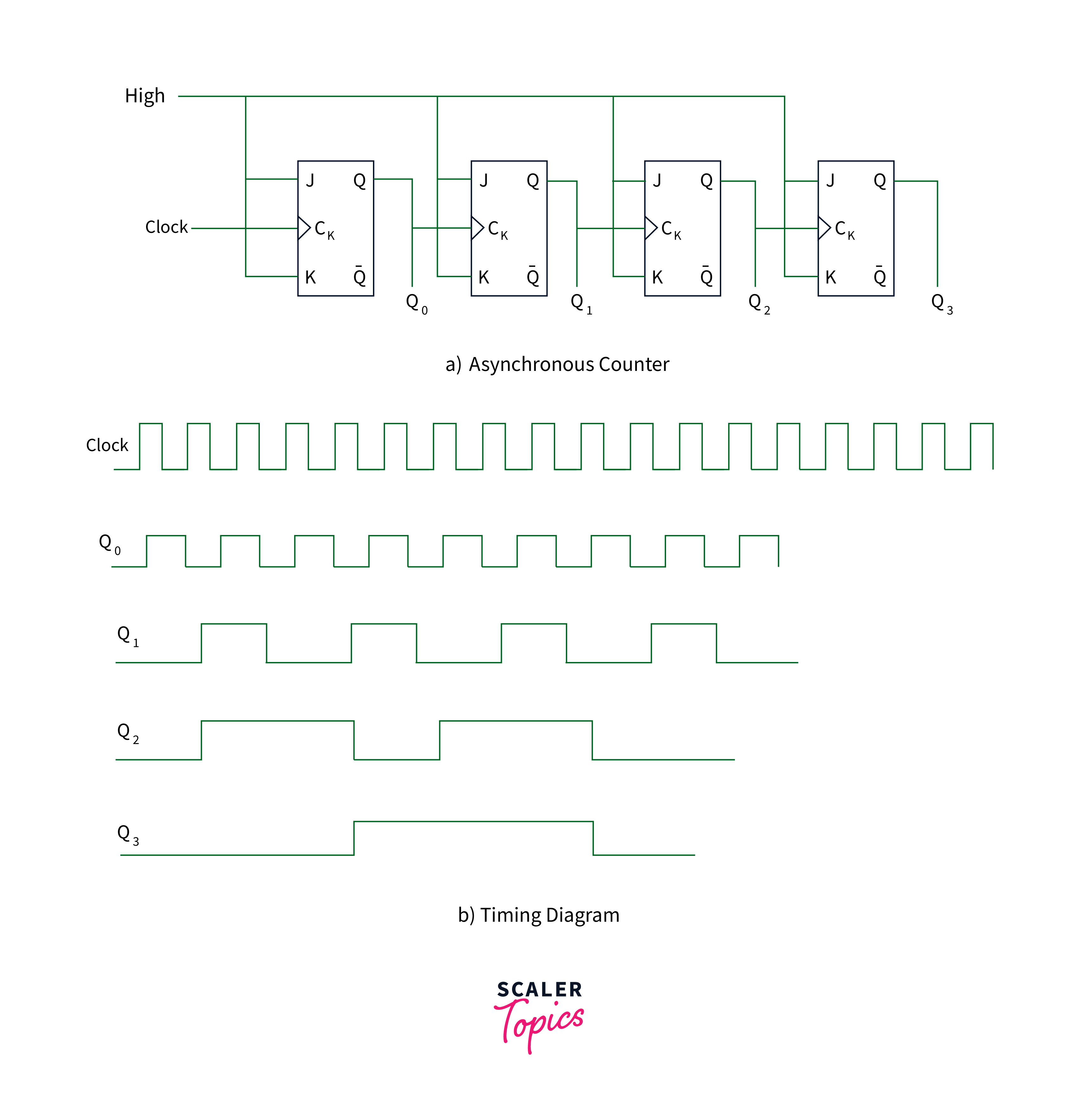
In the graphical representation above, each rectangle represents a flip-flop. The first flip-flop receives the main clock signal and the rest of the flip-flops receive the output of the previous flip-flop. As the clock signal pulses, the counter progresses through its states. One of the notable characteristics of asynchronous counters is their simplicity and ease of implementation, making them suitable for applications where timing accuracy is not a primary concern.
Synchronous Counter
On the other hand, a synchronous counter is designed in a way that all its flip-flops are clocked simultaneously, using the same clock signal. This ensures that all flip-flops change state at the same time, eliminating the ripple effect seen in asynchronous counters. The outputs of the flip-flops are then combined using logic gates to generate the desired count sequence.
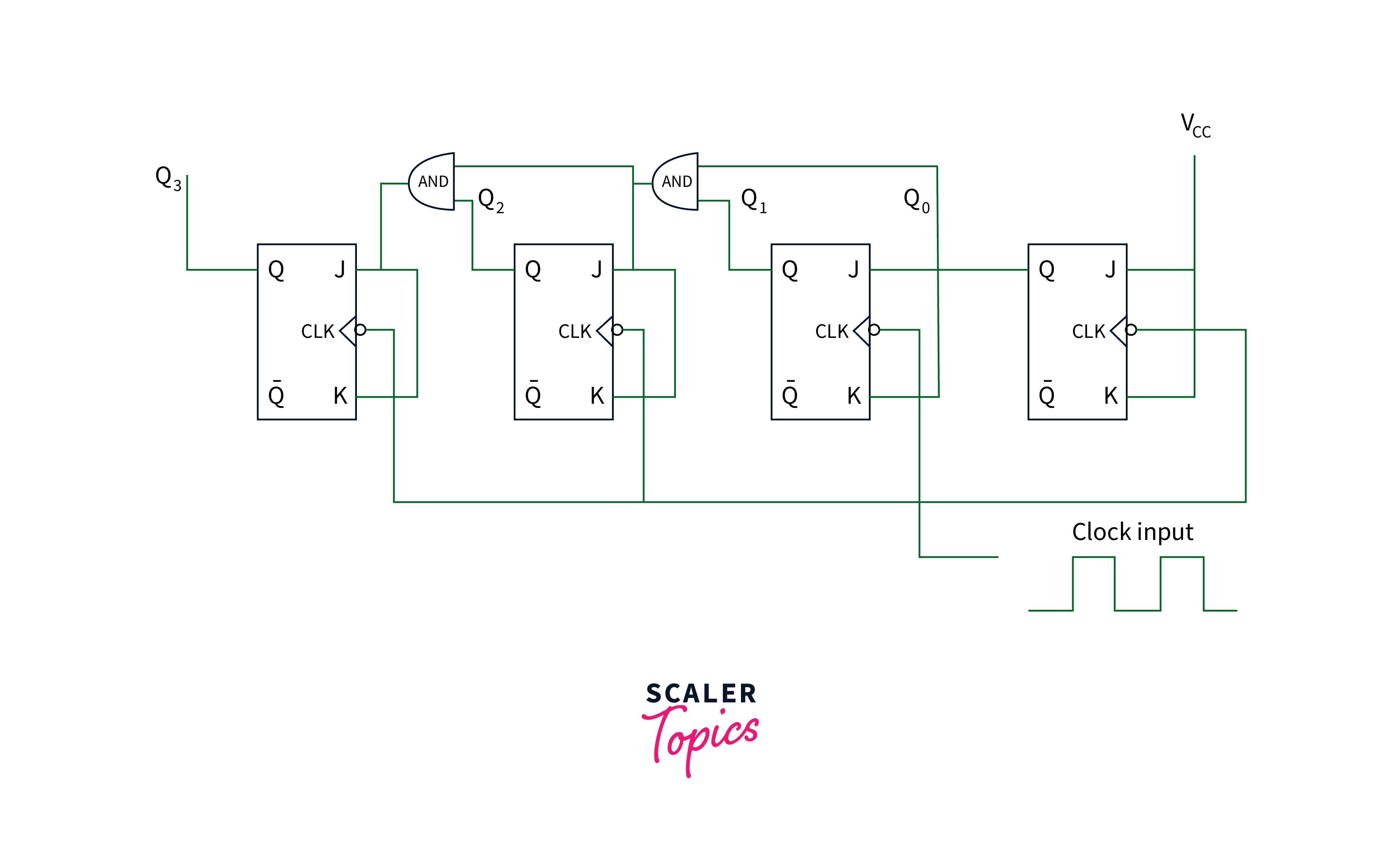
In the above graphical representation, the flip-flops are once again represented by rectangles. All flip-flops are driven by the same clock signal, making their transitions synchronous. Synchronous counters offer advantages in terms of uniform and accurate timing, making them suitable for applications that require precise counting and synchronization.
Difference between Synchronous and Asynchronous Counters
Let's compare these two types of counters in a tabular format to better understand their differences:
| Aspect | Asynchronous Counter | Synchronous Counter |
|---|---|---|
| Clocking | Each flip-flop is triggered by the output of the previous flip-flop, creating a ripple effect. | All flip-flops are triggered simultaneously by the same clock signal. |
| Timing Accuracy | Generally lower timing accuracy due to the propagation delay in the ripple effect. | Offers higher timing accuracy as all flip-flops transition simultaneously. |
| Propagation Delay | The ripple effect causes propagation delays, impacting the overall speed. | Minimal propagation delay, leading to faster operation. |
| Complexity | Less complex to design and implement. | Relatively more complex due to synchronization and logic gate usage. |
| Usage | Suitable for applications where timing accuracy is not critical. | Ideal for applications requiring precise counting and synchronization. |
| Speed | Slower operation compared to synchronous counters. | Faster operation due to reduced propagation delays. |
| Circuitry | Requires fewer logic gates and connections. | Involves more logic gates and interconnections. |
| Design Flexibility | Limited design flexibility due to ripple effect. | More design flexibility as all flip-flops are synchronized. |
| Applications | Used in applications where timing variations are permissible, like simple digital clocks. | Used in applications requiring precise timing, such as synchronous data transmission. |
FAQs
Q. What is the primary difference between asynchronous and synchronous counters?
A. The main difference lies in how the flip-flops are clocked. Asynchronous counters trigger flip-flops sequentially based on the output of the previous flip-flop, creating a ripple effect. Synchronous counters clock all flip-flops simultaneously using the same clock signal.
Q. Which counter type is more suitable for applications requiring accurate timing?
A. Synchronous counters are better suited for applications that demand precise timing and synchronization due to their simultaneous clocking and minimal propagation delays.
Q. Can asynchronous counters achieve high-speed operation?
A. Asynchronous counters tend to operate slower than synchronous counters due to the propagation delays introduced by the ripple effect.
Conclusion
- Synchronous counters operate with simultaneous clocking across all flip-flops, while asynchronous counters initiate a ripple effect, with each flip-flop triggering the subsequent one sequentially.
- Synchronous counters ensure superior timing accuracy through simultaneous transitions, whereas asynchronous counters introduce timing discrepancies due to propagation delays.
- Asynchronous counters encounter propagation delays due to the sequential flip-flop triggering, leading to slower operational speeds.
- Asynchronous counters boast simpler design and implementation, whereas synchronous counters demand increased complexity due to synchronization requirements and logic gate integration.
- Asynchronous counters suit applications where precise timing is less crucial, such as basic digital clocks. Synchronous counters excel in scenarios necessitating exact timing, like data transmission.
- Synchronous counters offer heightened speed by minimizing propagation delays, whereas asynchronous counters operate slower due to the ripple effect.
- Asynchronous counters involve fewer logic gates and connections, resulting in straightforward designs. Conversely, synchronous counters require more intricate circuitry.
- Synchronous counters provide enhanced design flexibility with synchronized flip-flops, while asynchronous counters offer limited flexibility.
- Asynchronous counters are apt for simpler applications, whereas synchronous counters shine in tasks requiring precise timing synchronization.
- Choosing between counter types depends on specific application requirements, involving trade-offs in timing accuracy, complexity, and operational speed.