


Fibonacci Series in C++
 FREE
FREE
Build an AI-First Career, Master the Complete Skillset
Choose from our industry-leading programs designed for career success
Modern Software and AI Engineering Program
Master full-stack development with AI integration


 +1000 more
Modern Data Science and ML with specialisation in AI
Advanced data science techniques with AI specialization
+1000 moreAdvanced AIML with Specialisation in Agentic AI
Deep dive into AIML with focus on Agentic systems
+1000 moreDevOps, Cloud & AI Platform Engineering
Build and manage AI-powered cloud infrastructure
+1000 moreAI Engineering Advanced Certification by IIT-Roorkee
Premier AI engineering certification from IIT-Roorkee

AI Forward Deployed Engineer Program
Full-stack engineering, production AI and client-facing consulting
+1000 moreOverview
Fibonacci series is a type of definite pattern that begins with 0,1 or 1,1.
Example of Fibonacci series: 0, 1, 1, 2, 3, 5, 8, 13, 21 , 34 . . . . . .
The pattern in Fibonacci Series is generated by adding the previous two consecutive terms to form a number. For Example, the first term 0 and the second term 1 when added from the third number, which is 1. Whereas the second number 1 and third number 1 when added from the fourth number which is 2 and so on.
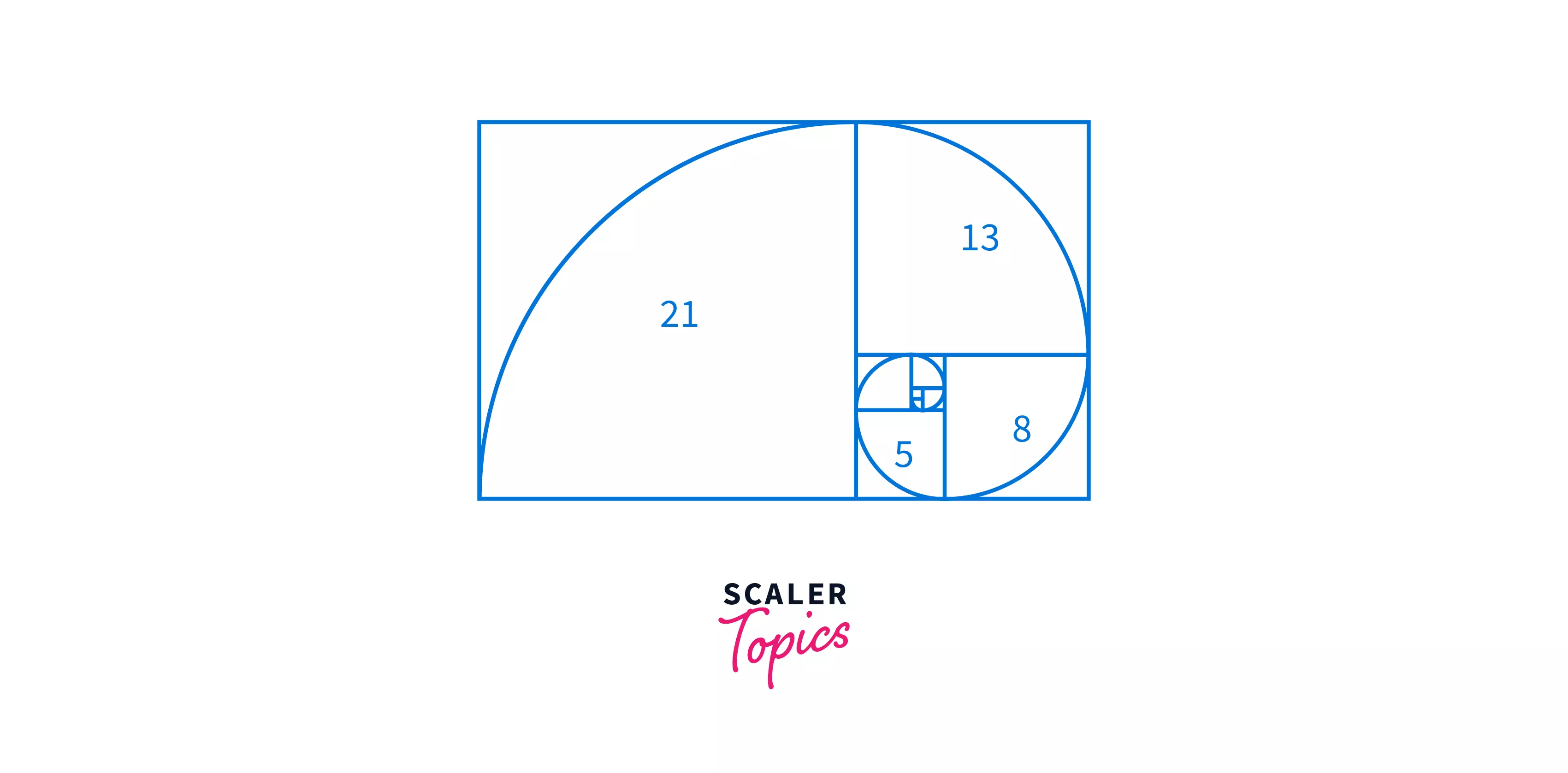
Fibonacci Series in C++
Let us Consider the following Fibonacci Series.
0, 1, 1, 2, 3, 5, 8, 13, 21, 34, 55, 89, 144, ……..
In mathematical terms, the sequence Fn of a Fibonacci series is defined by a recursive relation.
Recursive Relation:
where, and are the predefined value
Now, let us seed value into this formula. Considering n=2 we get
So, let us consider the following question to understand further.
Question:
Given a number n, print the Fibonacci Number as the output.
PseudoCode:
Output:
How Scaler Transformed Careers in Different Fields
Scaler learners achieved 2.5x salary growth with average post-Scaler CTC reaching ₹23L.
 Google
 Amazon
 Microsoft
 Flipkart
 Adobe1200+ more
Ways to Write the Fibonacci Series Program in C++
There are two popular ways of implementing the Fibonacci series in C++.
- Recursive Implementation
- Iterative Implementation
Starting with Recursive implementation.
Code:
Output
Time Complexity: O(2^n)
Auxiliary Space Complexity: O(n) due to the recursion stack.
But all the calculation for the series was done under the hood.
Let us build a recursive tree to understand how the calculation is being done.
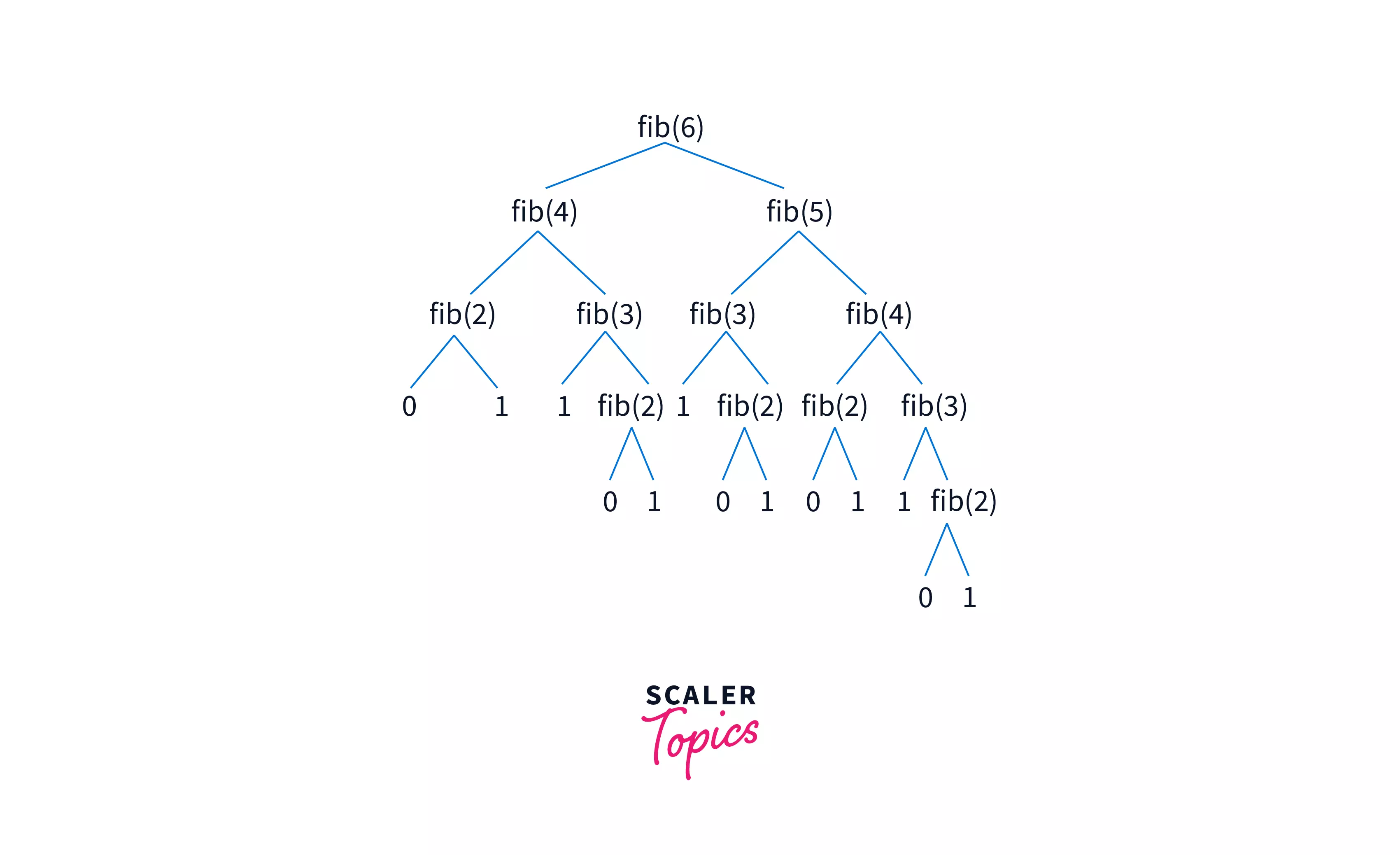
Next, we have Iterative Implementation.
Code:
Output:
Time Complexity: O(n), which is linear.
Space Complexity: O(1), which is constant.
Conclusion
We have discussed 2 popular methods to print the Nth Fibonacci number in C++. Now, it is totally up to you which method you find more suitable for the given problem statement.
If the space complexity does not matter then you can use the recursive approach, else you need to use the more efficient iterative approach.
Unlock the power of Dynamic Programming and take your coding skills to the next level – Enroll in Scaler Topics Dynamic Programming Course now!




