Gemini 4 Carbon vs GPT-6 Astra vs Claude Opus 5.5: Does Gemini Actually Win?
Short answer: on paper, barely. Gemini 4 Carbon is #1 on the Artificial Analysis Intelligence Index v5.0 with a 59. Claude Opus 5.5 scores 58 and GPT-6 Astra 57. A one-point gap is a photo finish, not a landslide. And most of us can’t use Carbon yet.
Google dropped Carbon on 28 October 2026, two weeks after Argon. The post ended with “hang tight!”, which is a bold way to describe a release date nobody has.
So here’s the longer version. What Google shipped, how it stacks up against GPT-6 Astra and Opus 5.5, where Gemini really does win, where it doesn’t, and what each one costs when the bill shows up.
What did Google actually launch with Gemini 4 Carbon?
The Gemini 4 Carbon launch post calls it Google’s strongest model, with “state-of-the-art cybersecurity and long horizon capabilities”. The short version:
• Date: 28 October 2026, about two weeks after Gemini 4 Argon.
• Rollout: some trusted cyber defenders get access first. More partners follow through the Fairwind Program. Wider availability comes “as soon as possible”, with no date.
• Price: $2 per million input tokens and $10 per million output tokens at launch, then $4 and $20. Cached input is 95% off.
• Safety: Google says Carbon goes through the US government’s voluntary pre-release testing, and reports 0.0% attack success on the Gray Swan prompt injection benchmark.
Notice the order. Cyber defenders first, everyone else later. That choice shapes the whole comparison, and I’ll come back to it.
Gemini 4 Carbon vs GPT-6 Astra vs Claude Opus 5.5: the scoreboard
The numbers below come from Artificial Analysis’s pages for Gemini 4 Carbon, Claude Opus 5.5, GPT-6 Astra and Gemini 4 Argon, checked on 29 Oct 2026.
| Model | Intelligence Index v5.0 | List price per 1M tokens (input / output) |
|---|---|---|
| Gemini 4 Carbon (High) | 59, #1 of 52 | $4 / $20 (launch price $2 / $10) |
| Claude Opus 5.5 (max) | 58, #2 of 52 | $4 / $20 |
| GPT-6 Astra (max) | 57, #3 of 51 | $10 / $50 |
| Gemini 4 Argon | 50, #13 of 52 | $4 / $20 |
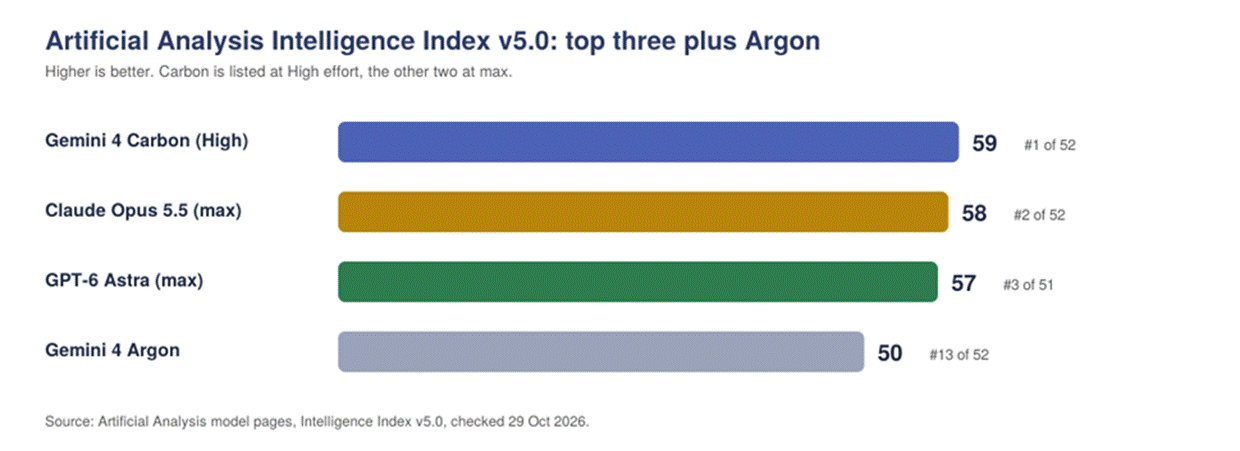
Chart: original, built from Artificial Analysis data. Source: Artificial Analysis, checked 29 Oct 2026.
A few things worth knowing about that 59:
• It’s a close race. The page I read lists no margin of error, so I’d call 59 vs 58 vs 57 a three-way tie with a seating chart.
• It’s a broad exam. v5.0 splits the score into four equal blocks: knowledge work, coding, science and general knowledge. It’s not your workload.
• It’s a big jump from Argon. Argon scores 50. Nine points above a model Google shipped weeks earlier is the real headline.
Build an AI-First Career, Master the Complete Skillset
Choose from our industry-leading programs designed for career success
Modern Software and AI Engineering Program
Master full-stack development with AI integration


 +1000 more
Modern Data Science and ML with specialisation in AI
Advanced data science techniques with AI specialization
+1000 moreAdvanced AIML with Specialisation in Agentic AI
Deep dive into AIML with focus on Agentic systems
+1000 moreDevOps, Cloud & AI Platform Engineering
Build and manage AI-powered cloud infrastructure
+1000 moreAI Engineering Advanced Certification by IIT-Roorkee
Premier AI engineering certification from IIT-Roorkee

AI Forward Deployed Engineer Program
Full-stack engineering, production AI and client-facing consulting
+1000 moreWhere does Gemini 4 Carbon actually win?
Quite a few places, to be fair. Google didn’t invent a lead out of nothing.
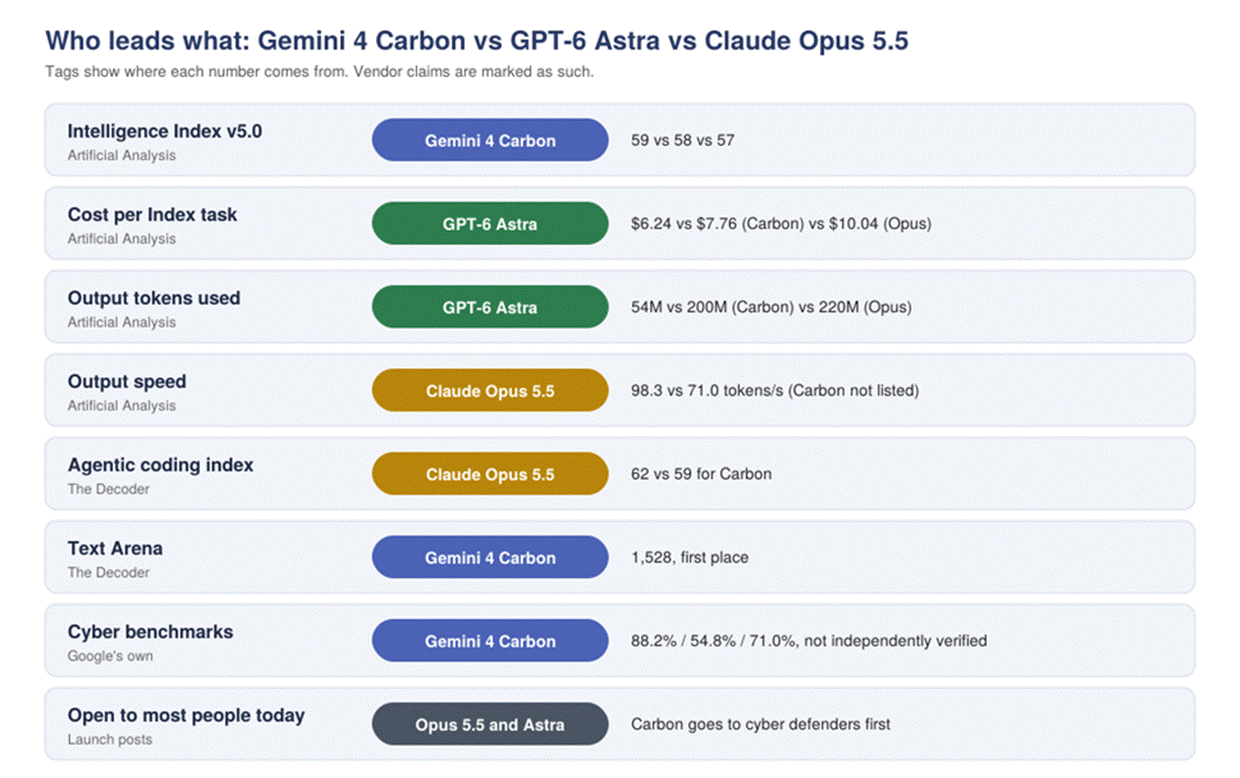
• The overall index. Carbon is first. According to The Decoder’s breakdown, it leads four of the nine evaluations inside it.
• Text Arena. It sits first at 1,528, per The Decoder.
• Cost per agent task. In Arena’s agent tests, Carbon’s median task cost is $1.80. That’s 72% below Opus 5.5 at max effort.
• Prompt injection. 0.0% attack success, down from Argon’s 0.7%. The Decoder points out that test looks close to saturated, so zero doesn’t mean unbreakable.
The cyber numbers deserve their own box.
Google reports 88.2% on SEC-bench Pro (finding vulnerabilities), 54.8% on ExploitGym (exploitation) and 71.0% on CWE-bench (patching). It also says secure-code success is more than double Argon’s.
Big caveat: these are Google’s own results, some run without guardrails, and nobody outside has checked them yet. Impressive. Also, grading your own homework is a tradition.
Where does it fall short?
This is the part the launch post skips. Fair enough, it’s a launch post.
• Agentic coding. Per The Decoder, Opus 5.5 scores 62 on Artificial Analysis’s coding agent index against Carbon’s 59. In Agent Arena, Opus 5.5 leads at +21.1%, with Carbon second at +16.2% and GPT-6 Astra at +13.4%.
• Hallucinations. On AA-Omniscience, The Decoder reports Carbon’s hallucination rate at 11%, up from Argon’s 4%. Accuracy rose to 58%, against 50% for Opus 5.5 and Astra. So: more right, and more confidently wrong. Classic.
• Talkativeness. Carbon used 200M output tokens to finish the index. Astra used 54M. The median model uses 64M. That’s a lot of thinking out loud.
• Speed on some jobs. The Decoder says finance and tax agent tasks take more than twice as long as on Argon, and legal research averages over 50 minutes a task.
• Web dev. WebDev Arena has it fourth, around 1,769. Fourth isn’t shabby. It’s just not first.
And then there’s the biggest one. You probably can’t use it.
What does each model cost per task, not just per token?
Sticker price and actual bill are two different things. Here’s the per-token list price, from the table above:
• Carbon and Opus 5.5: $4 input, $20 output per million tokens.
• GPT-6 Astra: $10 input, $50 output. 2.5 times the others.
Now the bill for finishing the same index, according to Artificial Analysis:
| Model | Cost per Index task | Output tokens used |
|---|---|---|
| GPT-6 Astra (max) | $6.24 | 54M |
| Gemini 4 Argon | $7.68 | 110M |
| Gemini 4 Carbon (High) | $7.76 | 200M |
| Claude Opus 5.5 (max) | $10.04 | 220M |
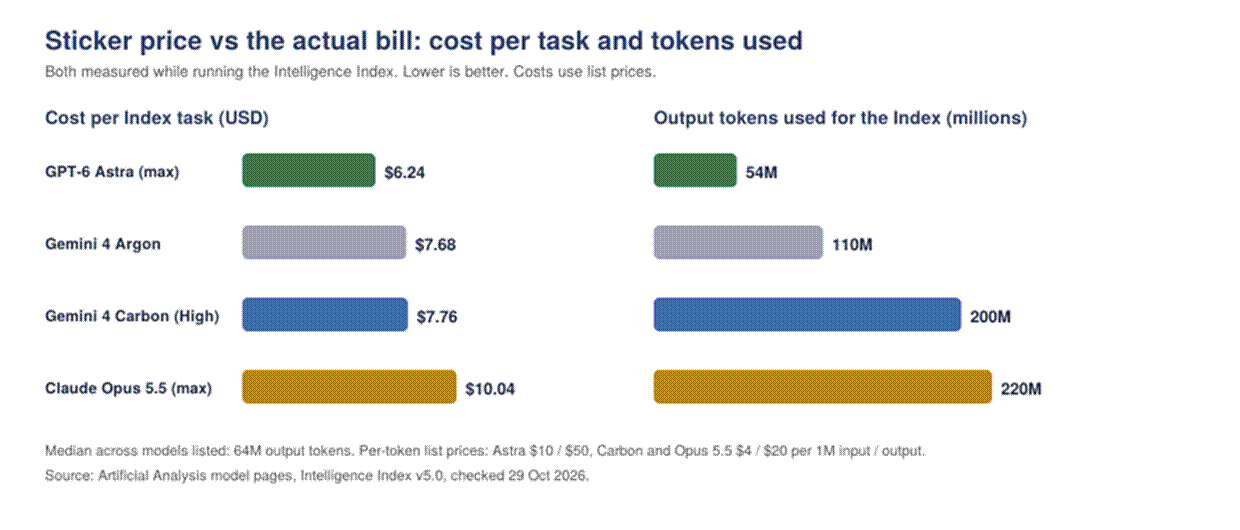
Chart: original, built from Artificial Analysis data. Source: Artificial Analysis, checked 29 Oct 2026.
The punchline: Astra has the highest price per token and the lowest price per task. It simply says less. Efficiency beats a discount.
One footnote on Carbon. The Decoder notes that Artificial Analysis uses list prices and ignores the introductory discount. While the launch rate lasts, Carbon’s real per-task cost should come in lower than $7.76. Outlets disagree on when that rate ends, so check Google’s pricing page before you budget.
Can you actually use Gemini 4 Carbon today?
Not really. Google’s plan has three stages:
1. Now: a subset of cyber defenders.
2. Next: more trusted partners through the Fairwind Program.
3. Later: developers, businesses and consumers, once Google has feedback and has tuned the guardrails.
Fairwind launched on 2 September 2026 as a limited-access program for governments and trusted partners. Google reports more than 650 partners. Participants agree to operating standards, including keeping use inside internal security teams and turning on multi-factor authentication.
Compare that with the others. Per Vellum’s GPT-6 Astra breakdown, Astra rolled out to paid ChatGPT plans, the API and AWS, with its cyber tools held back behind OpenAI’s Daybreak program. AI Weekly’s Claude Opus 5.5 report says Opus 5.5 launched on the API, including Amazon Bedrock, with cyber safeguards similar to Fable 5.1’s.
So all three labs now gate their strongest cyber capabilities. The difference is that Carbon’s whole launch is gated. Winning a leaderboard you can’t log into is a strange flex.
Which model should you pick?
Depends what you’re doing. Here’s where I’d lean, with the usual disclaimer that benchmarks are not your codebase.
• Agentic coding: Opus 5.5 has the edge on the coding agent index and in Agent Arena, per The Decoder.
• Lowest bill per finished task: GPT-6 Astra, on Artificial Analysis’s numbers.
• Broad reasoning, security work and multimodal input: Carbon, once you can get in. It takes text, image, speech and video, and has a 1M-token context window.
• You need something today: then Carbon is a moot point. Pick between the other two.
Honest advice? Take twenty of your real tasks and run all three. Ten minutes of your own data beats ten blog posts, including this one.
How Scaler Transformed Careers in Different Fields
Scaler learners achieved 2.5x salary growth with average post-Scaler CTC reaching ₹23L.
 Google
 Amazon
 Microsoft
 Flipkart
 Adobe1200+ more
What should you double-check before quoting these numbers?
Benchmark numbers get quoted fast and checked slowly. A few traps:
• Index versions differ. Vellum quotes Astra at 61.2 on Artificial Analysis Index v4.1.1. The v5.0 page gives it 57. Same model, different yardstick.
• Effort settings differ. Carbon is listed at High. Astra and Opus 5.5 are at max.
• Vendor numbers are vendor numbers. The cyber results come from Google, and Astra’s reported scores come from OpenAI’s own evals. Treat them as claims until someone else reproduces them.
• Things move quickly. Argon scored 50 only weeks before Carbon posted 59. This article will age. Check the date.
Picking the model is the easy half. If you’re an engineer who wants to be the person who actually ships these models inside a client’s messy stack, with legacy data, PII rules and a stakeholder who wants it Friday, Scaler’s AI Forward Deployed Engineer Program is a 12-month, live, mentor-led program built around a simulated client with legacy data behind a firewall and PII and PCI constraints.
FAQs
Is Gemini 4 Carbon available to everyone?
Not yet. Google is giving it first to a subset of cyber defenders, then to more trusted partners through the Fairwind Program. Wider availability for developers, businesses and consumers is planned “as soon as possible”, with no date. Check Google’s announcements, because that timeline could change quickly.
Turn Learning into Career Growth
Is Gemini 4 Carbon better than GPT-6 Astra?
On the Artificial Analysis Intelligence Index v5.0, yes: 59 against 57. But Astra costs less per task ($6.24 against $7.76) and uses far fewer tokens. Carbon also costs less per token at list price, so which is cheaper depends on how chatty the model is.
Is Claude Opus 5.5 better than Gemini 4 Carbon at coding?
On the coding agent index reported by The Decoder, Opus 5.5 scores 62 and Carbon 59, and Opus leads Agent Arena too. Carbon is first on the overall index, so the answer depends on whether your work looks like agentic coding or general reasoning.
How much does Gemini 4 Carbon cost?
At launch, $2 per million input tokens and $10 per million output tokens, with cached input 95% off. After the introductory period, $4 and $20. Artificial Analysis uses the higher list price. Check Google’s pricing page before budgeting, since the end date for the intro rate is reported inconsistently.
What is the Fairwind Program?
Google’s limited-access program for governments and trusted partners, launched on 2 September 2026. It gives vetted organizations early use of advanced cyber defense models. Participants agree to operating standards, such as limiting use to internal security teams and using multi-factor authentication. Google reports more than 650 partners.
What is the Artificial Analysis Intelligence Index?
It’s a composite score from Artificial Analysis. Version 5.0 averages four equal blocks: knowledge work, coding, science and general knowledge. Scores are not comparable across versions, and some tests changed between versions, so always note which version a number comes from.