Generative AI in Software Testing: Use Cases, Tools, Benefits & Limits
Generative AI in software testing means using large language models and generative tools to produce and maintain testing artefacts, test cases, test data, automation scripts, bug summaries, from plain-language inputs like requirements or code, instead of writing every single one by hand. Think of it as an assistant that drafts the tedious parts of QA, not an autopilot that replaces the tester. This page covers the real use cases, the tools, the genuine benefits, and, the part most vendor pages conveniently skip, the honest limits. For the wider context of where this fits, how AI is changing software development is worth a read alongside this one.
Why Is Generative AI a Big Deal for QA Teams?
Testing has always been the bottleneck nobody wants to admit is the bottleneck. Too many cases to write, test data that's genuinely painful to fabricate by hand, automation scripts that quietly break every release cycle. GenAI targets exactly those pain points, and it's a meaningful shift, not a revolution, worth saying plainly since adoption across QA teams is still early and pretty uneven company to company. Some teams have this baked into their pipeline. Others are still arguing about whether it's allowed to touch the code at all. If you're mapping where this sits in a broader QA career, the modern software testing roadmap covers the manual-to-automation-to-AI-assisted progression in full.
Where Is Generative AI Actually Used in Software Testing?
This is the section most of you actually came here for. Real use cases, one honest caveat each, no exceptions.
Test-Case Generation From Requirements
Turn a user story or spec into a first draft of test cases, happy path plus obvious edge cases, in seconds instead of an afternoon. The honest caveat: it misses domain-specific edge cases a human tester who's actually used the product would catch immediately. It knows the pattern, not your users.
Test Data Generation
Synthetic, realistic, edge-case-rich data on demand, genuinely useful when you can't touch real production data for privacy reasons. Caveat: check the generated data for unrealistic patterns or quiet bias, an AI's idea of "realistic" customer names and addresses skews in predictable, occasionally embarrassing directions.
Unit and UI/E2E Test Script Generation
Draft unit tests straight from a function, or Selenium, Playwright, or Cypress scripts from a plain description of a user flow. Caveat: generated selectors and assertions need review, always. A script that runs without erroring isn't the same thing as a script that's actually testing the right behaviour.
Build an AI-First Career, Master the Complete Skillset
Choose from our industry-leading programs designed for career success
Modern Software and AI Engineering Program
Master full-stack development with AI integration


 +1000 more
Modern Data Science and ML with specialisation in AI
Advanced data science techniques with AI specialization
+1000 moreAdvanced AIML with Specialisation in Agentic AI
Deep dive into AIML with focus on Agentic systems
+1000 moreDevOps, Cloud & AI Platform Engineering
Build and manage AI-powered cloud infrastructure
+1000 moreAI Engineering Advanced Certification by IIT-Roorkee
Premier AI engineering certification from IIT-Roorkee

AI Forward Deployed Engineer Program
Full-stack engineering, production AI and client-facing consulting
+1000 moreSelf-Healing Tests
AI updates locators and selectors automatically when the UI shifts, which cuts a huge chunk of the maintenance burden that quietly kills most automation suites over time. Caveat, and this one matters: self-healing can mask a genuine regression if it "heals" its way past what was actually a real break. A test that keeps passing isn't always good news.
Bug Triage and Defect Report Summarisation
Cluster duplicate bug reports, summarise long, rambling defect threads, draft clear repro steps from a messy description. Caveat: verify the severity calls yourself, an AI confidently mislabelling a critical bug as minor is a genuinely bad way to find out your triage process has a gap.
AI-Assisted Code Review
Flag risky changes and missing test coverage directly inside a pull request. Caveat: treat it as a second opinion, not a gate. It's a colleague glancing over your shoulder, not the person with final sign-off.
Requirements-to-Tests Traceability
Map requirements to the tests that actually cover them, and surface the coverage gaps nobody noticed because nobody had time to check by hand. This is one of the quieter, less flashy use cases, and also one of the more genuinely useful ones for audit-heavy teams.
Exploratory Testing Assistance
Suggest test ideas, charters, and areas a human tester might not think to probe on their own, useful as a brainstorming partner rather than a replacement for actual exploratory instinct. Testing sits inside a much wider set of applied-AI use cases, and real-world applications of machine learning is worth a look if you want the bigger picture beyond QA specifically.
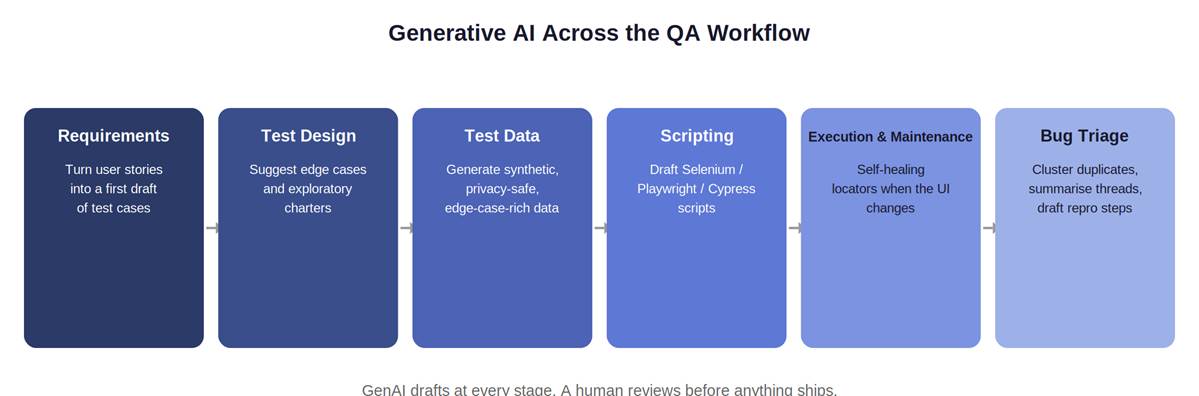
Where generative AI actually plugs into the QA workflow, from requirements to bug triage.
What Tools Bring Generative AI to Testing?
General-Purpose Coding Assistants
GitHub Copilot, ChatGPT, and similar tools get used inside the IDE to draft tests and test data alongside whatever else you're writing that day. The official GitHub Copilot documentation covers current capabilities in detail, worth checking directly since this category updates fast enough that anything written here would be stale within months.
AI-Native Test Automation Platforms
Purpose-built platforms that bake AI into the whole authoring and maintenance loop, not just a coding sidekick. Testim, now part of Tricentis since its 2022 acquisition, uses machine learning for smart locators that automatically recognise and update UI elements. mabl combines low-code test creation with auto-healing and visual anomaly detection, running directly inside CI/CD. Katalon layers AI-driven self-healing locators and natural-language test authoring (via its Studio Assist feature) on top of its existing automation platform. Applitools specialises specifically in visual AI, comparing screenshots the way a human eye would to catch layout and rendering regressions functional tests miss entirely.
| Tool / category | What it helps with | Best for | One honest limitation |
|---|---|---|---|
| GitHub Copilot / ChatGPT | Drafting tests & test data in the IDE | Developers writing unit tests as they code | General-purpose, not testing-specific; needs a reviewing eye |
| Testim (Tricentis) | Self-healing UI locators, test authoring | Teams already on Selenium-style automation | Enterprise pricing, quote-only |
| mabl | Auto-healing, visual checks, CI/CD-native | Teams wanting an all-in-one, low-code platform | Less control than hand-rolled scripts |
| Katalon | Self-healing + natural-language authoring | Mixed technical and non-technical QA teams | Broad scope can mean shallower depth per feature |
| Applitools | Visual AI regression testing | Catching layout and rendering bugs specifically | Doesn't replace functional test coverage |
Worth saying plainly: this is a fast-moving market. Features change, new tools appear, and vendors rebrand what they offer every year or so. Evaluate against your own stack and your own team's actual pain point, not against a list frozen at the moment someone wrote it.
What Are the Benefits of Using Generative AI in Testing?
Real benefits, with the honest "if done well" qualifier attached to every single one of them.
• Speed: faster test authoring, since a first draft in thirty seconds beats a blank file for twenty minutes.
• Broader coverage: edge cases a rushed human tester skips under deadline pressure, because the AI doesn't get tired or bored on the fortieth test case.
• Lower maintenance: self-healing genuinely cuts the flaky-suite upkeep that quietly eats a huge share of QA time every sprint.
• Freed-up time: testers spend less time on rote authoring and more on higher-value exploratory testing and actual quality strategy.
What Are the Limitations and Risks? The Honest Part
This is the section that makes or breaks whether a QA engineer trusts this page. Every benefit above has a shadow side, and pretending otherwise would be dishonest.
Hallucinated or Wrong Tests
AI confidently generates tests that assert the wrong thing, or worse, tests that pass while testing essentially nothing meaningful at all. It writes with total conviction regardless of whether it actually understood the requirement, which is a genuinely unsettling trait once you notice it.
How Scaler Transformed Careers in Different Fields
Scaler learners achieved 2.5x salary growth with average post-Scaler CTC reaching ₹23L.
 Google
 Amazon
 Microsoft
 Flipkart
 Adobe1200+ more
False Confidence and Coverage Illusions
A green suite full of shallow AI-generated tests can hide real gaps behind a comforting wall of checkmarks. More tests is not automatically more safety, and a dashboard that looks healthy can be actively lying to you about what's actually covered.
Flaky and Brittle Output
Generated scripts and selectors break easily and add their own maintenance noise on top of whatever flakiness already existed. Worth knowing the scale of this problem even without AI in the mix: Google's own engineering team found that roughly 1.5 percent of all test runs across their entire corpus come back flaky, and about 84 percent of pass-to-fail transitions they observed involved a flaky test rather than a genuine regression. AI-generated tests don't inherit immunity from this problem. If anything, freshly generated scripts with untested selectors tend to start out flakier, not less.
Data Privacy and Security
Sending proprietary code, unreleased requirements, or real customer data to a third-party model is a genuine governance concern, not a theoretical one. Know exactly what's allowed to leave your infrastructure before a well-meaning engineer pastes a production database schema into a chat window to save five minutes.
Why Human Review Is Non-Negotiable
Every AI-generated artefact needs a human in the loop, full stop, no exceptions carved out for "but this one looked fine." The tester's job shifts from writing everything by hand to reviewing and judging what a machine drafted, which is a different skill, not a lesser one. The advantages and disadvantages of AI covers this trade-off at a broader level if you want the general framing behind this specific, testing-flavoured version of it.
How Do You Adopt Generative AI in a QA Workflow?
Start Small and Low-Risk
Pilot on test-data generation or unit-test drafting first, not your critical regression suite that the whole release depends on. Learn where it actually helps before you bet anything important on it.
Turn Learning into Career Growth
Keep a Human in the Loop
Treat every piece of AI output as a first draft that a tester reviews and owns, the same way you'd treat a junior engineer's first pull request, useful and often good, but not merged without a look.
Measure Whether It Actually Helps
Track review time, escaped defects, and maintenance load before and after adopting a tool, then drop whatever doesn't actually move the needle, regardless of how impressive the vendor demo looked. If you're running AI-assisted tests inside an actual pipeline, how CI/CD pipelines fit automated testing is a useful technical companion. Agree upfront, before you start, exactly what code and data are allowed to go to external tools, this is much easier to decide calmly in advance than to untangle after something's already been pasted somewhere it shouldn't have gone.
What Does Generative AI Mean for Testers' Careers?
Straight talk, no fearmongering and no sugarcoating either. GenAI automates the tedious authoring parts of QA, not the actual judgment the job depends on. The routine "script writer" role genuinely shrinks over the next few years. The tester who can design a real test strategy, evaluate AI output critically instead of rubber-stamping it, and own quality end to end gets considerably more valuable, not less. The skill shift worth actually preparing for: prompt fluency, the discipline of reviewing AI output rather than trusting it by default, and, underneath all of it, deeper testing fundamentals than a tool can substitute for. If you want to get genuinely hands-on with the technology rather than just reading about it, building hands-on generative AI projects is a solid, practical next step.
FAQs
What is generative AI in software testing?
Using large language models and generative tools to produce and maintain testing artefacts, test cases, test data, scripts, bug summaries, from plain-language inputs, instead of writing every one by hand. It's an assistant, not an autopilot.
Can generative AI replace software testers?
No. It drafts artefacts a human still needs to design strategy around and review carefully. The judgment, the domain knowledge, and the accountability for quality still sit with a person, not the model.
What are the main use cases of GenAI in testing?
Test-case generation, test data generation, script generation, self-healing tests, bug triage and summarisation, AI-assisted code review, requirements traceability, and exploratory testing suggestions.
Which tools use generative AI for testing?
GitHub Copilot and ChatGPT for IDE-level drafting, plus AI-native platforms like Testim (now part of Tricentis), mabl, Katalon, and Applitools for visual testing. Always verify current features directly, since this market moves fast.
What are the risks of using AI-generated tests?
Hallucinated tests that assert the wrong thing, false confidence from shallow coverage, flaky and brittle generated output, and data-privacy exposure when proprietary code or data goes to a third-party model. Human review is non-negotiable for all of it.
Is generative AI the same as AI test automation?
Related but not identical. AI test automation is the broader category, including things like smart locators and self-healing. Generative AI specifically refers to using LLMs to produce new artefacts, tests, data, scripts, from a prompt or description.
How do I start using generative AI in QA?
Pilot on something low-risk like test-data generation, keep a human reviewing every output, and measure whether it's actually reducing review time or defects before rolling it out further. Agree on data-privacy boundaries before you start, not after.
Want to move from using AI tools to genuinely understanding how they work? Explore Scaler's guide to the best generative AI courses to learn LLMs, RAG and deployment.