Functions in Go Language
Overview
A function is simply a group of programming statements, When executed together they perform tasks in a step-by-step manner. functions also eliminate repetition of code and make the code reusable making them clean and ordered.
Introduction
Functions are a group of programming statements. Functions provide us with the concept of reusability which promotes code reusability, Reducing the usage of memory and development time. The function allows you to extract a commonly used block of code into a single component.
In Golang, Every code execution starts with the main() function which acts as an entry point for the execution flow.
Build an AI-First Career, Master the Complete Skillset
Choose from our industry-leading programs designed for career success
Modern Software and AI Engineering Program
Master full-stack development with AI integration


 +1000 more
Modern Data Science and ML with specialisation in AI
Advanced data science techniques with AI specialization
+1000 moreAdvanced AIML with Specialisation in Agentic AI
Deep dive into AIML with focus on Agentic systems
+1000 moreDevOps, Cloud & AI Platform Engineering
Build and manage AI-powered cloud infrastructure
+1000 moreAI Engineering Advanced Certification by IIT-Roorkee
Premier AI engineering certification from IIT-Roorkee

AI Forward Deployed Engineer Program
Full-stack engineering, production AI and client-facing consulting
+1000 moreSyntax
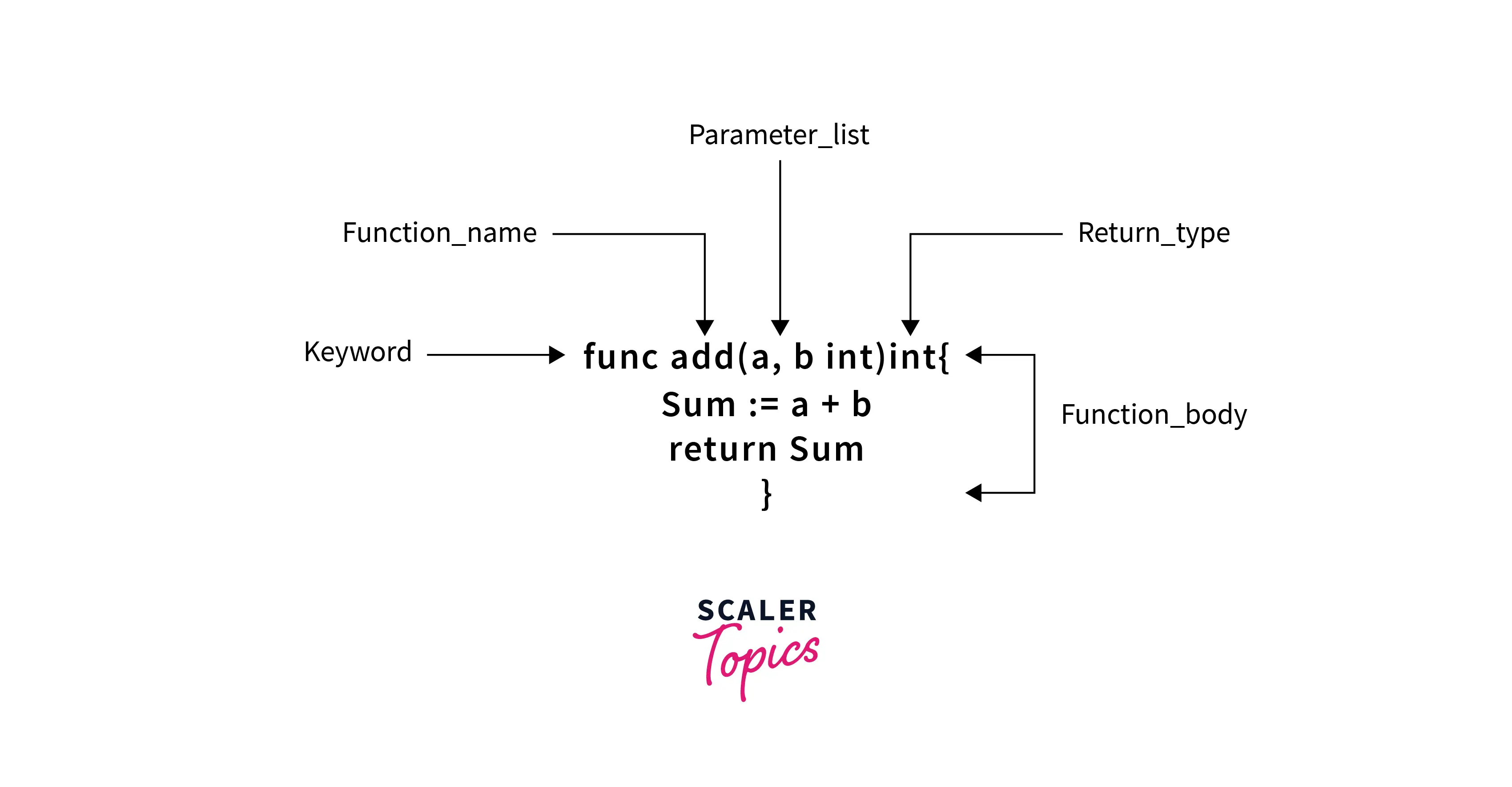
Function Declaration
The declaration of the function contains
- func: It is a keyword in the language, which is used to create a Golang function.
- function_name: It is the name of the function.
- Parameter-list: It contains the name and the type of the function inputs.
- Return_type: Returns types are optional in Golang. It contains details about what will a function return if we add a return type to our function, It is mandatory to pass a return value in our function.
Function Calling
Golang Function can be called in a below way.
Example
We will create an example of simple addition. A function add is created with the func keyword before it. the func keyword tells Go that this piece of code is a function. Later we invoked the function in the main() using its name.
Output:
Function Arguments
How Scaler Transformed Careers in Different Fields
Scaler learners achieved 2.5x salary growth with average post-Scaler CTC reaching ₹23L.
 Google
 Amazon
 Microsoft
 Flipkart
 Adobe1200+ more
Call by Value
When we pass values of variables to a function as parameters, those functions are known as Call By Value. Changes made to the function variable won't update the original variables as we pass copies of those.
Output:
Call by Reference
While Calling a function, If we pass the address of a variable instead of a value, Those functions are known as Call by Reference. Changes made to function variables update the original variables as we are passing the addresses of those.
Output:
More Examples
Let's see more examples of the Golang function.
Turn Learning into Career Growth
Golang Functions Returning Multiple Values
Output:
The Return Values of a Function can be Named in Golang
Output:
Golang Passing Address to a Function
Output:
Anonymous Functions in Golang
Output:
Conclusion
- Understood the concept of functions and studied the syntax and declaration of functions.
- Created a vast number of function examples.
- understood the concept of call by value and call by reference with examples.