


Image Inpainting in OpenCV
Overview
OpenCV is an open-source library for computer vision and image processing, with over 2500 optimized algorithms for various tasks such as object recognition, image enhancement, and feature detection. One important feature of OpenCV is its ability to perform image inpainting, which involves filling in missing or damaged parts of an image. Image inpainting has numerous applications in areas such as image restoration, object removal, and content-aware image resizing.
Introduction
Image inpainting is a technique used to remove unwanted objects or fill in missing areas in an image. OpenCV is a popular open-source computer vision library that provides various functions for image processing, including inpainting.
To perform image inpainting in OpenCV, you can use the paint function. This function takes in the image to be inpainted, a mask specifying the areas to be inpainted, and the inpainting algorithm to use. The supported inpainting algorithms are INPAINT_NS and INPAINT_TELEA.
Types of Image Inpainting
Image inpainting is a technique used to remove unwanted objects or fill in missing areas in an image. There are several types of image inpainting algorithms.
Exemplar Based Image Inpainting
Exemplar-based image inpainting, also known as texture synthesis, is a technique that fills in missing areas of an image by copying and pasting pixels from similar areas in the image. This technique is based on the observation that images have inherent self-similarity and that similar textures and patterns appear throughout an image.
The algorithm begins by identifying a target region to be filled and searching for a similar pattern or texture in the surrounding area, which is referred to as the source region. The algorithm then uses this information to fill in the missing pixels in the target region by blending the pixels from the source region with the pixels in the target region. This process is repeated until the target region is filled.
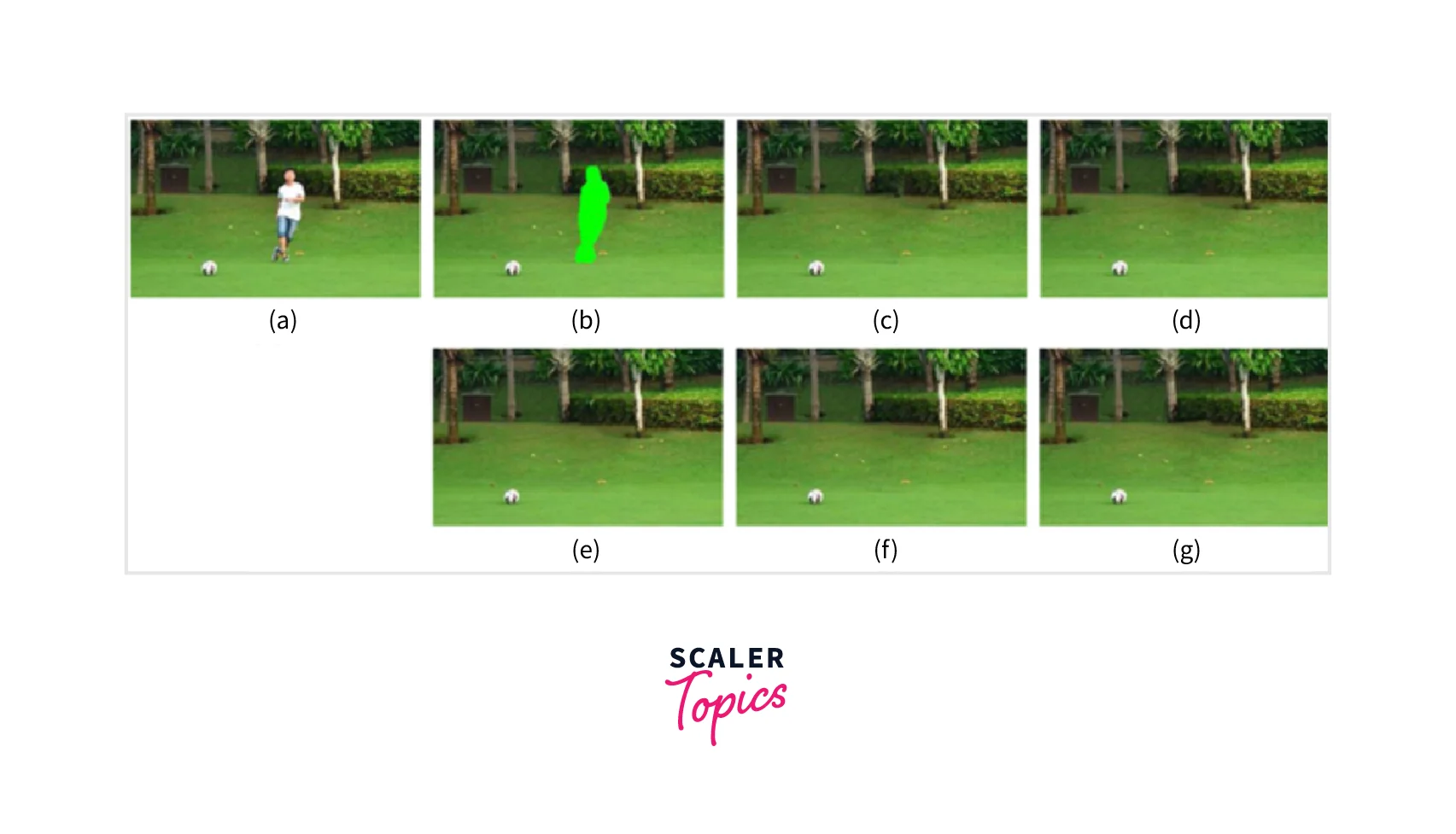
Exemplar-based image inpainting is particularly useful for filling in small holes or gaps in an image, such as scratches or small blemishes, but it may struggle with filling in larger or more complex missing areas.
Diffusion-Based Image Inpainting
Diffusion-based image inpainting, also known as partial differential equations (PDEs) based inpainting, is a technique that uses PDEs to fill in missing areas in an image. This technique is based on the idea that an image can be modeled as a two-dimensional surface, and the missing pixels can be filled in by modeling the diffusion of the image surface over time.
The algorithm begins by defining a partial differential equation that models the diffusion of the image surface. This equation is then solved numerically to fill in the missing pixels in the image. The algorithm can be tuned to prioritize different aspects of the image, such as texture, color, or edges, and can be used to fill in missing areas of any size or complexity.
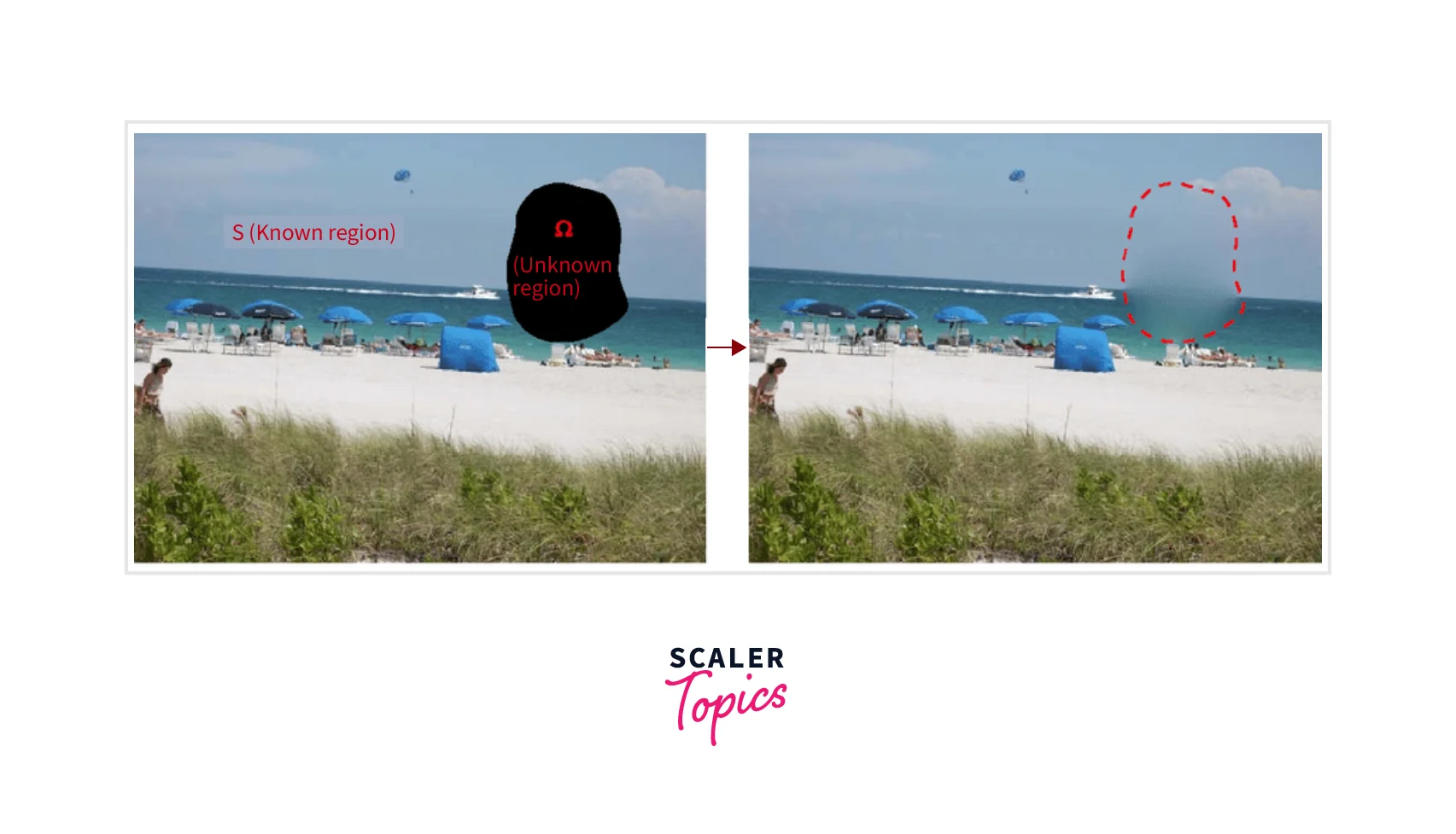 Diffusion-based image inpainting is particularly useful for filling in large missing areas in an image, such as removing large objects from an image or reconstructing damaged or degraded images, but it may be computationally expensive and requires careful tuning to achieve optimal results.
PDE Based Image Inpainting
PDE-based image inpainting is a variant of diffusion-based image inpainting that uses PDEs to propagate the smoothness of the image into the missing areas.
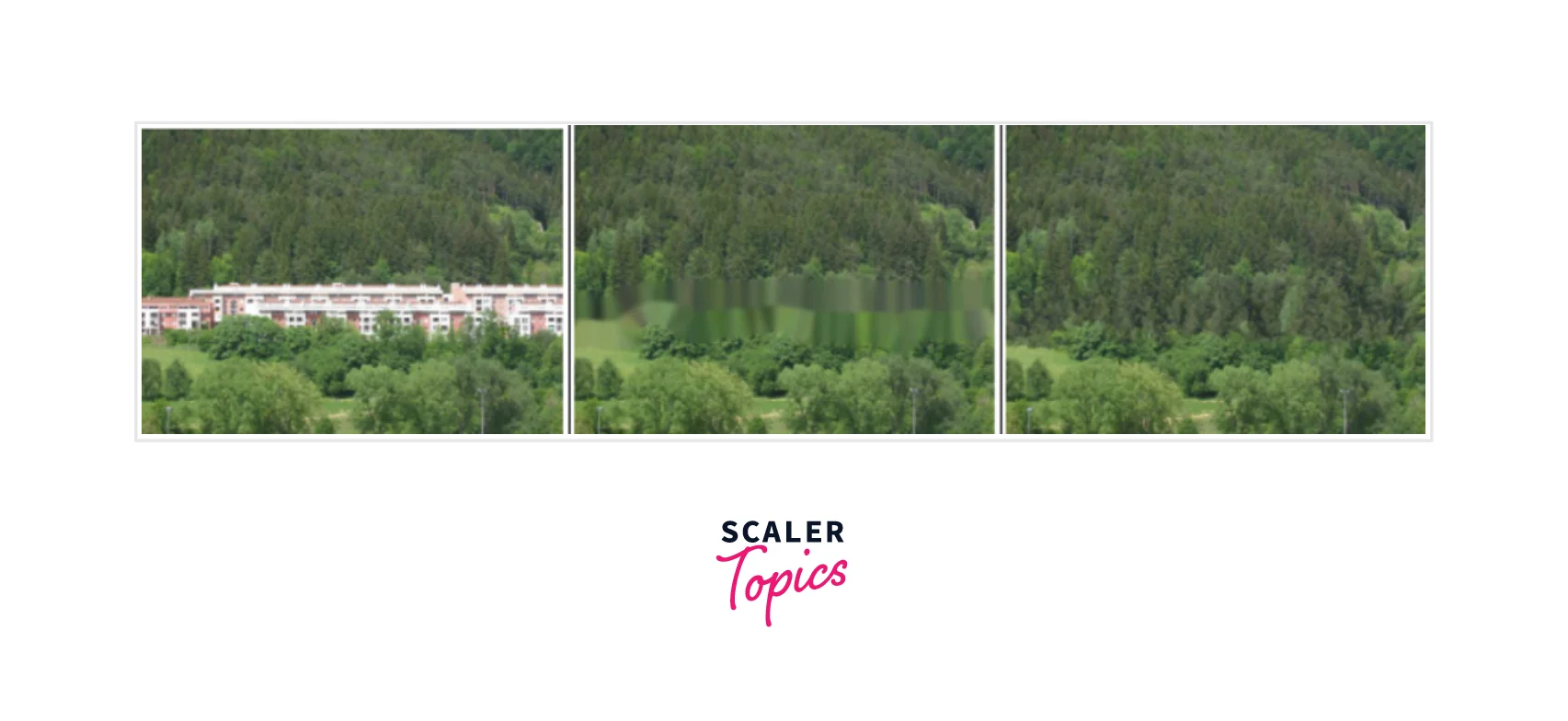
The algorithm includes a term that models the smoothness of the image and a term that models the data fidelity or the similarity between the image and its surroundings. The algorithm can be used to fill in missing areas of any size or complexity and can be tuned to prioritize different aspects of the image. It is particularly useful for filling in large missing areas in an image, but it can be computationally expensive and may require careful tuning to achieve optimal results.
Image Inpainting Techniques in OpenCV
OpenCV is an open-source computer vision library that provides several image inpainting techniques, including Navier-Stokes-based inpainting, fast marching-based inpainting, and Telea's algorithm-based inpainting.
Navier-Stokes Based Image Inpainting
Navier-Stokes-based image inpainting is a technique that uses the Navier-Stokes equations to model the flow of fluid in an image. The algorithm begins by identifying the missing areas in the image and using the Navier-Stokes equations to simulate the flow of fluid from the surrounding areas into the missing areas. This technique is particularly useful for filling in large missing areas in an image, such as removing large objects or reconstructing degraded images.
Fast Marching-Based Image Inpainting
Fast marching-based image inpainting is a technique that uses the fast marching method to fill in missing areas in an image. The algorithm begins by identifying the missing areas in the image and using the fast marching method to determine the order in which the missing areas should be filled in. This technique is particularly useful for filling in small missing areas in an image, such as scratches or small blemishes.
Telea's Algorithm Based Image Inpainting
Telea's algorithm-based image inpainting is a technique that uses an iterative approach to fill in missing areas in an image. The algorithm begins by identifying the missing areas in the image and using a weighted average of the surrounding pixels to fill in the missing areas. The algorithm then iteratively refines the filling by considering the error between the original image and the filled image. This technique is particularly useful for filling in missing areas of any size or complexity, and it is widely used in various computer vision applications.
Algorithms For Image Inpainting
Image inpainting is a process of filling in missing or damaged parts of an image. There are different algorithms available for image inpainting, including standard algorithms and machine learning-based algorithms.
Standard Algorithms
Standard algorithms for image inpainting are based on mathematical models and include techniques like fast marching, exemplar-based inpainting, and partial differential equations-based inpainting. These algorithms use various techniques such as diffusion, interpolation, and optimization to fill in the missing parts of an image. Fast marching-based inpainting is a popular standard algorithm used for filling small areas, while exemplar-based inpainting is commonly used for large missing regions of an image.
Machine Learning Based Algorithms
Machine learning-based algorithms for image inpainting use deep neural networks to learn the patterns of image features and fill in missing or damaged parts of an image. These algorithms can be trained using large datasets of images and can automatically learn the relationships between the missing pixels and the surrounding context. One of the popular deep learning-based algorithms for image inpainting is the Generative Adversarial Networks (GANs) which use a generator network to generate the inpainted image and a discriminator network to evaluate the quality of the generated image.
Machine learning-based algorithms have shown great performance and have become increasingly popular in recent years due to their ability to produce highly realistic and natural-looking results. However, they require a large amount of training data and significant computational resources for training and inference.
Implementation of Image Inpainting in OpenCV
Overview of the OpenCV Library
The OpenCV library provides several image inpainting functions, including:
- Navier-Stokes based inpainting: This function uses the Navier-Stokes equation to fill in the missing or damaged parts of an image.
- Telea's algorithm-based inpainting: This function uses an algorithm developed by Alexandru Telea that fills in missing parts of an image based on the surrounding pixel values.
- Fast marching-based inpainting: This function uses the fast marching algorithm to fill in missing or damaged parts of an image.
- Exemplar-based inpainting: This function fills in the missing parts of an image by searching for similar patches in the surrounding area.
- Patch-based image inpainting: This function fills in the missing parts of an image by copying patches from the surrounding area and using them to fill in the missing regions.
These functions can be used individually or in combination to achieve the desired image inpainting results. OpenCV also provides several other image-processing functions that can be used in conjunction with image inpainting, including filtering, edge detection, and color correction.
OpenCV supports various programming languages, including C++, Python, Java, and MATLAB. It also supports multiple platforms, including Windows, Linux, and macOS. The library is constantly evolving, with new functions and features being added regularly.
Overall, OpenCV is a powerful and versatile library for implementing image inpainting and other image-processing tasks. Its broad range of functions and cross-platform support make it a popular choice for computer vision and machine learning applications.
Detailed Explanation of the Image Inpainting Functions in OpenCV
cv2.inpaint(): The cv2.inpaint() function in OpenCV is a basic function that performs image inpainting based on the specified algorithm. The function takes four input arguments, including the input image, the mask image that specifies the region to be inpainted, the inpainting algorithm to be used, and a parameter that specifies the inpainting radius. This function is a straightforward implementation of the Navier-Stokes equation-based inpainting algorithm.
cv2.inpaintModes: The cv2.inpaintModes function in OpenCV is a function that returns a list of supported inpainting algorithms. The available algorithms include Navier-Stokes based, telea based, and fast marching-based algorithms.
cv2.inpaintTelea(): The cv2.inpaintTelea() function in OpenCV is an implementation of Telea's algorithm-based image inpainting. This function takes three input arguments, including the input image, the mask image that specifies the region to be inpainted, and the inpainting radius.
cv2.inpaintNS(): The cv2.inpaintNS() function in OpenCV is an implementation of the Navier-Stokes-based image inpainting algorithm. This function takes three input arguments, including the input image, the mask image that specifies the region to be inpainted, and the inpainting radius.
cv2.inpaintFMM(): The cv2.inpaintFMM() function in OpenCV is an implementation of the fast marching-based image inpainting algorithm. This function takes three input arguments, including the input image, the mask image that specifies the region to be inpainted, and the inpainting radius.
Applications of Image Inpainting
Image inpainting is a powerful tool that can be used to improve the visual quality of images, remove unwanted elements, and create visually appealing composites. Image inpainting has various applications in image processing and computer vision.
Image Restoration
Image restoration using inpainting techniques can be used to repair damaged images caused by scratches, tears, or other forms of physical damage.
Object Removal
Object removal is another important application, where inpainting can be used to remove unwanted objects or people from images. This is commonly used in the photography and film industry to remove wires, mics, or other equipment from the scene.
Content-Aware Image Resizing
Content-aware image resizing is a technique that involves resizing an image while preserving the important content. Inpainting can be used in this process to fill in the missing regions and maintain the overall image quality. This is useful for preserving important information in images while resizing them to fit different display sizes.
Inpainting can also be used in digital art and design for compositing, where different images are combined to create a final image. Inpainting can help blend the different parts of the images seamlessly.
Challenges and Future Directions
Image inpainting has made significant progress in recent years, but there are still several challenges and areas for improvement. Here are some of the challenges and future directions for image inpainting in OpenCV:
- Large-scale image inpainting: While current image inpainting techniques work well on small to medium-sized images, they can be computationally intensive and time-consuming on larger images. Future research can focus on developing more efficient algorithms to tackle large-scale image inpainting.
- Real-time image inpainting: Real-time image inpainting is a challenging problem, as it requires inpainting to be performed in near real-time on live video streams. Future research can focus on developing more efficient algorithms that can be run in real-time on devices with limited computational power.
- Handling complex scenes: Image inpainting can struggle when there are complex scenes with multiple objects and textures. Future research can focus on developing more advanced algorithms that can handle complex scenes and produce more visually pleasing results.
- Improved inpainting quality: While current image inpainting techniques can produce visually appealing results, there is still room for improvement in terms of inpainting quality. Future research can focus on developing more advanced algorithms that can produce even better results with higher accuracy.
- Integration with other image processing techniques: Image inpainting can be used in conjunction with other image processing techniques, such as image segmentation and object detection. Future research can focus on developing integrated systems that combine multiple image-processing techniques to produce even better results.
Conclusion
- Image inpainting is a powerful technique for restoring damaged images, removing unwanted objects, and resizing images while preserving important content.
- OpenCV provides several algorithms and functions for image inpainting, including Navier-Stokes-based inpainting, Fast marching-based inpainting, and Telea's algorithm-based inpainting.
- Image inpainting has numerous applications in various fields, such as digital art and design, medical imaging, image processing, and computer vision.
- Despite recent advancements, there are still challenges and areas for improvement in image inpainting, such as handling complex scenes and improving inpainting quality.
- As technology continues to advance, we can expect to see continued progress in image inpainting, with new and improved algorithms and techniques being developed.