


Career Opportunities in Artificial Intelligence in India
Overview
In this article, we will learn about Artificial Intelligence (AI) and how Artificial Intelligence job opportunities are in high demand across various industries as organizations embrace AI technologies for improved efficiency and decision-making.
We will also learn how to start a career in AI. Individuals should gain a solid understanding of foundational concepts, acquire programming skills, and enroll in AI-related courses.
Roles such as Data Scientists, Data Analysts, Big Data Engineers, Business Intelligence (BI) Developers, Machine Learning Engineers, AI Engineers, Robotics Scientists, and Data Warehouse Engineers are all part of the AI domain.
Lastly, Salaries in Artificial Intelligence job opportunities in India and how vary based on experience, skills, location, and industry, with entry-level positions earning around ₹4-10 lakhs per annum and senior-level roles earning upwards of ₹20 lakhs per annum.
Introduction
Artificial intelligence (AI) is a fast-emerging field that aims to create computer systems with human-like intelligence. Its primary goal is to construct machines that can perform tasks that require human intelligence, including learning, reasoning, problem-solving, and natural language understanding.
Artificial Intelligence job opportunities are in great demand as organizations across industries use AI technologies for increased efficiency and data-driven decision-making. Individuals can begin a career in AI by gaining a good understanding of core principles, learning programming skills, enrolling in AI-related courses, and gaining practical experience through projects.
AI provides exciting job opportunities, allowing experts to innovate and have a substantial impact on organizations and society. Individuals with expertise in computer science, engineering, mathematics, or similar subjects are often well-suited for AI courses.
Artificial Intelligence job opportunities are an exciting field with vast potential, attracting individuals from diverse backgrounds interested in the intersection of technology and intelligence.
How to Start a Career in Artificial Intelligence?
Starting a career in artificial intelligence (AI) requires a combination of education, practical experience, and continuous learning. Here are some steps you can take to begin a career in AI:
- Gain a Solid Foundation in Mathematics and Programming:
AI heavily relies on mathematical concepts such as linear algebra, calculus, probability theory, and statistics. Strengthen your knowledge in these areas. Additionally, learn programming languages commonly used in AI, such as Python, Java, or R. - Obtain a Relevant Degree or Certification:
Pursue a degree in computer science, data science, mathematics, or a related field. This will provide you with a formal education and a comprehensive understanding of AI concepts. Alternatively, you can opt for online courses and certifications focused specifically on AI and machine learning. - Specialize in AI Subfields:
AI encompasses various subfields, including machine learning, deep learning, natural language processing, computer vision, and robotics. Identify your area of interest and delve deeper into the specific techniques, algorithms, and tools related to that subfield. - Participate in AI Projects and Competitions:
Gain practical experience by working on AI projects and participating in competitions. These can include Kaggle competitions, open-source projects, or research collaborations. Hands-on experience will help you apply your knowledge, build a portfolio, and demonstrate your skills to potential employers. - Stay Updated with the Latest Trends:
AI is a rapidly evolving field, with new research papers, techniques, and tools emerging regularly. Stay updated by reading academic papers, following AI blogs and forums, attending conferences, and joining AI communities. This will help you stay current with the latest advancements and industry best practices. - Build a Portfolio:
Develop a portfolio showcasing your AI projects and implementations. This could include code repositories, project documentation, demonstrations, and any publications or articles you have authored. A strong portfolio demonstrates your practical skills and can make you stand out to employers. - Seek Internships and Entry-Level Positions:
Look for internships or entry-level positions in companies or research institutions that focus on AI. These opportunities will provide valuable industry experience and allow you to work alongside experienced professionals in AI-related projects. - Networking and Professional Development:
Attend industry events, meetups, and conferences related to AI. Engage with professionals in the field, join AI communities, and participate in online forums. Networking can lead to mentorship opportunities, job referrals, and collaborations. - Continuous Learning:
AI is an evolving field, and continuous learning is essential to stay competitive. Keep up with new research papers, online courses, and workshops to expand your knowledge and skills. Consider pursuing advanced degrees or certifications to further specialize in your area of interest.
Career Opportunities in Artificial Intelligence
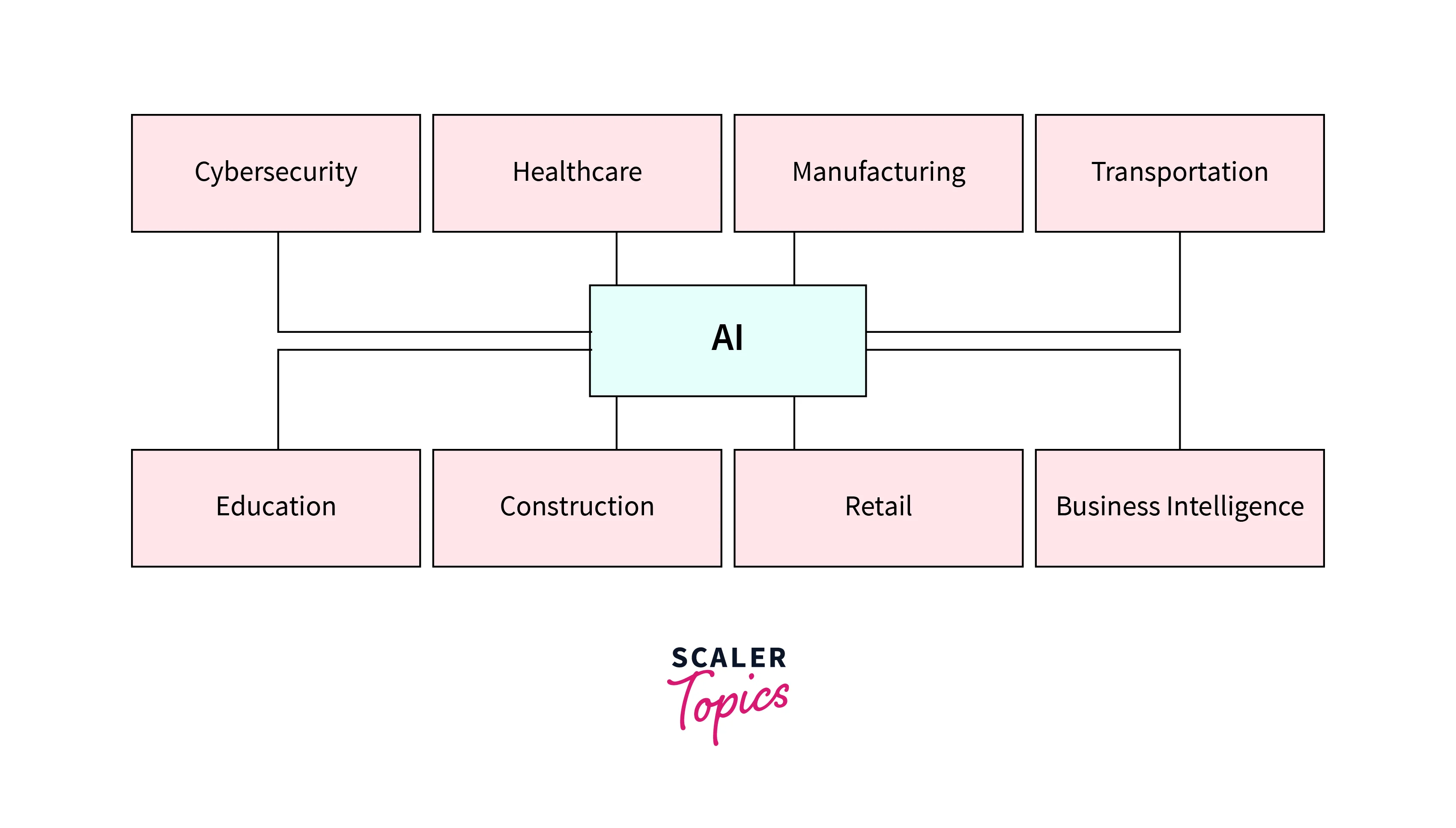
Artificial Intelligence job opportunities are across various industries.
Artificial Intelligence Jobs for Freshers
Freshers entering the field of Artificial Intelligence (AI) can explore several job roles and positions. Here are some entry-level AI jobs suitable for freshers:
- AI/ML Intern:
Many organizations offer internships specifically focused on AI and machine learning. As an intern, you will work closely with experienced professionals, gaining practical exposure to AI projects, data analysis, algorithm development, and model implementation. This role allows you to learn and apply AI concepts in a real-world setting. - Junior Data Scientist:
Junior data scientists assist senior data scientists in analyzing and interpreting complex datasets. They help with data preprocessing, feature engineering, and model development. This role provides hands-on experience in applying statistical techniques, machine learning algorithms, and data visualization to solve business problems. - AI Research Assistant:
As an AI research assistant, you can work with research teams in academia or industry. Your responsibilities may include literature review, data collection, running experiments, and assisting in the development of new AI algorithms or models. This role offers exposure to cutting-edge research and the opportunity to contribute to scientific publications. - AI Software Developer:
Entry-level AI software developers focus on implementing AI algorithms and models into software systems. They work on tasks such as coding, testing, and debugging AI components. This role requires proficiency in programming languages such as Python, Java, or C++, along with knowledge of AI libraries and frameworks. - AI Quality Assurance Engineer:
Quality assurance engineers in AI ensure the reliability and performance of AI systems and models. They develop test cases, conduct testing, and verify the accuracy of AI outputs. This role involves analyzing model behavior, identifying issues, and providing feedback for model improvement. - AI Application Support Engineer:
Application support engineers assist in deploying and maintaining AI applications. They troubleshoot technical issues, provide customer support, and work with development teams to address user needs. This role requires a good understanding of AI concepts and the ability to effectively communicate technical information. - AI Consultant/Analyst:
As an AI consultant or analyst, you can work with organizations to assess their AI requirements, evaluate potential AI solutions, and provide recommendations for implementation. This role involves understanding business processes, analyzing data, and suggesting AI strategies aligned with organizational goals. - AI Chatbot Developer:
Chatbot development is a popular area within AI. As a fresh graduate, you can start as a junior chatbot developer, building conversational agents using natural language processing (NLP) techniques. This role involves designing chatbot architectures, training language models, and integrating chatbots into applications. - AI Sales Associate:
In this role, you assist the sales team in promoting AI products or services. You provide product demonstrations, conduct market research, and engage with potential clients to understand their AI needs. This position requires a combination of technical knowledge and strong communication skills. - AI Data Analyst:
Entry-level AI data analysts focus on analyzing and interpreting data to derive meaningful insights. They work with large datasets, perform data cleaning and transformation, and assist in data-driven decision-making processes. This role provides an opportunity to work with AI tools and techniques in a data-centric environment.
Job Opportunities in Artificial Intelligence and its Domains
Data Scientists
Data scientists are professionals who use analytic, statistical, programming, and domain-specific knowledge to extract insights and value from large amounts of data. They use their knowledge and talents to solve business challenges, make data-driven decisions, and create predictive models.
Data Analyst
Data analysts are individuals that collect, analyze, interpret, and present data to assist organizations in making informed decisions. They are critical in gaining insights from data, spotting trends, and making meaningful recommendations.
Big Data Engineer
A Big Data Engineer is a specialist in developing, constructing, and maintaining the infrastructure and systems required for processing and analyzing enormous amounts of data. They use technology and tools designed expressly for big data, allowing organizations to extract important insights and make data-driven decisions.
Business Intelligence (BI) Developer
A BI Developer is a professional that designs, develops, and maintains business intelligence solutions to assist organizations in gathering, analyzing, and visualizing data for decision-making reasons. They use a variety of tools and technology to transform raw data into actionable insights and reports that drive strategic and operational choices.
Machine Learning Engineer
A Machine Learning Engineer is a specialist in the design, development, and implementation of machine learning models and systems. They use their knowledge of machine learning algorithms, programming, and data analysis to create intelligent systems capable of learning from data and making predictions or judgments.
Machine Learning Engineers are critical in the development and deployment of machine learning solutions for a variety of applications.
AI Engineer
An AI (Artificial Intelligence) Engineer is a specialist in the design, development, and implementation of artificial intelligence systems and solutions. They work on building algorithms, concepts, and technologies that allow robots to behave and think like humans. AI engineers use their expertise in machine learning, deep learning, natural language processing, computer vision, and other AI approaches to construct intelligent systems that can comprehend, learn, and make decisions based on input.
Robotics Scientist

A Robotics Scientist is a professional who specializes in robotic systems and technology research, design, development, and application. They work at the convergence of robotics, artificial intelligence, and engineering to develop intelligent robots capable of doing tasks autonomously or with human assistance. Robotics scientists help to progress different industries, such as industrial automation, healthcare, space exploration, agriculture, and others.
Data Warehouse Engineer
A Data Warehouse Engineer is a specialist in the design, development, installation, and upkeep of data warehouse systems. Data warehouses are large-scale repositories that store and organize data from numerous sources so that it can be analyzed and reported on. Data Warehouse Engineers are responsible for ensuring that the data warehouse infrastructure is efficient, scalable, and capable of processing enormous amounts of data.
Top Companies Working in the Artificial Intelligence Domain
The field of Artificial Intelligence (AI) has seen significant growth in recent years, with numerous companies actively working on AI-related projects and technologies. While there are many companies involved in AI, here are some top companies known for their advancements and contributions in the AI domain:
- Google:
Google is at the forefront of AI research and development. It has various AI-driven products and initiatives, including Google Search, Google Assistant, Google Cloud AI, and DeepMind, an AI research lab known for its breakthroughs in machine learning. - Amazon:
Amazon is heavily invested in AI, particularly through its Amazon Web Services (AWS) platform. It offers AI services like Amazon Rekognition for image and video analysis, Amazon SageMaker for machine learning, and Alexa, its voice-based AI assistant. - Microsoft:
Microsoft has made significant strides in AI with its Azure cloud platform. It provides various AI services and tools, such as Azure Machine Learning, Cognitive Services, and the Microsoft Bot Framework. Microsoft also invests in AI research through its Microsoft Research division. - IBM:
IBM has been a pioneer in AI for several decades. Its AI platform, Watson, is renowned for its natural language processing, machine learning, and data analytics capabilities. IBM offers AI solutions across multiple industries, including healthcare, finance, and customer service. - Facebook:
Facebook uses AI extensively to improve user experience and develop new features. It employs AI algorithms for personalized content recommendations, facial recognition, and language processing. Facebook AI Research (FAIR) is its dedicated research division. - Apple:
Apple integrates AI into its products and services, such as Siri, its voice assistant, and the Core ML framework for developers to incorporate machine learning into iOS apps. Apple focuses on privacy-centric AI solutions and on-device processing. - NVIDIA:
NVIDIA is a leading provider of hardware for AI acceleration. Its graphics processing units (GPUs) are widely used in deep learning and neural network training. NVIDIA's GPU-accelerated libraries and platforms, like CUDA and TensorRT, enable faster AI computations. - OpenAI:
OpenAI is an AI research organization dedicated to advancing AI safely and beneficially. It focuses on developing cutting-edge AI technologies and conducts research across various domains, including natural language processing and robotics. - Tesla:
Tesla, led by Elon Musk, is revolutionizing the automotive industry with AI-driven electric vehicles. Its Autopilot system utilizes advanced AI algorithms for autonomous driving and has been instrumental in shaping the future of transportation. - Baidu:
Baidu is a Chinese tech giant heavily involved in AI research and development. It operates Baidu Brain, an AI research division, and offers AI-based services like image recognition, speech recognition, and natural language processing.
Salaries in Artificial Intelligence
Salaries in the field of Artificial Intelligence (AI) in India vary based on factors such as experience, skills, location, company size, and industry. While it's difficult to provide precise figures due to the wide range of positions and variables, I can provide you with a general overview of AI salaries in India based on industry reports and trends.
- Entry-Level Positions:
For freshers or those with 0-2 years of experience in AI, the average salary can range from ₹4 lakhs to ₹10 lakhs per annum. These roles often include positions like AI/ML Intern, Junior Data Scientist, or AI Engineer. - Mid-Level Positions:
With 2-5 years of experience, professionals in AI can expect salaries ranging from ₹10 lakhs to ₹20 lakhs per annum. Job titles in this range may include Data Scientist, Machine Learning Engineer, or AI Developer. - Senior-Level Positions:
Professionals with over 5 years of experience and advanced skills in AI can earn salaries upwards of ₹20 lakhs per annum. Senior roles such as Senior Data Scientist, AI Researcher, or AI Architect fall into this category. - Leadership and Management Roles:
Those in leadership positions such as AI Managers, AI Team Leads, or AI Consultants can earn salaries in the range of ₹30 lakhs to ₹1 crore per annum or even higher, depending on the organization and responsibilities.
It's important to note that these figures are approximate and can vary significantly based on individual factors and market conditions. Additionally, salaries can be higher in major tech hubs like Bengaluru, Hyderabad, or Mumbai compared to other cities.
FAQs
1. What is the main goal of AI?
The primary goal of Artificial Intelligence (AI) is to create computer systems or computers capable of doing tasks that normally require human intelligence. This encompasses talents such as learning, reasoning, problem-solving, perception, natural language understanding, and others. The ultimate goal is to develop AI systems that can mimic or outperform human intellect in a variety of disciplines.
2. Are Artificial Intelligence Jobs in Demand?
Yes, jobs involving artificial intelligence are in high demand. As AI technologies become more widely adopted across industries, there is a growing demand for experts who can design, deploy, and maintain AI systems. Data Scientists, Machine Learning Engineers, AI Researchers, and AI Developers are in high demand, and this trend is projected to continue as organizations use AI to improve efficiency, automation, and data-driven decision-making.
3. How do I start a career in artificial intelligence?
To start a career in artificial intelligence, you can consider the following steps:
- Gain a solid understanding of the foundational concepts of AI, including machine learning, deep learning, and data science.
- Acquire programming skills, especially in languages commonly used in AI like Python or R.
- Enroll in AI-related courses or pursue a degree in AI, computer science, or a related field.
- Build practical experience through projects, internships, or research opportunities. Work on real-world problems and showcase your skills.
- Stay updated with the latest advancements and trends in AI by reading research papers, attending conferences, and joining AI communities.
- Develop a strong portfolio of AI projects and contribute to open-source AI projects if possible.
- Network with professionals in the field, attend AI meetups or conferences and participate in online AI communities.
- Consider obtaining certifications in AI or specialized areas within AI to demonstrate your expertise.
4. Is Artificial Intelligence a good career?
Yes, artificial intelligence is seen as a bright and rewarding professional option. AI professionals are in high demand across industries such as technology, healthcare, finance, manufacturing, and others. AI provides chances for innovation, issue-solving, and making a substantial effect on organizations and society. As AI evolves and becomes more integrated into other fields, it is projected to generate a plethora of work opportunities and meaningful career paths for those interested in the sector.
5. Who is eligible for an Artificial Intelligence course?
Eligibility for an AI course varies based on the institution or program that offers the course. Individuals having a background in computer science, engineering, mathematics, statistics, or a related discipline are generally well-suited to AI courses. AI courses, on the other hand, can be tailored for people from a variety of backgrounds who are interested in AI and eager to master the relevant concepts and abilities.
Conclusion
- The primary goal of Artificial Intelligence (AI) is to create computer systems or computers capable of doing activities that need human intelligence.
- As organizations implement AI technologies for increased efficiency and data-driven decision-making, artificial intelligence positions are in great demand.
- Individuals can begin a career in AI by gaining a good understanding of core principles, learning programming skills, enrolling in AI-related courses, gaining practical experience through projects, and staying up to date on the newest breakthroughs.
- Artificial Intelligence job opportunities promise career path that offers innovation potential and has a big impact on organizations and society.
- Individuals having a background in computer science, engineering, mathematics, or a similar discipline are often well-suited for AI courses.
- Programming, algorithms, statistics, and linear algebra are examples of prerequisites and recommended knowledge. It is a good idea to go over the course prerequisites.