


Print Left View of Binary Tree
 FREE
FREE

The left view of a binary tree corresponds to the nodes of the tree, which would be visible to someone seeing the tree from its left side, as shown in the image below -
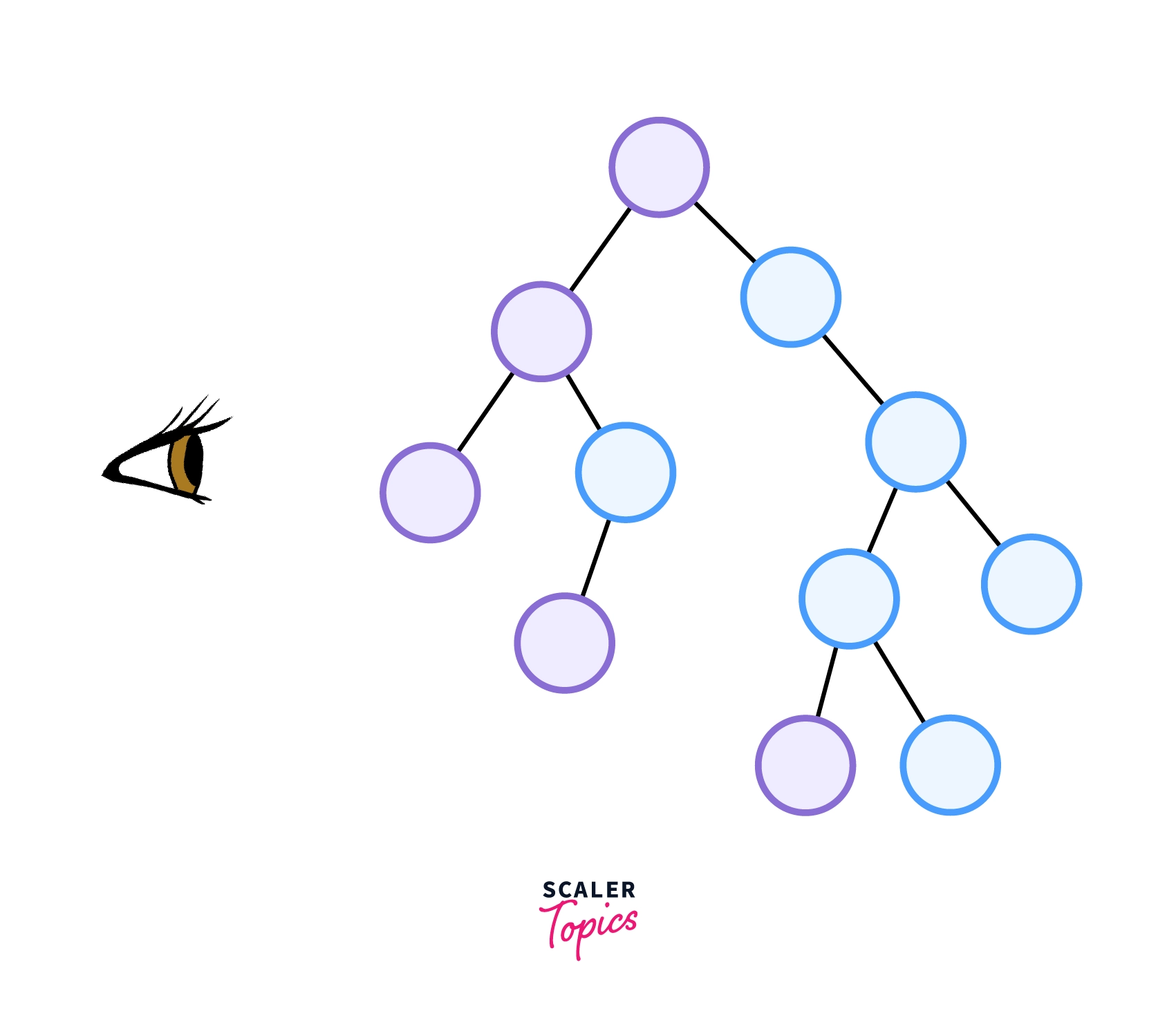
To print the left view of a binary tree, it's essential to recognize that the leftmost node at each level is visible from the left side.
Approach-1: Using Recursion
We can print a binary tree's left view using recursion.
Below is the implementation of the above approach -
The blueprint of code will be -
Variables -
- maxLevel - Global variable, which denotes the maxLevel traversed till now.
- level - Local variable, denoting the current level.
Methods -
- leftView - This wrapper function will call the leftView_Helper function passing root with the current level as 0.
- leftView_Helper - It will check whether the current level is greater than maxLevel. If yes, we will include the node in the answer and update the maxLevel. At last, we will recurse for the left subtree and then for the right subtree.
Build an AI-First Career, Master the Complete Skillset
Choose from our industry-leading programs designed for career success
Modern Software and AI Engineering Program
Master full-stack development with AI integration


 +1000 more
Modern Data Science and ML with specialisation in AI
Advanced data science techniques with AI specialization
+1000 moreAdvanced AIML with Specialisation in Agentic AI
Deep dive into AIML with focus on Agentic systems
+1000 moreDevOps, Cloud & AI Platform Engineering
Build and manage AI-powered cloud infrastructure
+1000 moreAI Engineering Advanced Certification by IIT-Roorkee
Premier AI engineering certification from IIT-Roorkee

AI Forward Deployed Engineer Program
Full-stack engineering, production AI and client-facing consulting
+1000 moreC/C++
Java
Output:
- Time Complexity - Since we are traversing all the nodes of the tree, time complexity is .
- Space Complexity - , though we don't use any array or auxiliary data structure, we must consider the recursive stack space used.
Approach-2: Using Level Order Traversal
The concept revolves around identifying and including all nodes in the left view that appear first in their respective levels. An effective strategy is to execute a level order traversal, ensuring the initial node at each level is noted.
To apply this concept, follow these steps:
- Execute a level order traversal across the tree.
- Maintain a record of the traversed level, noting the first node encountered at each level.
- Proceed to the subsequent level.
How Scaler Transformed Careers in Different Fields
Scaler learners achieved 2.5x salary growth with average post-Scaler CTC reaching ₹23L.
 Google
 Amazon
 Microsoft
 Flipkart
 Adobe1200+ more
C/C++
- Java
Output:
- Time Complexity - Since we are traversing all tree nodes, the time complexity is .
- Space Complexity - Since we have used a queue data structure to store the given tree's left view, the space complexity is .
Approach -3 : Using Queue and a Null Pointer
The solution to this problem involves utilizing a queue and a null pointer to signify the beginning of each level. By placing a null pointer initially and, when encountering one, set a boolean flag to true, indicating that the subsequent element should be considered part of the left view.
Following is the execution based on the outlined strategy:
Turn Learning into Career Growth
C/C++
Java
Output:
- Time Complexity - Since we are traversing all the tree nodes, the time complexity is .
- Space Complexity - , because we have used the queue, which stores the information about the nodes in the tree.
Conclusion
- In this article, we have seen what is meant by the left view of binary tree through a detailed example.
- We have discussed two recursive approaches to print the left view of binary tree. Both of them were traversing the tree in preorder fashion.
- Also, we have seen an iterative implementation using a queue data structure. In this approach, we were traversing the tree in the level order fashion.




