


Link State Advertisement
Overview
L.S.A. (Link State Advertisement) are messages communicated in the OSPF (Open Shortest Path First) domain to other routers through multicast. They are sent from internal routers to the D.R. (Designated Router) or the B.D.R. (Backup D.R.) to announce the changes. The role of the DR is to provide a central point for exchanging OSPF information among several routers on the same broadcast multiaccess network segment. The communication occurs on the 224.0.0.6 multicast address. The DR announces the changes to other routers via the 224.0.0.5 multicast address. There exist many different types of LSAs in OSPF.
Build an AI-First Career, Master the Complete Skillset
Choose from our industry-leading programs designed for career success
Modern Software and AI Engineering Program
Master full-stack development with AI integration


 +1000 more
Modern Data Science and ML with specialisation in AI
Advanced data science techniques with AI specialization
+1000 moreAdvanced AIML with Specialisation in Agentic AI
Deep dive into AIML with focus on Agentic systems
+1000 moreDevOps, Cloud & AI Platform Engineering
Build and manage AI-powered cloud infrastructure
+1000 moreAI Engineering Advanced Certification by IIT-Roorkee
Premier AI engineering certification from IIT-Roorkee

AI Forward Deployed Engineer Program
Full-stack engineering, production AI and client-facing consulting
+1000 moreLink State Advertisement
OSPF is a link-state routing protocol used for finding the best most optimal path between a source router and a destination router using its own SPF (Shortest Path First) algorithm. LSAs are messages communicated in the OSPF to other routers through multicast. Multicasting is a communication in which the sender transfers data to several, possibly all, receiving nodes present in the network, at the same time. Multicasting is a one-to-many and many-to-many communication. These OSPF routers exchange LSAs for maintaining and updating the topological OSPF database by the OSPF operating devices.
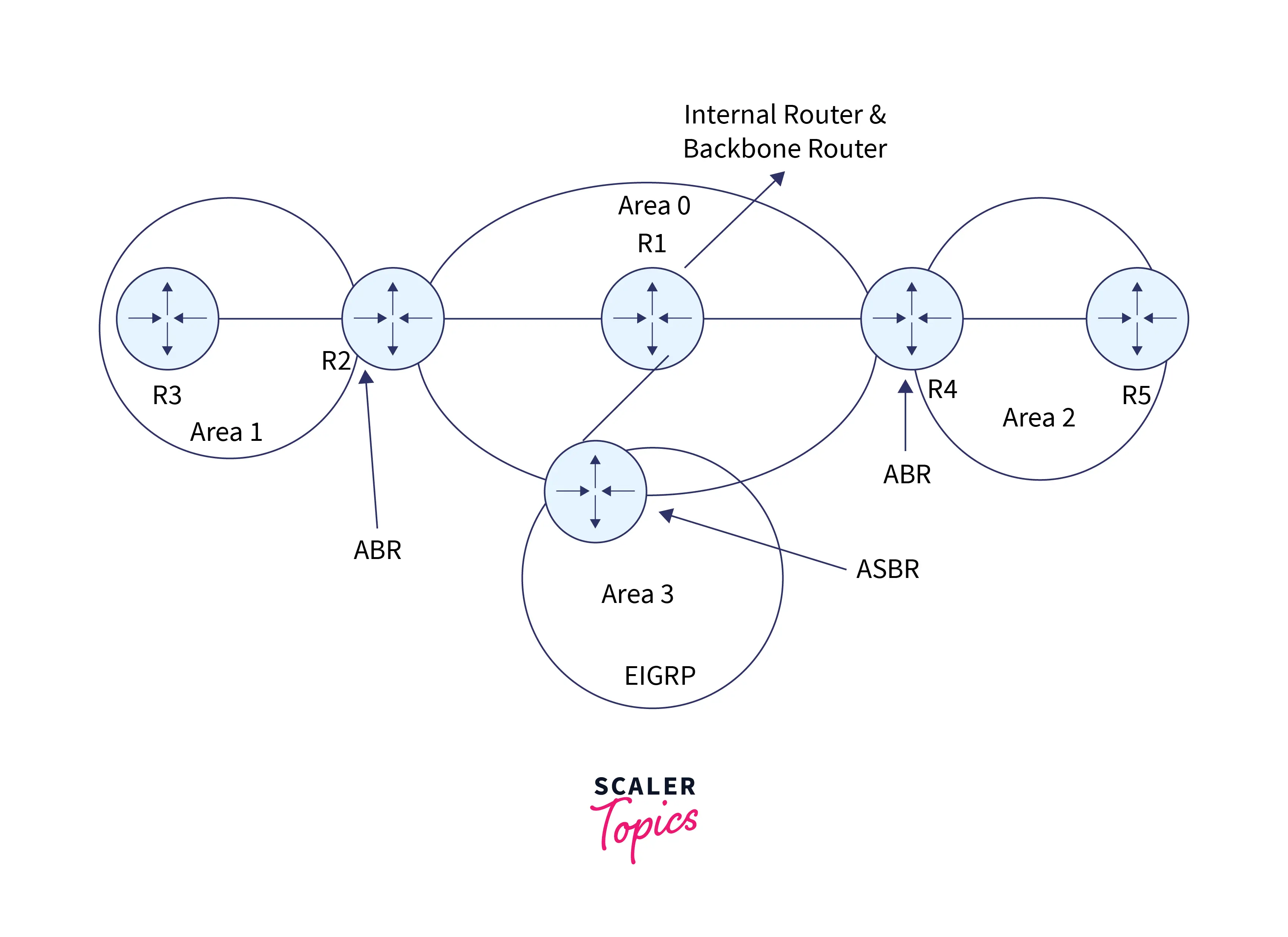
Router Roles
Let us understand the router roles in OSPF:
- Backbone router The routers in the backbone area are referred to as backbone routers. Area 0 is called as backbone area.
- Internal router This kind of router has all of its interfaces in a single area.
- Area Boundary Router (ABR) These routers connect the backbone area with some other site. The ABRs thus maintain multiple link-state databases that describe the topology of the other areas as well as the backbone topology.
- Autonomous System Border Router (ASBR) When an OSPF router connects to a different protocol (EIGRP, BGP, etc) then it is referred to as an Autonomous System (A.S.). An ASBR connects two different AS, one of the interfaces which are operating OSPF in area 0. These routers perform redistribution. ASBRs are capable of running OSPF as well as other routing protocols, such as RIP, BGP, etc.
Types of LSAs
There are 5 types of LSAs, explained as follows:
How Scaler Transformed Careers in Different Fields
Scaler learners achieved 2.5x salary growth with average post-Scaler CTC reaching ₹23L.
 Google
 Amazon
 Microsoft
 Flipkart
 Adobe1200+ more
Type 1 LSA
LSA type 1 is flooded by every router within an area. The LSA contains information related to the directly connected links. The LSA is identified by the originating router or the router ID. Type 1 LSA does not cross the ABR. This can be observed in the routing table as “O” routes. LSA 1 – O router consists of all Link IDs.

Type 2 LSA
The DR Router generates type 2 LSAs on the broadcast network. It consists of the subnet mask, network ID, a list of the routers that are attached, etc. We may have one type 2 LSA per transit broadcast of the Non-Broadcast Multiple Access (N.B.M.A.) Network in OSPF. An N.B.M.A. (Non-Broadcast Multiple Access) networks is one, to which multiple hosts are attached, but data can be transmitted directly only from one computer to another single host across a switched fabric or over a virtual circuit.
Type 2 LSA can't cross the area boundary router and may only be flooded within the area. We can see these within the routing table as “O” routes. LSA 2 – O network LSA consists of all the segment-attached routers.

Turn Learning into Career Growth
Type 3 LSA
This type of LSA is required for sharing information related to the network with other areas. The area boundary router advertises these LSAs and is present as “OIA” routes within the routing table. In order to flow the information in the AS, the ABRs subsequently regenerate the Type 3 LSAs. LSA 3 – OIA network summary LSA gives the description of a network from some other area and contains a subnet mask and network ID.

Type 4 LSA
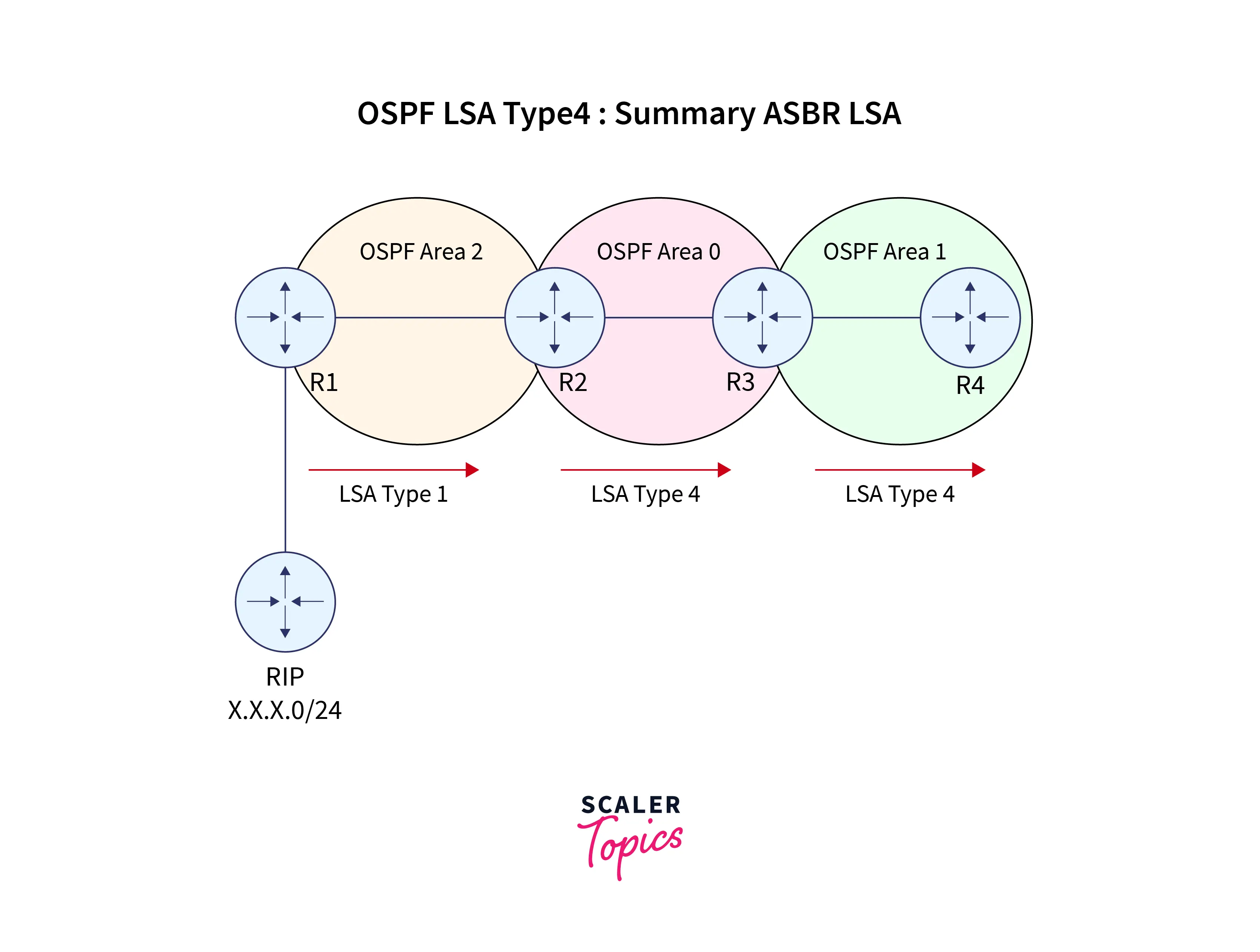
LSA type 4 is also called Summary LSA. It is required for advertising (to other areas within the very same autonomous system) the Autonomous System Border Router. The area boundary router of the originating area generates the type 4 LSAs. These LSAs flood through the AS and consist of only the autonomous system border router ID. LSA 4 – O IA summary ASB Link States are propagated between areas.
Type 5 LSA
Type 5 LSAs are owned as well as advertised by the autonomous system border router. Type 5 LSAs are required for advertising (via other autonomous systems) on the networks. The whole autonomous system is flooded with Type 5 LSAs. The advertising router ID is not altered all over the autonomous system while it propagates. A type 4 LSA is required for finding an ASBR. Note that by default the routes may not be summarized. LSA 5 – O E2 and O E1 external link states are propagated.

Conclusion
In this article we learned:
- L.S.A. (Link State Advertisement) are messages communicated in the OSPF (Open Shortest Path First) domain to other routers through multicast.
- The role of the DR (Designated Router) is to provide a central point for exchanging OSPF information among several routers on the same broadcast multiaccess network segment.
- OSPF is a link-state routing protocol used for finding the best most optimal path between a source router and a destination router using its own SPF (Shortest Path First) algorithm.
- There are various roles of routers: Backbone router, Internal router, Area Boundary Router (ABR), and Autonomous System Border Router (ASBR).




