


MVC Design Pattern
Overview
MVC is an architectural/design pattern that isolates the application's logic into three parts: Model, View, and Controller. The isolation is performed to assign specific responsibilities for each part. The Model represents the data, Controller handles the business logic, and View handles the presentation logic.
When Will We Need MVC Design Pattern?
MVC design pattern is used commonly while developing web applications. When we open a web page, the request goes to the server, which processes the request, reads data from the database, and renders the data on the web page. This most common web application use case fits nicely into the MVC design pattern.
When the request reaches the server, Controller takes care of handling the request, then reads the database and maps the data to the Model, and renders the retrieved data in the View
Build an AI-First Career, Master the Complete Skillset
Choose from our industry-leading programs designed for career success
Modern Software and AI Engineering Program
Master full-stack development with AI integration


 +1000 more
Modern Data Science and ML with specialisation in AI
Advanced data science techniques with AI specialization
+1000 moreAdvanced AIML with Specialisation in Agentic AI
Deep dive into AIML with focus on Agentic systems
+1000 moreDevOps, Cloud & AI Platform Engineering
Build and manage AI-powered cloud infrastructure
+1000 moreAI Engineering Advanced Certification by IIT-Roorkee
Premier AI engineering certification from IIT-Roorkee

AI Forward Deployed Engineer Program
Full-stack engineering, production AI and client-facing consulting
+1000 moreHow Does MVC Design Pattern Work?
Let's understand the working MVC design pattern using a web application use case. Even though we won't be writing any web-related code, we can understand the crux of it using a Java example.
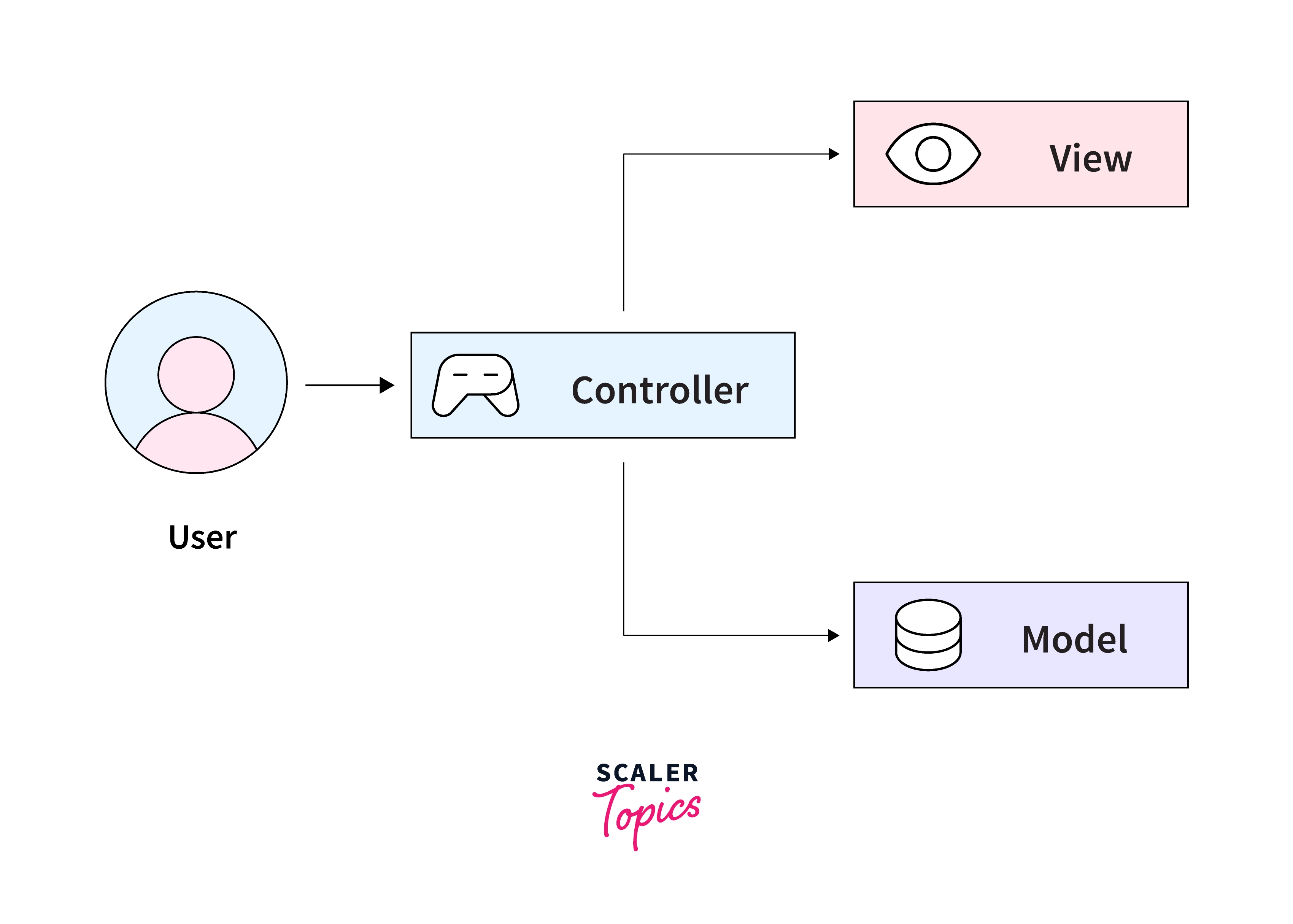
MVC design pattern is based on three components: Model, View, and Controller. The controller is the entry point in the MVC pattern. When the controller handles the request, it interacts with the datastore to fetch data and maps it to the Model; then, the model is passed to the View, which renders it.
Pseudocode
In this example, we create three classes User, UserController, and UserView. The User class refers to the user model. The UserController class refers to the controller that interacts with the data store and maps the response to the model and pass it to view. The UserView class refers to the view for the user where we print user information read from the model.

User
UserDataStore
UserController
How Scaler Transformed Careers in Different Fields
Scaler learners achieved 2.5x salary growth with average post-Scaler CTC reaching ₹23L.
 Google
 Amazon
 Microsoft
 Flipkart
 Adobe1200+ more
UserView
Main
Language Specific Code (Java + C++ + Python)
Java
User
UserDataStore
UserController
UserView
Main
Output
C ++
User
UserDataStore
UserController
UserView
Main
Output
Python User
UserDataStore
UserController
UserView
Main
Output
Turn Learning into Career Growth
Pros and Cons of MVC Design Pattern
Pros of MVC Design Pattern
- The business logic and presentation layer is isolated.
- Development is faster for bigger projects. As the business logic and presentation layer is separated, multiple groups can work parallelly on business logic and presentation logic. For smaller projects, we can do quick prototyping without using MVC boilerplate
Cons of MVC Design Pattern
- Not the best fit for small web applications and will be an overburden.
Relations with Other Patterns
The MVVM (Model-View-ViewModel) design pattern is similar to the MVC design pattern. Here ViewModel is responsible for rendering the view from the Model and provides its own methods and internal state to update the view.
Conclusion
- MVC is an architectural/design pattern that isolates the application's logic into three parts: Model, View, and Controller.
- In the MVC pattern, the Model represents the data, Controller handles the business logic, and View handles the presentation logic.
- MVC design pattern is used commonly while developing web applications.




