


Painters Partition Problem
 FREE
FREE

Overview
In Painters Partition problem, we have M boards of length {l1, l2,... lm} to paint, and there are N painters available. In Painters Partition, each painter takes one unit of time to paint one unit of the board.
Calculate the minimum amount of time to complete this task while keeping in mind that any painter will only paint contiguous sections of the board.
The board cannot be painted partially by one painter and partially by another, which means they cannot share the board to paint. Every painter will paint the contiguous board, which means that if the painter paints boards 1 and 3 but not 2, the painting is invalid.
Takeaways
In Painters Partition problem, we have M boards of length {l1, l2,… lM} to paint, and there are N painters available.
Transform Your Career
Choose from our industry-leading programs designed for career success
Modern Software and AI Engineering Program
Master full-stack development with AI integration


 +1000 more
Modern Data Science and ML with specialisation in AI
Advanced data science techniques with AI specialization
+1000 moreAdvanced AIML with Specialisation in Agentic AI
Deep dive into AIML with focus on Agentic systems
+1000 moreDevOps, Cloud & AI Platform Engineering
Build and manage AI-powered cloud infrastructure
+1000 moreAI Engineering Advanced Certification by IIT-Roorkee
Premier AI engineering certification from IIT-Roorkee

Example
Input 1: M = 5, N = 3, Arr = {5, 25, 30, 20, 15}
Output 1: 35
Input 2: M = 4, N = 2, Arr = {5, 6, 5, 6}
Output 2: 11
Input 3: M = 4, N = 2, Arr = {10, 15, 20, 25}
Output 3: 45
Example Explanation
Explanation for Input 1: Allocation for Painter 1: {5,25} Allocation for Painter 2: {30} Allocation for Painter 3: {20,15} When all of the painters have completed their work, the job will be completed, i.e., at time = .
Explanation for Input 2: Here, we’ll divide our array into two parts and assign the first two values to the first painter, i.e., 11, and the last two values, i.e., 11, to the second painter.
Explanation for Input 3: Similarly, here also, we’ll divide our array into two parts and assign the first two values to the first painter, i.e., 25, and the last two values, i.e., 45, to the second painter. So the answer would be 45.
Constraints
1 <= T <= 4 1 <= M <= 10^4 1 <= N <= M 1 <= Arr [i] <= 10^5
Where ‘T’ is the number of test cases, "M" is the length of the given array (boards). "N" is the number of painters available. Arr[i] denotes the i-th element in the array.






Approach 1: Brute-Force Solution
The brute force approach could be that we consider all possible sets of contiguous partitions and we will calculate the maximum sum partition in each case and return the minimum of all these cases. Let’s see properly how it could be done.
Algorithm:
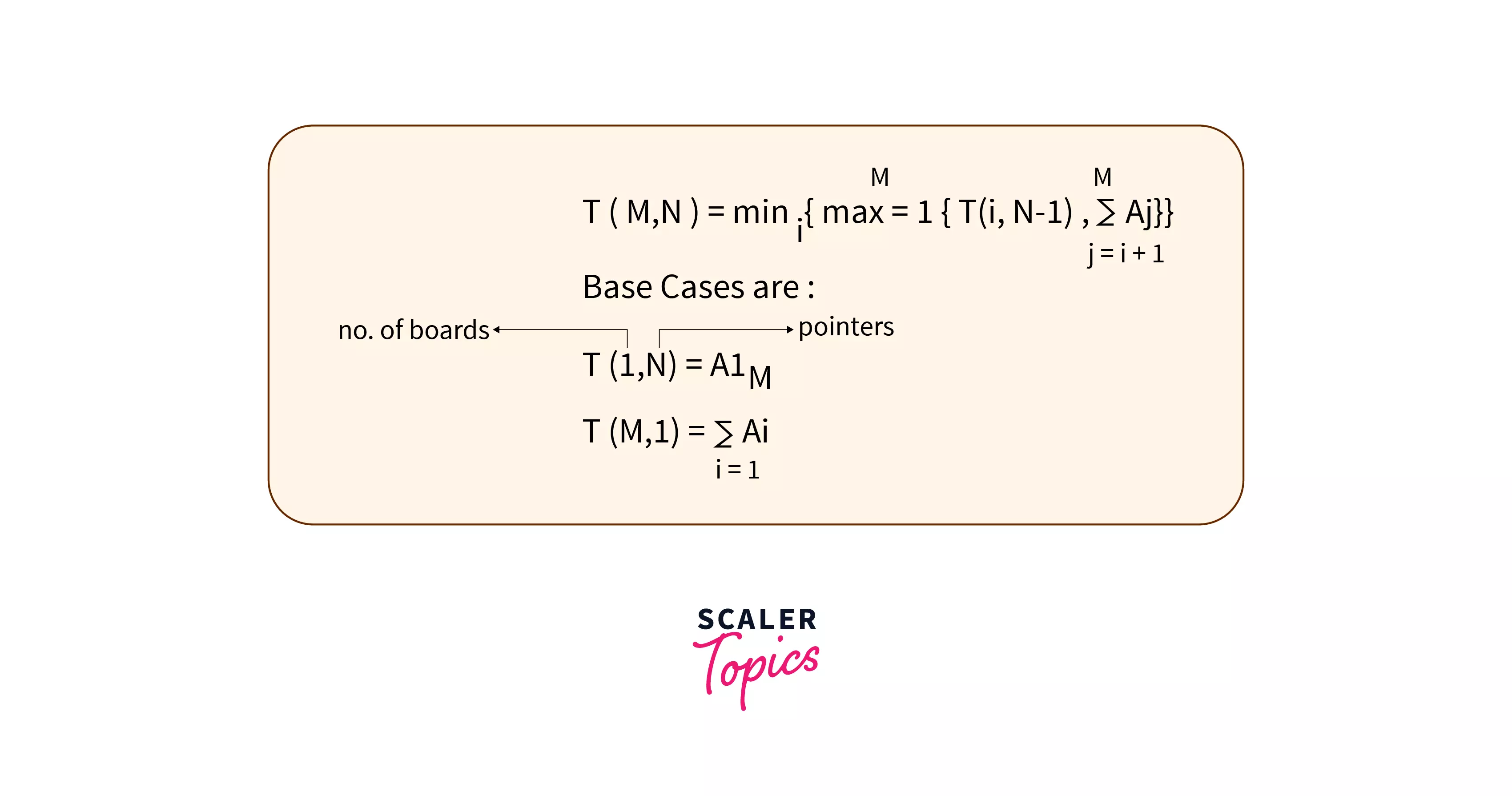
We can assume that we already have (N-1) partitions using (N-2) dividers. Now we have to make the (N-1)th divider to get N partitions. So simply, we can put in the (N-1)th divider to get N partitions. We will put the (N-1)th divider between the ith and (i+1)th elements, where i = 1 to n.
Note: Putting the (N-1)th divider before the first element or after the last element has the same effect.
We can calculate the total cost for the above arrangement as the maximum of the following:
- The final partition's cost would be sum(Ai..An), where the (N-1)th divider comes before element i.
- The maximum cost of any partition formed to the left of the (N-1)th divider.
See the below recurrence relation:
Scaler Placement Report and Statistics
Scaler learners achieved 2.5x salary growth with average post-Scaler CTC reaching ₹23L.
 Google
 Amazon
 Microsoft
 Flipkart
 Adobe1200+ more
Coding Implementation:
C++
Output:
Java
Output:
Python
Output:
Time Complexity
Time complexity would be exponential for the above algorithm. ......... times = where, 'N' is the number of painters. 'M' is the length of the given array (boards).
Space Complexity
Each function call of a recursive algorithm will take space, and if the maximum depth of the recursion tree is 'M' then the recursive algorithm's space complexity will be .
Turn Learning into Career Growth
Approach 2: Using Binary Search
In the previous algorithm, we discussed how we could solve this problem recursively by breaking it into subproblems, but that algorithm was taking more time and space. Now we will discuss a more efficient approach using binary search.
Algorithm
Here, our target value (that would always be in the searching range) is the maximum sum of a contiguous section in the allocation of boards. The highest value would always be the sum of all the elements in the array, and this will happen only when we allot 1 painter to all the sections of the board, and the lowest value could be the maximum value of the array.
Let's see how it works:
- We can allocate the maximum to one painter and divide the remaining sections so that their costs are minimized.
- One interesting thing is that if we have p painters, the values in the range increase, and the value of p decreases, and vice-versa.
- From this, we can find the target value when p=N.
- Now, we can easily find the target values when p=N and use our helper functions to find p and the minimum number of painters required when there is a maximum length of section a painter can paint.
Code Implementation
C++
Output:
Java
Output:
Python
Output:
Time Complexity
, where M is the length of the input array. Here we are traversing an array of size M and the partition function is taking the time , so the total complexity would be .
Space Complexity
O(1), as no extra space is used.
Conclusion
Now let's summarize our topic by what we have learned so far.
- Putting the (N-1)th divider before or after the first element has the same effect.
- The board cannot be painted partially by one painter and partially by another, which means they cannot share the board to paint.
- The brute force approach could be that we consider all possible sets of contiguous partitions and we will calculate the maximum sum partition in each case and return the minimum of all these cases.
- In binary search approach, our target value (that would always be in the searching range) is the maximum sum of a contiguous section in the allocation of boards.




