


How to Use the Pandas map() Function?
Pandas map(), as the name suggests, is used to map values with similar series together.
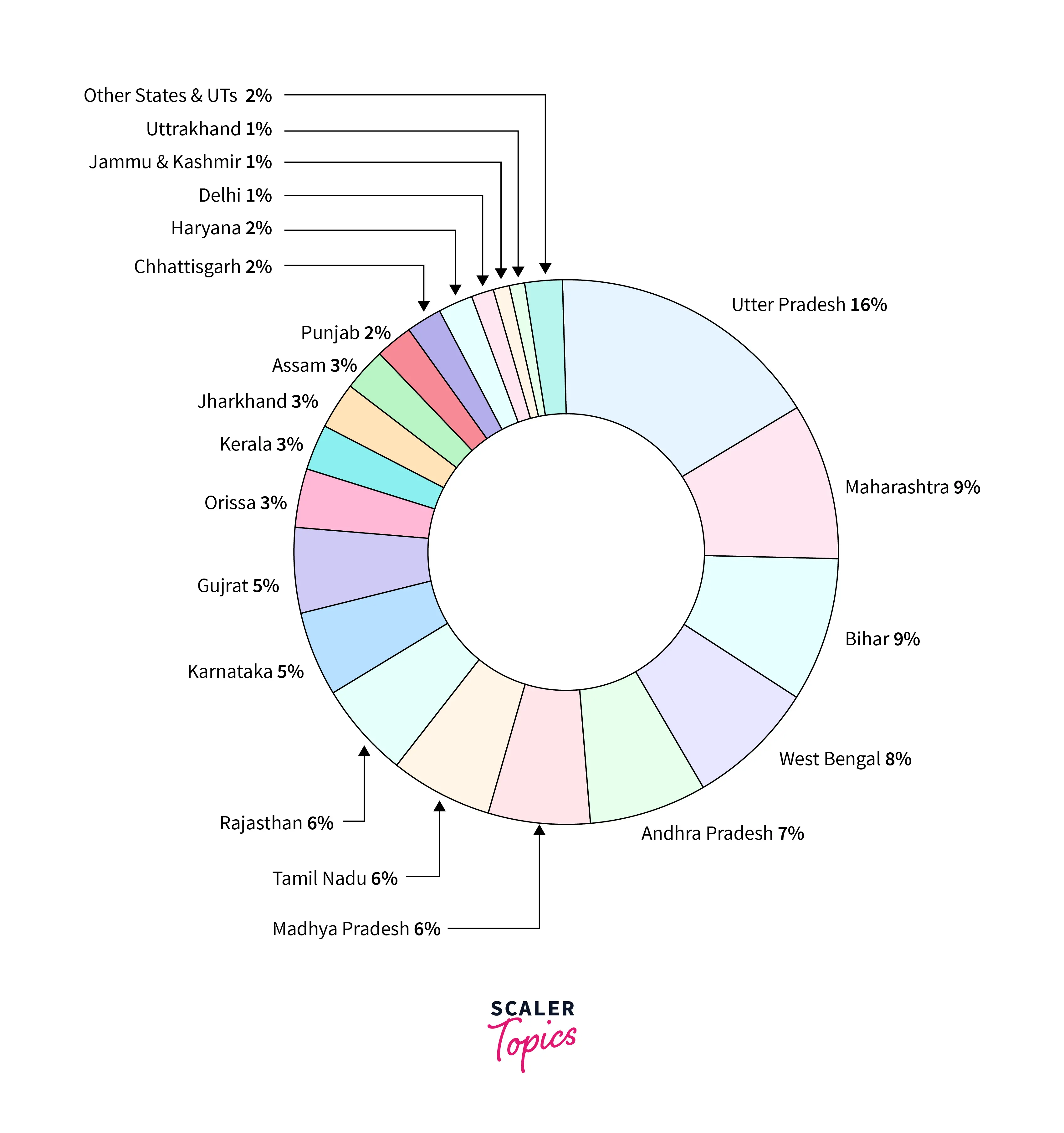
Let us consider a situation where we have a dataset of states in India and their population in alphabetical sequence. Here, on the one hand, we have the index and name of the state, and on the other hand, we have the index and population. Since the index is a typical value, we can directly map the state to the population.
Pandas Map can be used with series, dictionaries, or functions.
Build an AI-First Career, Master the Complete Skillset
Choose from our industry-leading programs designed for career success
Modern Software and AI Engineering Program
Master full-stack development with AI integration


 +1000 more
Modern Data Science and ML with specialisation in AI
Advanced data science techniques with AI specialization
+1000 moreAdvanced AIML with Specialisation in Agentic AI
Deep dive into AIML with focus on Agentic systems
+1000 moreDevOps, Cloud & AI Platform Engineering
Build and manage AI-powered cloud infrastructure
+1000 moreAI Engineering Advanced Certification by IIT-Roorkee
Premier AI engineering certification from IIT-Roorkee

AI Forward Deployed Engineer Program
Full-stack engineering, production AI and client-facing consulting
+1000 moreSyntax of Pandas map()
Let us understand the syntax of Panda's map.
Or
Where,
- Series.map defines the function where the map function is applied to Series.
- Self,arg and na_action are the parameters.
Parameters
Based on the above Pandas Map syntax, we have three parameters as discussed -
- Self is an optional attribute that directs the function to use the defined column or series only.
- Arg is the argument defining how we map the data, which can be either a function, a dictionary, or a series.
- Na_action defines how we interpret the missing nan values. In both of the above syntaxes, we have set it to None, which suggests that if the value is null, it will be converted to NaN.
Return Type
The return type for Pandas Map will always be a Series, with the same index as the function calling Series.
How Scaler Transformed Careers in Different Fields
Scaler learners achieved 2.5x salary growth with average post-Scaler CTC reaching ₹23L.
 Google
 Amazon
 Microsoft
 Flipkart
 Adobe1200+ more
Examples
Let us begin by creating a custom dataset.
Output:
-
Series.map() -
This function in Pandas Map can be used with a column ie a Series, where we can map new values from existing values in the given series.
The return type is a series as well.
Example 1:
Output:
Example 2:
Output:
-
Passing a dataframe -
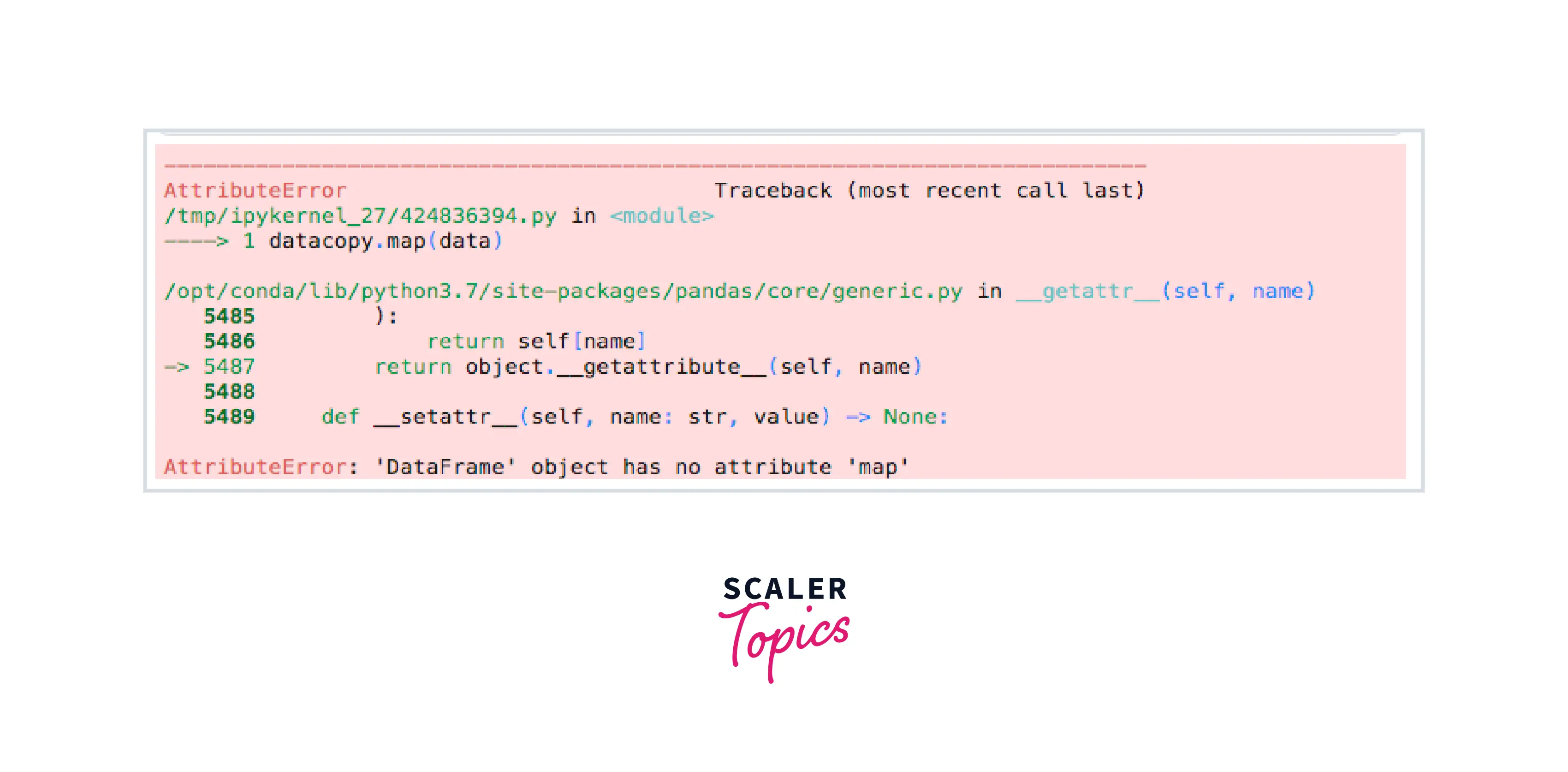
As discussed earlier, the Pandas Map function only applies to Series, Dictionaries, or Functions.
Thus, when we try to pass a Dataframe we get an error.
Output:
Example 1:
Output -
Example 2:
Output:

Both of the above examples prove that dataframes cannot be mapped.
-
Using map() with Dictionary -
Pandas Map can be used with a dictionary, within or outside the function.
Example 1:
Output:
-
Using a Function with Pandas Map -
We can use functions with Pandas Maps by applying the format function.
Output:
-
Use na_action = 'ignore' -
Let us use the same example as above using the na_action = 'ignore'.
Output:
Here, we can see the difference between the two examples. In the first case, since null values are not ignored, it is treated as all the other values in the series. In the second case, we can see that the function returns a null value instead of formatting it.
Conclusion
- Pandas Map function helps map values which have the same indices.
- The accepted values are Series, Dictionaries but not dataframes.
- The return type is always a series.




