


Ring Topology
Build an AI-First Career, Master the Complete Skillset
Choose from our industry-leading programs designed for career success
Modern Software and AI Engineering Program
Master full-stack development with AI integration


 +1000 more
Modern Data Science and ML with specialisation in AI
Advanced data science techniques with AI specialization
+1000 moreAdvanced AIML with Specialisation in Agentic AI
Deep dive into AIML with focus on Agentic systems
+1000 moreDevOps, Cloud & AI Platform Engineering
Build and manage AI-powered cloud infrastructure
+1000 moreAI Engineering Advanced Certification by IIT-Roorkee
Premier AI engineering certification from IIT-Roorkee

AI Forward Deployed Engineer Program
Full-stack engineering, production AI and client-facing consulting
+1000 moreOverview
In ring topology, every node has a connection with two neighbor nodes. And they share a single continuous pathway for signal transmission in the whole network. Ring topology is used by the Local area network (LAN) and wide area network (WAN).
What is Ring Topology?
In a computer network, a ring topology is a type of topology in which every node is connected to two nodes. They share a single continuous pathway for signal transmission in the whole network. Local area networks (LANs) generally use ring topologies.
In a ring topology, there are two neighbors for every node and signals transmit in opposite directions around the ring. It may be possible due to some reasons one node fails so in this case signals are rerouted from the default one with the help of other nodes as alternative paths. This can make the network more complex but it also improves fault tolerance and reliability of the network.
Fibre optic cable or twisted pair cable can be used for designing ring topologies. There are many factors on which the choice of type of cable depends. These can be the distance between the nodes, the speed required for transferring data, and many more factors.
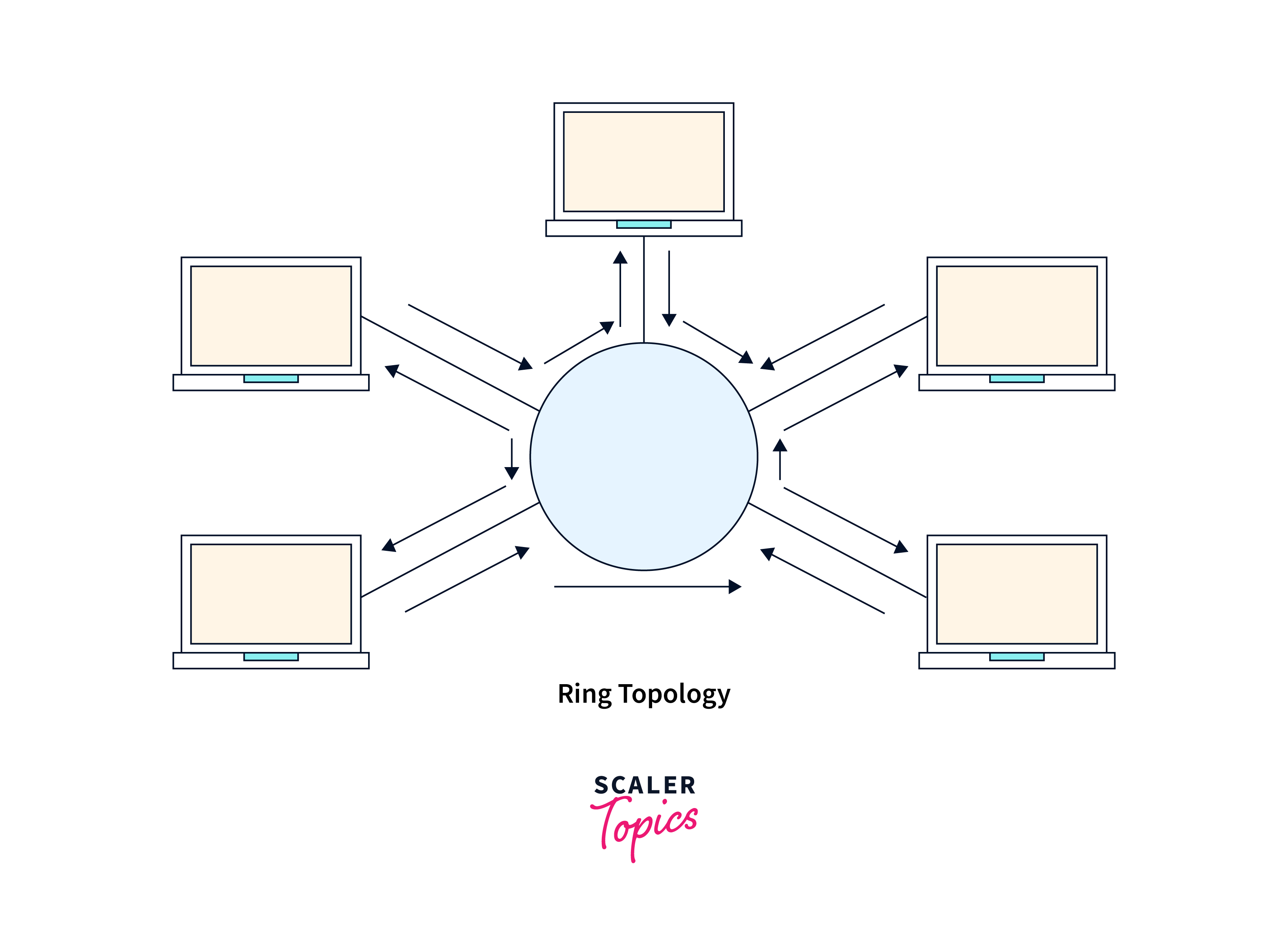
Working of Ring Topology
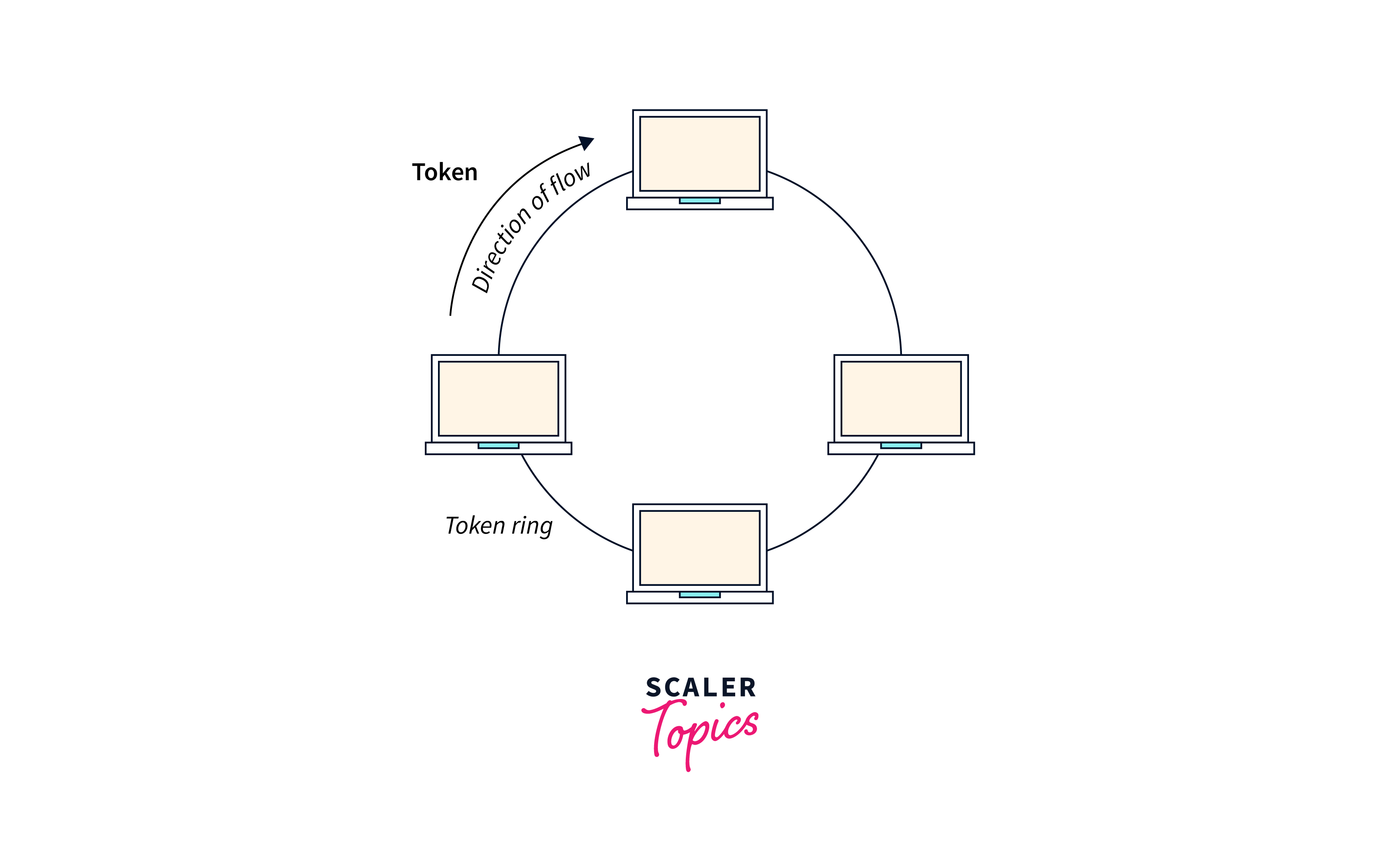
You need to follow the following steps to transfer data between nodes in a ring topology.
- Empty tokens can be circulated freely in the ring. The minimum speed of the ring is 16 MBPS and its maximum speed is 100 Mbps.
- These empty tokens behave like the placeholder for transmitting data frames and also have the information of the sender and receiver address.
- If there is a transmission of a message from the sending node then it will grab the token and attach data to it, along with the Mac address of the receiving node and its ID in the spaces available in the token.
- This filled token is transmitted to the next node present in the ring.
- The next node gets that token and checks whether the data present in it is useful for it or not, if so it copies data from the frame to the node sets the token to zero, and passes this blank token to the next note otherwise it if it is not useful for it then it will pass the as it is token to the next node.
- The above-mentioned step will repeat until the data reaches its final destination.
- The message will be initialized by the sender only when it comes to know that the receiver read the token.
- Now any node of the network can consume the token and it is ready to be recirculated.
- If any node in the network is found to be inactive then, the flow is broken but if the network has the dual ring support then, the data can be transferred in the reverse so that it can reach its right destination.
How Scaler Transformed Careers in Different Fields
Scaler learners achieved 2.5x salary growth with average post-Scaler CTC reaching ₹23L.
 Google
 Amazon
 Microsoft
 Flipkart
 Adobe1200+ more
Advantages of Ring Topology
The advantages of ring topology are given below:
- There are fewer chances of packet collision as the token is used and data flows in one direction only.
- It is also possible to add a workstation in ring topology without even affecting its performance.
- It works better in comparison to bus topology in terms of working under a heavy network load.
- In this type of network, it becomes very difficult for any outsider to interfere or tap into a network.
- If a user wants to expand the network according to its requirements, then it is very easy to add new nodes in a ring topology.
- In ring topology, every device has the right to access the token and have the chance to transmit it.
Disadvantages of Ring Topology
Following are some of the disadvantages of using ring topology:
- In terms of performance, bus topology is slower than ring topology.
- Failure of one node impacts the whole network.
- It is expensive in comparison to switches, hubs, or ethernet cards as this needs hardware for every workstation connection in the network.
- Troubleshooting a ring is difficult.
- It is completely dependent on a single cable.
- For communication between all computers, all computers are required to be switched on.
Turn Learning into Career Growth
Applications of Ring Topology
Some of the applications of ring topology are given below:
- Local area network (LAN) and wide area network (WAN) use ring topology.
- Ring topology is used in the telecommunication department and is also implemented in SONET fiber networks.
- There are so many companies that are using ring topology as their backup system for their network.
- There is the facility of the bi-directional route in ring topology so if the connection is misplaced then it can also route it in another direction.
- It is also implemented in the educational sector.
Conclusion
- In ring topology, every node has a connection with two neighbor nodes.
- If any node in the network is found to be inactive then, the flow is broken but if the network has the dual ring support then, the data can be transferred in the reverse so that it can reach its right destination.
- Less chances of packet collision, ease of adding a workstation, etc. are some advantages of ring topology.
- Local area network (LAN) and wide area network (WAN) use ring topology.




