


Scaler’s Focus: Interview Prep vs. Real Skills - What’s the Right Balance?
We went through various Scaler Reviews and noticed that many students showed concerns over the Scaler Program’s main aim, and questions such as “Is Scaler too focused on interview prep?” often arise amongst prospective learners.
Surely, everyone thinks that clearing the interview is what will get you the job. That could work, but sustaining in a demanding environment requires experience and skills. And this is exactly what we aim to help our learners with.
The truth is, technical interviews and day-to-day work don’t always overlap. Solving LeetCode-style problems might get you through the door, but being able to design systems, work on large codebases, and collaborate with teams is what helps you grow once you’re inside.
So the real question isn’t just “Will Scaler help me clear interviews?” but also “Will it make me job-ready for the long run?”
In this blog, we’ll explore how Scaler attempts to strike a balance between helping learners prepare for interviews and actually becoming job-ready.
The Interview Vs Skill-Building Debate
Coding bootcamps and tech courses often face this same dilemma. Should the curriculum emphasize DSA-heavy interview prep or end-to-end project experience that is essential for the workplace? And naturally, Scaler faces the same question, too.
We understood that some people have doubts about the program structure, and so, we will be addressing most of the common dilemmas faced by prospective learners.
Why Interview-Centric Learning Can Be Limiting
While interview prep can help you crack big-name companies, relying on it alone can be risky. Skills like system design, debugging, working with frameworks, and product thinking are equally crucial once you’re inside the company. We made a point to add this in our program so that this does not leave learners underprepared for day-to-day responsibilities.
What Learners Should Look For in a Tech Program
Below is a list of things a tech program should definitely involve:
- Solid fundamentals in DSA for interviews.
- Hands-on projects for workplace readiness.
- Industry-relevant curriculum that reflects current technologies.
- Mentorship and code reviews to make theories understandable with practice.
At Scaler, we decided to include all of these aspects. We considered the possibility that the program might be too intense, but after analyzing every aspect and placing it within a framework, we decided on a system that was both challenging and practical. You can also check out Scaler’s curricula for DSML, AIML, DevOps, and Academy to have a clear look at the program details.
What Does Scaler Include in Its Program?
Scaler is known for its structured way of learning. We believe that getting used to the working environment is as important as learning ways to crack an interview.
Let us show you how our curriculum is actually designed.
Weekly Schedule
Scaler’s weekly flow typically includes:
- Problem-Solving & DSA: We keep core sessions that help to sharpen logic and pattern recognition, which is crucial for both interviews and building solutions.
- Mock Interviews: We schedule practice rounds with mentors to give you a hang of how interviews are done and what all you can improve on. The timings and batches for mock interviews are updated while the learners are progressing with the curriculum.
- Project Hours: There is a dedicated time for hands-on coding, where learners build features, debug, and experiment with tools.
- Mentorship Sessions: One-on-one or small group sessions where mentors clarify doubts and provide guidance on practical applications for learners. This system is established to ensure that students stay sharp for interviews, but also keep learning how to apply skills whenever required.
Capstone Projects and Industry Tool Exposure
As a tech student, building exciting projects for your portfolio is what eventually gives you credibility. Hence, we built our capstone projects in a way that focuses on:
- System Design challenges (this will include ways to build scalable, high-traffic systems).
- End-to-end applications using real tech stacks.
- Case studies inspired by top product companies.
These projects are given to learners so that they are exposed to industry-level expectations. Instead of solving isolated and individual problems, you work on applications that include teamwork, deadlines, and the ability to handle complexity.
Peer Collaboration, Git, and Real Code Practices
Scaler believes that possessing knowledge and skills can also be effective when they can be used as a team. As most jobs assign projects team-wise, communication and transparency must also be clear to the person. Students are encouraged to:
- Work on GitHub repos, pushing and merging code just like in professional settings.
- Pair program with peers, creating a team-like environment.
- And also participate in code reviews, where learners build the habit of giving and receiving constructive feedback.
This way, students don’t just learn to “code alone,” but to work as engineers in a team, which is exactly what companies expect.
ScalerX Labs & Real Tech Stacks
ScalerX Labs is where the curriculum leans heavily on practical tool usage. Learners gain exposure to:
- Databases (SQL, NoSQL) for managing real datasets.
- Docker and containerization to understand deployment environments.
- Cloud tools and version control systems form the backbone of modern engineering.
- CI/CD workflows for understanding how code moves from development to production.
By the end of these labs, learners get a gist of having worked with the same tools companies use every day.
What Students Say About the “Prep vs Skill” Trade-Off
When you read Scaler reviews, you might have often seen reviews that appreciate the interview prep but sometimes wish for deeper, real-world application. Let’s look at both sides through actual student feedback:
“Mock Interviews Were My Breakthrough.”
“Scaler’s interview preparation and placement support were excellent, with mock interviews, resume reviews, and job referrals… The projects are practical, and you get a lot of exposure to real-world data science challenges.”
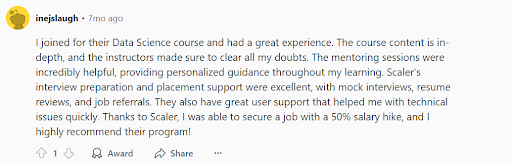
A Redditor expressed how the course content helped them immensely, as well as the mock interviews that were conducted. Practicing both gave them the right amount of preparation.
“Rigorous curriculum with real depth”
“Rigorous curriculum with real depth… Weekly assignments, mock interviews, and mentorship from industry professionals helped me stay accountable… Thanks to Scaler, I was not only able to strengthen my fundamentals but also build the confidence to tackle interviews at top-tier companies.”
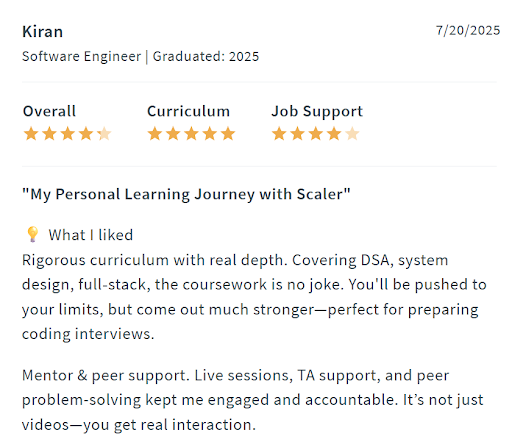
One of our learners, Kiran, admits that the mentorship, projects, mock interviews, and overall course gave her a well-rounded experience.
“Needed More System-Level Experience”
One Reddit user mentioned:
“The curriculum was pretty good overall, but I think the Scaler Academy could use a little more depth in system design.”

So, How Did Scaler Respond?
At Scaler, our teams have taken all the measures to adapt to the students’ feedback. Their System Design course overview now includes hands-on projects covering load balancers, databases, and scalable architectures. We always aim to provide the best resources for our students, and hence, all the feedback we receive only gives us a nudge to become more and more resourceful.
Scaler Student Career Outcomes - Do They Actually Use What They Learn?
The real effectiveness of any learning program lies in how well learners apply acquired skills on the job. At Scaler, we have seen multiple students leave with upgraded skills that helped them fit in smoothly into their jobs. Let’s look into some student stories:
From Learner to Backend Engineer
Abhishek Bhatt, who started in frontend development, was able to shift to backend roles with Scaler’s support:
“Scaler helped me with my preparation as the content was in a much more structured way... I got to learn the system design part... I got an offer from Ajio and started working with them. Even after my course, my learning didn’t halt... I eventually received offers from both Goldman Sachs and Intuit, deciding to go with Intuit.”
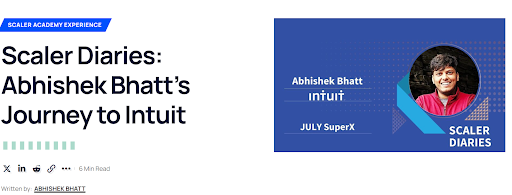
Check out the full story at: Scaler Student Experience
Skills That Show Up on the Job - Git, SQL, Clean Code
Several alumni highlight using Scaler-honed skills directly in their work:
Utkarsh Dwivedi mentioned how the structured curriculum and mentors helped him go from academic lag to landing an SDE role with a significant salary hike.
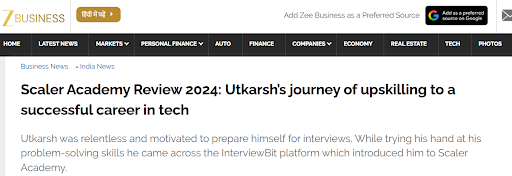
You can check out the full story at: Scaler Academy Review
On Course Report, learners consistently mention applying tools like Git version control, SQL database management, and clean coding styles in their actual jobs, such as their placements at Udaan and Paytm. Their feedback often focuses on how the methodical curriculum helped with practical skills they used from Day 1.
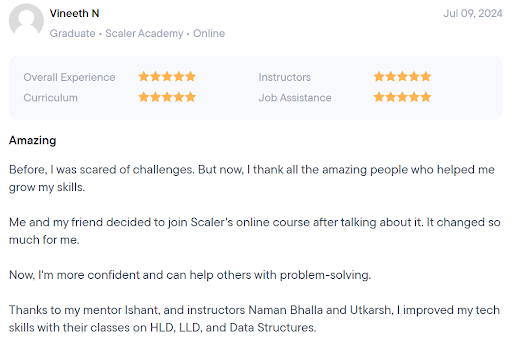
Vineeth explains in his review how the lectures helped him hone technical and problem-solving skills.
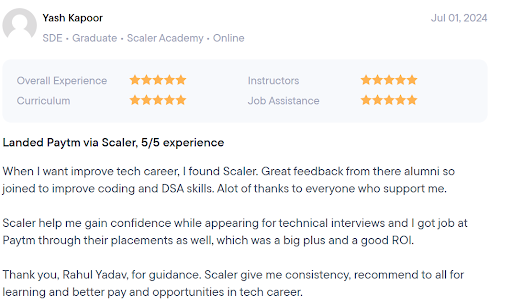
Yash mentions how he was able to land a role at Paytm with the help of Scaler’s well-rounded curriculum.
Common Tools & Practices Learned Through Scaler - Applied at Work
Scaler emphasizes not just technical skills but modern engineering processes, including:
- System design and architecting scalable solutions
- Backend frameworks and real tech stacks such as Docker, SQL/NoSQL, REST APIs
These show up routinely in alumni roles where the ability to handle real-world scenarios matters as much as coding logic.
At Scaler, when we mention skill upgradation, we take our word for it. All the course structures and modules are prepared with current industry standards, and wherever improvement is required, our team actively works on filling every gap possible.
Scaler Vs Other Programs Comparison
If you have spent some time researching upskilling programs, and found way too many courses to choose from. Then worry not, as we’ll provide a direct comparison with a few popular courses. Also, note that none of these comparisons are made to demean the other courses; they are just to give you an objective lens about every course to help you understand the differences better.
| Platform | Mock Interview Hours | Project Depth | Mentor Frequency | Tech Stack Coverage |
|---|---|---|---|---|
| Scaler | They are kept for 50+ hrs, typically industry-style | Full-stack, ML, system design | Weekly 1:1 as well as group | Advanced, job-relevant stack |
| UpGrad | It is Limited, mostly academic focus | Case-study heavy | Monthly sessions | Broad, degree-oriented |
| Coursera | Provide pre-recorded courses | Varies by course | No personal mentors | Wide but self-chosen |
| Masai | Moderate, placement-linked | Functional projects | Regular guidance | Core web & app dev |
All the courses mentioned here serve different purposes. For instance, Coursera offers flexible, self-paced courses that suit learners who want to explore topics independently. UpGrad provides online courses that are often chosen by individuals looking to explore their interests or strengthen their academic foundations. As for Scaler, we focus on career-driven learners, offering systemized learning with features such as mock interview hours, mentorship support, real-world projects, and an updated tech stack. Each of these platforms has its own strengths. While some emphasize academic exploration, others are built around industry readiness or flexible upskilling. Considering Scaler? To learn more, check out: Scaler Admission FAQ
FAQs
Many learners wonder whether Scaler is only about interview prep or if it really helps in building long-term career skills. Let’s address the most common questions:
Does Scaler only teach you to crack interviews?
No. While interview prep is a big part of Scaler’s program, the curriculum is designed to make you strong in problem-solving, system design, and writing clean, production-level code. The goal isn’t just landing a job but sustaining the environment it comes with.
Are Scaler’s projects practical enough for real jobs?
Yes. Scaler projects are modeled after real-world use cases. For example, you might build scalable systems or optimize backend logic that mirrors what companies expect from engineers. These projects are added to the curriculum to prepare you for real-world scenarios.
Will I learn tools like SQL, Docker, Python, and Git?
Yes, definitely. Scaler integrates essential tools and practices into the learning journey. You’ll not only practice coding but also work with SQL databases, containerization with Docker, version control via Git, and popular languages like Python and Java.
How much time goes into real project work vs mock prep?
Both get equal attention. Mock interviews build confidence and sharpen problem-solving under pressure, while project work ensures you can apply those skills in real scenarios. On average, learners spend a balanced amount of time on both, so you graduate job-ready, not just interview-ready.
Conclusion
Scaler believes in maintaining a balance between rigorous interview preparation and genuine skill-building. While the program does place heavy emphasis on mock interviews and structured prep, this isn’t at the expense of real-world readiness. Learners who actively engage with mentors, projects, and assignments often find themselves not only landing jobs but also getting adjusted well in the fast-paced environment. That said, Scaler’s model is most effective for motivated individuals who are ready to put in consistent effort. Most of our students have appreciated our approach to the curriculum and how it helps them develop technical as well as non-technical skills. If you’re someone serious about long-term career growth in tech, Scaler can provide both the discipline and direction needed to succeed. To explore whether it’s the right fit for you, download the curriculum PDF or talk to an alumnus today.