


Selection Statement in Java
 FREE
FREE

Overview
In java, selection statements are also known as branching statements or conditional or decision-making statements. It is used to select part of a program to be executed based on condition. In this article, we will be learning about selection statements in java along with its types and uses.
Build an AI-First Career, Master the Complete Skillset
Choose from our industry-leading programs designed for career success
Modern Software and AI Engineering Program
Master full-stack development with AI integration


 +1000 more
Modern Data Science and ML with specialisation in AI
Advanced data science techniques with AI specialization
+1000 moreAdvanced AIML with Specialisation in Agentic AI
Deep dive into AIML with focus on Agentic systems
+1000 moreDevOps, Cloud & AI Platform Engineering
Build and manage AI-powered cloud infrastructure
+1000 moreAI Engineering Advanced Certification by IIT-Roorkee
Premier AI engineering certification from IIT-Roorkee

AI Forward Deployed Engineer Program
Full-stack engineering, production AI and client-facing consulting
+1000 moreWhat is a Selection Statement in Java?
These are statements that control programs in java. They are used for selecting a path of execution if a certain condition is met.
The Selection Statements in Java
Following are the types of selection statements in java:
if Statement
General format:

Example:
Output:
Explanation: if the test expression is true then the statement is executed else the statement is not executed.
How Scaler Transformed Careers in Different Fields
Scaler learners achieved 2.5x salary growth with average post-Scaler CTC reaching ₹23L.
 Google
 Amazon
 Microsoft
 Flipkart
 Adobe1200+ more
if-else Statement
General format:

Example:
Output:
Explanation: if the test expression is true then the statement is executed else statement 2 is executed.
Nested if Statement
General format:
Example:
Output:
Explanation: In this, writing an if statement inside another if statement is called the next if statement. If the first condition is true, it will check for the second condition after which the inner block will be executed else not.
Turn Learning into Career Growth
if- else if- else Statement
General format:
Example:
Output:
Explanation: if test expression1 is true then statement 1 is executed else if test expression2 is true then statement2 is executed else statement3 will be executed.
Switch Statement
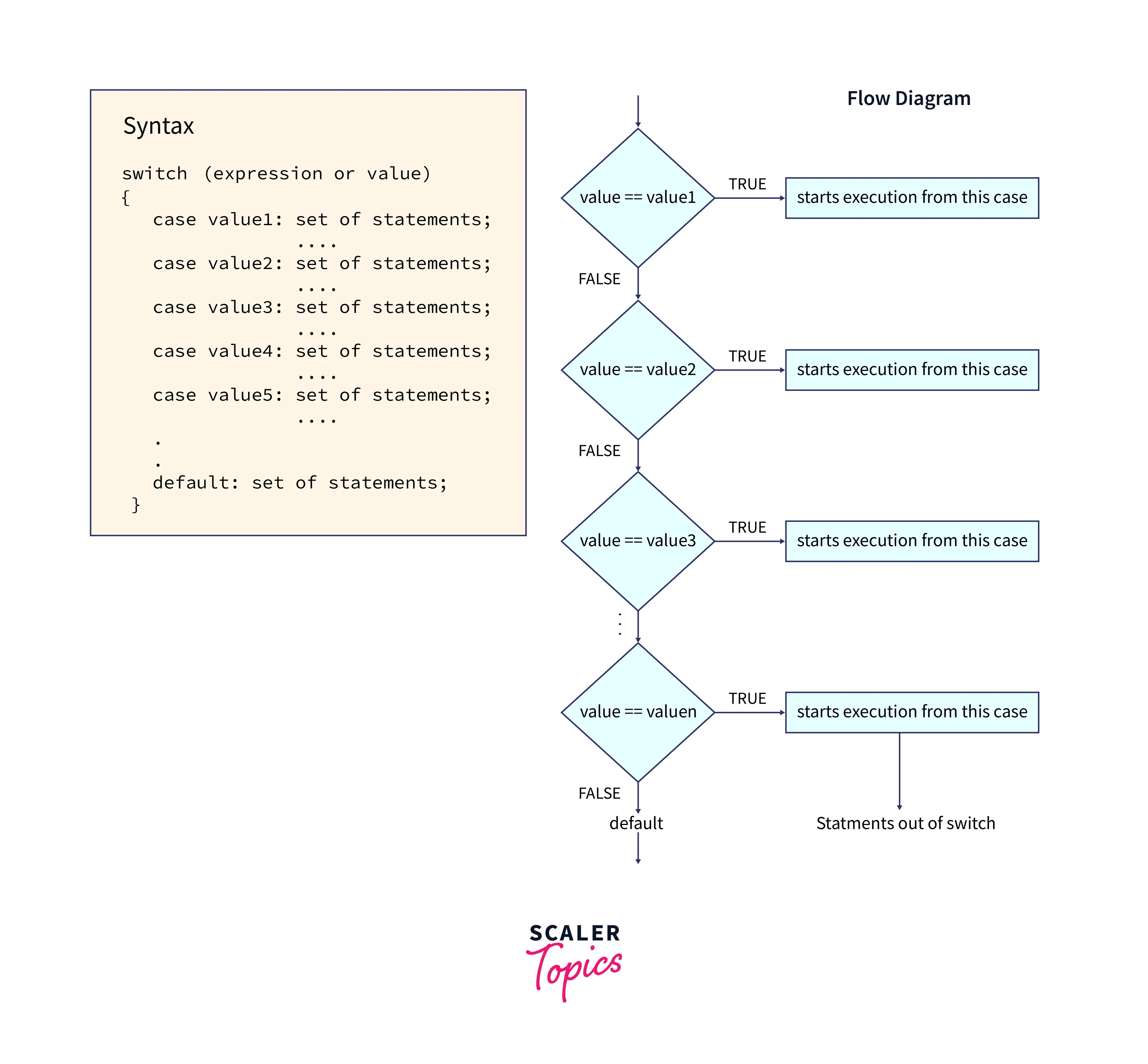
General format:
Example:
Output:
Explanation: if the value of the expression is matched with value 1, then the corresponding stmt sequence is executed. If not matched with value 1 then try with the next case value and so on. If none of the cases match then default stmt is executed. All cases should be unique. The expression must be of type byte, short, int, or char Each case value should be literal. Default is not compulsory and can be written anywhere.
Note:
- single statement does not require { }
- Block of statements require { }
Conclusion
- Selection statements are also known as branching statements or conditional or decision-making statements. It is used to select part of a program to be executed based on condition.
- The selection statements in Java
- if statement
- if-else statement
- nested if statement
- if-else if statement
- switch statement
- These are statements that control programs in java. They are used for selecting a path of execution if a certain condition is met.




