


Service Mesh in DevOps
Overview
Service mesh is a critical component in DevOps practices, providing enhanced observability, security, and control for microservices-based architectures. It acts as a dedicated infrastructure layer, facilitating communication and data exchange between services. By abstracting away the complexity of network and communication concerns, service mesh enables seamless deployment, scaling, and management of microservices. It offers features like traffic management, load balancing, circuit-breaking, and fault tolerance, ensuring efficient and reliable service-to-service communication.
Introduction
Service mesh has emerged as a fundamental technology in the world of DevOps, revolutionizing the way microservices-based architectures are managed and orchestrated. In a nutshell, a service mesh is a dedicated infrastructure layer that enables secure, reliable, and observable communication between services. It abstracts away the complexity of network and communication concerns, allowing DevOps teams to focus on delivering and scaling applications without worrying about the underlying infrastructure.
Service mesh provides a plethora of features, including traffic management, service discovery, load balancing, security, and observability, all of which are crucial in building resilient and scalable microservices applications. By leveraging a service mesh, DevOps practitioners can streamline development, enhance operational efficiency, and deliver robust and scalable applications to their end-users.
Why do You Need a Service Mesh?
There are several reasons why a service mesh is necessary in modern application architectures:
-
Service-to-service communication:
In microservices-based architectures, there can be numerous services communicating with each other. Managing and securing this communication manually can be complex and error-prone. A service mesh provides a centralized and automated approach to handling service-to-service communication, ensuring reliability, security, and scalability.
-
Traffic management:
Service mesh offers traffic management capabilities such as load balancing, routing, and service discovery. It enables fine-grained control over how traffic is distributed between services, allowing for efficient resource utilization and improved overall system performance.
-
Observability:
A service mesh provides deep insights into the behavior of services, offering metrics, logs, and distributed tracing. This observability helps in identifying and troubleshooting issues quickly, enabling faster debugging and performance optimization.
-
Security:
Service mesh enhances security by providing encryption and authentication capabilities. It can enforce policies for service-to-service communication, implement access control, and enable secure communication between services, protecting against potential threats.
-
Resilience and fault tolerance:
A service mesh can implement features like circuit breaking and retry mechanisms to handle failures and network disruptions gracefully. This helps in building robust and resilient applications that can recover from failures and maintain high availability.
-
Scalability and agility:
By abstracting away the complexities of networking and communication, service mesh allows developers to focus on building and deploying services rapidly. It provides the necessary infrastructure to scale services independently, enabling agility and efficient resource allocation.
What is a Service Mesh?
A service mesh is a dedicated infrastructure layer that facilitates communication between services in a microservices architecture. It acts as a transparent and decentralized network of proxies that are deployed alongside services. These proxies intercept and manage service-to-service communication, offering a range of capabilities and features to improve the reliability, security, and observability of the system.
The primary purpose of a service mesh is to abstract away the complexities of network communication from individual services, allowing developers to focus on business logic rather than networking concerns. It provides a standardized way to handle common communication patterns, such as service discovery, load balancing, routing, authentication, and encryption.
Service meshes typically employ a sidecar proxy pattern, where each service has its proxy container that handles inbound and outbound traffic on behalf of the service. This approach enables granular control and monitoring of communication between services without requiring changes to the application code.
In addition to facilitating communication, a service mesh offers features like traffic management, fault tolerance, circuit breaking, distributed tracing, metrics collection, and security policy enforcement. These capabilities help improve the resilience, scalability, and observability of the microservices architecture.
Popular service mesh implementations include Istio, Linkerd, and Consul Connect. These frameworks provide the necessary tools and components to deploy, manage, and control the service mesh infrastructure, allowing DevOps teams to effectively operate and scale microservices-based applications.
Components of a Service Mesh Architecture
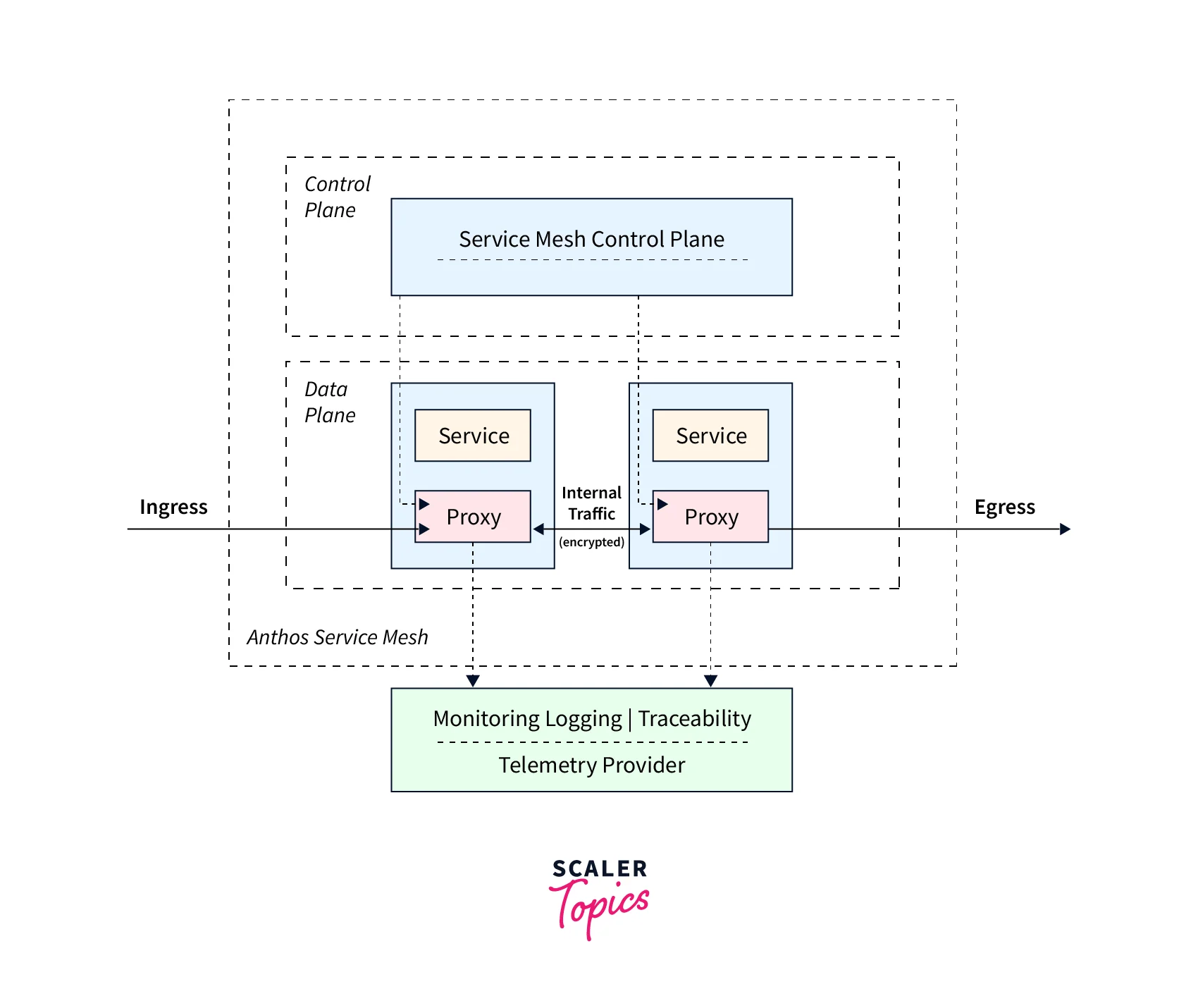
The Data Plane
The data plane, also known as the sidecar proxy layer, is responsible for handling the actual communication between services. It typically consists of lightweight proxies that are deployed alongside each service in the mesh. These proxies intercept and manage the inbound and outbound traffic of the service, acting as intermediaries. Key features and functions of the data plane include:
-
Service Proxy:
Each service is paired with a proxy, which intercepts requests and responses, allowing for traffic management and control.
-
Load Balancing:
The data plane proxies distribute incoming requests across multiple instances of the same service, ensuring efficient resource utilization and high availability.
-
Service Discovery:
Proxies maintain a service registry and provide service discovery capabilities, enabling services to locate and communicate with each other dynamically.
-
Security:
Proxies handle encryption and authentication between services, ensuring secure communication within the mesh.
-
Observability:
The data plane collects and forwards metrics, logs, and tracing information, providing visibility into the behavior and performance of services.
The Control Plane
The control plane is responsible for managing and configuring the data plane proxies. It provides a centralized management and control interface for the service mesh. The control plane orchestrates the behavior of the proxies, ensuring consistency, scalability, and security across the mesh. Key features and functions of the control plane include:
-
Service Mesh Configuration:
The control plane defines and manages the configuration for the service mesh, including traffic management rules, security policies, and service discovery information.
-
Service Discovery and Routing:
The control plane maintains a global view of the service mesh and provides service discovery and routing capabilities to enable efficient and reliable communication between services.
-
Policy Enforcement:
The control plane enforces security policies, traffic management rules, and other policies across the mesh, ensuring compliance and adherence to defined guidelines.
-
Telemetry and Monitoring:
The control plane collects and aggregates telemetry data from the data plane proxies, providing a comprehensive view of the system's behavior. It enables monitoring, alerting, and troubleshooting of the service mesh.
-
Dynamic Configuration:
The control plane allows for dynamic configuration updates and can automatically propagate changes to the data plane proxies, enabling real-time adaptability and configuration management.
How does Service Mesh Work?
Service mesh works by deploying a network of proxies, known as sidecar proxies, alongside each service in a microservices architecture. These proxies intercept and manage the communication between services, providing a centralized control and management layer.
Here's a step-by-step explanation of how service mesh works:
-
Deployment:
Each service in the microservices architecture is paired with a sidecar proxy, which runs alongside the service in the same pod or container. The proxy is responsible for handling inbound and outbound traffic for that specific service.
-
Interception:
All traffic, including requests and responses, between services is intercepted by the sidecar proxies. These proxies act as intermediaries, allowing them to inspect, manipulate, and control the traffic flow.
-
Service Discovery:
The sidecar proxies maintain a service registry, which contains information about all the services within the mesh. They use this registry for service discovery, allowing services to locate and communicate with each other dynamically.
-
Traffic Management:
The sidecar proxies enable advanced traffic management capabilities. They can perform load balancing by distributing incoming requests across multiple instances of a service. They can also implement routing rules to direct traffic based on various criteria, such as versioning, geographical location, or request attributes.
-
Security:
Service mesh provides security features at the proxy level. The sidecar proxies handle encryption and authentication between services, ensuring secure communication within the mesh. They can enforce access control policies, implement mutual TLS (Transport Layer Security), and authenticate and authorize requests.
-
Observability:
The sidecar proxies collect telemetry data, including metrics, logs, and distributed tracing information. This data is forwarded to a centralized monitoring and observability system, allowing DevOps teams to gain insights into the behavior and performance of the services. It facilitates monitoring, troubleshooting, and performance optimization.
-
Control Plane:
The service mesh architecture includes a control plane, which is responsible for managing and configuring the sidecar proxies. It provides a centralized interface to define and enforce policies, configure traffic management rules, and propagate changes to the proxies. The control plane enables dynamic configuration updates and ensures consistent behavior across the mesh.
Benefits of Deploying a Service Mesh
Deploying a service mesh brings several benefits to the development and operation of microservices-based architectures. Here are some key advantages:
-
Traffic Management:
Service mesh provides advanced traffic management capabilities such as load balancing, routing, and service discovery. This ensures efficient resource utilization, and improved performance, and enables seamless service-to-service communication.
-
Security:
Service mesh enhances the security of microservices architectures by providing encryption, authentication, and access control at the proxy level. It enforces security policies and enables secure communication between services, protecting against potential threats and vulnerabilities.
-
Observability:
Service mesh offers comprehensive observability features, including metrics, logs, and distributed tracing. It provides deep insights into the behavior and performance of services, facilitating monitoring, troubleshooting, and performance optimization.
-
Resilience and Fault Tolerance:
With features like circuit breaking and retries, service mesh improves the resilience of microservices architectures. It helps services handle failures and network disruptions gracefully, ensuring high availability and minimizing the impact of service outages.
-
Scalability and Agility:
Service mesh enables independent scaling of services by managing traffic distribution and load balancing. It allows for rapid deployment and scaling of microservices, providing flexibility and agility to meet changing demands.
-
Centralised Management:
Service mesh architecture includes a control plane that provides a centralized management interface. It allows for dynamic configuration, policy enforcement, and propagation of changes to the proxies, ensuring consistent behavior across the mesh.
-
Service Versioning and A/B Testing:
Service mesh enables easy implementation of service versioning and A/B testing strategies. It allows for traffic routing based on different versions or configurations of services, enabling seamless testing and rollouts of new features or changes.
-
Developer Productivity:
By abstracting away the complexities of network communication, service mesh simplifies the development process for individual services. Developers can focus on business logic without worrying about networking concerns, leading to increased productivity and faster time to market.
Available Service Meshes
Consul Connect, Linkerd, and Istio Service Mesh are three popular options for implementing service mesh architectures in microservices-based applications.
Consul Connect
Consul Connect, developed by HashiCorp, is a service mesh and service discovery tool. It focuses on networking and security features for distributed architectures. Consul Connect provides service discovery for dynamic communication, secure service-to-service communication through mutual TLS encryption, and traffic management capabilities like load balancing and circuit breaking.
Linkerd
Linkerd is a lightweight and easy-to-use service mesh designed for cloud-native applications. It emphasizes simplicity, performance, and reliability. Linkerd offers features such as load balancing, request routing, and retries for efficient and resilient service communication. It provides secure communication through mTLS encryption and integrates with popular monitoring and observability tools.
Istio Service Mesh
Istio is a feature-rich and widely adopted service mesh solution. It offers advanced traffic management, security, and observability features. Istio provides traffic routing, load balancing, and fault injection capabilities. It enforces secure communication through mTLS encryption, implements authentication and authorization policies, and integrates with observability tools for metrics, logs, and distributed tracing.
Conclusion
- Service mesh in DevOps brings several benefits to microservices architectures by providing enhanced control, security, and observability.
- It simplifies service-to-service communication by abstracting away the complexities of network communication from individual services.
- Service mesh enables advanced traffic management capabilities like load balancing, routing, and service discovery, improving performance and resource utilization.
- It enhances security through features like encryption, authentication, and access control at the proxy level, ensuring secure communication within the mesh.
- Service mesh offers comprehensive observability features, including metrics, logs, and distributed tracing, enabling effective monitoring, troubleshooting, and performance optimization.
- It improves resilience and fault tolerance by handling failures and disruptions gracefully, ensuring high availability, and minimizing the impact of service outages.
- Service mesh enables scalability and agility by allowing independent scaling of services and facilitating rapid deployment and scaling of microservices.
- It provides a centralized management interface through the control plane, enabling dynamic configuration, policy enforcement, and consistent behavior across the mesh.
- Service mesh increases developer productivity by abstracting networking concerns, allowing developers to focus on business logic and accelerating the development and deployment of microservices-based applications.