

State Space Search in Artificial Intelligence
What Is State Space Search in AI?
State space search in artificial intelligence is a problem-solving technique used to find a sequence of actions that transforms an initial state into a goal state. It represents all possible states of a problem and explores them systematically to identify a valid solution path. State space search is used in AI for solving puzzles, planning tasks, and decision-making problems.
State Space Search - Key Components
State space search in AI is built around a structured representation of a problem using specific components. These components define how a problem is modeled and how the search process progresses from the starting point to the desired solution.
Key Components of State Space Search
-
State: A state represents a specific configuration or situation of a problem at a given point in time. Each state describes the current status of all relevant variables in the problem.
-
Initial State: The initial state is the starting point of the search process. It defines the condition of the system before any actions are performed.
-
Goal State: The goal state represents the desired solution or final condition that the search algorithm aims to reach. A problem is considered solved when the goal state is achieved.
-
Operators (Actions): Operators are the valid actions or moves that can be applied to a state to generate a new state. These actions help transition from one state to another during the search process.
-
State Space Graph: A state space graph is a visual or conceptual representation of all possible states of a problem and the transitions between them. In this graph, nodes represent states, and edges represent operators that connect one state to another.
Together, these components form the foundation of state space representation in AI and enable systematic exploration of possible solutions.
Stop learning AI in fragments—master a structured AI Engineering Course with hands-on GenAI systems with IIT Roorkee CEC Certification


AI Engineering Course Advanced Certification by IIT-Roorkee CEC
A hands on AI engineering program covering Machine Learning, Generative AI, and LLMs - designed for working professionals & delivered by IIT Roorkee in collaboration with Scaler.
Enrol Now
Problem Formulation in State Space Search
Problem formulation in state space search defines how a real-world or computational problem is represented so that an AI system can solve it systematically. A well-defined formulation helps the search process identify valid moves, evaluate progress, and determine the most efficient path to reach the solution. In artificial intelligence, problems are typically formulated using the following formal components:
Elements of Problem Formulation
-
Initial State: The initial state represents the starting configuration of the problem. It describes the condition of the system before any actions are applied. All search processes begin from this state.
-
Actions: Actions define the set of possible operations that can be performed on a given state. These actions determine how the system can move from one state to another during the search process.
-
Transition Model: The transition model describes the result of applying a specific action to a state. It defines how one state changes into another when an operator is executed, ensuring that each action produces a predictable outcome.
-
Goal Test: The goal test determines whether a particular state satisfies the desired solution criteria. The search process continues until a state meets the goal condition defined for the problem.
-
Path Cost: Path cost measures the total cost required to reach a state from the initial state. It may represent distance, time, number of moves, or any other performance metric used to evaluate solution efficiency.
Proper problem formulation in state space search helps AI systems explore solutions effectively by clearly defining the starting point, possible moves, evaluation criteria, and optimal path selection.
How State Space Search Works
State space search works by systematically exploring possible states of a problem to find a sequence of actions that leads from the initial state to the goal state. The search process evaluates different paths and selects valid transitions until a solution is reached or all possibilities are explored.
Step-by-Step Working of State Space Search
1. Start From the Initial State - The search process begins from the initial state, which represents the starting condition of the problem. This state acts as the root of the search process.
2. Generate Possible Successor States - The system applies valid operators (actions) to the current state to generate new states. These newly generated states are called successor states and represent possible progress toward the solution.
3. Explore the State Space - The search algorithm evaluates the generated states and selects one or more states for further exploration. The method used to explore states depends on the chosen search strategy, such as breadth-first search or depth-first search.
4. Check the Goal State - Each newly generated state is tested to determine whether it satisfies the goal condition. If the goal test is successful, the search process terminates.
5. Track the Solution Path - Once the goal state is reached, the sequence of actions taken from the initial state to the goal state is recorded. This sequence represents the solution to the problem.
If the goal state is not found, the search continues by exploring remaining states in the state space. This step-by-step exploration enables AI systems to solve complex problems by evaluating multiple possible paths systematically.
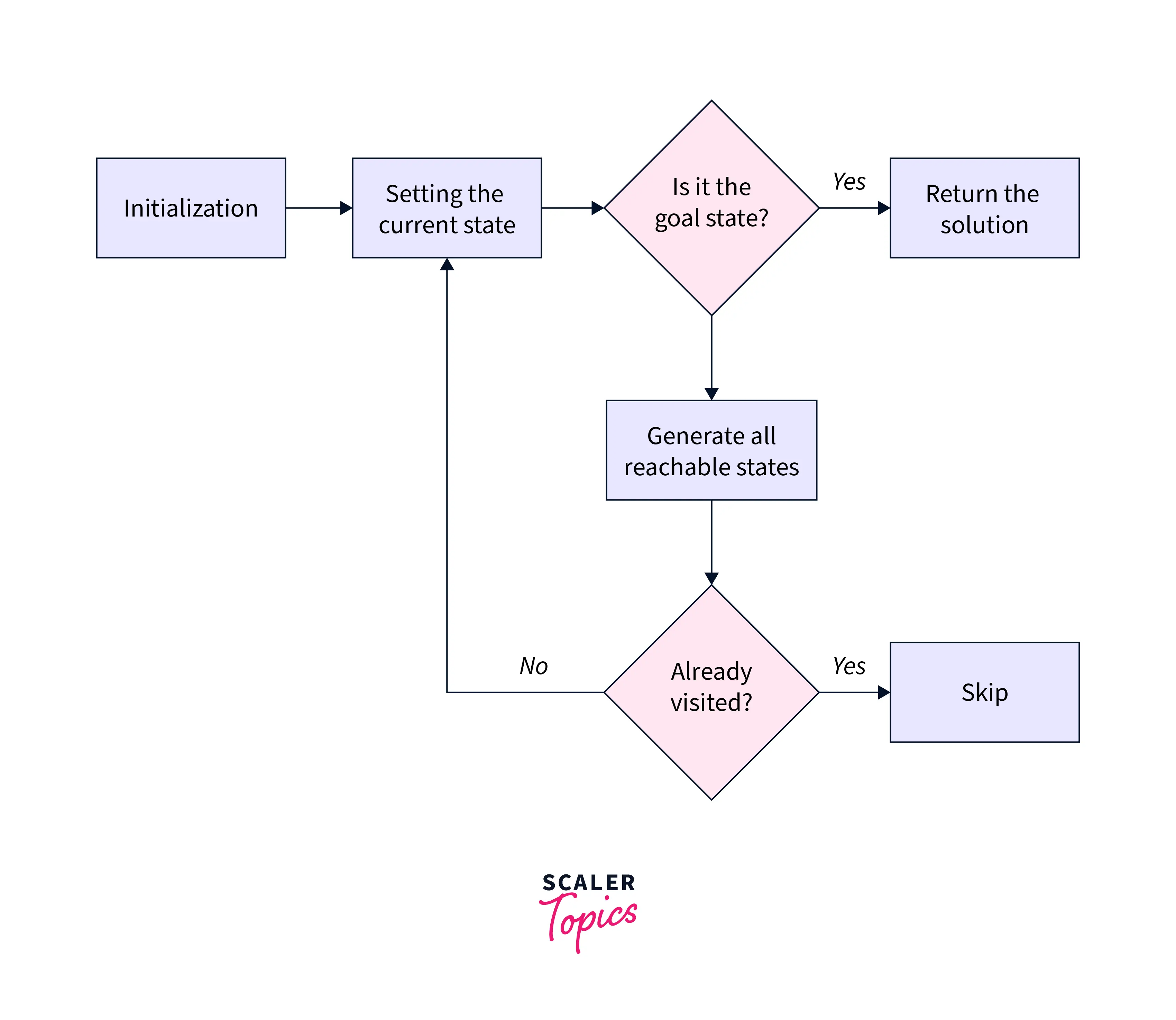
State Space Search Diagram
Understanding how states transition step-by-step can be difficult at times, and we totally understand that. Hence, to make this easier to visualize, the diagram below provides a graphical representation of state space search.
It shows how the search process moves from the initial state to the goal state through different intermediate states and operators.
Example of State Space Search in AI
A classic example of state space search in artificial intelligence is the “Water Jug Problem”. This problem shows how AI systems represent different states of a problem and apply actions systematically to reach a goal state.
Water Jug Problem Description
Suppose there are two water jugs:
- Jug A can hold 4 liters of water
- Jug B can hold 3 liters of water
- The objective is to measure exactly 2 liters of water using these jugs
This problem is solved by representing each possible configuration of water in both jugs as a state and applying valid operations to transition between states.
States
A state represents the amount of water present in both jugs at a particular time.
Each state can be represented as:
(State of Jug A, State of Jug B)
Examples:
- (0, 0) - Both jugs are empty
- (4, 0) - Jug A is full, Jug B is empty
- (1, 3) - Jug A contains 1 liter, Jug B contains 3 liters
Operators (Actions)
Operators define valid actions that can be performed on the jugs. These include:
- Filling a jug completely
- Emptying a jug
- Pouring water from one jug to another until one jug is full or the other becomes empty
Goal State
The goal is to obtain exactly 2 liters of water in any of the jugs.
For example:
(2, 0)
or
(2, 3)
Search Progression
The state space search explores possible transitions step-by-step:
- Start with the initial state - (0, 0)
- Fill Jug B - (0, 3)
- Pour water from Jug B into Jug A - (3, 0)
- Fill Jug B again - (3, 3)
- Pour water from Jug B into Jug A until Jug A is full - (4, 2)
- Empty Jug A - (0, 2)
The goal state is achieved because Jug B contains exactly 2 liters of water.
Master structured AI Engineering + GenAI hands-on, earn IIT Roorkee CEC Certification at ₹40,000
AI Engineering Course Advanced Certification by IIT-Roorkee CEC
A hands on AI engineering program covering Machine Learning, Generative AI, and LLMs - designed for working professionals & delivered by IIT Roorkee in collaboration with Scaler.
Enrol NowTypes of State Space Search
State space search in artificial intelligence can be performed in different directions depending on how the problem is approached. The two main types of state space search are forward search and backward search.
1. Forward State Space Search
Forward state space search starts from the initial state and explores possible states by applying valid actions until the goal state is reached. This approach is commonly used when the starting condition of a problem is clearly defined, and operators are easy to apply.
2. Backward State Space Search
Backward state space search begins from the goal state and works backward by identifying actions that could have produced the goal. The search continues until it reaches the initial state. This approach is useful when the goal state is well defined and the number of possible goal conditions is limited.
Advantages of State Space Search
State space search in artificial intelligence provides a structured approach to solving complex problems by representing them as a collection of states and transitions. This method offers several advantages that make it widely applicable in AI problem-solving and planning tasks.
1. Systematic Problem Solving
State space search follows a well-defined process to explore possible states and transitions. This systematic exploration ensures that all valid solution paths are considered, reducing the chances of missing a correct solution. It also allows search algorithms to evaluate and compare multiple paths effectively.
2. General-Purpose Approach
State space search is not limited to a specific type of problem. It can be applied to various AI applications such as puzzle solving, path planning, robotics, and decision-making tasks. This flexibility makes it a fundamental technique in artificial intelligence problem representation.
3. Easy to Model Complex Problems
Many problems that do occur in actual scenarios can be easily represented using states and operators. By breaking complex tasks into smaller state transitions, state space search simplifies problem modeling and helps AI systems understand how to reach the desired goal efficiently.
Limitations of State Space Search
Although state space search is a powerful problem-solving technique in artificial intelligence, it has certain limitations when applied to complex or large-scale problems. These challenges mainly arise due to the rapid growth of possible states and the computational resources required to explore them.
1. State Explosion Problem
One major limitation of state space search is the rapid increase in the number of possible states as the complexity of a problem grows. This phenomenon, known as state explosion, makes it difficult for search algorithms to explore all possible states efficiently, especially in problems with a large number of variables or possible actions.
2. Memory-Intensive Computation
State space search often requires storing multiple states and tracking explored paths during the search process. As the number of states increases, the memory required to store these states and maintain search data structures also increases significantly, which can affect system performance.
3. Not Scalable for Large Problems
State space search works effectively for small or moderately complex problems, but becomes inefficient for very large problem spaces. When the number of possible states grows excessively, exploring every state becomes computationally expensive, making the technique less practical for large-scale AI applications.
State Space Search vs Search Algorithms
Students, at first, confuse state space search with search algorithms such as Breadth-First Search (BFS) and Depth-First Search (DFS).
However, state space search is a conceptual framework used to represent problems, while search algorithms are techniques used to explore the state space and find solutions.
Become the Ai engineer who can design, build, and iterate real AI products, not just demos with an IIT Roorkee CEC Certification
AI Engineering Course Advanced Certification by IIT-Roorkee CEC
A hands on AI engineering program covering Machine Learning, Generative AI, and LLMs - designed for working professionals & delivered by IIT Roorkee in collaboration with Scaler.
Enrol NowState Space Search vs Search Algorithms Comparison
| Aspect | State Space Search | Search Algorithms (BFS, DFS, etc.) |
|---|---|---|
| Purpose | Represents a problem as states and transitions | Explores the state space to find a solution |
| Nature | Conceptual problem representation | Computational methods used for searching |
| Focus | Defines possible states, actions, and goal conditions | Determines how states are explored |
| Examples | Puzzle representation, planning problems, pathfinding models | BFS, DFS, Uniform Cost Search, A* Search |
| Role in AI | Provides the structure of the problem | Provides the strategy to solve the problem |
State space search defines how a problem is modeled by identifying states, operators, initial conditions, and goal states. It provides the framework that allows AI systems to understand the problem environment.
Search algorithms such as BFS and DFS operate within this framework by deciding how states should be explored. They determine the order in which states are visited and how the solution path is discovered.
FAQs
What is state space search in artificial intelligence?
State space search in artificial intelligence is a problem-solving technique that represents a problem as a set of possible states and transitions between them. The search process explores these states systematically to find a path from an initial state to a goal state using defined actions or operators.
Which problem is an example of state space search?
The Water Jug problem and the 8-Puzzle problem are classic examples of state space search in AI. In these problems, each configuration is treated as a state, and valid moves act as operators that transition the system toward a defined goal state.
How is state represented in state space search?
In state space search, a state is represented as a specific configuration of all relevant variables of a problem at a given time. For example, in the Water Jug problem, a state is represented as an ordered pair showing the amount of water in each jug.
What is the difference between state space search and problem space?
State space search refers to the technique of exploring all possible states to solve a problem, while problem space represents the entire set of possible states and transitions of that problem. In simple terms, problem space is the environment, and state space search is the method used to navigate it.
Why is state space search inefficient?
State space search can be inefficient due to the state explosion problem, where the number of possible states grows rapidly with problem complexity. This leads to high memory usage and increased computational time, making it difficult to scale for large or complex AI problems.