Static Routing
Overview
Static routing is a fundamental concept in computer networking in which network routers are manually configured to direct traffic between different networks or subnets. Unlike dynamic routing, which uses protocols to exchange routing information and make routing decisions dynamically, static routing needs administrators to manually establish the routes that data packets should take. The static routing method can be used when network traffic is predictable and well-planned. It cannot be used in an extensive and constantly changing network since it is incapable of reacting to network changes.
Build an AI-First Career, Master the Complete Skillset
Choose from our industry-leading programs designed for career success
Modern Software and AI Engineering Program
Master full-stack development with AI integration


 +1000 more
Modern Data Science and ML with specialisation in AI
Advanced data science techniques with AI specialization
+1000 moreAdvanced AIML with Specialisation in Agentic AI
Deep dive into AIML with focus on Agentic systems
+1000 moreDevOps, Cloud & AI Platform Engineering
Build and manage AI-powered cloud infrastructure
+1000 moreAI Engineering Advanced Certification by IIT-Roorkee
Premier AI engineering certification from IIT-Roorkee

AI Forward Deployed Engineer Program
Full-stack engineering, production AI and client-facing consulting
+1000 moreWhat is Static Routing?
Static routing is a routing technique in which routers use manually configured routing entries rather than dynamic ones. Unlike dynamic routing, which uses protocols to exchange routing information and make routing decisions dynamically, static routing needs administrators to manually establish the routes that data packets should take.
While static routing has various drawbacks, it is the most natural and effective routing method in some scenarios. It is frequently regarded as the most basic routing approach and requires extensive manual involvement. When information paths require frequent changes, they often become less efficient as a routing preference.
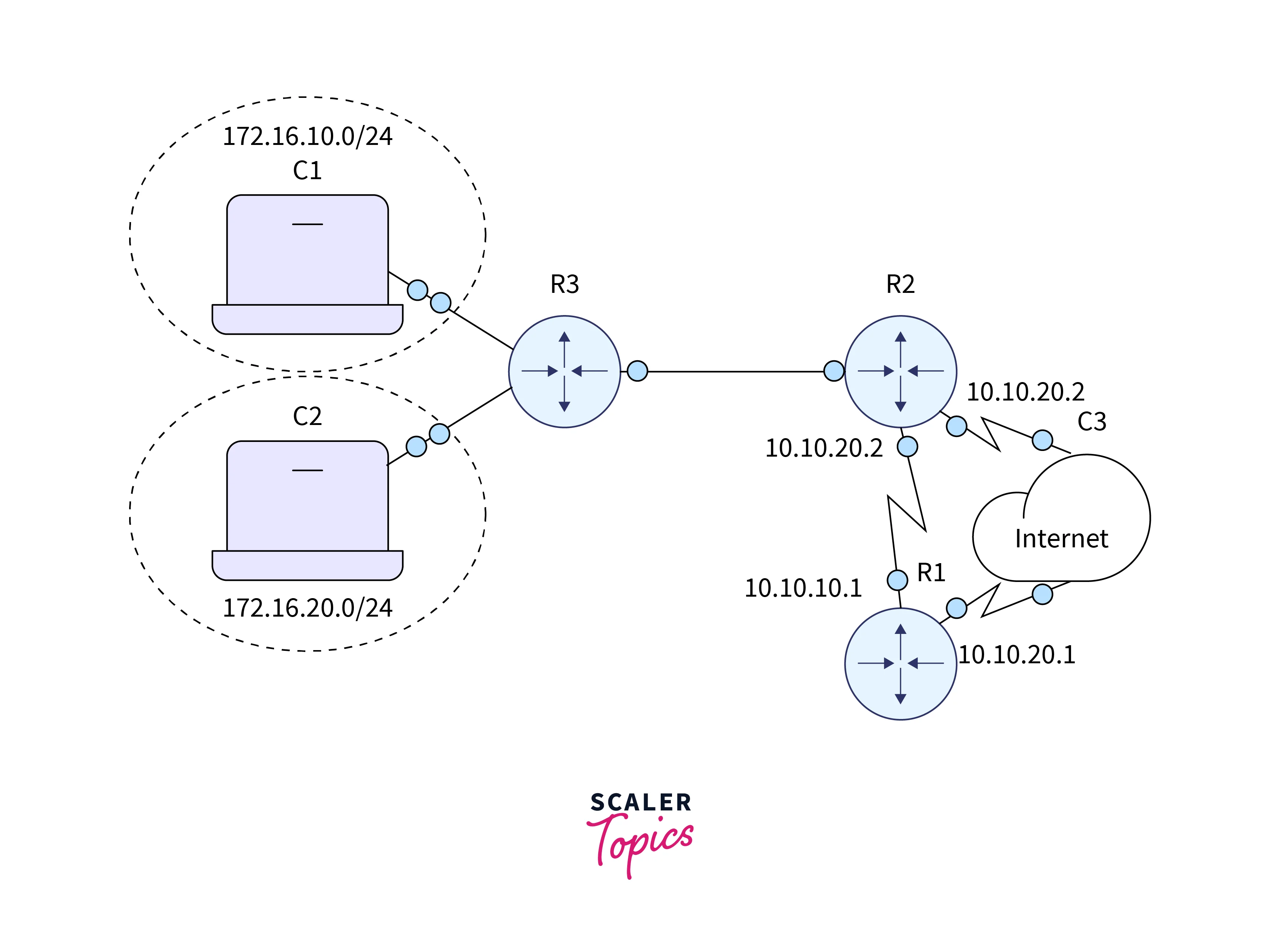
Uses
The following are some uses of static routing:
- It is used to establish an exit point from a router when no other routes are available, which is known as a default route.
- Static routing is preferable for small networks with few routes because of its efficiency, it saves excessive resource consumption from dynamic routing information exchanges.
- It is typically used as a complement to dynamic routing as a backup solution when dynamic routes become unavailable.
- It facilitates the transmission of routing details between multiple routing protocols, allowing for the harmonic integration of routing information across various network environments.
Advantages
Static routing has various advantages, including:
- It imposes less burden on the router's CPU and does not cause any additional traffic to be transmitted to other routers.
- It provides the network administrator with total control over the network's routing operations.
- It's well-suited for configuration within smaller networks.
- Static routes can be considered more secure in some cases, as they don't rely on communication between routers to exchange routing information.
- Static routing allows administrators to specify exact routes for certain types of traffic.
Disadvantages
Static routing has various disadvantages, including:
- Static routes are prone to errors upon administrator input due to their manual configuration.
- Static routing cannot respond to network changes or failures, making it less robust in dynamic environments.
- Static routes can disrupt the normal operation of routing protocols. This can be addressed by manually altering the administrative distance.
- Configuring static routes can be time-consuming, particularly with a large number of routers, and reconfiguration can be slow and inefficient.
- Static routes might not always reflect the most efficient paths for data to traverse the network.
How Scaler Transformed Careers in Different Fields
Scaler learners achieved 2.5x salary growth with average post-Scaler CTC reaching ₹23L.
 Google
 Amazon
 Microsoft
 Flipkart
 Adobe1200+ more
Working on Static Routing Algorithm
Here is the working of the Static routing algorithm explained in a stepwise manner:
Step - 1:
A static router must maintain a routing table that includes each network in the internetwork to function properly.
Turn Learning into Career Growth
Step - 2:
In this step, hosts inside a network are configured to have default gateway addresses that match the IP addresses of the local router interfaces.
Step - 3:
When a host needs to transmit a packet to another network, the packet is sent to the local router. Following that, the host examines its routing table to determine the best path for forwarding the packet.
Step - 4:
Static routers are usually more difficult to administer than dynamic routers. However, they have the benefit of enhanced security because the administrator has direct control over the router's configuration.
Conclusion
- Static routing is a fundamental concept in computer networking in which network routers are manually configured to direct traffic between different networks or subnets.
- Static routing, as compared to dynamic routing, which uses protocols to share routing information and make routing decisions dynamically, requires administrators to manually specify the routes that data packets should travel.
- Static routing can be utilized in situations when network traffic is predictable and well-planned.
- It cannot be utilized in an extensive and constantly changing network since it is incapable of reacting to network changes.
- Static routing imposes less burden on the router’s CPU and does not cause any additional traffic to be transmitted to other routers.
- Static routing cannot respond to network changes or failures, making it less robust in dynamic environments.