The Economics of the Forward Deployed Engineer Model
Short answer: an FDE is expensive, and early on the work drags gross margin below normal software levels. Companies accept that because embedded engineers win bigger contracts, capture customer data and build a moat. The bet only works if the services shrink as the product matures.
Software investors have a favorite number: 80% gross margin. Hire a team of expensive engineers to sit inside your customers and watch that number wobble.
So why does everyone from Palantir to the AI labs do it anyway?
Because the margin you give up early can buy you the customer. Here’s the logic, the real numbers I could find, and where the numbers are shakier than the headlines suggest.
Why do companies accept lower margins for FDEs?
The best explanation is in a16z’s Trading Margin for Moat. Its argument: enterprise AI products are too complex to sell like self-serve software, so hands-on services are worth the cost early.
• Bigger first contracts. Hands-on support helps land larger initial deals, shows customers will pay and informs future pricing.
• Owning the workflow. Being the “system of work” means controlling where and how data enters, which becomes a durable moat.
• Gross profit over gross margin. The goal is to grow total gross profit quickly, not hit 80% from day one.
a16z backs this with history. Enterprise software giants started thin:
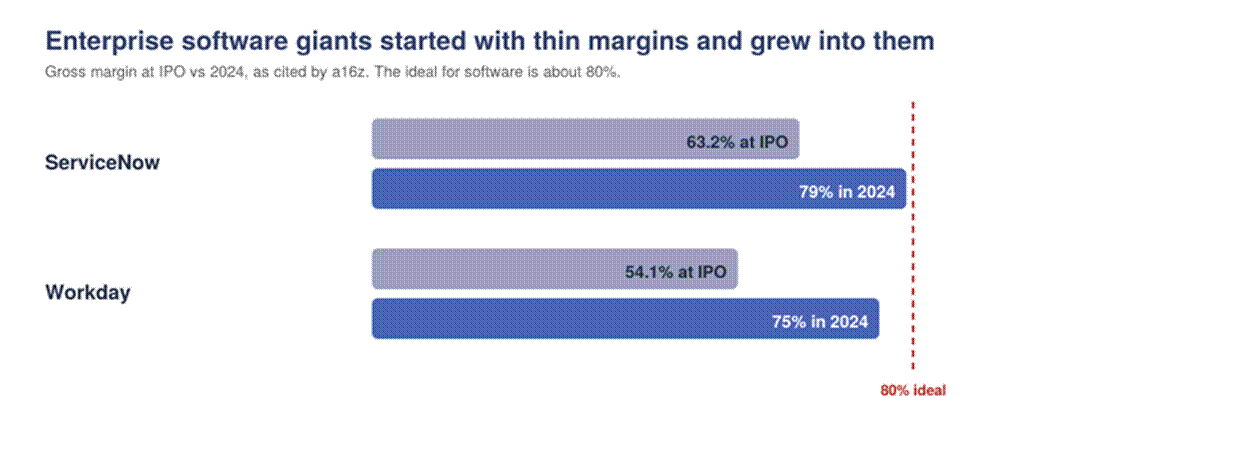
Chart: original, built from a16z’s figures. Checked 1 Nov 2026.
The pattern a16z describes: lower margins while implementation is heavy, then pricing power and partner ecosystems lift them. It also notes that AI can automate parts of implementation itself.
Fair counterpoint, which a16z also raises: critics say services limit scalability and signal a commodity product. The author’s reply is that most durable enterprise models include hands-on help, and ecosystems come later.
Build an AI-First Career, Master the Complete Skillset
Choose from our industry-leading programs designed for career success
Modern Software and AI Engineering Program
Master full-stack development with AI integration


 +1000 more
Modern Data Science and ML with specialisation in AI
Advanced data science techniques with AI specialization
+1000 moreAdvanced AIML with Specialisation in Agentic AI
Deep dive into AIML with focus on Agentic systems
+1000 moreDevOps, Cloud & AI Platform Engineering
Build and manage AI-powered cloud infrastructure
+1000 moreAI Engineering Advanced Certification by IIT-Roorkee
Premier AI engineering certification from IIT-Roorkee

AI Forward Deployed Engineer Program
Full-stack engineering, production AI and client-facing consulting
+1000 moreHow much does an FDE actually cost?
A lot, and the sources agree on the direction if not the number.
Forbes calls the on-site engineer “the most expensive job in enterprise AI”. It says senior technical roles at OpenAI and Anthropic can reach the high six figures, and that it is unclear whether pay stays that high across thousands of deployments. It gives no per-FDE cost figure.
For numbers, one unit-economics analysis cites Levels.fyi from May 2026: Anthropic median total compensation of $582K, OpenAI around $450K and Palantir about $238K on average. It then models a fully loaded cost of $845K a year at a frontier lab. Treat that last number as the author’s assumption, not a reported cost.
• Pay is only part. Benefits, tooling, travel and management add to it.
• Seniority drives price. These are senior engineers who ship production code against legacy systems.
• Costs differ widely. A lab’s package and a mid-market vendor’s are far apart.
When does one FDE pay for themselves?
It depends on contract size. The same analysis builds an illustrative model, which I’m including to show the shape of the logic, not as data. It assumes a 40% gross margin and an $845K fully loaded cost, and neither is sourced.
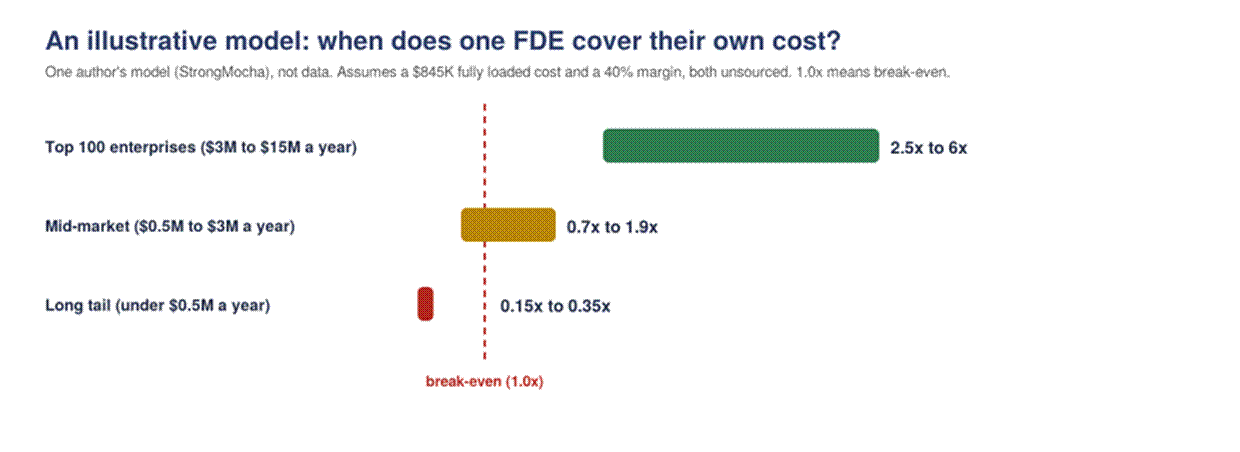
Chart: original, built from one author’s model (StrongMocha). Illustrative, not data. Checked 1 Nov 2026.
Read it like this:
• Large enterprise deals cover the cost with room to spare. Contracts of $3M to $15M a year, in the model, cover an FDE 2.5x to 6x.
• Mid-market is knife-edge. Between 0.7x and 1.9x. Some deals pay, some don’t.
• Small deals lose money. Under $500K a year, the model has an FDE covering well under half their cost.
The source has its own inconsistencies: its summary quotes different cost and return figures from its table. So the useful takeaway is the pattern. Big contracts justify FDEs. Small ones usually don’t.
How low are AI gross margins, really?
Lower than classic SaaS, partly because of services and partly because of compute. A roundup by Offset Partners compiles figures from different surveys:
Chart: original, built from figures compiled by Offset Partners (ICONIQ, Bessemer, Aleph). Samples and definitions differ. Checked 1 Nov 2026.
Three caveats before you quote any of that:
• Different samples. One survey covers about 300 executives, another 20 startups, another 342 SaaS and AI firms.
• Expectations are not results. The 53% and 59% are what respondents project.
• Compute muddies it. Offset says inference and serving costs alone ran at 19% to 38% of revenue in its nine client engagements, so not all of the gap comes from FDEs.
Does the margin come back? What Palantir shows
Palantir is the original FDE company, so it’s the obvious test. Its Q1 2026 results filing shows:
• Revenue: about $1.63 billion, up 85% year on year.
• US commercial revenue: $595 million, up 133%.
• Adjusted operating margin: 60%.
• Gross profit: about $1.42 billion. By my own arithmetic that is roughly 87% of revenue. The filing states no gross margin.
So at scale, an FDE-heavy company can have software-level margins. Two honest cautions: the filing doesn’t say how FDE costs are classified, and Palantir spent years building a product around those deployments.
That is Forbes’s open question too: can the AI labs turn repeated engagements into reusable platform IP, as Palantir did with Foundry and AIP? The margin only recovers if the answer is yes.
How Scaler Transformed Careers in Different Fields
Scaler learners achieved 2.5x salary growth with average post-Scaler CTC reaching ₹23L.
 Google
 Amazon
 Microsoft
 Flipkart
 Adobe1200+ more
What does this mean for India’s IT services firms?
This is the awkward bit. Bessemer’s roadmap on IT services and AI lays out the contrast. India’s IT sector is valued at $264 billion. At TCS, revenue doubled from $15 billion to $30 billion over a decade, but headcount went from 320,000 to 608,000, leaving revenue per employee flat at about $49,000.
In other words: adding people and billing hours, not adding product. Bessemer argues time-and-materials pricing misaligns incentives in the AI era, and expects AI-first firms to sell on outcome-based pricing. It also says Indian IT firms spend under 2% of revenue on IP creation, against 20% or more at global product companies.
The FDE model is a version of services that earns product margins if you productize it. That’s the difference worth studying.
What should a company do about FDE economics?
• Track margin by cohort. Know which customers pay for their FDEs and which don’t.
• Set a contract floor. If your model shows small deals lose money, change the offer, not the math.
• Make productization the metric. a16z’s own advice: build reusable libraries and clear APIs, and automate pipelines and integrations.
• Sell services honestly. a16z suggests selling services at cost and aligning staff with account executives, rather than giving implementation leads quotas.
• Decide how the story ends. Software margin at scale, or an openly services business. Both are fine. Pretending to be one while being the other isn’t.
If you are an engineer or team lead who wants to learn the deployment skills this model depends on: the Scaler AI Forward Deployed Engineer course focuses on deploying AI in client environments. It teaches the work, not the finance, so pair it with the business reading above.
For more on the role itself, see our FDE hub and the nearest live FDE guide.
Frequently asked questions
Turn Learning into Career Growth
Why do FDEs lower a company’s gross margin?
Because their cost sits in the work of delivery. Senior engineers working inside customer environments are expensive, and early on their time is not yet reusable product. a16z’s view is that this is a deliberate trade: lower margin now for bigger contracts, customer data and a moat.
How much does a forward deployed engineer cost a company?
No source gives a reliable single figure. Forbes calls it the most expensive job in enterprise AI. Levels.fyi data cited by one analysis puts median compensation at $450K to $582K at two AI labs and about $238K at Palantir. Fully loaded costs run higher.
Can an FDE model reach software margins?
Possibly. Palantir’s Q1 2026 filing implies roughly 87% gross profit as a share of revenue, by my arithmetic, with revenue up 85%. But it built a product from its deployments over years, and the filing does not say how FDE costs are classified.
Are FDEs worth it for small deals?
Usually not, in the one illustrative model I found, where contracts under $500K a year covered well under half an FDE’s cost. Treat that as a pattern from one author’s assumptions, not a rule, and run your own numbers before deciding.