


The Forward-Deployed Engineer Playbook: How the Role Actually Runs a Deployment
The forward deployed engineer playbook is the repeatable methodology an FDE uses to take a client from an unclear problem to a working, scaled solution. It's a lifecycle, not a job description. This page is how a deployment runs, not what an FDE is. If you need the role definition first, see how to become a forward deployed engineer.
Here's what you'll get: five phases, and for each one, the goals, the work, the deliverables, the people involved, and the traps that sink real deployments. This is the repeatable process underneath every FDE's day.
The FDE Deployment Lifecycle at a glance
Every FDE deployment follows the same arc, regardless of industry, client, or technology. The names vary slightly by company, but the shape is consistent:
Discovery → Prototype → Embed → Scale → Handoff
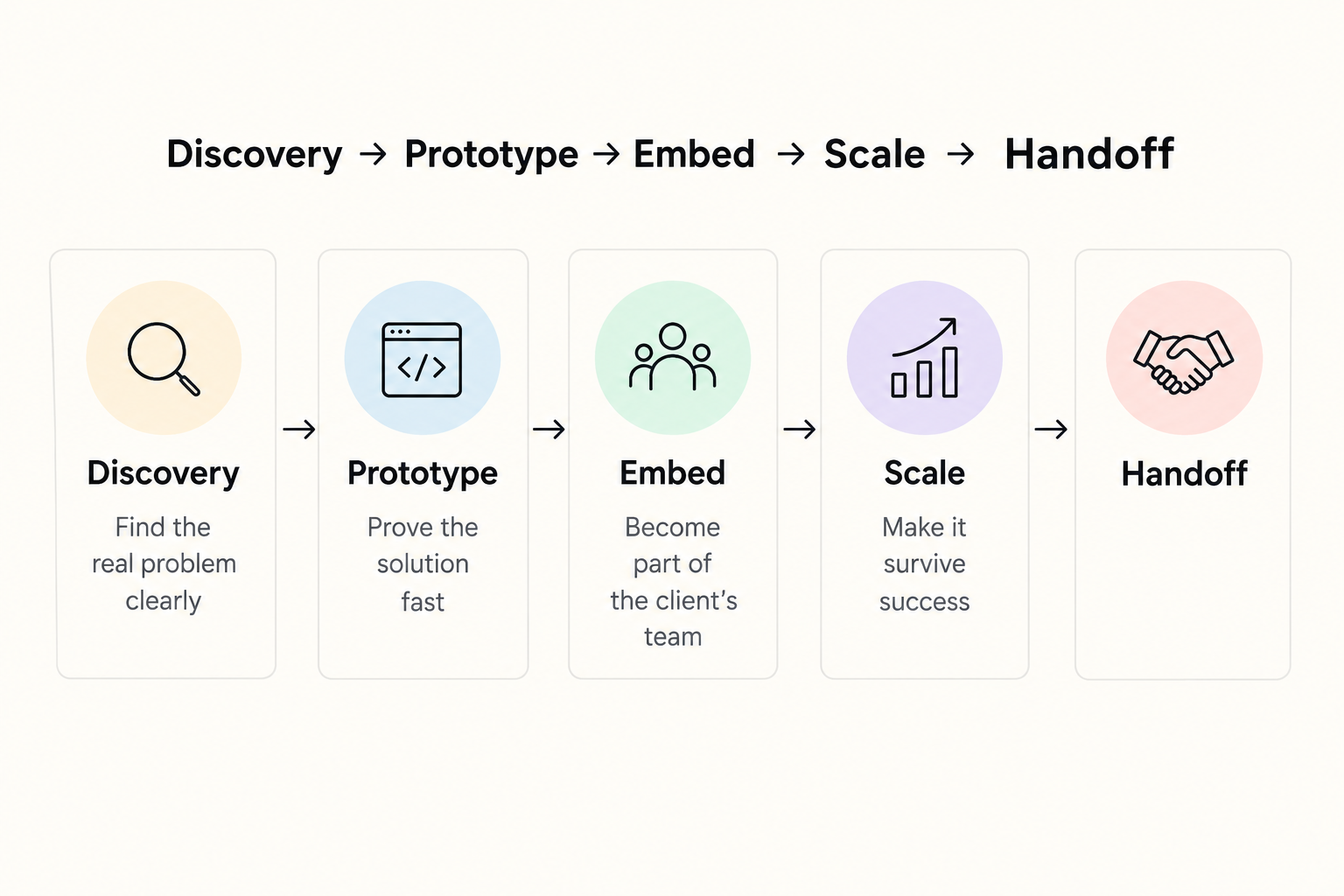
Forward Deployed Engineer deployment playbook phases: discovery, prototype, embed, scale and handoff
| Phase | Goal | Key artifact | Primary stakeholder |
|---|---|---|---|
| Discovery | Find the real problem and define success | Discovery doc, success criteria, stakeholder map | Client sponsor, end users |
| Prototype | Prove the solution works on real data, fast | Working demo on client data, technical approach note | Client sponsor, power users |
| Embed | Become part of the client's team | Hardened solution, runbooks, training materials | Client's engineers, operators, managers |
| Scale | Make it reliable, repeatable, and operable | Production deployment, monitoring, reusable template | Client's ops team, your own product team |
| Handoff | Leave so the client can run it without you | Handoff plan, documentation, support taper | Client sponsor, client's engineering team |
Now let's walk through each phase in detail.
Every phase below shows the role of a forward deployed engineer in practice: the same engineer stays with the client from the first conversation to the final handoff.
Phase 1: Discovery: Finding the Real Problem
The Goal of Discovery
Leave with a sharp, agreed problem statement and a definition of success. Not a feature list. Not a vague "they want AI." A specific, measurable understanding of what the client is trying to achieve and what's standing in the way.
Discovery is where most deployments are won or lost. Get the problem right, and the rest of the phases flow. Get it wrong, and you'll build something technically impressive that doesn't matter.
What You Actually Do
- Shadow users. Don't just talk to the client's leadership. Sit with the people who will actually use the system. Watch how they work. Ask "what does a good day look like?" and "what breaks your day?" The answers are different from what the leadership deck says.
- Map the data and systems. What data exists? Where does it live? What format is it in? What are the access constraints? This is the unglamorous work that determines whether your solution will actually function in the client's environment.
- Separate the stated problem from the real one. The client says "we need a dashboard." The real problem is "our analysts spend 4 hours a day manually pulling data from three systems." The solution to the second problem might not be a dashboard at all.
- Have the security and data-access conversation early. Not after you've built the prototype. If the client's data can't leave their network, you need to know that before you design anything.
The Artifacts You Leave Behind
- A discovery/problem-definition doc: what the problem is, why it matters, what success looks like.
- A success-criteria list: measurable outcomes the client agrees to.
- A stakeholder map: who cares about this project, who approves it, who uses it, who blocks it.
- A rough data inventory: what data exists, where it lives, what shape it's in.
Build an AI-First Career, Master the Complete Skillset
Choose from our industry-leading programs designed for career success
Modern Software and AI Engineering Program
Master full-stack development with AI integration


 +1000 more
Modern Data Science and ML with specialisation in AI
Advanced data science techniques with AI specialization
+1000 moreAdvanced AIML with Specialisation in Agentic AI
Deep dive into AIML with focus on Agentic systems
+1000 moreDevOps, Cloud & AI Platform Engineering
Build and manage AI-powered cloud infrastructure
+1000 moreAI Engineering Advanced Certification by IIT-Roorkee
Premier AI engineering certification from IIT-Roorkee

AI Forward Deployed Engineer Program
Full-stack engineering, production AI and client-facing consulting
+1000 moreWho's in the Room
Client sponsor (the person who approved the project), end users (the people who will use the system), the client's IT/security team (who control access), and your own product and engineering leads (who need to scope the work).
Where Discovery Goes Wrong
Scoping the problem the client said instead of the one they have. If you build what was requested instead of what's needed, you'll deliver a technically correct solution to the wrong problem.
Skipping the security and data-access conversation. You'll hit this wall eventually. Hitting it after the prototype wastes weeks.
No agreed definition of success. If nothing is defined as "done," nothing can be called done. The project drifts. The client changes their mind. You can't push back because you never agreed on what "good" looks like.
For gathering requirements the way a system designer would, that course covers the constraints-thinking and requirements-mapping that discovery demands.
Phase 2: Prototype: Proving the Solution Fast
The Goal of a Prototype
Show the client a working slice of the solution against their real data, fast enough to keep momentum and cheap enough to throw away. The prototype exists to prove the hardest assumption, not to impress with polish.
What You Build (and What You Deliberately Don't)
Build the thin vertical slice that proves the hardest assumption. If the risk is "can we connect to their legacy database?", build the connection. If the risk is "will the model work on their data?", run the model on their data. Don't build the dashboard, the auth system, or the admin panel. Build the one thing that was actually in doubt.
Hard-code what you can. Skip the polish. Speed and learning over completeness. A working demo on real data in two weeks beats a polished product in two months that was built on assumptions.
The Artifacts
- A working demo on client data: not a mockup, not a slide deck. Something the client can touch and react to.
- A short technical-approach note: what you built, why, what you learned, what the next phase would require.
- An updated risk and assumption list: what was proven, what's still unknown.
Who You're Building For
The client sponsor and one or two power users whose "yes, that's it" unlocks the next phase. Not the whole organisation. Not the executive team. The two people who will actually use this and can tell you whether it solves the problem.
Prototype Pitfalls
- Over-engineering the throwaway. The prototype is meant to be thrown away or significantly rebuilt. If you build it like production code, you've wasted time on something that will change.
- Building on fake data so the demo lies. A prototype that works on clean sample data but breaks on the client's real data is worse than no prototype. It sets false expectations.
- Chasing breadth instead of proving the one thing that was actually in doubt. If you build five features instead of proving the one risky assumption, you've spent time learning nothing.
For the full-stack build skills a prototype demands, that roadmap covers the hands-on engineering across the stack that the prototype phase requires.
The prototype phase is where the FDE skill set comes together: fast engineering, real data, client feedback loops. The FDE course for software engineers builds exactly this muscle through real deployment projects that mirror the prototype-to-embed cycle.
Phase 3: Embed: Becoming Part of the Client's Team
The Goal of Embedding
Move from vendor to trusted teammate. Build the solution with the client, not for them, so it survives after you leave. This is the phase that most distinguishes FDE work from a normal engineering role.
How Scaler Transformed Careers in Different Fields
Scaler learners achieved 2.5x salary growth with average post-Scaler CTC reaching ₹23L.
 Google
 Amazon
 Microsoft
 Flipkart
 Adobe1200+ more
What Embedding Looks Like Day to Day
On-site or deeply-synced remote work. Daily contact with users. Iterating in tight loops: build, show, get feedback, fix, repeat. Absorbing domain knowledge: the client's industry, their workflows, their politics, their constraints. Handling the organisational reality, not just the code.
The embed phase is where the FDE earns trust. Trust isn't given; it's built through consistent delivery, honest communication, and showing up when things break. The client's team watches how you handle a production issue at 6 p.m. on a Friday. That moment defines the relationship more than any demo.
The Artifacts
- The hardened solution in the client's environment: not a prototype anymore, but a working system the client's team uses daily.
- Documentation and runbooks: written for the client's engineers, not for yours. Clear enough that someone who didn't build the system can operate it.
- Training for the client's people: hands-on sessions, not slide decks. The client's team should be able to use and troubleshoot the system.
- A growing "what we learned about this domain" document: the domain knowledge that makes the next deployment faster.
Who You Work With Now
You're inside the client's team: their engineers, their operators, their managers. Your own company is now the remote party. The relationship inverts: you spend more time with the client's people than with your own team.
Where Embedding Breaks
- Staying a vendor and never earning trust. If the client sees you as "the outside person who built the thing," they won't take ownership. You need to be "the person on our team who made this work."
- Building something only you can operate. If the system breaks when you're not in the room, you've built a dependency, not a solution. Design for the client's team to maintain.
- Letting scope creep because you're too close to every user request. When you're embedded, every user has a feature request. Saying "yes" to everything turns a focused solution into a bloated mess. The FDE has to scope and prioritise, just like a PM.
- Burnout. The embed phase is intense. Client-facing pressure, travel, ambiguity, and the constant context-switching between building and communicating. Be honest about this: the embed phase is where FDEs burn out if they don't set boundaries.
For the ownership and cross-functional responsibilities engineers grow into, that guide covers the broader ownership picture that the embed phase intensifies.
Phase 4: Scale: Making It Survive Success
The Goal of Scaling
Turn a working pilot into something reliable, repeatable, and operable at real volume by other people. The embed phase proves the solution works. The scale phase proves it works without you babysitting it.
Turn Learning into Career Growth
What Scaling Involves
- Hardening for load and edge cases. The prototype handled the happy path. The production system needs to handle the messy path: high volume, slow networks, inconsistent data, user errors.
- Automating the manual bits. If you're manually running a script every morning, that's not scaled. Automate it. If you're manually checking data quality, build a check. The goal is a system that runs without daily human intervention.
- Monitoring and alerting. You need to know when something breaks before the client tells you. Set up monitoring, logging, and alerting so failures are visible and diagnosable.
- Security and compliance sign-off. The client's security team needs to approve the production deployment. This conversation should have started in discovery; the sign-off happens here.
- Turning one client's solution into a reusable pattern. The best FDEs extract patterns from each deployment that make the next one faster. If you solved a data-integration problem at one client, document the pattern so the next FDE doesn't start from scratch.
The Artifacts
- A production-grade deployment: running in the client's environment, handling real load, with monitoring and alerting.
- Runbooks: operational documentation for the client's team. How to restart, how to diagnose, how to escalate.
- A template or internal product: a reusable pattern that other FDEs can apply to the next client.
- A case study: what worked, what didn't, what the next deployment should do differently.
Scaling Pitfalls
- Assuming pilot code is production code. It's not. The prototype was fast and fragile. Production needs to be reliable and maintainable. The rewrite between prototype and production is real work, not a cleanup.
- No observability, so failures are invisible. If you can't see what's happening in the system, you can't fix it when it breaks. Monitoring is not optional.
- Solving it so specifically for one client that nothing carries to the next. If every deployment starts from scratch, the FDE function doesn't scale. Extract patterns. Document reusable solutions. Build internal tools.
For how engineering scope and seniority step up as you scale systems, that guide shows where junior and senior FDE work diverges. Scaling is where the senior FDE earns their keep.
Phase 5: Handoff: Leaving Cleanly
The phase competitors forget entirely. The goal: the client can run, maintain, and extend the solution without you.
- Transfer of ownership. The client's team owns the system now. Not you. This means explicit handover of access, credentials, documentation, and decision-making authority.
- Documentation and training. Not just a README. Hands-on training sessions where the client's engineers operate the system while you watch. The test: can they fix a production issue at 2 a.m. without calling you?
- A defined support taper. Don't disappear overnight. Define a support window: full support for two weeks, on-call for questions for a month, then gone. The taper gives the client confidence and gives you a clean exit.
- The honest measure of a good handoff: the solution is still running and improving six months after you've gone. If the client calls you six months later because something broke and nobody else can fix it, the handoff failed.
- Pitfall: no handoff plan. If you leave without a plan, the client silently depends on you forever. The "win" quietly rots. The FDE is seen as someone who builds things that can't survive without them. That reputation kills the next deal.
How the FDE Playbook Differs from a Normal Deployment
A normal engineering deployment optimises for shipping code: build, test, deploy, monitor. The FDE playbook optimises for solving a client's problem inside their reality.
| Normal deployment | FDE deployment | |
|---|---|---|
| Primary goal | Ship working code | Solve the client's problem |
| Environment | Your own infrastructure | The client's messy, existing stack |
| Success metric | Code deployed and running | Client's business outcome improved |
| Key phases | Build, test, deploy | Discovery, prototype, embed, scale, handoff |
| Who defines "done" | Your product team | The client |
| What happens after deploy | Monitor and iterate | Embed, train, hand off, walk away |
The FDE playbook includes three phases that normal deployments don't: discovery (because the problem isn't defined yet), embed (because the solution has to work in the client's reality), and handoff (because the client has to run it without you). Those three phases are what make FDE work different from product engineering.
For Palantir's own account of how the role runs day to day, that piece shows one FDE's experience of running this playbook. This page is the structured methodology underneath that narrative.
Common Questions About How FDEs Run Deployments
What are the phases of an FDE deployment?
Five phases:
(1) Discovery, where you find the real problem and define success;
(2) Prototype, where you prove the solution works on real data fast;
(3) Embed, where you become part of the client's team and build with them;
(4) Scale, where you make the solution reliable and operable at real volume;
(5) Handoff, where you leave so the client can run it without you.
What's the difference between the FDE playbook and a day in the life of an FDE?
The playbook is the repeatable methodology the process underneath every deployment. A "day in the life" is one engineer's narrative account of running that process on a specific day. The playbook gives you the phases, artifacts, and pitfalls. The day-in-the-life gives you the texture and feeling. They're companions, not alternatives.
What does a Forward Deployed Engineer actually deliver in each phase?
Discovery: a problem-definition doc, success criteria, stakeholder map, and data inventory. Prototype: a working demo on client data and a technical-approach note. Embed: a hardened solution, runbooks, and training materials. Scale: a production deployment, monitoring, and a reusable template. Handoff: documentation, training, a support taper, and a system the client owns.
How is an FDE deployment different from a normal software deployment?
A normal deployment optimises for shipping code. An FDE deployment optimises for solving the client's problem inside their reality. That means three extra phases: discovery (the problem isn't defined yet), embed (the solution has to work in the client's environment), and handoff (the client has to run it without you).
What's the hardest phase of an FDE deployment?
Usually embed. The code is the easier part. The hard part is earning the client's trust, absorbing their domain knowledge, handling organisational politics, and building something that survives after you leave. The embed phase is also where burnout risk is highest, because the client-facing pressure is constant.
Do FDEs travel and work on-site?
Often yes, especially during the embed phase. The amount varies by company, client, and deployment phase. During a new client deployment, travel can be significant. Once a system is live and handed off, it calms down. Be honest about this: the on-site reality is real and it's a defining feature of the role.
What skills does running an FDE deployment require?
Requirements and system thinking (discovery), fast full-stack building (prototype), stakeholder communication and domain absorption (embed), production engineering and observability (scale), and documentation and training (handoff). The common thread: the ability to own a problem end to end, under ambiguity, with the client watching.




