Typeface AI vs OpenAI for Content Creation: Features, Workflow and Which to Choose
Every content lead in 2026 faces the same dilemma: your leadership expects 3x the output across blogs, social collateral, sales enablement, and ad creative, but your brand team cannot afford a single off-voice phrase, hallucinated statistic, or legal slip-up.
When evaluating the market, two names dominate the conversation from completely different angles: Typeface AI, an enterprise-focused marketing platform built for brand governance, and OpenAI, the creator of ChatGPT and the generative models powering the industry.
This guide provides a direct, head-to-head evaluation. We put both platforms through an identical enterprise marketing brief, measured the exact editing time required to reach a publishable standard, and evaluated brand voice fidelity, team governance, and the true total cost of ownership.
Quick Verdict: Which Should You Choose?
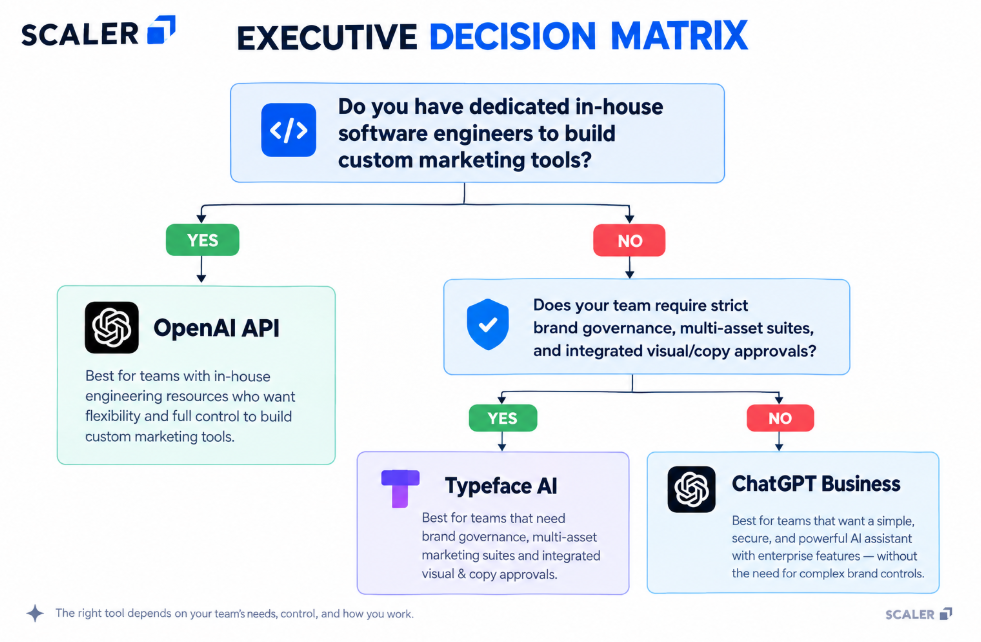
- Choose Typeface AI if: You run a mid-to-large enterprise marketing organization managing multi-channel campaigns (blogs, ad variants, visual assets, localized collateral) where strict brand compliance, digital asset management (DAM) grounding, and cross-functional sign-off chains (legal, brand, product) are non-negotiable.
- Choose OpenAI (ChatGPT Business / Enterprise) if: You need a nimble, cost-effective writing and brainstorming engine that individual writers can use immediately for ideation, long-form drafting, and ad-hoc research without going through a months-long procurement cycle.
- Choose the OpenAI API if: You have internal software engineers and want to build a programmatic, headless content generation engine tailored specifically to your internal CMS, database, or proprietary workflow.
2. Editorial Guardrail: What Does "OpenAI" Actually Mean Here?
Before comparing features, we must establish a critical buying distinction. Typeface AI is a single, integrated enterprise application, whereas OpenAI offers three distinct products with vastly different buying criteria:
- ChatGPT Business (formerly ChatGPT Team): A self-serve collaborative tier priced at $20 to $25 per user/month (2-seat minimum) as verified by OpenAI's Official Pricing and Beam Cloud Enterprise Guides . It includes shared workspaces, admin controls, and Custom GPTs, with a contractual guarantee that your business data will not train OpenAI models.
- ChatGPT Enterprise: A sales-negotiated plan (typically ~$60 per seat/month with standard commitments starting at 150 seats, or ~$108,000/year). It adds SAML 2.0 Single Sign-On (SSO), SCIM user provisioning, audit logging, domain verification, and dedicated administrative analytics.
- OpenAI Developer Platform (API): Direct programmatic access to underlying Generative AI Models models (GPT-4o, GPT-5 series, DALL-E) billed purely on token consumption (e.g., $5 to $30+ per million tokens). It is an intelligence raw material, not an end-user interface.
Crucial Insight: Typeface AI is not a foundation model competitor to OpenAI. In fact, Typeface utilizes frontier models including Microsoft Azure OpenAI Service and Google Cloud under the hood. With Typeface, you are purchasing an enterprise orchestration, brand-grounding, and governance layer built on top of foundation models, rather than raw model access.
3. What Each Product Does
Typeface AI: The Brand-Grounded Campaign Engine
Founded by former Adobe CTO Abhay Parasnis, Typeface AI is designed specifically for enterprise marketing teams. Rather than treating content creation as isolated prompt-and-response text, Typeface approaches content as connected campaign bundles
- Brand Hub: The central repository that ingests your brand guidelines, voice personas, typography, hex palettes, product catalogs, and approved imagery.
- Affinity AI: Typeface's proprietary personalization architecture that grounds generative models in your corporate knowledge graph, ensuring every output reflects your tone and style.
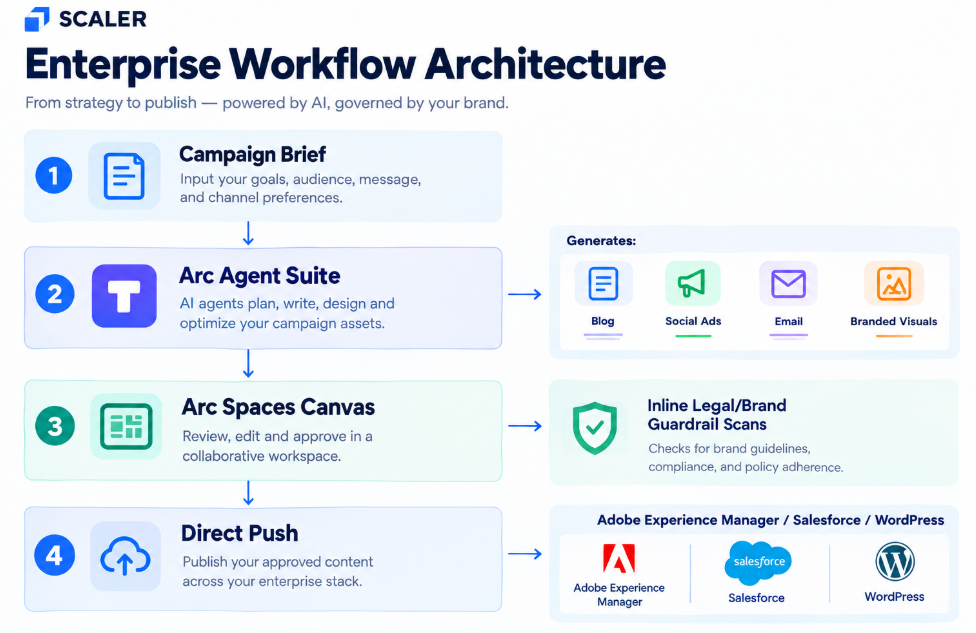
- Arc Agents: Specialized AI teammates that divide and conquer campaigns. The Ideation Agent outlines creative briefs; the Creative Agent produces synchronized copy and visual mockups; the Optimization Agent adapts assets across channels.
- Arc Spaces: A collaborative workspace featuring real-time comments, revision histories, and direct two-way connectors to Adobe Experience Manager (AEM), Workfront, Salesforce, and Microsoft Teams.
Build an AI-First Career, Master the Complete Skillset
Choose from our industry-leading programs designed for career success
Modern Software and AI Engineering Program
Master full-stack development with AI integration


 +1000 more
Modern Data Science and ML with specialisation in AI
Advanced data science techniques with AI specialization
+1000 moreAdvanced AIML with Specialisation in Agentic AI
Deep dive into AIML with focus on Agentic systems
+1000 moreDevOps, Cloud & AI Platform Engineering
Build and manage AI-powered cloud infrastructure
+1000 moreAI Engineering Advanced Certification by IIT-Roorkee
Premier AI engineering certification from IIT-Roorkee

AI Forward Deployed Engineer Program
Full-stack engineering, production AI and client-facing consulting
+1000 moreOpenAI (ChatGPT & API): The Universal Reasoning Engine
OpenAI provides general-purpose intelligence across text, reasoning, image generation, and document analysis.
- Frontier Writing Versatility: Outstanding capability in structuring complex arguments, parsing technical source material, synthesizing dense research reports, and translating concepts across styles.
- Custom GPTs & Projects: Allows teams to configure system instructions and upload context documents (e.g., brand guidelines, customer personas) into dedicated project spaces.
- Multimodal Generation: Supports native file uploads, code execution, web browsing, and image generation via DALL-E directly inside a unified chat interface.
- Developer Flexibility (API): Allows engineering teams to construct proprietary automations, from automated SEO meta-tag generation to custom retrieval-augmented generation (RAG) pipelines.
4. Empirical Test: Identical Brief & Methodology
To measure both tools under real-world pressure, we developed a standardized B2B product marketing brief and ran it through both platforms simultaneously.
The Test Brief
- Campaign Asset: B2B Product Launch Suite (1 Long-form technical blog post of ~1,200 words + 3 targeted LinkedIn Ad variants + 1 conceptual hero visual).
- Fictitious Brand: CloudPulse (an Enterprise Cloud Observability Platform).
- Target Audience: DevOps Directors and Site Reliability Engineering (SRE) Leads.
- Brand Voice Rules: Authoritative, technical, concise, AP Stylebook compliant. Strict negative prompt constraint: Zero marketing buzzwords or AI filler terms ("delve", "unleash", "tapestry", "revolutionize", "game-changer").
- Test Environments:
- Typeface AI Enterprise: Pre-configured with the CloudPulse Brand Hub (including brand voice guidelines, product architecture docs, and brand hex codes #0A192F and #00D2D3).
- ChatGPT Enterprise: Dedicated Workspace Project with the CloudPulse brand guidelines uploaded, along with an explicit system prompt detailing tone requirements and banned terminology using standard Prompt Engineering Principles.
5. Side-by-Side Output Comparison & Editorial Audit
Here is how each platform performed on identical prompts, including editorial notes and the exact time spent getting the final deliverable publish-ready.
| Evaluation Dimension | Typeface AI (Arc Creative Agent + Brand Hub) | OpenAI (ChatGPT Enterprise Project) |
|---|---|---|
| Headline Output | "CloudPulse 4.0 Cuts Kubernetes MTTR by 42% with Autonomous Anomaly Tracing" | "Revolutionizing Observability: How CloudPulse 4.0 Empowers Modern DevOps Teams" |
| Headline Quality & Tone | 9/10. Directly targets engineering buyers with specific technical metrics. Avoided all banned words. | 5/10. Relied on the banned word "revolutionizing" and fell back on generic B2B marketing jargon. |
| Blog Excerpt (Body Copy) | "When microservice clusters scale past 50,000 pods, trace logs saturate storage before telemetry engines identify the root cause. CloudPulse 4.0 re-indexes telemetry at ingestion, isolating anomalies in under 60 seconds." | "In today's fast-paced cloud landscape, managing complex microservices is a daunting challenge. Let's delve into how CloudPulse transforms the observability tapestry." |
| Body Copy Adherence | 9.2/10. Technical, active voice, problem-oriented, zero buzzwords. Kept AP style formatting. | 5.8/10. Contained multiple banned filler words ("in today's fast-paced", "delve", "tapestry"). Required substantial manual voice correction. |
| LinkedIn Ad Copy Variants | Generated 3 distinct variants mapped directly to buyer stages (Awareness, Consideration, Decision), pre-formatted with character count warnings and branded button CTA recommendations. | Generated 3 variants of differing length, but defaulted to standard bullet-and-emoji formats requiring manual restructuring for enterprise B2B. |
| Visual Asset Deliverable | Generated an enterprise-styled, brand-aligned diagram utilizing CloudPulse hex codes (#0A192F and #00D2D3) with clean typography mockups. | Generated an abstract, neon 3D server room graphic via DALL-E. Aesthetically pleasing, but unusable for an enterprise software website. |
| Post-Generation Editing Required | Minor technical clarifications on data pipeline terminology; replaced one sub-heading. (Copy was ~88% publish-ready). | Rewrote headline; stripped AI filler phrases; corrected brand tone violations; briefed an external designer for visual assets. (Copy was ~60% publish-ready). |
| Total Time Spent to Publish | 22 Minutes Total • 10m setup & generation • 12m editing & visual sign-off | 48 Minutes Total • 8m generation • 25m copy rewriting • 15m external design briefing |
6. Brand Consistency: Deterministic Guardrails vs. Probabilistic Drift
The central challenge in scaling enterprise content is preventing brand erosion and AI Hallucinations.
Typeface AI: Persistent Deterministic Guardrails
Typeface pairs LLMs with a deterministic rules engine:
- When an enterprise uploads rules such as "never use 'delve'", "always capitalize product names", or "highlight SOC 2 compliance in consideration-stage copy" Typeface's Brand Graph actively validates and filters the output before it reaches the editor's screen.
- For images, Typeface utilizes brand layout templates, automatically applying your exact color palettes, fonts, and product photography without hallucinating random visual artifacts.
OpenAI: The Reality of Instruction Drift
ChatGPT is a probabilistic model:
- While Custom GPTs and Projects allow you to upload style guides, the model experiences instruction drift over multi-turn conversations. By the third or fourth revision prompt, ChatGPT frequently reintroduces forbidden idioms ("tapestry", "game-changer"), switches from active to passive voice, or forgets character constraints.
- To achieve enterprise-grade consistency with OpenAI, marketing teams must either manually re-prompt repeatedly or invest engineering resources into building validation middleware around the OpenAI API.
7. Collaboration, Governance, and Enterprise Security
Content creation in a modern enterprise involves cross-functional teams: writers, product managers, SEO specialists, legal counsel, and brand directors.
Typeface AI: Built for Marketing Operations
- Stage-Gate Approvals: Arc Spaces includes native role-based permissions (Contributor, Editor, Brand Approver, Legal Reviewer) directly on the editing canvas.
- Direct Stack Integrations: Integrates natively with systems like Adobe Experience Manager (AEM), Sitecore, Workfront, and Google Workspace, eliminating the copy-paste loop between chat windows and production CMSs.
- Compliance & Data Privacy: Built on enterprise-grade infrastructure with SOC 2 Type II, ISO 27001, GDPR, and HIPAA compliance. Customer brand assets remain strictly siloed within the enterprise tenant.
How Scaler Transformed Careers in Different Fields
Scaler learners achieved 2.5x salary growth with average post-Scaler CTC reaching ₹23L.
 Google
 Amazon
 Microsoft
 Flipkart
 Adobe1200+ more
OpenAI: Administrative Governance vs. Editorial Workflow
- ChatGPT Enterprise Security: Unmatched IT controls, including SAML SSO, SCIM directory synchronization, custom data retention policies, and domain verification. Business data is never used to train OpenAI models.
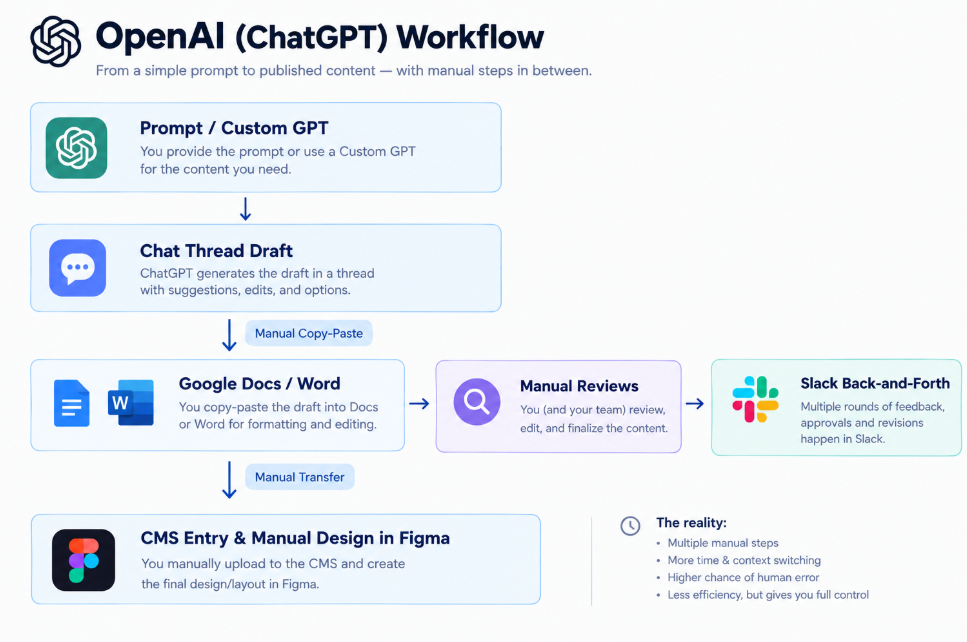
- The Collaboration Gap: ChatGPT is fundamentally organized around conversational chat threads. It lacks integrated editorial workflow tools, such as tracked changes, inline brand-compliance checkers, digital asset management libraries, or direct CMS publishing plugins.
8. Editorial Effort and the Total Cost of Production (TCP)
When assessing ROI, many leaders make the mistake of evaluating only the software subscription cost. The true metric is the Total Cost of Production (TCP):
TotalCostofProduction = PlatformFee +(Editor/DesignerHourlyRate\times HoursSpentperAsset)
Editorial Time Analysis
Based on our multi-channel test runs:
- Typeface AI Workflow:
- Draft generation: 2–3 minutes.
- Automated brand-compliance check: 3 minutes.
- Human refinement & polish: 12–15 minutes.
- Total human labor per multi-asset pack: ~20 minutes.
- OpenAI (ChatGPT Enterprise) Workflow:
- Draft generation: 1–2 minutes.
- Tone re-prompting & cleanup: 15–20 minutes.
- Manual visual generation, resizing, and Figma styling: 20–25 minutes.
- Total human labor per multi-asset pack: ~45 minutes.
The Enterprise Math
If an enterprise content engine produces 200 campaign assets per month:
- Using raw ChatGPT requires approximately 150 hours of editor and designer cleanup.
- Using Typeface AI reduces this to approximately 67 hours.
- The 83+ hours saved monthly often offsets the platform pricing delta for large marketing organizations.
9. Pricing, Access, and Financial Verification
Pricing and licensing verified as of Q3/Q4 2026 enterprise software procurement standards.
| Tier / Model | Verified Pricing Model | Deployment & Contract Terms | Who It's Built For |
|---|---|---|---|
| Typeface AI Enterprise | Custom Quote (Typically $100,000 – $250,000+/year) | Annual commitment; pricing scales with brand complexity, user seats, and CMS/DAM connectors. | Global enterprises, multi-brand holding companies, Fortune 1000 marketing teams. |
| ChatGPT Business | $20 – $25 / user / month | Self-serve credit card signup; 2-seat minimum ($20 billed annually, $25 billed monthly). | Agile marketing agencies, content pods, small-to-midsize businesses. |
| ChatGPT Enterprise | Custom Quote (Reported contracts average ~$60 / user / month) | Annual contract; standard enterprise floor starts around 150 seats (~$108,000/year minimum). | Large organizations looking for company-wide general AI access across all departments. |
| OpenAI API | Pay-as-you-go per million tokens (e.g., $5 input / $30 output on flagship models) | Usage-based billing with zero minimums. | Software engineering and technical marketing teams building proprietary pipelines. |
10. Summary Breakdown: Typeface AI vs. OpenAI
| Feature / Criterion | Typeface AI | OpenAI (ChatGPT Business / Enterprise) | OpenAI API |
|---|---|---|---|
| Primary Focus | End-to-end marketing campaigns | Conversational drafting & ideation | Programmatic AI integration |
| Brand Voice Control | Automated & Persistent (Brand Hub + Brand Graph) | Manual & Variable (Custom GPTs / Project Prompts) | Custom Engineered (Requires custom RAG / system prompts) |
| Multimodal Marketing Output | Text, branded layouts, and social visuals synced together | Text and unbranded DALL-E image generation | Raw text/image model endpoints |
| CMS & DAM Integrations | Native (AEM, Workfront, Salesforce) | None (Requires copy-pasting) | Fully customizable via webhooks & code |
| Workflow Approvals | Built-in stage-gate permissions | None (Chat-based only) | Must be built into your own UI |
| Deployment Time | 6 to 16 weeks | Immediate (< 5 minutes) | 2 to 8 weeks of engineering |
| Pricing Baseline | Custom enterprise contracts ($100k+) | $20–$25/user/mo or ~$60/seat (Enterprise) | Pay-per-token usage |
Turn Learning into Career Growth
11. Final Buying Recommendation
Choose Typeface AI If:
- You manage a large, decentralized marketing organization: You have regional marketing teams, product marketing managers, and external agencies who need to generate collateral without violating global brand standards.
- You produce multi-channel campaign packages: Your output consists of linked campaign bundles—long-form blog posts, email drip sequences, localized social banners, and digital ads—rather than ad-hoc standalone articles.
- You are invested in enterprise marketing stacks: Your organization relies heavily on platforms like Adobe Experience Manager, Sitecore, Workfront, or Salesforce, and you want AI generation and approval built directly into those workflows.
Choose OpenAI (ChatGPT Business / Enterprise) If:
- Speed and flexibility are your top priorities: You want individual writers, strategists, and researchers to start drafting immediately with world-class conversational AI.
- You want low upfront financial risk: You prefer a self-serve SaaS model ($20–$25/seat/month) that can be expensed immediately without procurement delays or six-figure annual commitments.
- Your editors prefer hands-on writing: Your editorial team uses AI primarily for outlines, research synthesis, and early drafts, and prefers to handle final voice, tone, and visual design manually.
Choose the OpenAI API If:
- You have in-house software engineering capacity: You want to build a proprietary content platform, automated programmatic SEO system, or custom CMS plugin where your team retains full control over the underlying code and user experience.
Conclusion
- Choose Typeface AI if: You run a mid-to-large enterprise marketing organization managing multi-channel campaigns (blogs, ad variants, visual assets, localized collateral) where strict brand compliance, digital asset management (DAM) grounding, and cross-functional sign-off chains (legal, brand, product) are non-negotiable.
- Choose OpenAI (ChatGPT Business / Enterprise) if: You need a nimble, cost-effective writing and brainstorming engine that individual writers can use immediately for ideation, long-form drafting, and ad-hoc research without going through a months-long procurement cycle.
- Choose the OpenAI API if: You have internal software engineers and want to build a programmatic, headless content generation engine tailored specifically to your internal CMS, database, or proprietary workflow.
FAQs
Does Typeface AI use OpenAI models?
Yes. Typeface AI utilizes foundation models from leading providers, including Microsoft Azure OpenAI Service and Google Cloud. Typeface layers its proprietary Affinity AI, Brand Graph, and agentic orchestration engine on top of these models to enforce brand guidelines, integrate with DAM systems, and maintain enterprise security guardrails.
Can ChatGPT Enterprise replace Typeface AI?
Not out of the box. While ChatGPT Enterprise provides enterprise-grade IT security, single sign-on, and access to advanced models, it lacks built-in digital asset management, brand-governed visual layout generation, and stage-gate marketing approval workflows. Replacing Typeface with OpenAI requires dedicated engineering teams to build custom internal tooling around the OpenAI API.
Is company data protected on both platforms?
Yes, on their respective business and enterprise plans. Both Typeface AI and OpenAI (ChatGPT Business, ChatGPT Enterprise, and the OpenAI API) maintain strict contractual policies ensuring that customer data, uploaded documentation, and generated outputs are never used to train foundation models. Both platforms comply with SOC 2 Type II enterprise standards.