


Introduction to OpenCV
OpenCV (Open Source Computer Vision Library) is an open-source computer vision and machine learning software library. It contains more than 2500 optimized algorithms, including a comprehensive set of both classic and state-of-the-art computer vision and machine learning algorithms. OpenCV can be used for real-time image processing, object detection, face recognition, and many other applications. It is written in C++, but also has interfaces for Python, Java, and MATLAB. OpenCV is widely used in research, academia, and industry and is constantly updated and improved by a large community of developers.
OpenCV has numerous practical applications in real life, including surveillance systems, robotics, augmented reality, autonomous vehicles, medical imaging, and many others. For example, it is used in traffic monitoring systems to detect and track vehicles and pedestrians, in medical imaging for diagnosis and treatment planning, and manufacturing for quality control and inspection.
The importance of OpenCV lies in its ability to provide efficient and accurate solutions for computer vision and image processing tasks. It enables developers to build robust and reliable applications with minimal effort. Its user-friendly interface and extensive documentation make it accessible to a wide range of users, from beginners to experts. Its open-source nature makes it accessible to everyone, promoting collaboration and innovation in the field of computer vision.
What is Computer Vision?
Computer vision is a field of study focused on enabling computers to interpret and understand digital images and videos from the real world. It involves developing algorithms and techniques for extracting information from images and videos to aid in decision-making and automation. Computer vision has numerous applications in various industries, including healthcare, security, transportation, and entertainment. Its applications range from simple tasks such as facial recognition to more complex tasks such as object detection, image segmentation, and 3D modelling. Computer vision is a rapidly evolving field that is driven by advancements in artificial intelligence, machine learning, and deep learning.
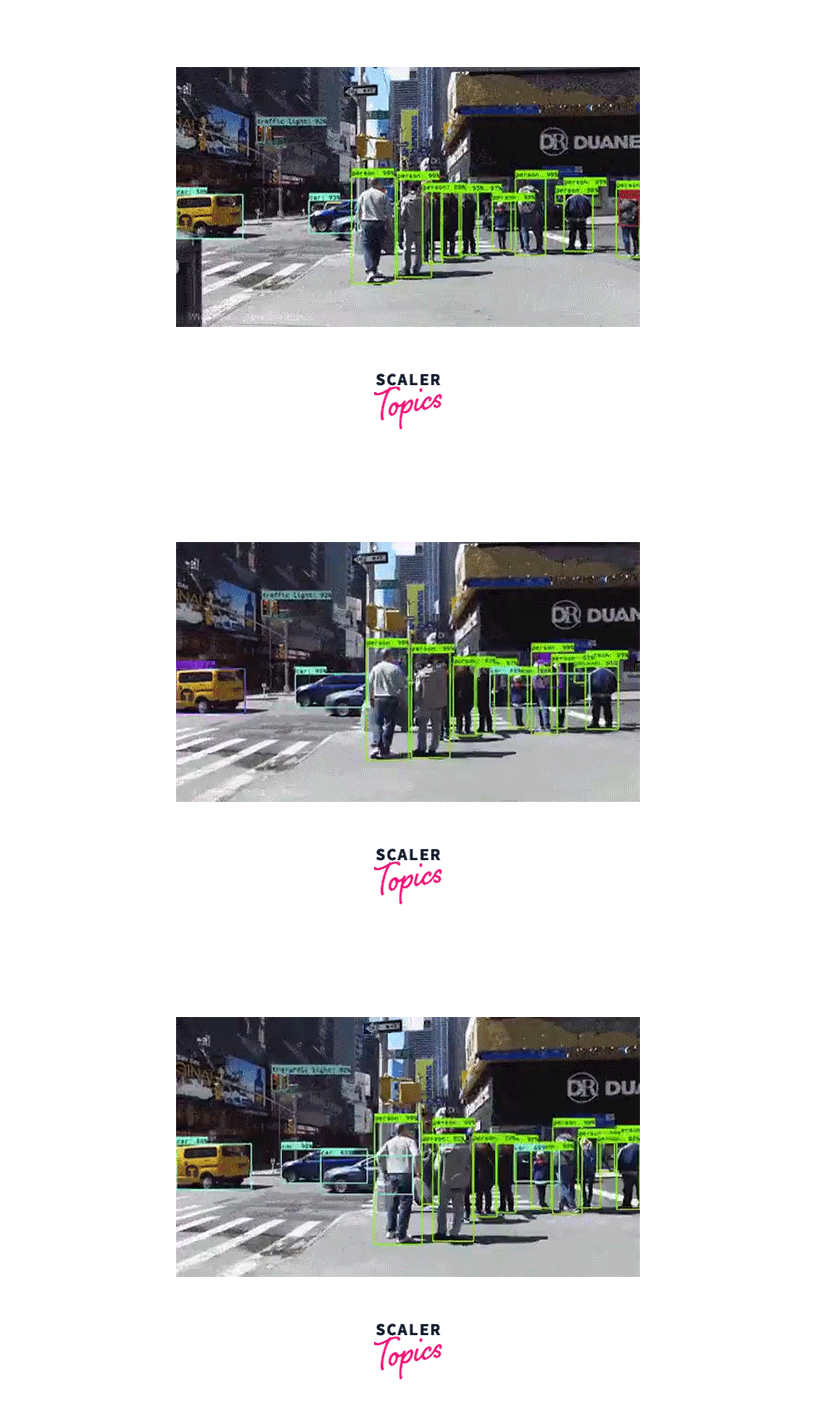
An Introduction to OpenCV Library
Now, let's look into what is Opencv. OpenCV (Open Source Computer Vision) is an open-source library of computer vision and machine learning algorithms. It was initially developed by Intel and is now maintained by a community of developers. OpenCV provides a wide range of functionalities for processing images and videos, such as object detection, tracking, image filtering, and more. It is written in C++ and supports multiple programming languages, including Python, Java, and MATLAB.

OpenCV is cross-platform and runs on various operating systems, including Windows, Linux, and macOS. Its user-friendly interface and extensive documentation make it accessible to a wide range of users, from beginners to experts. OpenCV has numerous practical applications in real life, including surveillance systems, robotics, augmented reality, autonomous vehicles, medical imaging, and many others. The library is constantly evolving, with new functionalities and improvements added with each new release.
Hope the answer to the question of what is Opencv is made clear and precise, now let's go in deep into the history of Opencv.
History of OpenCV
OpenCV (Open Source Computer Vision) was initially developed in 1999 by Intel Research and later maintained by Willow Garage and now by a community of developers. Its first version was released in 2000, and since then, it has undergone several updates and revisions, with the latest version being OpenCV 4.5.4, released in 2021.
OpenCV was initially developed as a research project aimed at enhancing computer vision capabilities. It started as a set of C functions for computer vision algorithms and later evolved into a comprehensive library of computer vision and machine learning functions. The library's development was driven by the need to provide efficient and accurate solutions for computer vision and image processing tasks in various industries.
OpenCV's open-source nature and broad functionalities have made it popular among researchers, developers, and hobbyists. Today, it has become the go-to library for computer vision and machine learning applications, with numerous practical applications in real-life, including surveillance systems, robotics, augmented reality, autonomous vehicles, medical imaging, and many others. The library continues to evolve and is maintained by a large community of developers
Installation and Setup
Installing and setting up OpenCV can be done in different ways depending on the operating system and environment. Here are brief steps on how to install and set up OpenCV on MacOS, Windows, and using Conda:
For MacOS:
- Install the Homebrew package manager by running /bin/bash -c "curl -fsSL" in the terminal.
- Install OpenCV using Homebrew by running brew install OpenCV in the terminal.
- Verify the installation by running the below Python code in the terminal.
Windows:
- Download the appropriate OpenCV version for Windows from the official OpenCV website.
- Extract the downloaded file to a directory.
- Add the OpenCV directory to the system path.
- Verify the installation by running python -c "import cv2; print(cv2.version)" in the command prompt.
Using Conda:
- Install Anaconda or Miniconda, package manager.
- Create a new environment by running conda create --name opencv-env python=3.8 in the terminal or command prompt.
- Activate the environment by running conda activate opencv-env in the terminal or command prompt.
- Install OpenCV by running conda install openCV in the terminal or command prompt.
- Verify the installation by running python -c "import cv2; print(cv2.version)" in the terminal or command prompt.
OpenCV Library Modules
OpenCV is a comprehensive computer vision and machine learning library that provides various modules for different applications. Here is a brief introduction to some of the key modules of the OpenCV library:
Core Functionality
This module contains the basic functions and data structures used throughout OpenCV, including data types, matrix operations, basic image processing, and mathematical operations.
Image Processing
This module provides functions for image manipulation, including filtering, morphological operations, transformations, and feature detection. It includes various image processing algorithms and techniques, such as edge detection, colour space conversion, histogram equalization, and more.
Video
This module provides tools for video processing and analysis, including motion estimation, object tracking, and background subtraction. It enables various video processing tasks, such as video stabilization, optical flow, and video compression.
Video I/O
This module provides functions for reading and writing video files in different formats. It supports various video formats, including AVI, MP4, and WMV. It also includes functions for video streaming over networks.
Calib3d
This module provides tools for camera calibration, stereo vision, and 3D reconstruction. It includes functions for camera calibration, such as camera matrix estimation, distortion correction, and stereo rectification. It is used in various applications that require depth perception, such as robotics and augmented reality.
Features2d
This module provides functions for feature detection and description, including SIFT, SURF, and ORB. It is used for various computer vision tasks, such as object detection, recognition, and tracking.
Objdetect
This module provides functions for object detection and recognition using pre-trained models, such as face detection and pedestrian detection. It includes various pre-trained classifiers for object detection and recognition.
Highgui
This module provides an interface for creating graphical user interfaces (GUIs) and handling user input, including window management, mouse and keyboard events, and image display. It enables the creation of interactive applications that can display images and videos, and handle user input.
These modules collectively provide various functionalities for different computer vision applications, enabling developers to implement complex computer vision algorithms and techniques easily.
Features of OpenCV Library
OpenCV Library provides a wide range of features for computer vision and image processing applications. Here are some of its most notable features:
Cross-Platform Support: OpenCV is designed to work on different platforms, including Windows, Linux, macOS, and mobile platforms, such as iOS and Android.
Data Structures and Algorithms: OpenCV uses efficient data structures and algorithms for image processing, enabling fast and accurate processing of large images and video streams.
Supports Various Image and Video Formats: OpenCV supports a wide range of image and video formats, including BMP, JPEG, PNG, TIFF, AVI, and MP4.
Machine Learning and Deep Learning Integration: OpenCV provides integration with popular machine learning and deep learning libraries, such as TensorFlow and PyTorch, enabling developers to build sophisticated computer vision applications.
Real-Time Image and Video Processing: OpenCV provides functions for real-time image and video processing, enabling developers to build applications that can process video streams in real time.
Camera Calibration and 3D Reconstruction: OpenCV includes tools for camera calibration and 3D reconstruction, enabling developers to build applications that require accurate 3D information.
Object Detection and Tracking: OpenCV provides pre-trained models for object detection and tracking, enabling developers to build applications that can detect and track objects in real time.
Graphical User Interface (GUI) Support: OpenCV provides an interface for creating GUIs and handling user input, enabling developers to build interactive applications with image and video display capabilities.
These features collectively make OpenCV a powerful tool for various computer vision and image processing applications, from basic image manipulation to advanced machine learning-based object detection and recognition.
How OpenCV Works?
OpenCV is a library of computer vision algorithms that provides developers with pre-written, optimized code for various computer vision tasks. OpenCV is written in C++, and it also has bindings for other programming languages, such as Python.
OpenCV works by providing a set of functions and data structures for developers to use in their applications. These functions and data structures are designed to work efficiently with large images and video streams, and they are optimized for performance.
OpenCV can perform a wide range of tasks, such as image processing, feature detection, object recognition, and machine learning-based tasks. It achieves this by using various algorithms and techniques, such as filtering, edge detection, thresholding, feature extraction, and machine learning models.
OpenCV also includes tools for camera calibration, 3D reconstruction, and stereo vision, which enable developers to build applications that require accurate 3D information.
In addition, OpenCV supports various input and output formats for images and videos, such as BMP, JPEG, PNG, TIFF, AVI, and MP4. This makes it easy for developers to work with different types of media sources.
Overall, OpenCV works by providing developers with a comprehensive set of tools and algorithms for computer vision and image processing tasks, allowing them to focus on building applications rather than writing low-level code from scratch.
Why is OpenCV used for Computer Vision?
OpenCV is a popular library used for computer vision because it provides a powerful set of tools and algorithms for image and video processing tasks. Here are some of the main reasons why OpenCV is used for computer vision:
1. Easy to use: OpenCV provides a simple and easy-to-use interface for developers to work with. The library is written in C++ and also has bindings for other programming languages, such as Python. This allows developers to write code in the language they are most comfortable with.
2. Wide range of functions: OpenCV has a wide range of functions for image and video processing tasks, such as filtering, edge detection, thresholding, feature detection, and machine learning. These functions can be combined to perform complex tasks, such as object detection and recognition.
3. Optimization: OpenCV is optimized for performance and can process large images and video streams efficiently. It also supports parallel processing, which allows it to take advantage of multi-core CPUs and GPUs.
4. Cross-platform: OpenCV is cross-platform and works on a variety of operating systems, including Windows, macOS, Linux, and Android. This makes it easy for developers to write code that can run on multiple platforms.
5. Open source: OpenCV is open source, which means that it is freely available and can be modified and distributed by anyone. This has led to a large community of developers who contribute to the library and share their code and knowledge.
Overall, OpenCV is used for computer vision because it provides a powerful, easy-to-use, and optimized set of tools and algorithms for image and video processing tasks, making it an ideal choice for building computer vision applications.
Conclusion
- OpenCV is a popular open-source library used for computer vision tasks such as image and video processing.
- It provides a wide range of functions for core functionality, image processing, video, video I/O, calib3d, features2d, objdetect, and highgui.
- OpenCV can be used for a variety of applications, including object detection, facial recognition, augmented reality, and self-driving cars.
- It is easy to use and has a simple interface, making it accessible for developers of all levels of expertise.
- OpenCV is optimized for performance and supports parallel processing, which allows it to process large images and video streams efficiently.
- With its cross-platform support and the large community of developers, OpenCV is a powerful tool for building computer vision applications and pushing the boundaries of what is possible with visual data.