


Will AI Replace Forward Deployed Engineers, or Make Them Unstoppable?
You've seen the headline a hundred times this year: AI is coming for engineers. But will AI replace forward deployed engineers specifically, the role every AI lab seems to be hiring for right now? Short answer: no, for the core of the job, and yes, for a narrower slice of it than most FDEs would like to admit. This piece audits the actual job, task by task, instead of just asserting a conclusion, and lets the answer fall out honestly.
Will AI Replace Forward Deployed Engineers? The Short Answer
No. AI is very unlikely to replace great forward deployed engineers, because the heart of the role, client trust, navigating ambiguity, judgment under pressure, is exactly what AI is worst at today. But AI will absolutely automate real parts of the job, and FDEs who only ever did those parts are genuinely at risk. The rest of this piece audits the role task by task instead of arguing from a headline.
This is the FDE-specific version of a much bigger debate. If you want the wider question answered too, the broader question of whether AI will replace software engineers covers the general case this piece narrows down from.
What Does a Forward Deployed Engineer Actually Do? A Quick Refresher
A forward deployed engineer is a hybrid role, part software engineer, part solutions architect, part consultant, who embeds on-site or closely with a customer to turn a powerful but generic product, often an AI product these days, into something that actually solves that specific client's messy problem. Palantir coined the title, and it's now hot at OpenAI and a wave of AI-first startups racing to prove their models translate into real enterprise value. Every FDE job splits into two halves, roughly: the technical build half, and the human, client-facing half. This is one branch of a much wider shift in how a software engineer's career path is evolving, worth knowing if you're mapping where this role sits relative to a more traditional track.
Build an AI-First Career, Master the Complete Skillset
Choose from our industry-leading programs designed for career success
Modern Software and AI Engineering Program
Master full-stack development with AI integration


 +1000 more
Modern Data Science and ML with specialisation in AI
Advanced data science techniques with AI specialization
+1000 moreAdvanced AIML with Specialisation in Agentic AI
Deep dive into AIML with focus on Agentic systems
+1000 moreDevOps, Cloud & AI Platform Engineering
Build and manage AI-powered cloud infrastructure
+1000 moreAI Engineering Advanced Certification by IIT-Roorkee
Premier AI engineering certification from IIT-Roorkee

AI Forward Deployed Engineer Program
Full-stack engineering, production AI and client-facing consulting
+1000 moreThe Honest Audit: Which FDE Tasks Can AI Actually Do?
Here's the table that does the actual arguing on this page. Score each real weekly task honestly, and a pattern falls out on its own.
| FDE task | Can AI do it today? | What stays human |
|---|---|---|
| Writing prototype / glue code | Yes, largely | Reviewing it and knowing when it's wrong |
| Wiring integrations & data pipelines | Partly | Handling the messy, undocumented edge cases |
| Drafting deployment scripts & runbooks | Yes, largely | Deciding what actually needs to be in them |
| Writing first-draft docs | Yes, largely | Editing for what the client actually needs to know |
| Debugging a known error class | Partly | Novel failures nobody's seen before |
| Discovering what the client actually needs | Barely | The whole thing, this is almost entirely human |
| Translating vague asks into technical specs | Partly | The translation judgment itself |
| Managing client relationships & expectations | Barely | Nearly all of it |
| Navigating the client's internal politics | Barely | Nearly all of it |
| Making judgment calls under ambiguity | Barely | Nearly all of it |
| Building trust so the client adopts the tool | Barely | Nearly all of it |
Look at where the red and amber rows cluster versus the green ones. AI eats the build rows almost completely. It barely touches the human rows at all. That pattern isn't spin, it's just what happens when you actually list the tasks instead of arguing from a title.
And to be honest about how far the build half has actually come: modern AI coding agents genuinely write real, production-adjacent code now, not toy demos. The rise of AI coding agents like Devin is worth reading if you want the fuller picture of how much of that grunt work has already shifted. That's not a threat to admit, it's what frees an FDE to spend more time on the harder half.
A meaningful slice of the technical work is now AI-assisted or fully AI-done, and that's genuinely fine. It frees the FDE for the harder, higher-value half of the job that the table above shows AI still can't touch.
Why the Core of the FDE Role Is AI-Resistant
Navigating Ambiguity and Undefined Problems
FDEs get handed vague, contradictory, half-formed problems and have to decide what's actually worth building. AI needs a well-specified prompt to do anything useful. The FDE's actual job is creating that specification out of chaos in the first place, which is precisely the step no model does for you.
Client Trust and Relationship-Building
Adoption is a human act, full stop. A skeptical enterprise stakeholder buys the person sitting across the table before they buy the product. AI can draft the follow-up email beautifully. It cannot be the trusted face in the room when the deployment is genuinely at risk of falling apart.
Judgment, Context, and Accountability
Deciding what not to build, reading the political room correctly, owning the outcome once it's live in someone else's production environment. Someone has to be accountable to the client when it breaks, and that someone is human. These are exactly the "barely, stays human" rows in the table above, not a coincidence. As this shifts what actually makes an engineer valuable, the human skills that increasingly define engineering careers is worth a look, since judgment and context are becoming the differentiator well beyond just the FDE role.
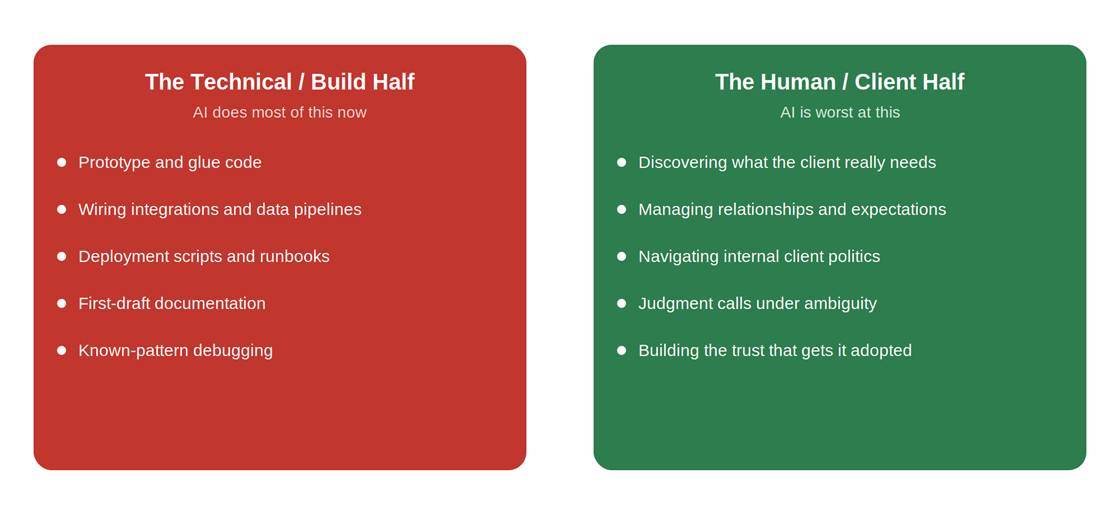
The FDE role split into its two halves: the AI-heavy technical build side, and the AI-resistant human side.
SCALER | 12 MONTH PROGRAM
AI Forward Deployed
Engineer Program
Full-stack engineering, production AI, and client-facing consulting — built around a real client engagement you run from first call to production scale.
ENROLL NOWHiring from this program





What Should FDEs, and Aspiring FDEs, Do to Stay Ahead?
The part most competing pieces skip entirely. Concrete moves, not vague reassurance.
Double down on the human core, discovery, communication, and stakeholder management, since that's exactly what the table above shows AI can't touch. Get genuinely fluent using AI as a tool rather than quietly competing with it, prompt well, orchestrate agents, and review AI output critically rather than shipping it blind. Go deep on a specific domain so you understand the client's actual world, not just the underlying technology. Build real judgment through ambiguous, high-stakes projects, not tutorials with a clean answer key. And deliberately develop product and consulting instincts alongside the engineering ones, since that combination is exactly what the role rewards now.
The automatable half of the job is table stakes now, everyone can lean on an AI coding agent. Your actual career equity sits in the half that isn't automatable. If you want a concrete path to build the AI-orchestration side of this specifically, an AI engineer roadmap to build modern, in-demand skills lays out exactly that.
Conclusion
AI won't replace the forward deployed engineer. It will replace a narrow definition of the job, the FDE who was really just a coder who happened to sit near the client. That version was always going to be exposed once AI could write the glue code itself. The FDE who's a genuinely trusted problem-solver, who uses AI to move faster rather than fearing it as competition, is more valuable now than at any point since Palantir coined the title. Forbes' own take on this lands on a similar note from the executive side: the complexity of coding has genuinely gone away, but the premium on human judgment has, if anything, doubled because of it. The task-audit framework above is the honest reason why.
Strong demand for these skills is also visible in what companies pay forward deployed engineers today.
How Scaler Transformed Careers in Different Fields
Scaler learners achieved 2.5x salary growth with average post-Scaler CTC reaching ₹23L.
 Google
 Amazon
 Microsoft
 Flipkart
 Adobe1200+ more
Check Out These Reads on FDE Pay and Career Growth
FAQs
Will AI replace forward deployed engineers?
Short honest answer: no for the human core of the role, yes for the automatable half. FDEs who only did prototyping and integration grunt work are exposed. FDEs who lead with discovery, trust, and judgment are safer than most engineering roles right now.
Turn Learning into Career Growth
What parts of the FDE job can AI actually automate?
Prototyping, glue code, wiring integrations, drafting deployment scripts and runbooks, and first-draft documentation, the build half. These are increasingly AI-assisted or fully AI-done, and that's a genuine shift, not spin.
Is forward deployed engineer a good career in the age of AI?
Yes. Demand is rising sharply at AI-first companies specifically because the human skills the role depends on are AI-resistant. Industry data points to demand for the role surging even as AI automation advances elsewhere.
How is AI changing the forward deployed engineer role?
It compresses the build cycle from weeks to hours in many cases, which shifts an FDE's time toward discovery, client relationship work, and judgment calls, the parts of the job that were always the harder, higher-value half.
What skills should an FDE build to stay relevant?
Client discovery, communication under ambiguity, domain depth in the client's actual world, fluency orchestrating AI agents rather than hand-coding everything, and judgment built through real, high-stakes projects rather than tutorials.
Are forward deployed engineers safe from AI compared to regular software engineers?
Somewhat more insulated, since the role is unusually client-facing and ambiguity-heavy by design. That's not a guarantee, but it does mean the FDE role leans harder on exactly the skills current AI is worst at.
Do forward deployed engineers still need to code if AI writes the code?
Yes, but increasingly as a reviewer, orchestrator, and architect rather than a line-by-line typist. You still need to know when AI-generated code is wrong, which requires genuine technical depth, not just prompting skill.
The takeaway: in an AI-shaped industry, the engineers who thrive won't be the fastest typists, they'll be the ones who can navigate ambiguity, earn a client's trust, and use AI as a tool rather than fear it as a rival. That's the kind of durable, industry-ready engineer Scaler School of Technology is built to develop.




