


XML Syntax
Overview
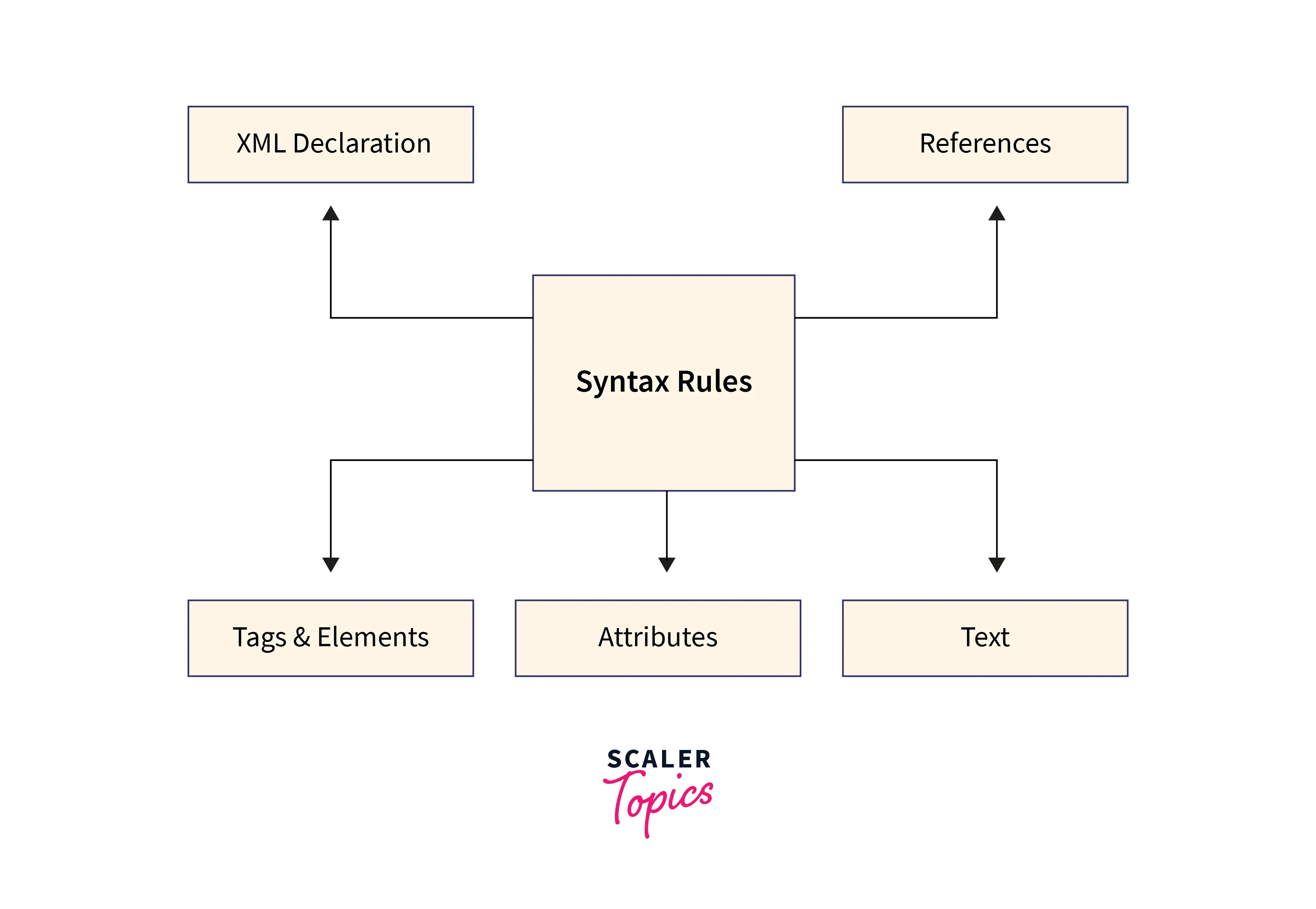
XML, or eXtensible Markup Language, is a versatile and widely used standard for storing and transporting data. It provides a way to structure documents and exchange information between different systems. Understanding XML syntax is fundamental to working with XML documents effectively. In this article by Scaler Topics, we'll dive into the various aspects of XML syntax, including the XML declaration, tags, elements, nesting, root elements, XML references, and more. So, let's begin our journey into the world of XML syntax!
XML Declaration
At the beginning of an XML document, you'll find an XML declaration. It's not mandatory, but it's considered good practice to include one. The declaration provides important information about the document, such as its version and encoding.
For example, an XML declaration looks like this:
Here, <?xml signifies the beginning of the declaration, version="1.0" indicates the XML version being used (in this case, version 1.0), and encoding="UTF-8" specifies the character encoding, which is commonly UTF-8 for international character support.
Syntax Rules for XML Declaration
- The XML declaration must be the first thing in an XML document, before any elements or content.
- It must begin with <?xml and end with ?>.
- The version attribute is required, and it should specify the XML version being used.
- The encoding attribute, though not mandatory, is highly recommended to ensure proper interpretation of characters.
- Other optional attributes like standalone may be included as needed.
Tags and Elements
XML documents consist of tags and elements. A tag is a construct that starts with < and ends with >. It marks the beginning or end of an element. For example, <name> is an opening tag, and </name> is a closing tag.
An element is made up of an opening tag, content, and a closing tag.
For example:
In this example, <book> is the opening tag, </book> is the closing tag, and everything in between constitutes the content of the element.
Syntax Rules for Tags and Elements
- Tags must be properly nested. This means they can't overlap. For instance, <a><b></a></b> is invalid because the b tag overlaps with the a tag.
- Tags are case-sensitive. <book> and <Book> are considered different.
- All elements must have an opening and a closing tag, even if the element is empty. For empty elements, you can use a self-closing tag like <empty />.
- Elements can be nested within one another to create hierarchies.
Element Syntax
Elements can have attributes that provide additional information about the element. Attributes are specified within the opening tag and are written as name="value".
For example:
In this example, category is an attribute of the book element.
Nesting of Elements
One of the powerful features of XML is the ability to nest elements within one another. This allows for the creation of complex data structures. For example:
In this example, the library element contains two book elements, each with its own title and author.
Root Element
Every XML document must have a single root element that encloses all other elements. This root element is the highest-level element in the hierarchy and contains all other elements as its children.
For example:
In this example, <library> is the root element.
XML References
XML documents can include references to other entities, such as characters that have special meaning in XML (like <, >, &, etc.) or to external resources.
For example, the < reference represents the less-than sign <, and > represents the greater-than sign >. These references are essential for including special characters within an XML document.
XML Text
The content within elements is referred to as text. This text can include any characters, including letters, numbers, symbols, and whitespace.
For example:
In this example, the text content of the description element is XML syntax allows for a structured representation of data.
Conclusion
- Understanding XML syntax is crucial for effectively working with XML documents.
- We've covered the XML declaration, tags, elements, nesting, root elements, XML references, and more.
- By following the syntax rules, you can create well-formed XML documents that can be easily processed by various applications.
- Keep in mind that XML is not just a markup language; it's a versatile tool for data representation and exchange.
- With its clear and flexible syntax, XML continues to be a cornerstone of modern data processing.