


IBM RAG and Agentic AI Professional Certificate: What is it?
The IBM RAG and Agentic AI Professional Certificate is a comprehensive, nine-course training program designed by IBM. It equips software engineers with advanced generative AI skills, focusing on Retrieval-Augmented Generation (RAG), autonomous AI agents, LangChain framework implementations, and production-grade AI system deployment.
Introduction to the IBM RAG and Agentic AI Professional Certificate
The landscape of Artificial Intelligence has transitioned rapidly from monolithic, static Large Language Models (LLMs) to dynamic, context-aware systems capable of autonomous execution. The IBM RAG and Agentic AI Professional Certificate emerges as a structured, rigorous curriculum designed to bridge the gap between theoretical generative AI and applied engineering. Targeted at software engineers, data scientists, and systems architects, this certification focuses heavily on the mechanics of building enterprise-grade applications that leverage real-time data and autonomous reasoning.
Unlike introductory courses that merely scratch the surface of prompt engineering, this professional certificate dives into the complex architectural patterns required to circumvent the inherent limitations of standard LLMs—namely, knowledge cutoffs and hallucination. By integrating Retrieval-Augmented Generation (RAG) and Agentic AI frameworks, developers learn how to ground model responses in proprietary data and empower models to execute multi-step tool-use operations. The program encompasses nine distinct courses, moving logically from foundational concepts to advanced, hands-on architectural implementations utilizing industry-standard libraries like LangChain and IBM's Watsonx platform.
Core Curriculum and Program Structure
To fully grasp the technical depth of the IBM RAG and Agentic AI Professional Certificate, one must examine its modular curriculum. The program is meticulously structured to ensure that learners build compounding knowledge. It transitions from the statistical behavior of foundational models to the deterministic engineering of agentic systems. Each module demands a strong understanding of Python programming and API integration, ensuring the focus remains on implementation rather than mere conceptualization.
Build an AI-First Career, Master the Complete Skillset
Choose from our industry-leading programs designed for career success
Modern Software and AI Engineering Program
Master full-stack development with AI integration


 +1000 more
Modern Data Science and ML with specialisation in AI
Advanced data science techniques with AI specialization
+1000 moreAdvanced AIML with Specialisation in Agentic AI
Deep dive into AIML with focus on Agentic systems
+1000 moreDevOps, Cloud & AI Platform Engineering
Build and manage AI-powered cloud infrastructure
+1000 moreAI Engineering Advanced Certification by IIT-Roorkee
Premier AI engineering certification from IIT-Roorkee

AI Forward Deployed Engineer Program
Full-stack engineering, production AI and client-facing consulting
+1000 moreFoundation Courses: Generative AI and Prompt Engineering
The initial phase of the certificate establishes the baseline required for interacting programmatically with LLMs. While experienced engineers might be familiar with basic prompting, the curriculum quickly advances into systematic prompt engineering methodologies. Learners explore zero-shot, few-shot, and Chain-of-Thought (CoT) prompting techniques as programmatic controls rather than manual inputs.
This section also delves into the foundational architecture of transformer models. Understanding attention mechanisms and tokenization is critical because subsequent modules on chunking and context window management in RAG rely heavily on a developer's grasp of token economics. You will learn to evaluate model constraints, calculate token limitations, and format complex JSON-based inputs and outputs to ensure deterministic interactions with non-deterministic models.
Intermediate Courses: RAG (Retrieval-Augmented Generation)
The intermediate modules form the technical crux of the certificate. RAG is introduced not merely as a concept, but as a multi-component distributed system. Developers are taught how to architect pipelines that ingest, vectorize, index, and retrieve unstructured data.
You will delve into the mathematical foundations of vector embeddings. When text is converted into high-dimensional vectors, similarity is often calculated using Cosine Similarity. The curriculum expects an understanding of how semantic distance is computed using standard formulas: Cosine Similarity = (A · B) / (||A|| * ||B||) = Σ(Ai * Bi) / (√(ΣAi²) * √(ΣBi²))
Learners build pipelines that process documents using advanced chunking strategies—such as recursive character splitting and semantic chunking—to maintain contextual integrity before storing these representations in vector databases (e.g., Milvus, Pinecone, or ChromaDB). The courses emphasize the optimization of the retrieval phase, exploring techniques like Maximum Marginal Relevance (MMR) and multi-query retrieval to ensure the LLM is fed the most accurate, relevant context possible.
Advanced Courses: Agentic AI and LangChain
The final technical phase elevates the curriculum from passive retrieval systems to active, autonomous agents. Agentic AI represents a paradigm shift where the LLM functions as a reasoning engine capable of routing tasks, querying external APIs, executing code, and iterating based on execution feedback.
This section leans heavily on LangChain and LangGraph to build ReAct (Reasoning and Acting) loops. Developers learn how to bind external tools—such as SQL database query engines, web search APIs, and internal microservices—to an agent. The course covers the precise construction of system prompts that enforce rigid JSON-schema outputs, allowing the agent to parse its own responses and decide on subsequent actions. Memory management, a notoriously complex aspect of agentic workflows involving conversational buffers and vector-backed long-term memory, is also covered in exhaustive detail.
Technical Skills and Tools Acquired
Completing this certification requires mastering a modern stack of AI engineering tools. The program is inherently practical, meaning engineers must translate architectural diagrams into functioning code. The focus spans both open-source ecosystems and enterprise solutions, ensuring flexibility in various production environments.
Frameworks and Libraries
The dominant framework taught throughout the certification is LangChain. Developers learn to construct complex chains utilizing LangChain Expression Language (LCEL), which allows for declarative composition of prompts, LLMs, and output parsers. Alongside LangChain, students are introduced to Hugging Face for localized model deployment and embedding generation.
Additionally, IBM heavily integrates its own Watsonx.ai platform. This exposes learners to enterprise-grade AI deployment, focusing on governance, model monitoring, and secure API utilization. You will learn how to interface with Watsonx APIs using Python, managing authentication, payload structuring, and asynchronous stream handling.
How Scaler Transformed Careers in Different Fields
Scaler learners achieved 2.5x salary growth with average post-Scaler CTC reaching ₹23L.
 Google
 Amazon
 Microsoft
 Flipkart
 Adobe1200+ more
Architectural Patterns
Beyond specific syntax, the true value of the IBM RAG and Agentic AI Professional Certificate lies in the architectural patterns it instills. You will master:
- Naive RAG vs. Advanced RAG: Moving beyond simple semantic search to implement pre-retrieval optimization (query expansion) and post-retrieval processing (reranking).
- Agentic Workflows: Implementing the ReAct pattern where a model evaluates an observation, determines a thought process, and executes an an action iteratively.
- Tool Binding: Engineering reliable interfaces between non-deterministic models and deterministic functions (e.g., REST APIs, database connectors).
- Evaluation Metrics: Implementing frameworks like RAGAS to quantitatively measure the faithfulness, answer relevance, and context precision of a RAG pipeline.
Hands-On Components and Practical Application
Theoretical knowledge of vector spaces and LLM parameters is insufficient for modern software engineering. Recognizing this, the IBM RAG and Agentic AI Professional Certificate mandates rigorous hands-on application. Every conceptual module is paired with practical lab environments, primarily delivered through Jupyter Notebooks hosted on IBM Cloud or Coursera’s integrated lab system. These hands-on components are designed to simulate real-world engineering constraints, requiring developers to write, debug, and optimize Python code.
Capstone Project Overview
The culmination of the certificate is a comprehensive Capstone Project. This is not a guided tutorial, but an open-ended engineering requirement where learners must architect an end-to-end Agentic RAG system.
Typically, the capstone requires the developer to ingest a corpus of unstructured, domain-specific data (such as financial reports or medical documentation). The engineer must:
- Design a data ingestion pipeline that effectively chunks and embeds the data.
- Deploy a vector database to index the embeddings.
- Construct an AI agent using LangChain capable of dynamic tool routing.
- Implement memory so the agent can maintain context over a multi-turn session.
- Deploy the solution with a functional UI (often utilizing Streamlit or Gradio).
Here is a simplified architectural representation of the code structures you are expected to build and understand by the end of the capstone:
Turn Learning into Career Growth
Recommended Experience and Prerequisites
Because the IBM RAG and Agentic AI Professional Certificate is fundamentally an engineering-focused curriculum, it is not suited for absolute beginners. Attempting this certification without the proper prerequisites will result in steep learning curves during the hands-on lab sessions.
The primary prerequisite is a robust proficiency in Python programming. Learners must be comfortable with object-oriented programming concepts, asynchronous code execution, and dependency management. Furthermore, a foundational understanding of interacting with REST APIs is critical, as modern AI engineering is heavily dependent on API-based microservices.
While profound expertise in deep learning math is not strictly required, a basic understanding of probability, linear algebra, and data structures will significantly aid in comprehending how vector embeddings function in multi-dimensional space. Familiarity with standard data manipulation libraries such as Pandas and NumPy is also highly recommended, as data preparation is a significant step in the RAG pipeline. If you have previously worked as a backend developer, data engineer, or machine learning practitioner, you possess the ideal background for this program.
Career Impact and Industry Relevance
The software engineering job market is currently undergoing a massive structural shift. Traditional backend and full-stack roles are increasingly demanding AI-integration capabilities. Acquiring an ibm ai agent certification directly addresses this evolving market demand. By completing this program, engineers transition from standard software development into high-demand roles such as AI Engineer, LLM Ops Engineer, and Cognitive Architect.
Bridging the Generative AI Skills Gap
Currently, there is a massive disparity between developers who know how to use ChatGPT via a web interface and engineers who can build autonomous, LLM-backed systems. Enterprise companies cannot rely on simple API calls for production applications due to strict requirements around data privacy, hallucination mitigation, and operational determinism.
RAG and Agentic frameworks solve these enterprise constraints. RAG ensures the model's answers are anchored in factual, private corporate data, significantly reducing hallucination. Agentic workflows allow businesses to automate complex, multi-step tasks rather than simple Q&A. By proving competence in these exact methodologies through a globally recognized credential, engineers drastically increase their marketability, positioning themselves to lead enterprise AI transformations rather than just participating in them.
Instructors and Delivery Methodology
The content within the IBM RAG and Agentic AI Professional Certificate is authored and delivered by IBM’s own senior data scientists, AI architects, and specialized technical trainers. This ensures that the curriculum is deeply rooted in actual industry practice rather than pure academic theory. The delivery methodology is entirely asynchronous, making it highly accessible for working professionals.
Courses are hosted on platforms like Coursera and rely on a hybrid delivery model. This includes high-quality video lectures for conceptual grounding, extensive reading materials for deep technical specifications, and interactive quizzes for immediate knowledge retention checks. The true differentiator in delivery, however, is the IBM Skills Network Labs. These browser-based environments provide pre-configured Jupyter Notebooks, ensuring that learners do not waste hours managing local Python environments, Docker containers, or dependency conflicts. You can immediately focus on the architecture and logic of RAG systems.
Comparing AI Certifications: Why Choose This One?
When evaluating how to upskill in the AI space, engineers frequently compare modern Generative AI certifications against traditional Data Science or Machine Learning credentials. Understanding the differences in scope, tooling, and desired outcomes is vital for making an informed career decision.
Below is a technical comparison of the IBM RAG and Agentic AI Professional Certificate versus a standard Traditional Machine Learning Certification.
| Feature / Focus Area | IBM RAG and Agentic AI Professional Certificate | Traditional Machine Learning Certification |
|---|---|---|
| Core Mathematical Focus | Vector semantics, Cosine Similarity, Token economics, Semantic distance. | Calculus, Gradient Descent, Statistical modeling, Backpropagation. |
| Primary Architecture | Retrieval-Augmented Generation (RAG), ReAct Agents, LLM Orchestration. | Random Forests, Support Vector Machines (SVM), Convolutional Neural Networks (CNNs). |
| Key Frameworks Taught | LangChain, LangGraph, LlamaIndex, Hugging Face, Watsonx. | Scikit-Learn, TensorFlow, PyTorch, Keras, Pandas. |
| Data Processing Methodology | Text chunking, Embedding generation, Vector indexing (Chroma, Milvus). | Feature engineering, Dimensionality reduction (PCA), Data imputation, Normalization. |
| Output Determinism | Managing non-deterministic outputs via Prompt Engineering and JSON parsing tools. | Highly deterministic continuous values (Regression) or discrete classes (Classification). |
| Ideal Job Role Outcome | AI Engineer, LLM Ops Engineer, Generative AI Architect. | Data Scientist, Machine Learning Engineer, Quantitative Analyst. |
As demonstrated, the IBM RAG and Agentic AI Professional Certificate is highly specialized. It does not teach you how to train a model from scratch using PyTorch; rather, it teaches you how to orchestrate pre-trained foundational models into robust, autonomous enterprise applications.
Frequently Asked Questions (FAQ)
1. Is prior knowledge of Deep Learning required for the IBM RAG and Agentic AI Professional Certificate? No, deep learning expertise is not mandatory. While understanding neural network architecture is beneficial, this certificate focuses on applied Generative AI and orchestration. You need strong Python skills, an understanding of APIs, and basic data manipulation knowledge. You will be utilizing pre-trained models, not calculating gradients or training models from scratch.
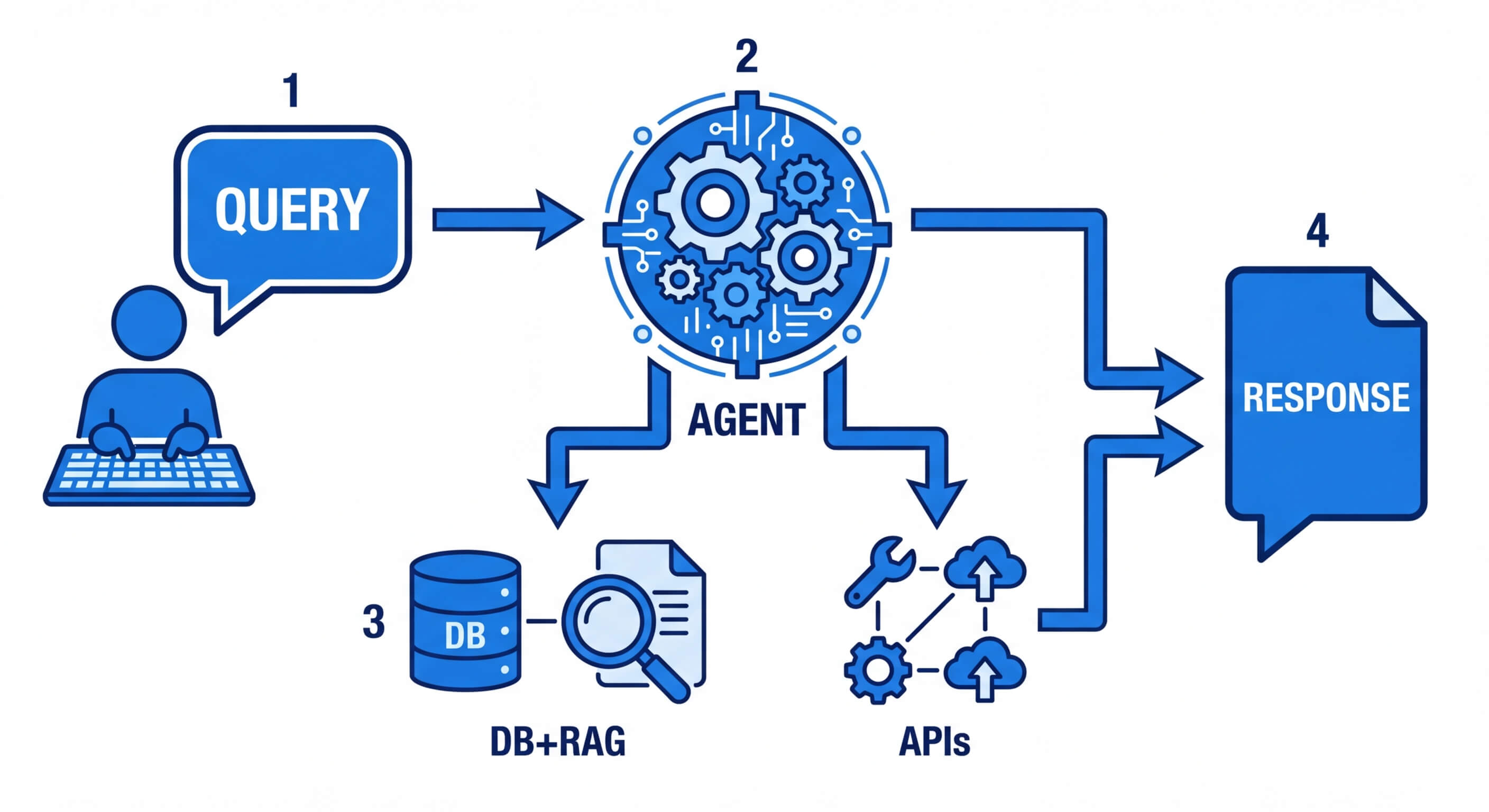
2. How does an "Agentic" workflow differ from a standard RAG pipeline? A standard RAG pipeline is a linear, single-pass process: a user asks a query, the system retrieves relevant documents from a vector database, appends them to a prompt, and the LLM generates an answer. An Agentic workflow, however, is iterative and autonomous. The LLM acts as a reasoning engine capable of dynamically choosing which tools to use (e.g., searching the web, querying a SQL database, or triggering a RAG retrieval), observing the output of those tools, and deciding if further actions are necessary before providing a final answer.
3. Am I locked into using only IBM Watsonx throughout the certification? While IBM Watsonx is prominently featured to provide an enterprise-grade deployment perspective, the curriculum heavily utilizes open-source standards. You will spend significant time working with open-source libraries like LangChain, Hugging Face embeddings, and generic vector databases like Chroma, making your skills highly transferable to AWS, GCP, Azure, or local server environments.
4. What is the standard time commitment to complete the certificate? For a software engineer with strong Python proficiency, the program typically takes 2 to 3 months to complete if dedicating 5 to 10 hours per week. Absolute beginners to Python or APIs will likely need longer to grasp the underlying programming concepts before mastering the LangChain syntax and Agentic logic.
5. How are vector embeddings compared in a RAG system? In a RAG system, user queries and document chunks are converted into dense vectors. The system then compares the query vector to the document vectors using mathematical distance metrics. The most common metric is Cosine Similarity, which measures the cosine of the angle between two vectors. A cosine similarity close to 1 indicates high semantic relevance, whereas a score closer to 0 indicates low relevance. The database retrieves the top-k vectors with the highest similarity scores to feed context to the LLM.




