15 Best Generative AI Books to Read in 2026 (Beginner to Advanced)
Good generative AI books are surprisingly easy to find and surprisingly hard to rank honestly. Most lists just recycle the same ten titles in the same order, with a paragraph lifted straight from the back cover. This one doesn't do that. Below are 15 genuinely worthwhile generative AI books, grouped by level, each with a plain verdict on who it's actually for and, sometimes more usefully, who should skip it for now and come back later.
How to Choose a Generative AI Book
The honest answer is that "best" depends entirely on where you're starting and what you actually want out of it. Before picking anything off this list, be straight with yourself about three things: your current level, how comfortable you are with math and Python, and whether your goal is to understand the field, build with it, or make decisions about it at work.
This list uses four groups to match that reality: Beginner-friendly, for people starting from close to zero. Hands-on practitioner, for people who can code and want to build. Deep-technical, for people who want the math and the from-scratch mechanics. And business, ethics and the big picture, for people who need to lead, decide, or just understand what this technology is actually doing to the world.
One honest rule this whole list follows, and most competing lists don't: every technical pick here genuinely teaches generative AI specifically, meaning LLMs, transformers, diffusion, GANs, prompting, or fine-tuning. There's a real market of pop-AI and business-hype books that get lumped into "generative AI books" lists purely because AI is in the title. None of them made this list just to pad the count to a round number.
A book is one input into a bigger plan, not the whole plan. If you want the sequence these books fit into rather than just a stack of titles, a structured generative AI roadmap lays that out properly.
Best Generative AI Books for Beginners
This is the group most people land on this page looking for. A quick note before you dive in: "beginner" here means new to generative AI specifically, not necessarily new to computers. A couple of these assume zero math; a couple quietly expect some Python.
You Look Like a Thing and I Love You — Janelle Shane
Verdict: Zero math, genuinely funny, and it does something rarer than it sounds: it builds correct intuition about how models actually behave, including all the weird ways they fail. Start here if you want to understand the shape of the problem before touching any code.
Co-Intelligence — Ethan Mollick
Verdict: The best pick for non-engineers and working professionals who need to actually use LLMs well, not just know what they are. Mollick writes about prompting and working alongside AI in a way that holds up even as the specific tools change underneath it.
Build an AI-First Career, Master the Complete Skillset
Choose from our industry-leading programs designed for career success
Modern Software and AI Engineering Program
Master full-stack development with AI integration


 +1000 more
Modern Data Science and ML with specialisation in AI
Advanced data science techniques with AI specialization
+1000 moreAdvanced AIML with Specialisation in Agentic AI
Deep dive into AIML with focus on Agentic systems
+1000 moreDevOps, Cloud & AI Platform Engineering
Build and manage AI-powered cloud infrastructure
+1000 moreAI Engineering Advanced Certification by IIT-Roorkee
Premier AI engineering certification from IIT-Roorkee

AI Forward Deployed Engineer Program
Full-stack engineering, production AI and client-facing consulting
+1000 moreThe Hundred-Page Machine Learning Book — Andriy Burkov
Verdict: Fast, honest, and refreshingly free of padding. It won't teach you generative AI directly, but it gives you the machine learning foundations you'll want before the generative-specific books stop making full sense.
Hands-On Machine Learning — Aurélien Géron
Verdict: The classic on-ramp, and the best bridge from beginner to practitioner on this whole list. Some Python is genuinely required here, so don't start with this one if you've never written a line of code. If you have, this is where beginner ends and practitioner begins.
Who should skip the beginner tier entirely: if you already have a working ML background and just want the generative-specific material, jump straight to the practitioner tier below. Re-reading beginner-level ML material you already know is a waste of the one resource none of these books can give you back, your time.
| Book | Math needed | Coding needed | Best for |
|---|---|---|---|
| You Look Like a Thing and I Love You | None | None | Total beginners, curious non-technical readers |
| Co-Intelligence | None | None | Professionals who want to use AI well, not build it |
| The Hundred-Page ML Book | Light | Light | Readers who want fast, honest ML foundations |
| Hands-On Machine Learning | Moderate | Yes, Python | Readers ready to bridge into practitioner territory |
This list sits on top of general machine learning fundamentals, so if you want the wider view before narrowing into generative models specifically, the best machine learning books for beginners and professionals is worth a look too.
Best Hands-On Generative AI Books for Practitioners
This tier is for readers who can already code and want to actually build things: GANs, diffusion models, transformers, real applications. Same honest format, now with an eye on what you'll actually be able to build after finishing each one.
Generative Deep Learning — David Foster
Verdict: The most practical tour of GANs, VAEs, diffusion, and transformers with real code attached to every concept. After this one, you'll have actually built small versions of most of the generative model families you keep reading headlines about.
Natural Language Processing with Transformers — Tunstall, von Werra & Wolf
Verdict: Written by people from Hugging Face, which shows. This is the fastest path from zero to shipping a real transformer or LLM application, since it's built entirely around the library most practitioner work actually runs on.
Everything in this book traces back to one paper worth knowing exists even if you never read it end to end: "Attention Is All You Need", the 2017 paper that introduced the transformer architecture every model in this list eventually builds on.
Deep Learning for Coders with fastai and PyTorch — Howard & Gugger
Verdict: Top-down and code-first. You build working models in chapter one and pick up the theory as you go, which suits engineers who learn by breaking things rather than reading proofs first.
AI Engineering — Chip Huyen
Verdict: Less about training models, more about turning them into real products: evaluation, deployment, RAG, and all the unglamorous engineering that sits around a generative system in production. This is the book that closes the gap between "I trained a model" and "I shipped a product."
What you can build after each, in one line: Foster gets you a working GAN or diffusion model from scratch. Tunstall, von Werra and Wolf get you a shipped transformer application. Howard and Gugger get you a working project from day one, theory included. Huyen gets you the production layer around whatever model you've already built.
Reading builds the mental model, but the thing that actually gets you hired is a portfolio. Once you've picked up a book or two here, go build something: generative AI projects you can build to get hired is the natural next step.
Best Deep-Technical Books to Learn LLMs From Scratch
The advanced tier, for readers who want the math and the actual mechanics, not just the API surface. Worth being upfront: not every book here is meant to be read cover to cover. Some are references you keep coming back to, and treating a reference like a novel is how good books end up abandoned on page forty.
Build a Large Language Model (From Scratch) — Sebastian Raschka
Verdict: The standout modern pick on this entire list. You implement a GPT-style model step by step in PyTorch, from tokenization through pretraining to fine-tuning. If you only buy one book from this whole tier, make it this one.
How Scaler Transformed Careers in Different Fields
Scaler learners achieved 2.5x salary growth with average post-Scaler CTC reaching ₹23L.
 Google
 Amazon
 Microsoft
 Flipkart
 Adobe1200+ more
Deep Learning — Goodfellow, Bengio & Courville
Verdict: The landmark theory reference in the field, and worth saying plainly: this is not a beginner's first book, whatever any other list tells you. Use it as a deep reference alongside a hands-on book like Raschka's, not as your starting point. Reading it cover to cover before you've built anything is a great way to give up.
Designing Machine Learning Systems — Chip Huyen
Verdict: The systems and MLOps view that turns raw model knowledge into production skill: data pipelines, monitoring, retraining, the parts that don't show up in a Jupyter notebook demo. Pairs naturally with her later book, AI Engineering, once you've got the ML systems basics down.
A clean order for this tier, if you want one: start with Raschka to build something real, keep Goodfellow, Bengio and Courville on the shelf as a reference for whenever the math gets fuzzy, then move into Huyen's systems book once you're ready to think about production.
If you want the full structured path this tier feeds into, rather than just the books, how to learn large language models from scratch walks through it end to end.
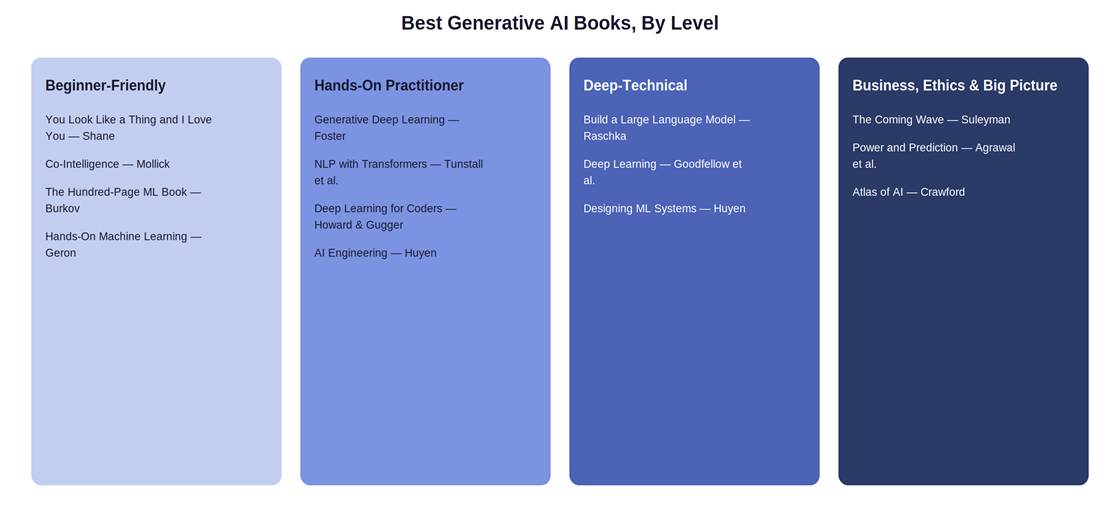
The best generative AI books in 2026, grouped by level from beginner to deep-technical.
Best Books on Generative AI Ethics, Business and the Big Picture
For readers who want to lead, decide, or genuinely understand impact, not just implementation. Useful for students prepping for interview questions on responsible AI, and for professionals who have to make adoption calls without pretending the technology is either magic or harmless. None of these three require any code at all, so if the technical tiers above felt heavy, this is a fine place to spend a week instead.
The Coming Wave — Mustafa Suleyman
Verdict: Where the technology is heading and why governance actually matters, written by a DeepMind co-founder who has genuine skin in this game rather than an outside observer's guesswork.
Power and Prediction — Agrawal, Gans & Goldfarb
Verdict: The economics of AI, argued clearly: how generative AI changes what's cheap and what's suddenly valuable. Less hype, more the kind of thinking you'd actually want before making a real business decision.
Atlas of AI — Kate Crawford
Verdict: The social, labour, and environmental costs that most hype-driven coverage skips entirely. This is the critical lens the rest of this list doesn't provide on its own, and it's worth reading precisely because it's uncomfortable.
Books tell you what to learn; they don't sequence it for you. If you want the full curriculum these titles slot into, the full generative AI syllabus does that structuring.
Turn Learning into Career Growth
Free Ways to Learn Generative AI (Beyond Books)
Not everyone can or should buy a shelf of books, and honestly, some of the best material in this field is free anyway. Official framework docs and tutorials cover a genuinely surprising amount of practitioner-level ground at no cost.
Start with Hugging Face documentation if the transformer and LLM side is your priority, since it's the same ecosystem the NLP with Transformers book is built around. For the deep-technical side, the PyTorch tutorials are a genuinely solid free companion to Raschka's and Howard and Gugger's books, walking through many of the same underlying mechanics for free. Several authors on this list, Raschka especially, also publish free companion code and articles alongside their books.
If budget is the blocker rather than interest, a free deep learning course is a genuinely solid structured alternative to starting with a stack of purchases.
Worth saying plainly before you move on: books, free or paid, give you the mental model. They don't build a portfolio by themselves. At some point the reading has to turn into something you actually built and can show someone.
FAQs
What is the best book to learn generative AI for beginners?
It depends on your comfort with math and code. For a zero-math starting point, Janelle Shane's You Look Like a Thing and I Love You builds solid intuition. If you can already code a little, Géron's Hands-On Machine Learning is the stronger bridge forward.
Can I learn generative AI on my own from books?
Yes, for the fundamentals and mental models. But books alone don't produce a portfolio. Pair reading with actually building something small, since that's what interviews and hiring managers genuinely care about.
Which book teaches you to build an LLM from scratch?
Sebastian Raschka's Build a Large Language Model (From Scratch) is the clearest, most current option, walking through tokenization, attention, pretraining, and fine-tuning a GPT-style model in PyTorch step by step.
Do I need to know machine learning before reading generative AI books?
Basic ML helps a lot. If you're starting from zero, read one foundations book first, The Hundred-Page Machine Learning Book is a fast, honest option, before jumping into generative-specific material.
Is Deep Learning by Goodfellow good for beginners?
It's a landmark reference, not a first book. The math is dense and it assumes you already have some model-building experience to anchor the theory to. Start with a hands-on book, then use Goodfellow as a reference when you need the deeper math.
Are there free books or resources to learn generative AI?
Yes. Official documentation from Hugging Face and PyTorch covers a lot of practitioner ground for free, and several authors publish free companion code and articles alongside their paid books.
How many generative AI books should a beginner read?
One foundations book plus one hands-on book is genuinely enough to start. Depth after that comes from building projects, not from reading a fifth or sixth book on the same fundamentals.
Books give you the mental model. A structured course gives you the projects, feedback, and portfolio that actually get you hired. When you're ready to go beyond reading, explore Scaler's guide to the best generative AI courses to learn LLMs, RAG and deployment.