


Difference Between OOP and POP
Overview
Object-Oriented Programming (OOP) and Procedural Programming (POP) are two important ways of writing code. In OOP, we organize our code into reusable objects that have both data and behavior. This helps make our code modular and flexible, so we can easily extend and reuse existing objects to create complex systems. On the other hand, POP follows a more step-by-step approach to programming. It focuses on completing tasks in a specific order by using procedures or functions. This means that the code is executed in a structured and sequential manner. Both OOP and POP have their own strengths and weaknesses, and they are suitable for different programming tasks.
Object-Oriented Programming
Before learning about the difference between OOP and POP, let us learn about OOP first.
Object-Oriented Programming (OOP) has evolved as a revolutionary paradigm in computer programming, allowing developers to design robust and adaptable software solutions. OOP has altered how we design and construct complex applications by emphasizing modularity, encapsulation, and reusability. In this article, we will look at the definition, benefits, drawbacks, applications, and features of Object-Oriented Programming, as well as its impact and significance in software development.
Object-Oriented Programming is a programming paradigm that organizes data and functions into reusable structures known as objects. These objects represent actual entities and have properties (data) and behaviors (functions or methods). Classes are the essential building blocks of OOP, serving as blueprints for generating objects. Objects are formed from classes through the instantiation process, allowing developers to work with individual instances and control their characteristics and behaviors.

Advantages:
- Modularity: OOP emphasizes breaking down large systems into smaller, self-contained objects. This promotes code reusability and maintainability.
- Teamwork and Parallel Development: OOP allows different developers to work on individual components, enabling parallel development and boosting productivity.
- Easier Comprehension and Testing: Modular code in OOP is easier to understand and test since it divides functionality into discrete components.
- Encapsulation: OOP encapsulates data and methods within objects, protecting them from external interference. This - ensures data integrity and enhances security.
- Controlled Access: Well-defined interfaces in OOP control access to object properties and methods, reducing the chance of unintended changes.
- Inheritance: OOP supports inheritance, allowing new classes to inherit properties and behaviors from existing classes. This promotes code reuse and reduces repetition.
- Efficient Code Maintenance: With inheritance, modifications made in base classes are automatically applied to derived classes, making code maintenance more efficient.
Disadvantages:
While Object-Oriented Programming has many advantages, it is crucial to recognize its disadvantages.
- Because of its abstract nature and the requirement to understand notions such as classes, objects, and inheritance, OOP can be difficult to grasp, especially for novices.
- The learning curve for OOP ideas and techniques can be steep, taking time and effort to master.
- The performance overhead associated with OOP is another potential negative.
- The additional levels of abstraction and runtime polymorphism introduced by OOP might impact an application's execution speed.
- Alternative programming paradigms may be more appropriate in cases where performance is crucial, such as embedded systems or high-frequency trading.
Applications:
Object-Oriented Programming offers a wide range of applications in a variety of domains. OOP provides a versatile and adaptable framework for constructing sophisticated software systems, from desktop and online apps to mobile development and game design. Its modular and reusable design makes it ideal for large-scale applications requiring code maintainability and expansion. OOP is also useful in developing graphical user interfaces (GUIs) and modeling real-world scenarios using principles such as polymorphism and inheritance.
Features:
Encapsulation and Modularity:
OOP enables encapsulation, the bundling of data and methods within objects. This allows us to create self-contained units that can be easily understood and maintained. Encapsulation fosters code modularity by hiding the internal complexities, making it easier to collaborate and update the codebase. It promotes the "don't repeat yourself" (DRY) principle, reducing code duplication and improving overall code quality.
Code Reusability:
One of the major advantages of OOP is code reusability. By creating reusable objects and classes, developers can save time and effort. Code that has already been tested and validated can be leveraged in different application parts, promoting efficiency and consistency. This significantly reduces development time and ensures a more maintainable codebase in the long run.
Inheritance and Polymorphism:
OOP facilitates inheritance, allowing the creation of subclasses that inherit properties and methods from parent classes. Inheritance promotes code reuse and provides a hierarchical structure, making the code more organized and easier to understand. Polymorphism, another key aspect of OOP, enables objects of different classes to be treated interchangeably, enhancing flexibility and extensibility.
Scalability and Flexibility:
OOP encourages the development of scalable and flexible software systems. The modular nature of objects allows for easier integration and adaptation of new features. OOP's emphasis on the separation of concerns enables developers to work on different components simultaneously, enhancing collaboration and enabling the rapid development of complex applications.
Industry Standard and Community Support:
OOP has become an industry-standard approach in software development, and a vast ecosystem of libraries, frameworks, and tools has been built around it. This provides developers with a wealth of resources, community support, and documentation. Leveraging OOP allows developers to tap into this rich ecosystem, speeding up development and ensuring compatibility with existing software infrastructure.
Examples:
Here are a few code examples in C++ to illustrate some of the concepts mentioned above:
1. Class Definition and Object Instantiation:
Explanation: In this example, we define a class called Circle with a private member variable radius and a public member function calculateArea(). The Circle class represents a circle object with its radius and the ability to calculate its area. In the main() function, we create an instance of the Circle class called myCircle with a radius of 5.0. We then call the calculateArea() method on the myCircle object and display the result.
2. Inheritance:
Explanation: In this example, we demonstrate inheritance by defining a base class called Shape with width and height member variables and a virtual calculateArea() method. The Rectangle and Triangle classes are derived from the Shape class, inheriting its properties and methods. Each derived class overrides the calculateArea() method to provide the specific implementation for calculating the area of the corresponding shape. In the main() function, we create instances of Rectangle and Triangle and call their calculateArea() methods to calculate and display their respective areas.
In conclusion, Object-Oriented Programming is a cornerstone in software development, offering a modular, reusable, and scalable approach to building complex applications. Despite its learning curve and performance considerations, the advantages of OOP, including modularity, encapsulation, and code reuse, far outweigh the challenges.
Procedural-Oriented Programming
Before learning about the difference between OOP and POP, let us learn about POP first.
Procedural Oriented Programming (POP) is a programming paradigm that breaks down a program into smaller, self-contained procedures or functions. It is one of the oldest and most widely used programming approaches, emphasizing the step-by-step execution of instructions. This section will explore the description, advantages, disadvantages, applications, and features of Procedural Oriented Programming.
Description:
In Procedural Oriented Programming, the program is organized around procedures or functions, a collection of instructions grouped to perform a specific task. These procedures can be reused throughout the program, promoting code reusability and modularity. POP relies on variables to store and manipulate data and control structures like loops and conditional statements to determine the flow of execution.
Advantages:
- Simplicity: POP follows a linear execution model, making it easy to understand and implement. It is particularly beneficial for beginners or those who prefer a straightforward approach to programming.
- Modularity and Reusability: Procedures allow for modular programming, where each function performs a specific task. This modularity promotes code reusability, as functions can be called from different program parts, reducing redundancy and improving maintainability.
- Efficiency: Procedural Oriented Programming tends to be efficient regarding memory usage and execution speed. It relies on efficiently managing variables and data structures, making it suitable for resource-constrained environments.
- Debugging and Maintenance: Debugging becomes more manageable with the code divided into smaller procedures. Identifying and fixing issues within a specific function is often easier than dealing with the entire program. Maintaining and updating the codebase is also simpler due to its modular nature.
Disadvantages:
- Lack of Data Encapsulation: In POP, data is typically shared among different functions through global variables. This lack of encapsulation can lead to data integrity issues and make it challenging to manage large-scale projects.
- Limited Scalability: As the program grows, it becomes harder to maintain and manage due to the absence of encapsulation and the linear execution model. Adding new features or making significant changes can take time and effort, making code difficult to extend or adapt.
Applications:
Procedural Oriented Programming has found extensive applications in various domains:
- System Programming: POP is often used in system-level programming, where low-level control and efficiency are crucial. Operating systems, device drivers, and embedded systems often rely on procedural programming.
- Scientific and Numeric Computing: Procedural programming is suitable for scientific simulations and numerical computations. Its efficient memory management and speed make it well-suited for these applications.
- File Processing: Many file processing tasks, such as reading and writing data from files, can be efficiently implemented using procedural programming.
Features:
Loose Coupling and Scalability:
POP promotes loose coupling between components, enabling them to interact without having direct dependencies. With POP, publishers, and subscribers communicate through events, decoupling them from each other. This loose coupling fosters scalability, as components can be added or removed independently without impacting the entire system.
Event-Driven Architecture:
POP leverages an event-driven approach, allowing for asynchronous and parallel processing of events. When an event occurs, publishers notify all interested subscribers, who can then respond accordingly. This paradigm is especially useful in scenarios where real-time data updates, notifications, or event-triggered actions are required.
Extensibility and Maintainability:
By adopting the POP pattern, applications become more extensible and maintainable. As new features or functionalities need to be added, new publishers and subscribers can be integrated seamlessly. This modular approach simplifies the system's evolution, making it easier to introduce changes or enhancements without impacting existing components.
When to Use POP?
- Distributed Systems: POP is well-suited for distributed systems where components reside on different servers or communicate over networks. It facilitates communication between disparate system parts, ensuring data consistency and synchronization across various nodes.
- Real-Time Updates and Notifications: When applications require real-time updates or notifications, such as chat systems, stock tickers, or collaborative editing tools, POP shines. It enables efficient propagation of events to subscribers, ensuring timely information delivery.
- Decoupled Interactions: If you anticipate frequent changes in your application's components or need to integrate third-party services without tightly coupling them, POP is ideal. It allows for flexible interactions between publishers and subscribers, enabling seamless integration and reducing interdependencies.
Examples:
Here are a few code examples in C++ to illustrate some of the concepts mentioned above:
1. Example of a Procedure/Function:
Explanation: In this example, we have a procedure called displayWelcomeMessage() that displays a welcome message. It is defined outside the main() function. By calling the displayWelcomeMessage() procedure within the main() function, we execute the instructions within the procedure.
2. Example of Variables:
Explanation: In this code snippet, we declare and initialize variables (age, height, and name) with their respective data types (int, float, and std::string). The values are then displayed using std::cout.
3. Example of Control Structures:
Explanation: Two control structures, the if-else statement and the for loop, provide specialized functionality in this code sample. The if-else statement checks the condition of the number variable to see if it is positive or negative. It shows the corresponding message based on the evaluation. This control structure supports conditional branching, which lets the code make decisions depending on certain situations.
On the other hand, the for loop repeatedly executes a block of code for a defined number of iterations. The loop is set to iterate five times in this scenario. This iterative structure is useful when repeating a task, such as iterating through a collection or completing calculations.
Procedural Oriented Programming (POP) is a popular programming paradigm due to its simplicity, modularity, and efficiency. It emphasizes dividing jobs into smaller, more manageable procedures, boosting code reusability and maintainability. POP, on the other hand, may have constraints in terms of scalability and data encapsulation. It is especially well suited for system programming, scientific computing, and file processing activities where efficiency and direct control over hardware resources are important.
To learn more about the OOP, refer to the link here.
Difference between OOP and POP
Let us now learn about the difference between OOP and POP, let us learn about OOP.
Two prominent programming paradigms have emerged in software development: Object-Oriented Programming (OOP) and Procedural Programming (POP). While they both serve the purpose of creating efficient and functional code, they differ significantly in their approach and structure. In this section, we will look into the dissimilarities between OOP and POP, shedding light on their distinctive characteristics.
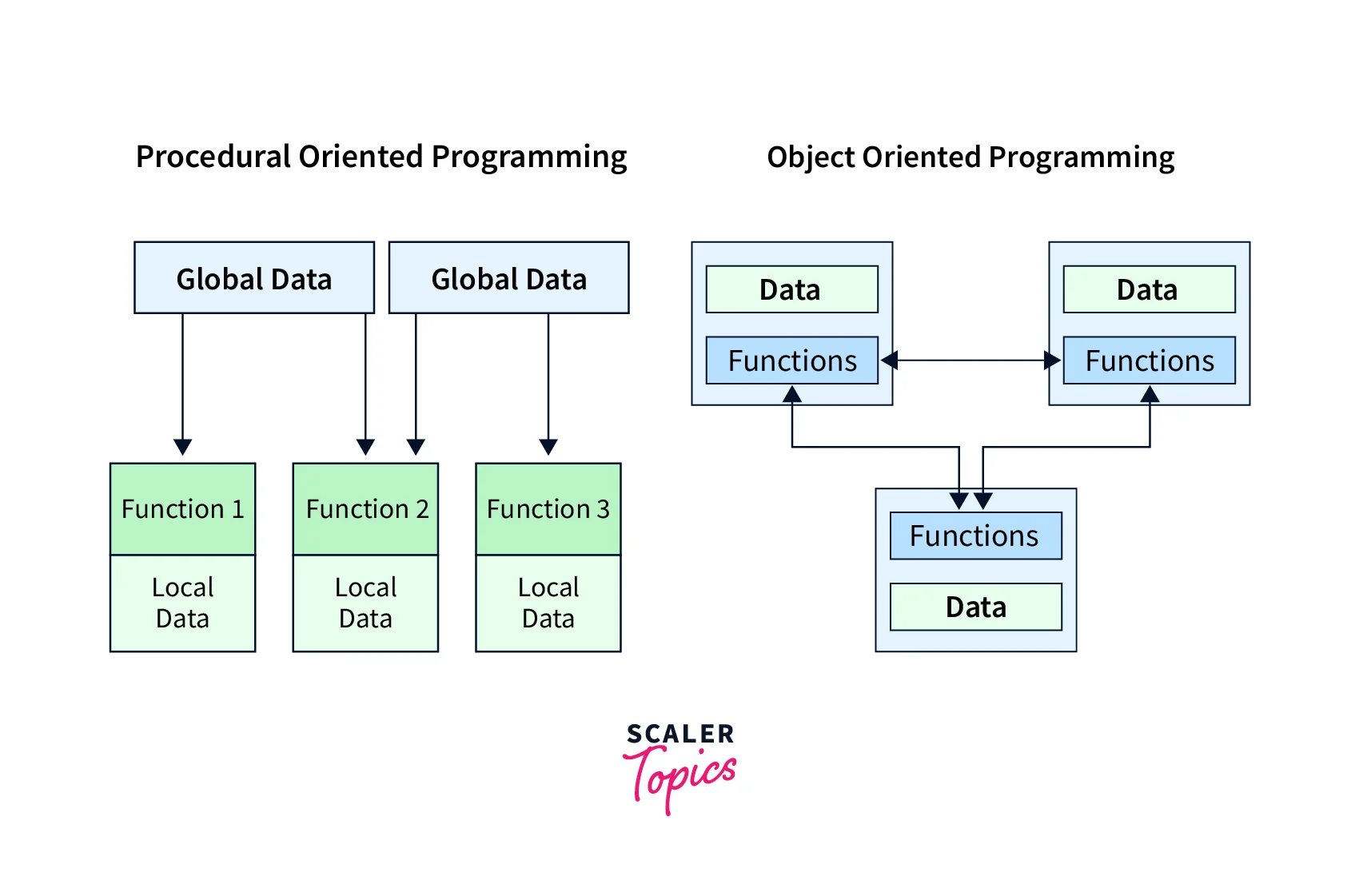
The way OOP and POP handle code organization is one of their main distinctions. POP uses a procedural approach, which structures the program around functions or procedures that manipulate data. The execution flow is organized in a top-down manner. In OOP, the core focus is creating classes and objects that reflect the things in the problem domain. Method calls, which are used to communicate between objects, make it possible for the code to be more modular and versatile.
The idea of data encapsulation is a further noteworthy distinction. Data integrity issues could arise in POP since data is frequently stored in global variables and is available to all functions. In OOP, access to data is restricted by methods and contained within objects. This capsule encourages
Example: Let's consider a simple example of calculating the area of a rectangle using POP. We define a function called "calculateArea" that takes the length and width of the rectangle as input and returns the calculated area.
On the other hand, OOP encourages the idea of encapsulation, in which an object's internal workings are concealed and access to its data and methods is managed through interfaces. This improves code maintainability and data security. Subclasses can extend and inherit the traits and behaviors of their parent classes thanks to inheritance, which makes it possible to create hierarchical relationships between classes. The flexibility and adaptability of code are increased through polymorphism, which enables objects of different classes to respond differently to the same method call. OOP principles let developers build complicated systems more efficiently. The modularity of objects makes it simpler to collaborate on, maintain, and organize code. The reusability of objects also encourages code efficiency and speeds up development.
Example: To illustrate OOP, let's consider a scenario where we model a simple banking system. We create a class called BankAccount with attributes like account number and balance and methods like deposit and withdrawal.
The key differences between OOP and POP:
- Structure: OOP emphasizes organizing code into reusable objects, while POP structures code around procedures or functions.
- Data Manipulation: OOP focuses on manipulating data through objects with defined behavior, whereas POP manipulates data through functions.
- Code Reusability: OOP facilitates code reusability through inheritance and polymorphism, allowing objects to inherit properties and behaviors from other objects. POP lacks such mechanisms.
- Encapsulation: OOP promotes encapsulation, where data and methods are bundled within an object, enhancing data security. POP does not inherently enforce encapsulation.
- Complexity Management: OOP handles complex systems by breaking them into smaller, manageable objects. POP may become unwieldy and difficult to maintain as complexity increases.
Let us now summarize the difference between OOP and POP.
| Feature | Object-Oriented Programming | Procedural Programming |
|---|---|---|
| Key Focus | Objects and their interactions | Procedures and functions |
| Data Management | Data and behavior are encapsulated in objects | Data and behavior are separate entities |
| Abstraction | Encourages the use of abstract classes and interfaces | Does not emphasize abstraction |
| Inheritance | Supports inheritance, allowing classes to inherit properties and methods | Does not support inheritance |
| Polymorphism | Allows objects of different types to be treated as the same type | Does not provide inherent polymorphism |
| Code Reusability | High level of code reusability through inheritance and composition | Relies on functions and subroutines for code reusability |
| Code Organization | Follows a modular approach, with objects as self-contained modules | Relies on functions and procedures for code organization |
| Flexibility | Provides flexibility through polymorphism and dynamic binding | Relies on structured programming, offering less flexibility |
| Complexity Management | Encourages managing complexity through encapsulation and abstraction | Manages complexity through modular code organization and stepwise design |
| Real-World Modeling | Well-suited for modeling real-world entities and their interactions | May not align well with real-world modeling, focusing more on processes |
To sum up, Procedural-Oriented Programming (POP) and Object-Oriented Programming (OOP) are two different programming paradigms that vary in their core ideas and techniques for structuring code.
The foundation of OOP is the idea of objects, which contain data and behavior within classes. It encourages modularity, reusability of code, and modeling of actual entities. Encapsulation protects data security and integrity by obfuscating internal information and allowing for managed access. Classes can inherit traits and behaviors from parent classes through inheritance, making it easier to reuse code and create hierarchical relationships. Thanks to polymorphism, objects can take on several shapes and react differently to the same method call. Abstraction improves the organization and flexibility of the code by allowing the definition of common behavior and features shared by several objects. The development of modular and loosely linked systems is encouraged by OOP, which enhances maintainability and scalability.
Contrarily, POP adopts a procedural approach, structuring code into sequentially run procedures or functions. POP focuses on carrying out instructions step-by-step to complete a task. Its simplicity, clarity, and readability make it appropriate for smaller programs or simple jobs without intricate linkages or code reuse. POP relies on parameters to convey data between functions and global variables to store data.
There are numerous considerations while deciding between OOP and POP. Due to its structured and modular approach, ability to reuse code, and ability to simulate real-world entities, OOP is frequently chosen for bigger projects with complicated problem domains. It encourages a more structured and dependable codebase. Conversely, POP offers simplicity and ease of execution, making it appropriate for smaller programs or jobs with a linear flow.
Developers are better equipped to choose the best programming paradigm for their projects when they are aware of the differences between OOP and POP. It is critical to consider the project's needs, the problem's complexity, the desired organization of the code, and the team's experience and proficiency with each paradigm. Both OOP and POP have advantages and disadvantages. Thus, the decision between the two should consider the particular requirements and objectives of the development project.
Conclusion
- OOP emphasizes data organization into objects, encapsulating data and the procedures (methods) that manipulate that data. The primary focus is on modeling real-world entities and their interactions.
- POP, on the other hand, revolves around procedures or functions that operate on data. It emphasizes breaking down a problem into steps or tasks to achieve the desired outcome.
- OOP promotes encapsulation, where data and methods that manipulate the data are bundled together within an object. This provides data security and enhances code reusability, making it easier to manage complex systems.
- In POP, data and procedures are typically separated, with less emphasis on encapsulation. Modularity is achieved by dividing the program into smaller, manageable functions.
- OOP encourages abstraction, where simplified models represent complex systems. This helps in managing complexity and allows developers to focus on essential details.
- POP does not explicitly provide mechanisms for abstraction. Developers have to rely on functions and procedures to achieve similar effects.
- OOP relies on message passing between objects to achieve communication and interaction. Objects communicate by invoking methods on other objects, leading to a more flexible and dynamic system.