Frontend Frameworks 101: What They Are and Which One to Learn
Every beginner eventually hits the same wall. You've learned HTML, CSS, and enough JavaScript to build a to-do list, and now someone in a forum is telling you to "just learn React," someone else swears by Vue, and your cousin who works at a bank insists Angular is the only serious choice. All three are right, technically. None of them are being helpful.
This guide is the version I wish existed when I was picking my first one: what a frontend framework actually is, why they exist at all, how the big ones work under the hood, and which one makes sense for you specifically in 2026, not for some hypothetical enterprise team you don't work for.
What Is a Frontend Framework?
A frontend framework is a collection of pre-written code, reusable components, and conventions that handles the repetitive parts of building a user interface. So you're not manually rewriting the same button logic fifty times across a project.
Think of it as a pre-fabricated building kit instead of a pile of raw lumber. You can build a bookshelf either way. One of them takes a weekend and doesn't wobble.
Here's the bit that trips up almost everyone: React is technically a library, not a framework.
· It only handles the view layer (what shows up on screen)
· You're expected to bring in routing and state tools separately
· Angular, by contrast, ships as a full framework, routing, forms, and HTTP handling all included out of the box
The real difference is about who's in charge. In a library, you call the code when you need it. In a framework, the framework calls your code on its own schedule.
Nobody's going to fail your interview over calling React a "frontend framework" though. The industry gave up on that argument years ago, and React's own documentation doesn't seem particularly bothered by the label either.
Second common mix-up, worth getting out of the way early: Bootstrap is a CSS framework, not a JavaScript frontend framework.
· It gives you pre-styled buttons and grid layouts
· It doesn't manage state or rendering logic the way React or Vue does
· You'll often see both used together on the same project: Bootstrap or Tailwind for the look, React or Vue for the actual behaviour
Build an AI-First Career, Master the Complete Skillset
Choose from our industry-leading programs designed for career success
Modern Software and AI Engineering Program
Master full-stack development with AI integration


 +1000 more
Modern Data Science and ML with specialisation in AI
Advanced data science techniques with AI specialization
+1000 moreAdvanced AIML with Specialisation in Agentic AI
Deep dive into AIML with focus on Agentic systems
+1000 moreDevOps, Cloud & AI Platform Engineering
Build and manage AI-powered cloud infrastructure
+1000 moreAI Engineering Advanced Certification by IIT-Roorkee
Premier AI engineering certification from IIT-Roorkee

AI Forward Deployed Engineer Program
Full-stack engineering, production AI and client-facing consulting
+1000 moreWhy Do Developers Use Frontend Frameworks?
Here's a counter button written in plain JavaScript. Nothing fancy:
Fine for one button. Now picture forty interactive elements on a page, all needing to stay in sync, a cart total that updates when quantity changes, which updates a shipping estimate, which updates whether the checkout button is even clickable. Tracking every one of those updates by hand is exactly how bugs get born. Frameworks fix this with declarative components: you describe what the UI should look like for a given state, and the framework handles the actual updating.
• Reusable components, build a button once, reuse it two hundred times with different props
• Built-in or ecosystem-standard state management, one source of truth instead of variables scattered across six files
• Routing, so your app feels like multiple pages without actually reloading anything
• Genuinely faster development once you're past the learning curve, less boilerplate, more features shipped
• A community large enough that whatever's broken at midnight, someone already asked about it in 2023
Worth being honest about: you don't always need one. A five-page brochure site or a static landing page will load faster and cost you nothing in build tooling if you just write plain HTML and CSS with a sprinkle of JS. Reach for a framework when there's real, evolving state to manage. Not because a framework is what everyone expects you to reach for by default.
How Frontend Frameworks Work
This is the part most beginner guides skip entirely, which is a shame, because it's the part that actually makes debugging make sense later. Every component-based framework organises your UI as a tree. A page component contains a header, which contains a nav bar, which contains links. Data mostly flows one direction, down the tree, parent to child, which is exactly why a bug in a child component so rarely explains itself without checking what its parent handed down.
Where frameworks genuinely differ is how they decide what to update on screen once your data changes.
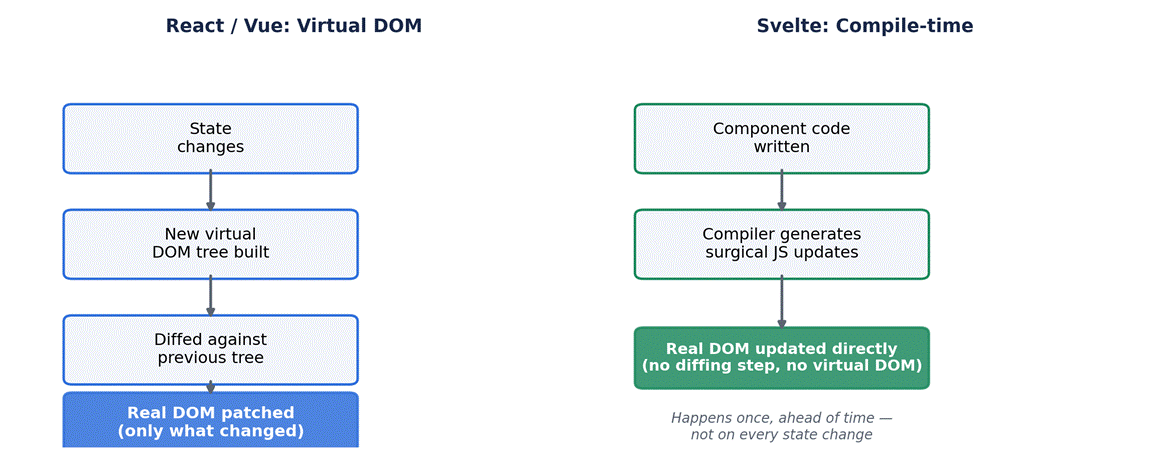
React and Vue both use a virtual DOM, a lightweight copy of the page kept in memory. When state changes, they build a new virtual tree, diff it against the old one, and patch only the real DOM nodes that actually changed. Svelte skips that whole process. It's a compiler, meaning the analysis happens when you build the app, not while someone's using it, and it spits out plain JavaScript that updates the DOM directly. Less work at runtime, smaller bundles, and it's the main reason Svelte tends to win benchmark comparisons.
One more thing worth knowing before you pick anything: almost nobody ships a raw React, Vue, or Svelte app anymore without a meta-framework wrapped around it, Next.js for React, Nuxt for Vue, SvelteKit for Svelte. These add server-side rendering, so pages arrive from the server already assembled instead of getting built in the browser after a blank flash of white. Better for SEO, faster first paint, and by 2026 this is the default starting point for a real project, not some advanced thing you bolt on later.
The Most Popular Frontend Frameworks in 2026
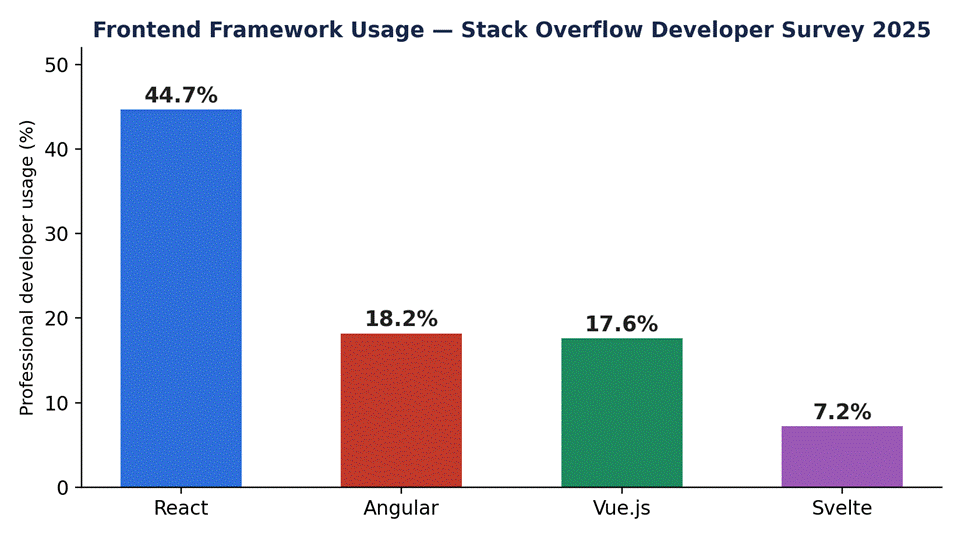
Quick detour before the individual breakdowns. TypeScript became the single most-used language on GitHub by contributor count in August 2025, overtaking JavaScript itself for the first time ever. That's not a fun fact to impress people at a party with, it means frameworks with strong native TypeScript support (Angular especially, Vue 3 and React close behind) now carry a real hiring edge, because teams increasingly write typed code as the default, not the exception. Keep that in mind while reading the usage figures below, pulled from the 2025 Stack Overflow Developer Survey, which polled more than 49,000 developers across 177 countries, so it's not exactly a small sample size.
React
React is Meta-backed and, at 44.7% professional-developer usage in that same survey, still the single most-used option by a wide margin. It's in most India frontend job listings, has by far the largest ecosystem of libraries and tutorials, and gets paired with Next.js in production almost by default now. The trade-off is JSX, writing HTML-looking syntax inside JavaScript, which takes most beginners a week or two to stop finding weird. Learn React fundamentals and the syntax stops being the obstacle fairly quickly, promise.
Angular
Google-backed, and built for structure from the ground up, dependency injection, RxJS observables, TypeScript from line one of every project. It sits around 18.2% usage, concentrated heavily in enterprise and IT-services companies, particularly the large Indian service firms building internal dashboards and long-lived business tools. It has the steepest learning curve of the four, no argument there, but if your career runs through a services company, Angular is a genuinely marketable, specific skill precisely because fewer beginners push through the ramp-up. Head over to Scaler's Angular fundamentals if that's the direction you're leaning.
How Scaler Transformed Careers in Different Fields
Scaler learners achieved 2.5x salary growth with average post-Scaler CTC reaching ₹23L.
 Google
 Amazon
 Microsoft
 Flipkart
 Adobe1200+ more
Vue.js
Vue's whole pitch is the gentlest on-ramp among the big three. Templates that look close to plain HTML, gradual adoption (you can sprinkle it into an existing page instead of rewriting the whole thing), and documentation that people consistently praise for actually being readable, which shouldn't be rare but somehow is. It holds around 17.6% usage, is strong among startups, and has a genuinely large footprint across Asia-Pacific. Nuxt is its meta-framework equivalent to Next.js, for whenever a Vue project needs server-side rendering.
Svelte
Svelte trades ecosystem size for developer happiness, roughly 7.2% usage, but consistently the highest satisfaction and retention scores in the State of JS survey of any major framework, mostly because it compiles away at build time instead of shipping a virtual DOM to the browser. Bundles stay tiny, and the syntax stays close enough to plain JavaScript that it rarely feels like "learning a framework" in the first place. The honest catch is a smaller job market. Most people land here as a second framework, after React or Vue, once components already make sense and they just want something leaner.
Others Worth Knowing
• Next.js, React's meta-framework, now the default starting point for new React projects rather than an optional add-on
• Astro, ships zero JavaScript by default, great for content-heavy sites that only need occasional interactivity
• Qwik, built around something called "resumability," which skips the usual hydration step for near-instant interactivity
• SolidJS, React-like syntax with Svelte-like compiled performance, small but genuinely devoted following
The pattern across all four: server-first, ship-less-JavaScript architecture is where things are heading in 2026, whichever base framework you actually start with.
Turn Learning into Career Growth
The Same Counter Button, Three Ways
Since a lot of this article has been theory so far, here's the exact same counter component written in React, Vue, and Svelte. Same behaviour, wildly different amount of typing.
React
Vue
Svelte
Notice Svelte barely looks like it's doing anything special, no useState, no ref wrapper, just a variable. That's the compiler doing its job quietly in the background instead of asking you to think about it.
Frontend Framework Comparison (2026)
All of it side by side now, condensed to what actually changes your day-to-day experience with each one:
| Criteria | React | Angular | Vue.js | Svelte | Notes |
|---|---|---|---|---|---|
| Learning curve | Moderate, JSX takes a week to click | Steep, TypeScript and RxJS and DI on day one | Gentle, templates read like HTML | Gentle, reads like plain JS | Vue and Svelte are the friendliest on-ramps |
| Ecosystem | Largest by a wide margin | Large, mostly batteries-included | Solid and growing | Smaller, but active | Bigger ecosystem means fewer dead ends at 1am |
| Job demand (India) | Highest, by volume | Strong in enterprise and service firms | Rising, especially at startups | Niche for now | React shows up in most listings, full stop |
| Performance | Very good | Good | Very good | Excellent, no virtual DOM to diff | Real apps rarely feel the gap benchmarks show |
| TypeScript support | Strong, added on top | Native, assumed from line one | Strong in Vue 3 | Good and improving | Angular basically requires it |
| Best for | Career-focused learners, startups, freelancing | Enterprise teams, regulated industries | Fast MVPs, small teams | Performance-obsessed apps, second framework |
How to Choose Your First Frontend Framework
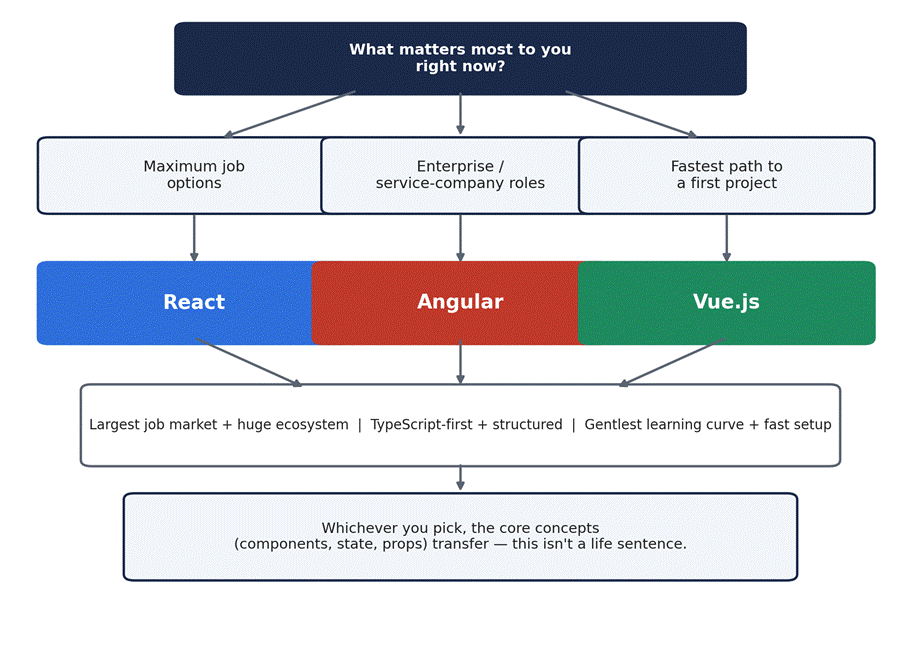
If you'd rather skip the flowchart and just get an answer: maximum job options points to React, enterprise or services-company ambitions point to Angular, and wanting a working project in your hands by this weekend points to Vue. None of these is a trick question, and none of them locks you in forever.
Here's the part nobody tells beginners clearly enough: the first framework you learn is not a life sentence. Components, props, state, one-way data flow, these concepts are close to universal. Someone genuinely comfortable in React can pick up productive Vue in a couple of weeks, not months, because the mental model barely shifts, only the syntax does. If you want the deeper side-by-side once you've actually picked a starting point, our full Angular vs React vs Vue comparison goes further into production trade-offs than a beginner needs on day one anyway.
How to Start Learning a Frontend Framework (Roadmap)
Prerequisites first. Every framework above assumes solid HTML, CSS, and JavaScript, functions, arrays, promises, basic DOM manipulation. Weak JS fundamentals are the number one reason beginners bounce off React in week two, not React itself being hard. Practice JavaScript fundamentals with Scaler's free course before opening a framework tutorial at all, it saves you from debugging two unfamiliar things simultaneously, which is nobody's idea of a fun Tuesday.
Then pick your framework and actually build something. Learn React hands-on with Scaler's free React JS course if React's your pick from above, watching tutorial videos without typing a single line yourself is close to learning nothing at all.
Three project ideas, roughly in order of difficulty:
• A to-do app, components, state, list rendering, the basics in one small package
• An API dashboard, fetch real data, handle loading and error states, get comfortable with async logic
• A full CRUD app, add a backend or something like Firebase, and you've got an actual portfolio piece
For the wider map beyond just the framework itself, HTML and CSS, Git, deployment, the whole picture, Scaler's front-end developer roadmap and the broader web development roadmap are worth bookmarking alongside whichever framework course you pick up next.
Want to go from framework basics to production-ready full-stack skills? Explore Scaler's Software Development Program for the structured, cohort-based version of everything this guide just walked you through solo.
FAQs
Which frontend framework is best for beginners?
Vue and Svelte are the easiest to pick up syntactically. If you're optimising for jobs, React is still the stronger long-term bet. If you just want a working first project fastest, start with Vue.
Is React a framework or a library?
Technically a library, it only handles the view layer. In practice, the industry (and most job listings) treat the React ecosystem, including Next.js and its routing and state tools, as a full framework.
Is Bootstrap a frontend framework?
Bootstrap is a CSS framework for styling and layout, not a JavaScript frontend framework like React or Angular. Plenty of projects use both together.
Which frontend framework is most in demand in 2026?
React leads by a wide margin, at roughly 45% professional usage and the majority of frontend job listings. Angular holds a strong second position, concentrated in enterprise and services companies.
Should I learn JavaScript before a frontend framework?
Yes. Every framework assumes you're already comfortable with functions, arrays, promises, and basic DOM concepts. Shaky JS fundamentals are the most common reason beginners struggle with React specifically.
Can I learn two frontend frameworks at once?
Not recommended while you're still a beginner. Master one, build a few real projects, and a second framework takes a fraction of the time, since most of the underlying concepts carry over directly.