

Generative AI Examples: Real-World Use Cases Across Industries
Generative AI examples are practical applications of artificial intelligence models that create novel content, such as text, code, images, or synthetic data, rather than simply analyzing or classifying existing data. These examples span from AI-assisted code completion to generating realistic medical imagery for research.
Generative Artificial Intelligence represents a paradigm shift in machine learning and software engineering. Unlike traditional discriminative models, which are trained to classify or predict based on input data (e.g., identifying a cat in an image), generative models learn the underlying distribution of a dataset to generate entirely new, synthetic artifacts that resemble the original data. This capability has unlocked a vast landscape of applications, fundamentally altering workflows, making a data science course essential for many fields, and beyond. Understanding these applications is no longer a niche specialization but a core competency, and understanding what is ai engineering is crucial for modern technical professionals. This article provides a technically rigorous exploration of real-world generative AI examples, detailing the underlying models and their practical implementations across key industries.
Foundational Concepts of Generative AI
Before examining specific examples, it is essential to establish a firm understanding of the core technical principles that enable generative AI. The field is predicated on complex neural network architectures designed to model high-dimensional probability distributions. These models are trained on vast datasets and learn to capture the latent patterns, structures, and relationships within the data, which allows them to generate new samples from that learned distribution. This section will dissect the key distinction between generative and discriminative AI and introduce the primary architectural pillars: Variational Autoencoders (VAEs), Generative Adversarial Networks (GANs), and Transformers.
Stop learning AI in fragments—master a structured AI Engineering Course with hands-on GenAI systems with IIT Roorkee CEC Certification


AI Engineering Course Advanced Certification by IIT-Roorkee CEC
A hands on AI engineering program covering Machine Learning, Generative AI, and LLMs - designed for working professionals & delivered by IIT Roorkee in collaboration with Scaler.
Enrol Now
Differentiating Generative AI from Discriminative AI
The fundamental distinction between generative and discriminative models lies in the probabilistic question they aim to answer.
-
Discriminative Models: These models learn the conditional probability P(Y|X), which is the probability of a label Y given an input X. Their objective is to learn the boundary between different classes of data. For instance, a spam email classifier learns to distinguish between "spam" and "not spam" based on the email's content (X). It doesn't know how to write a spam email; it only knows how to classify one. Common examples include Support Vector Machines (SVMs), Logistic Regression, and standard Convolutional Neural Networks (CNNs) used for classification.
-
Generative Models: These models learn the joint probability distribution P(X, Y) or the unconditional probability P(X). By learning the entire distribution of the data, they can generate new samples. For example, a generative model trained on a dataset of faces (X) learns what constitutes a face and can then generate new, photorealistic images of non-existent people. This ability to sample from the learned distribution is the essence of "generation."
Core Architectures: VAEs, GANs, and Transformers
The capabilities of modern generative AI are built upon several key neural network architectures.
-
Variational Autoencoders (VAEs): A VAE is a generative model that learns a low-dimensional representation of the data, known as the latent space. It consists of two main components: an encoder and a decoder. The encoder maps the input data to a latent space distribution, and the decoder samples from this distribution to reconstruct the original data. By sampling new points in the latent space and feeding them to the decoder, VAEs can generate novel data. They are particularly valued for their stable training dynamics but sometimes produce slightly blurrier outputs compared to other methods.
-
Generative Adversarial Networks (GANs): A GAN consists of two neural networks, a Generator and a Discriminator, which are trained simultaneously in a zero-sum game. The Generator's objective is to create synthetic data that is indistinguishable from real data. The Discriminator's objective is to determine whether a given sample is real (from the training set) or fake (from the Generator). Through this adversarial process, the Generator becomes progressively better at creating realistic data. GANs are renowned for producing high-fidelity images but can be notoriously difficult to train.
-
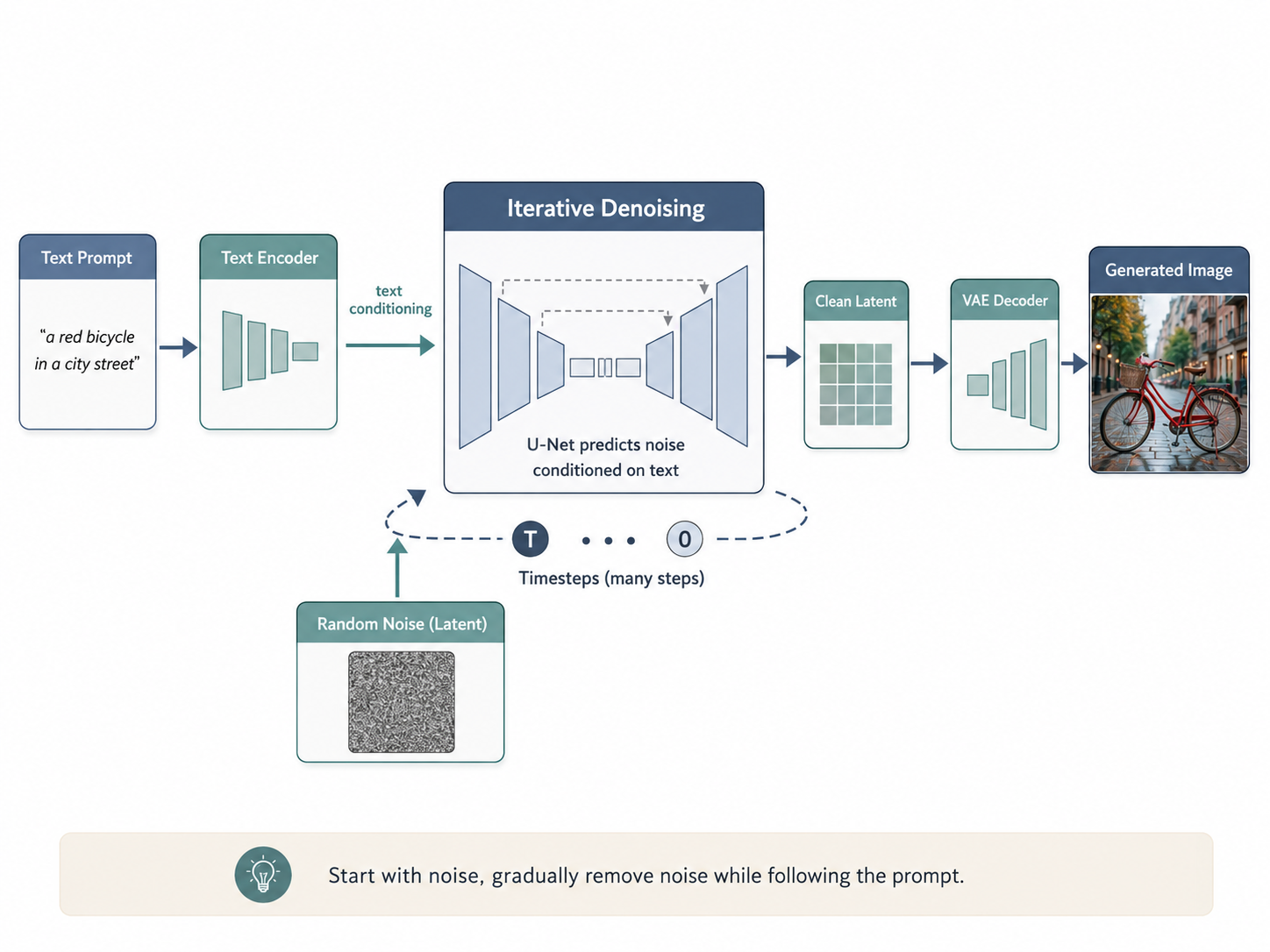
Transformers and Diffusion Models: Originally developed for Natural Language Processing (NLP), the Transformer architecture, with its self-attention mechanism, has proven exceptionally effective at modeling long-range dependencies in sequential data. This is the basis for understanding what are foundation models in generative ai. More recently, this architecture has been adapted for vision tasks. Diffusion models, often built using Transformer-like components (e.g., U-Nets with attention), work by systematically adding noise to an image and then training a model to reverse the process. To generate an image, the model starts with pure noise and iteratively "denoises" it according to a text prompt, resulting in state-of-the-art image quality and prompt fidelity.
Transform Your Career
Choose from our industry-leading programs designed for career success
Modern Software and AI Engineering Program
Master full-stack development with AI integration


 +1000 more
Modern Data Science and ML with specialisation in AI
Advanced data science techniques with AI specialization
+1000 moreAdvanced AIML with Specialisation in Agentic AI
Deep dive into AIML with focus on Agentic systems
+1000 moreDevOps, Cloud & AI Platform Engineering
Build and manage AI-powered cloud infrastructure
+1000 moreAI Engineering Advanced Certification by IIT-Roorkee
Premier AI engineering certification from IIT-Roorkee

Generative AI Examples in Software Development and Engineering
For software engineers, generative AI is not a distant concept but an increasingly integrated tool that augments and accelerates the development lifecycle. These models, trained on billions of lines of code and technical documentation, function as sophisticated partners in tasks ranging from initial implementation to final testing. This shift introduces significant productivity gains by automating repetitive work, reducing cognitive load, and enabling developers to focus on higher-level system design and logic.
Become the Ai engineer who can design, build, and iterate real AI products, not just demos with an IIT Roorkee CEC Certification
AI Engineering Course Advanced Certification by IIT-Roorkee CEC
A hands on AI engineering program covering Machine Learning, Generative AI, and LLMs - designed for working professionals & delivered by IIT Roorkee in collaboration with Scaler.
Enrol NowAI-Assisted Code Generation
AI-powered Tools for ai code generation have evolved from simple token-based suggestions to generating entire functions and code blocks based on natural language comments or existing context.
- How it Works: Tools like GitHub Copilot, powered by OpenAI's Codex model (a fine-tuned version of GPT), analyze the context of the code being written—including preceding lines, comments, and function names—to predict and suggest the most probable next sequence of code. The underlying Transformer model has been trained on a massive corpus of public source code from repositories like GitHub, allowing it to learn programming patterns, idioms, and API usage across dozens of languages.
- Example Implementation: A developer can write a comment describing a function, and the tool will generate the implementation.
Automated Unit Test Creation
Writing comprehensive unit tests is critical for software quality but is often a time-consuming and repetitive task. Generative AI tools can analyze a given function or class and automatically generate relevant unit tests, including edge cases.
- How it Works: These tools parse the source code to understand its logic, inputs, outputs, and potential failure points (e.g., null inputs, division by zero). They then generate test cases that assert the expected behavior. This significantly speeds up the process of achieving high code coverage and encourages a more robust testing culture. Tools like CodiumAI or Diffblue specialize in this domain.
Synthetic Data Generation for Testing and Training
Developing and testing applications often requires large, realistic datasets that may be difficult or impossible to obtain due to privacy regulations (e.g., GDPR, HIPAA) or data scarcity. Generative models, particularly GANs and VAEs, can generate high-fidelity synthetic data that mirrors the statistical properties of the original data without exposing sensitive information.
- Use Cases:
- Privacy-Preserving Analytics: Training machine learning models on synthetic data that retains the patterns of real user data without containing any personally identifiable information (PII).
- Database Testing: Populating development and staging databases with large volumes of realistic-looking data to perform load testing and identify performance bottlenecks.
- Augmenting Imbalanced Datasets: In classification problems where one class is underrepresented (e.g., fraud detection), generative models can create new samples of the minority class to balance the dataset and improve model performance.
Natural Language to Code/SQL Translation
A significant application of LLMs in engineering is the translation of natural language queries into executable code or database queries. This democratizes data access for non-technical stakeholders and accelerates prototyping for developers.
- How it Works: A user can input a plain English request, such as "Show me the total sales for each product category in the last quarter, sorted from highest to lowest." The generative model, fine-tuned for SQL or a specific programming language, translates this into a well-formed query.
This capability is being integrated into business intelligence (BI) platforms, database clients, and IDEs, reducing the barrier to complex data retrieval and analysis.






Use Cases in Content Creation and Media
The impact of generative AI has been most visibly demonstrated in the creative industries. These models are transforming the pipelines for creating written content, visual art, music, and video, shifting the role of human creators from pure origination to curation, prompting, and refinement. The underlying technology often involves sophisticated diffusion models for images and large-scale Transformer architectures for text and audio.
Text Generation and Summarization
Large Language Models (LLMs) are at the forefront of text-based content creation. They can draft articles, write marketing copy, compose emails, and generate documentation.
- Models: OpenAI's GPT-4, Google's Gemini, and Meta's Llama series are prominent examples.
- Applications:
- Content Marketing: Generating initial drafts for blog posts and articles, which are then refined by human editors.
- Technical Documentation: Assisting developers in writing clear and comprehensive documentation for APIs and software libraries.
- Document Summarization: Condensing long research papers, legal documents, or financial reports into concise summaries, enabling faster information processing.
Image and Art Generation
Text-to-image models have captured the public imagination by translating descriptive prompts into complex and often beautiful visuals.
- Models: DALL-E 3, Midjourney, and the open-source Stable Diffusion are leading platforms.
- How it Works: These systems are typically based on diffusion models. The model learns a process to gradually denoise a random noise field while being conditioned by a text prompt (which is processed by a text encoder like CLIP). By iterating this denoising process, it synthesizes a new image that aligns with the semantic meaning of the prompt. This allows for fine-grained control over the subject, style, composition, and lighting of the generated image.
Scaler Placement Report and Statistics
Scaler learners achieved 2.5x salary growth with average post-Scaler CTC reaching ₹23L.
 Google
 Amazon
 Microsoft
 Flipkart
 Adobe1200+ more
Music and Audio Synthesis
Generative AI is also being applied to the auditory domain, creating novel musical compositions, sound effects, and even human-like speech.
- Models: Google's MusicLM can generate high-fidelity music from text descriptions (e.g., "a calming lofi hip-hop beat for studying"). OpenAI's Jukebox generates music with vocals in various genres.
- Applications:
- Royalty-Free Music: Creating custom background tracks for videos, podcasts, and games without licensing fees.
- Sound Design: Generating unique sound effects for film and interactive media.
- Voice Synthesis: Creating highly realistic text-to-speech (TTS) systems and voice clones for accessibility tools, virtual assistants, and digital dubbing.
Video Generation and Editing
Video generation is one of the most computationally intensive and challenging frontiers of generative AI. Models must not only generate realistic frames but also maintain temporal coherence and logical progression across sequences.
- Models: OpenAI's Sora, RunwayML's Gen-2, and Pika Labs are pioneering this space.
- Applications:
- Prototyping and Storyboarding: Quickly generating video concepts for advertisements or films.
- Special Effects: Creating complex visual effects that would traditionally require significant manual effort and CGI expertise.
- Content Personalization: Generating short, dynamic video clips for personalized marketing campaigns.
Applications in Enterprise and Business Operations
Beyond creative and development-centric applications, generative AI is providing significant value within core business functions. By automating intelligence-based tasks, these models enhance efficiency, improve customer experiences, and unlock new strategic insights from enterprise data.
Enhanced Customer Support with Intelligent Chatbots
Traditional chatbots rely on decision trees and predefined scripts, limiting their ability to handle complex or unexpected queries. Generative AI-powered chatbots, often built on fine-tuned LLMs, can engage in more natural, context-aware conversations.
- How it Works: These systems are often integrated with a company's knowledge base using a technique called Retrieval-Augmented Generation (RAG). When a user asks a question, the system first retrieves relevant documents or data from the knowledge base and then uses an LLM to synthesize a coherent, human-like answer based on that retrieved information. This ensures factual accuracy while maintaining conversational flexibility.
Market Research and Trend Analysis
Enterprises can leverage LLMs and various data mining techniques to analyze and synthesize vast quantities of unstructured text data from sources like market reports, customer reviews, social media feeds, and news articles.
- Use Case: A consumer goods company could use an LLM to analyze thousands of online product reviews to identify emerging feature requests, common complaints, and shifts in consumer sentiment, providing actionable insights for product development and marketing strategy far more quickly than manual analysis would allow.
Turn Learning into Career Growth
Personalized Marketing and Advertising Copy
Generative models can create highly targeted marketing copy at scale. By providing the model with information about a specific customer segment (e.g., demographics, past purchase behavior), it can generate email subject lines, ad headlines, and product descriptions tailored to that audience's preferences. This leads to higher engagement rates and improved campaign performance.
Scientific and Medical Generative AI Examples
In high-stakes fields like medicine and scientific research, generative AI is accelerating discovery and innovation. These models are used to explore vast solution spaces, generate novel hypotheses, and create valuable synthetic data for training other AI systems.
Drug Discovery and Molecular Design
Designing new drug molecules is a complex, multi-objective optimization problem. Generative models can learn the chemical principles of molecular structure and generate novel, valid molecules that are optimized for specific properties, such as binding affinity to a target protein or low toxicity. This can dramatically shorten the initial discovery phase of pharmaceutical research.
Medical Image Synthesis for Training and Augmentation
A significant bottleneck in developing AI for medical diagnostics is the lack of large, annotated datasets, especially for rare diseases. Generative models (like GANs or diffusion models) can be trained on existing medical images (e.g., X-rays, MRIs, CT scans) to generate new, realistic synthetic images. These synthetic images can be used to augment training datasets, improving the robustness and accuracy of diagnostic classification models without compromising patient privacy.
Protein Folding and Design
While DeepMind's AlphaFold is a predictive model for determining a protein's structure from its amino acid sequence, generative AI is being used for the inverse problem: protein design. Researchers are using generative models to design entirely new protein sequences that are predicted to fold into specific, desired 3D structures. These novel proteins could function as new therapeutics, enzymes, or biomaterials.
Comparing Generative AI Models and Their Applications
Different generative AI architectures are suited for different tasks due to their unique properties. The table below provides a high-level comparison of the primary model types.
| Model Architecture | Core Principle | Primary Strengths | Common Weaknesses | Key Use Cases |
|---|---|---|---|---|
| Variational Autoencoder (VAE) | Learns a probabilistic mapping to a continuous latent space. Consists of an encoder and a decoder. | Stable training; provides a smooth and meaningful latent space; efficient generation. | Generated samples can be blurry or less sharp compared to GANs. | Data compression, anomaly detection, generating structured data (e.g., molecular structures). |
| Generative Adversarial Network (GAN) | Two networks (Generator, Discriminator) compete in a zero-sum game. | Generates extremely sharp and high-fidelity images; state-of-the-art for image realism. | Training can be unstable (mode collapse); difficult to evaluate convergence. | Photorealistic image generation, style transfer, synthetic medical imaging. |
| Transformer / LLM | Uses self-attention mechanisms to model long-range dependencies in sequential data. | Exceptional at understanding context and generating coherent, long-form text; highly scalable. | Computationally expensive to train and run; can "hallucinate" or generate factually incorrect information. | Code generation, natural language processing, text summarization, chatbots. |
| Diffusion Model | Learns to reverse a process of gradually adding noise to data. | State-of-the-art sample quality and diversity; better training stability than GANs; strong prompt adherence. | Inference (generation) can be slow due to the iterative denoising process. | High-fidelity text-to-image and text-to-video generation, audio synthesis. |
Technical Challenges and Ethical Considerations
Despite its transformative potential, the deployment of generative AI is accompanied by significant technical and ethical challenges that engineers and researchers must address.
- Model Hallucinations and Factual Inaccuracy: LLMs can generate text that is plausible and grammatically correct but factually wrong or nonsensical. This is a critical barrier to their use in applications requiring high factual reliability. Techniques like RAG are used to mitigate this, but it remains an open research problem.
- Computational Cost and Environmental Impact: Training large-scale generative models requires immense computational resources, consuming significant amounts of energy and contributing to a substantial carbon footprint.
- Data Privacy and Copyright Issues: Models trained on public data from the internet may inadvertently memorize and reproduce copyrighted material or sensitive personal information, leading to complex legal and privacy challenges.
- Bias and Fairness: Generative models can inherit and amplify biases present in their training data. If a model is trained on biased text or images, it may generate content that perpetuates harmful stereotypes, which requires careful data curation and algorithmic fairness interventions.
The Future Trajectory of Generative AI
The field of generative AI is evolving at an unprecedented pace. The next wave of innovation is likely to focus on several key areas:
- Multimodality and Model Integration: The future lies in models that can seamlessly understand and generate content across multiple modalities—text, images, audio, and video—within a single, integrated system.
- On-Device Generative AI: As models become more efficient, we will see powerful generative capabilities running locally on personal devices like smartphones and laptops, enhancing privacy and reducing latency.
- Autonomous Agents and Systems: Generative models will serve as the "brains" for more sophisticated autonomous agents that can perform complex, multi-step tasks, such as planning a trip, managing a calendar, or automating software development workflows.
Frequently Asked Questions (FAQ)
Q1: What is the difference between a GAN and a Diffusion model for image generation? A GAN uses an adversarial training process where a generator and a discriminator compete, which can lead to very sharp images but unstable training. A Diffusion model learns to reverse a noising process, which is generally more stable to train and often produces higher-quality, more diverse images, though the generation process can be slower due to its iterative nature.
Q2: How can I fine-tune a pre-trained generative model for a specific task? Fine-tuning involves taking a large, pre-trained model (like GPT or Llama) and continuing its training on a smaller, task-specific dataset. This adjusts the model's weights to specialize its performance for your use case, such as adopting a specific writing style or understanding a niche technical domain. Techniques like LoRA (Low-Rank Adaptation) allow for efficient fine-tuning without retraining the entire model.
Q3: What programming languages and frameworks are essential for working with Generative AI? Python is the de facto standard language for AI/ML development. Essential frameworks include PyTorch and TensorFlow for building and training neural networks. The Hugging Face ecosystem (Transformers, Diffusers, Datasets) is indispensable for accessing and working with pre-trained generative models.
Q4: Are generative AI models just "stochastic parrots"? This term, meaning they just randomly stitch together things they've seen, is a subject of debate. While models do learn from patterns in their training data, state-of-the-art generative models demonstrate emergent capabilities like reasoning, planning, and tool use that suggest a more complex form of synthesis and generalization rather than simple mimicry. However, their understanding is not human-like and is grounded entirely in the statistical patterns of their training data.