Generative AI vs Machine Learning: How They Relate and Differ
Generative AI is not the opposite of machine learning, it's a part of it. Machine learning is the broad field of teaching computers to learn from data, and generative AI is a newer branch of it, built on deep learning, that creates new content instead of just predicting or classifying. So the real comparison here isn't generative AI vs machine learning, it's generative AI vs traditional, discriminative machine learning, the older, still-dominant kind that scores, sorts, and predicts. This page gets that hierarchy straight, then gives you the fair comparison and real examples of each. If you want the foundational piece first, the different types of machine learning is worth reading alongside this one.
Worth naming the mistake up front, since it's the whole reason this page exists. Almost every "GenAI vs ML" article online treats the two as opposite, rival categories, ML predicts, GenAI creates, as if they're sitting on opposite sides of a fence. That framing is wrong, and it quietly teaches you something false. Generative AI predicts too, it just predicts the next word or pixel instead of a label. Get the hierarchy right first, and the rest of this comparison actually makes sense instead of feeling like two unrelated definitions bolted together.
What Is Machine Learning?
Instead of hand-coding every rule, you show a computer lots of examples and it learns the pattern on its own. A spam filter is the classic case: nobody wrote a rule for every possible spam email, the system learned what spam tends to look like from thousands of examples. Netflix recommendations and loan-approval scoring work the same way underneath. Most classic ML is discriminative, meaning it learns to tell things apart, predict a number, classify into a category, or score a risk. The two big learning styles worth knowing by name are supervised learning, where you give the model labelled examples, and unsupervised learning, where it finds patterns on its own without labels. IBM's own explainer on machine learning is a solid, vendor-neutral second opinion on this definition. If you want to actually build this skill set, how to learn machine learning step by step lays out a real path rather than a scattered reading list.
What Is Generative AI?
Generative AI is a type of AI that creates new content, text, images, audio, or code, that didn't exist before, by learning patterns from huge datasets and then generating fresh output. ChatGPT writing an email for you, DALL-E or Stable Diffusion making an image from a text prompt, GitHub Copilot suggesting the next line of your function, all the same underlying idea. Here's the technical point that trips people up: it's still learning from data and still making predictions, it just predicts what comes next, the next word, the next pixel, and strings those predictions together into something new. Underneath, this runs on deep learning, neural networks, transformers, and large language models. The transformer architecture paper by Vaswani and colleagues (2017) is the actual research behind most modern generative models, and the paper that introduced Generative Adversarial Networks, by Ian Goodfellow and colleagues in 2014, is the primary source for generative modelling itself, well worth knowing exists even if you never read the maths in full. A full generative AI learning roadmap covers the skills and tech stack behind all of it if you want the deeper path.
Build an AI-First Career, Master the Complete Skillset
Choose from our industry-leading programs designed for career success
Modern Software and AI Engineering Program
Master full-stack development with AI integration


 +1000 more
Modern Data Science and ML with specialisation in AI
Advanced data science techniques with AI specialization
+1000 moreAdvanced AIML with Specialisation in Agentic AI
Deep dive into AIML with focus on Agentic systems
+1000 moreDevOps, Cloud & AI Platform Engineering
Build and manage AI-powered cloud infrastructure
+1000 moreAI Engineering Advanced Certification by IIT-Roorkee
Premier AI engineering certification from IIT-Roorkee

AI Forward Deployed Engineer Program
Full-stack engineering, production AI and client-facing consulting
+1000 moreHow Generative AI and Machine Learning Actually Relate
Here's the sentence that fixes most of what's wrong with the rest of the internet on this topic: generative AI is a type of machine learning, not an alternative to it. Picture it as nested circles, not a two-column rivalry. Artificial intelligence is the whole field, the broadest circle. Machine learning is the subset of AI that learns from data. Deep learning is the subset of machine learning that uses large neural networks. Generative AI is the specific application of deep learning that creates content. Each one sits fully inside the one before it. Nothing here is competing with anything else. If the ML-to-DL boundary specifically still feels fuzzy, how deep learning fits inside machine learning untangles that exact layer.
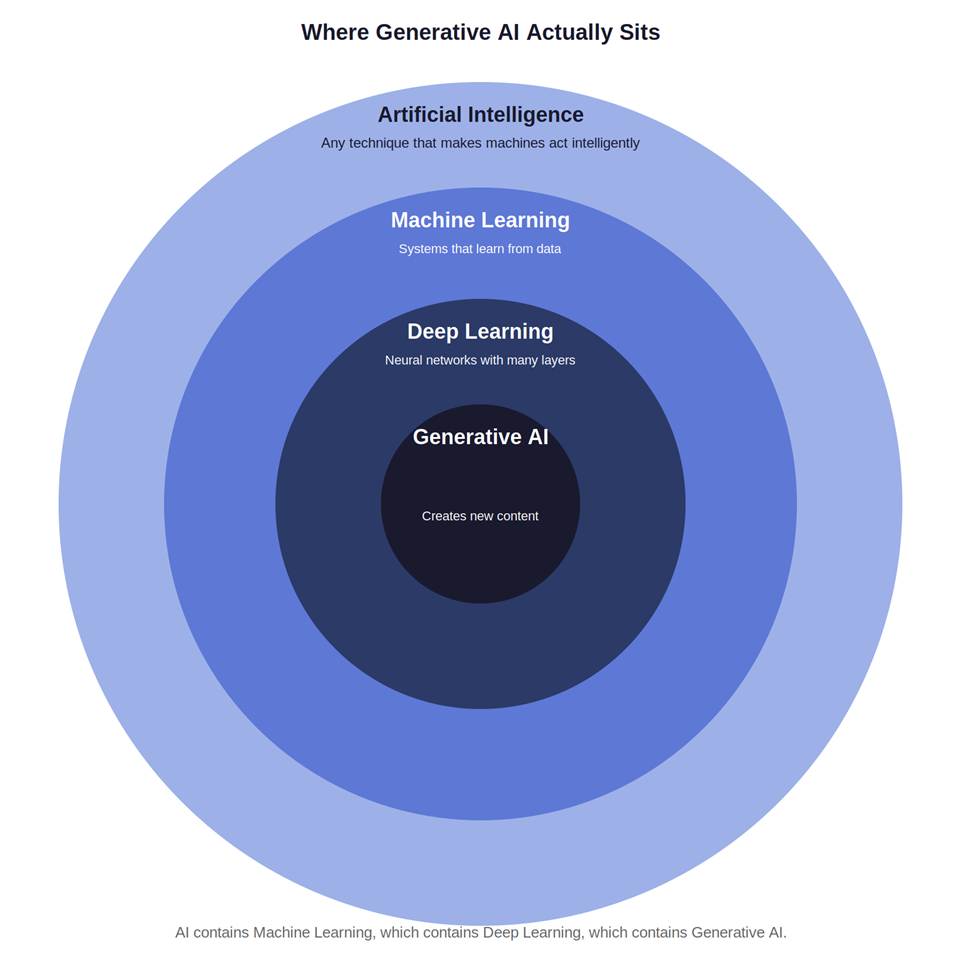
Not four rivals. Generative AI sits nested inside deep learning, inside machine learning, inside AI.
This distinction isn't pedantic, it changes how you evaluate a claim. If someone tells you "generative AI will replace machine learning," that sentence doesn't actually parse once you've seen the diagram, it's like saying squares will replace rectangles. What can genuinely happen is that generative approaches take over tasks that discriminative ML used to handle, and that traditional ML keeps quietly running the decisions underneath most of the software you use daily, credit checks, spam filters, fraud flags, without anyone calling it "AI" out loud.
Video: Artificial Intelligence vs Machine Learning | Key Differences between AI and ML (Scaler Academy, YouTube: watch?v=_pSUu3x0Sd8) — reinforces this same nested relationship, just at the AI-vs-ML layer specifically.
Generative AI vs Traditional Machine Learning: The Key Differences
Quick reminder before the table: this is generative AI compared against traditional, discriminative ML specifically, not against machine learning as a whole, since generative AI is itself a form of machine learning.
| Axis | Traditional (Discriminative) ML | Generative AI |
|---|---|---|
| Main goal | Predict, classify, score, decide | Create new content |
| What it produces | A label, number, or probability | Text, images, audio, code |
| Typical models | Regression, decision trees, SVMs, classic neural nets | LLMs, transformers, diffusion models, GANs |
| Data and training | Often labelled data, task-specific, smaller | Massive unlabelled or self-supervised data, foundation models |
| Example | Spam detection, credit scoring | ChatGPT, DALL-E, Copilot |
| Core skill to build it | Feature engineering, model selection | Prompting, fine-tuning, working with foundation models |
| When to use it | You need a decision or prediction from structured data | You need to generate something new |
Walk the two rows that matter most: goal and data. Traditional ML is built to make one decision well, usually from data your organisation already has, structured, labelled, task-specific. Generative AI is built to produce something new, and it typically needs vastly more data plus a foundation model as its starting point rather than training from scratch on your own dataset. Worth being honest about the nuance here too: generative models still predict, a language model is technically predicting the next token over and over. "Prediction vs creation" is a useful simplification, not a hard wall between two different kinds of math. The difference between generative and predictive AI goes deeper on exactly that nuance if it's the part you want to actually understand properly.
Real-World Examples of Each
Where Traditional ML Is Used
Fraud detection scoring a transaction in milliseconds, recommendation engines ranking what you'll probably click next, demand forecasting for inventory, medical-image classification flagging a scan for review, and credit scoring deciding loan risk. Real-world applications of machine learning has more grounded examples if you want the fuller picture, including some genuinely large-scale case studies.
Where Generative AI Is Used
Chatbots and assistants holding a conversation, marketing copy and image generation, code assistants drafting functions, drug-molecule design exploring chemical structures that don't exist yet, and synthetic data generation for training other models without touching real customer data.
How Scaler Transformed Careers in Different Fields
Scaler learners achieved 2.5x salary growth with average post-Scaler CTC reaching ₹23L.
 Google
 Amazon
 Microsoft
 Flipkart
 Adobe1200+ more
Where They Work Together
Most real products quietly use both. An ML model routes or ranks a request, then a generative model drafts the actual reply. A recommendation engine, traditional ML, picks which products to show, and a generative model writes fresh, tailored descriptions for each one instead of reusing the same canned copy for everyone. A fraud-detection model, traditional ML again, flags a suspicious transaction, and a generative model drafts the customer-facing email explaining why the card got temporarily blocked. Neither layer replaces the other, they're doing genuinely different jobs in the same pipeline.
Which One Should You Learn or Use?
This isn't a pick-one situation, generative AI sits on top of ML fundamentals, it doesn't replace them. If you're starting out, the ML and deep learning foundations, data, models, neural networks, come first. Generative AI is where you specialise once those fundamentals are solid, not a shortcut around them.
For a specific task: choose traditional ML when you need a prediction or decision from your own structured data. Choose generative AI when you need to create content that didn't exist before. Honest career note, since this matters for anyone deciding what to study next: employers increasingly want engineers who understand both layers, the ML base and the generative layer built on top of it, not one without the other. A team that only knows how to prompt an LLM but can't explain why a model is overfitting, or a team that can tune a random forest but has never touched a transformer, are both going to feel the gap eventually.
FAQs
Turn Learning into Career Growth
Is generative AI a part of machine learning?
Yes. Generative AI is a subset of machine learning, built specifically on deep learning. The nesting runs AI, then machine learning, then deep learning, then generative AI, each one fully inside the last.
What is the main difference between generative AI and machine learning?
The honest framing is generative AI versus traditional ML: traditional ML predicts, classifies, or scores, while generative AI creates new content. But both are still machine learning underneath, they're not two separate, rival fields.
Is ChatGPT machine learning or generative AI?
Both. It's a generative AI system, and it's also, itself, a machine-learning model, specifically a large language model trained using deep learning techniques.
What are generative and discriminative models?
Discriminative models learn to tell classes apart, like deciding if an email is spam or not. Generative models learn to produce new samples, like writing a fresh sentence or generating a new image from scratch.
Should I learn machine learning before generative AI?
Generally yes. Generative AI is built on ML and deep learning foundations, so understanding how models learn from data, get trained, and get evaluated makes the generative layer click far faster than skipping straight to prompting.
Can generative AI and traditional ML be used together?
Yes, and real products often do exactly this. A common pattern: a traditional ML model handles ranking or routing a request, then a generative model drafts the actual content or reply based on that ranking.
Now that generative AI and machine learning sit in the right places in your head, the natural next step is to actually build the skills. Explore Scaler's guide to the best generative AI courses to learn LLMs, RAG and deployment.