


How to Become a Forward Deployed Engineer (Even Without the Perfect Background)
A Forward Deployed Engineer is a software engineer who works embedded with customers, building, customising, and deploying a product inside the client's real environment. The role sits between engineering and the customer, and it's one of the hottest hybrid roles in tech right now. If you want to become a Forward Deployed Engineer, this page is the plan to get there, wherever you're starting from.
For a more detailed view, our FDE roadmap for 2026 breaks each phase into specific skills and projects.
What Does a Forward Deployed Engineer Actually Do? (The 60-Second Version)
An FDE is a software engineer embedded directly with a customer who builds, customises, and ships a vendor's product inside the client's real environment. Part engineer, part solutions consultant. The role exists because companies like Palantir don't just sell software; they send engineers into client organisations to make the software work on real data, in real systems, for real users.
The role is hot in 2026 because AI and data-platform companies need engineers who can ship and talk to customers. Building the product is only half the job. Making it work inside a client's messy reality is the other half, and that's what FDEs do.
For a deeper look at a strong software engineering foundation, that roadmap covers the core skills every FDE starts from. This page is the plan to build on top of that foundation.
What Skills Do You Need to Become an FDE?
The FDE skill set is three-legged, not one flat list. You need all three, but the balance shifts depending on your background.
Engineering Skills (The Non-Negotiable Core)
Strong coding (usually Python, JavaScript, or Java), data structures and algorithms, APIs, databases, cloud basics, and enough system design to deploy in someone else's stack. This is what separates an FDE from a solutions consultant. You're an engineer first. The client-facing part is built on top of real technical ability, not instead of it.
To learn system design from the ground up, that guide covers the architecture and deployment skills FDEs lean on daily. FDEs deploy into unfamiliar architectures constantly; system design is a differentiating skill.
Build an AI-First Career, Master the Complete Skillset
Choose from our industry-leading programs designed for career success
Modern Software and AI Engineering Program
Master full-stack development with AI integration


 +1000 more
Modern Data Science and ML with specialisation in AI
Advanced data science techniques with AI specialization
+1000 moreAdvanced AIML with Specialisation in Agentic AI
Deep dive into AIML with focus on Agentic systems
+1000 moreDevOps, Cloud & AI Platform Engineering
Build and manage AI-powered cloud infrastructure
+1000 moreAI Engineering Advanced Certification by IIT-Roorkee
Premier AI engineering certification from IIT-Roorkee

AI Forward Deployed Engineer Program
Full-stack engineering, production AI and client-facing consulting
+1000 moreClient and Product Skills (What Makes It "Forward Deployed")
Communication, requirement-gathering, translating fuzzy customer problems into shipped features, comfort with ambiguity, and demo/presentation ability. This is the half most engineers under-prepare for. The FDE doesn't just build; they sit with the client, understand what they actually need (not what they said they need), and ship something that works in their environment.
Domain Knowledge (The Multiplier)
Enough of the customer's world to be credible in the room. Fintech, healthcare, defence, supply chain, data platforms. You don't need to be a domain expert, but you need to speak the client's language well enough to ask the right questions and design solutions that fit their reality.
| Skill area | What it covers | How to build it |
|---|---|---|
| Engineering | Coding, DSA, APIs, databases, cloud, system design | Structured learning, projects, open-source contributions |
| Client & product | Communication, requirement-gathering, demos, ambiguity | Real projects with non-technical stakeholders, presentations |
| Domain | Industry knowledge (fintech, healthcare, defence, etc.) | Reading, projects in the domain, client-facing experience |
The three-legged skill stack engineering, client/product, and domain knowledge is what makes FDEs rare and well-paid. Building all three on your own is possible but slow. The FDE course for software engineers structures all three into a single, phased learning path with real projects and mentor guidance, so you're not assembling the pieces alone.
SCALER | 12 MONTH PROGRAM
AI Forward Deployed
Engineer Program
Full-stack engineering, production AI, and client-facing consulting — built around a real client engagement you run from first call to production scale.
ENROLL NOWHiring from this program





The Step-by-Step Roadmap: How to Become a Forward Deployed Engineer
Here's the phased plan. Each phase builds on the last. The timeline depends on where you're starting from, but the sequence is the same for everyone.
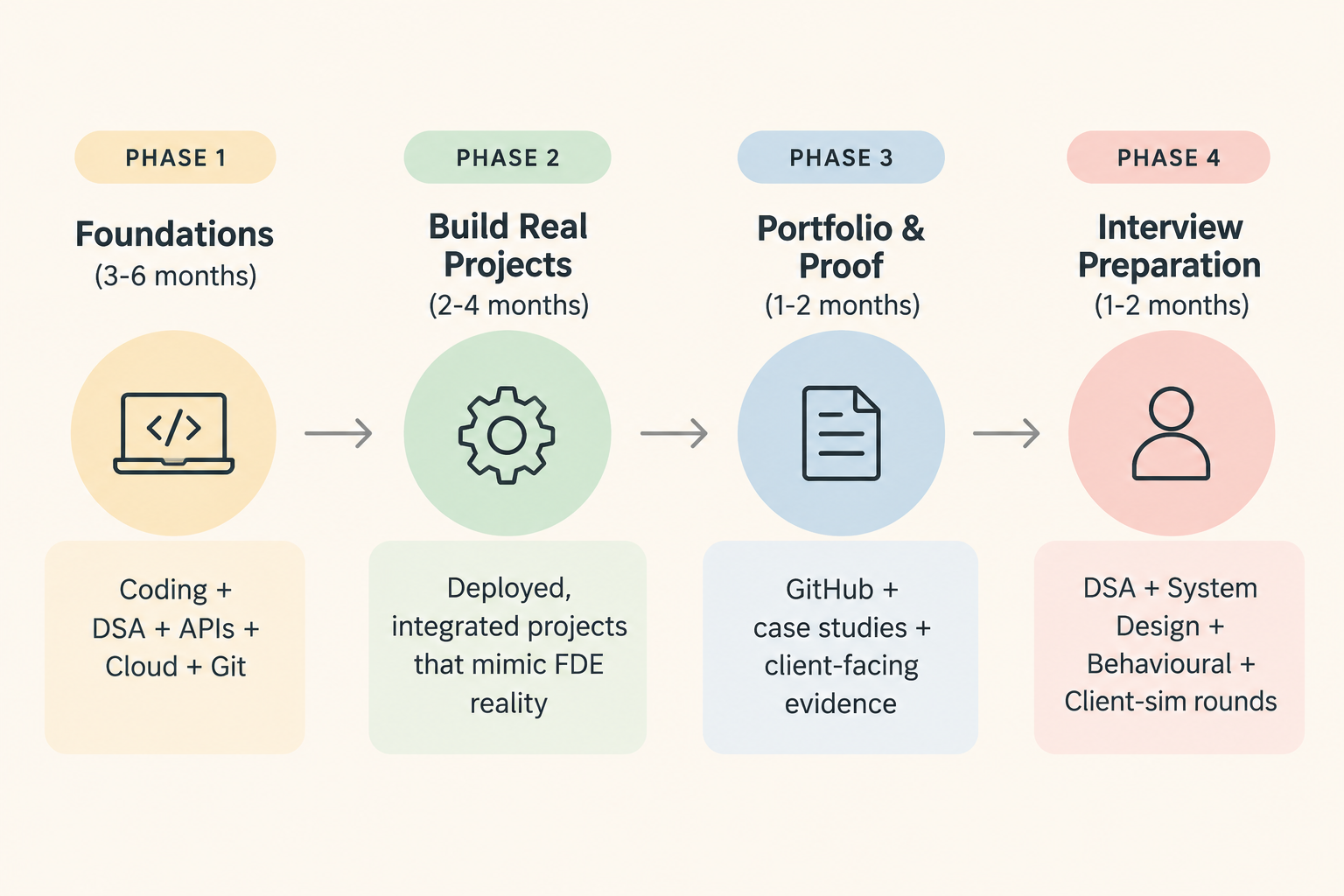
Step-by-step roadmap to become a Forward Deployed Engineer: foundations, projects, portfolio, and interview phases with timeline
Phase 1: Foundations (Build the Engineering Base)
Duration: 3-6 months for a beginner; 1-3 months for an existing developer.
This is the longest phase for a beginner, and it's the one you can't skip. The FDE role is an engineering role first. If you can't write clean code, design a basic system, and deploy a working application, the client-facing skills don't matter.
What to cover:
- Programming fluency: Python or JavaScript are the most common in FDE roles. Be comfortable writing production-quality code, not just solving algorithm problems.
- Data structures and algorithms: the standard bar. Arrays, hash maps, trees, graphs, sorting, searching, dynamic programming. You don't need competitive-programming depth, but you need to be solid.
- One backend framework: Flask, Django, Express, or Spring. Enough to build a working API.
- One frontend or API layer: React basics or REST API design. Enough to build something a client can interact with.
- Git and version control: non-negotiable for any engineering role.
- Cloud and deployment basics: AWS, GCP, or Azure. Enough to deploy an application, not just run it locally.
If you want proof of your cloud basics along the way, a few forward deployed engineer certifications are worth the effort.
Phase 2: Build Real, Deployed Projects
Duration: 2-4 months.
Not toy apps. Not tutorial projects. Something integrated, deployed, and used. The projects that get you hired as an FDE are the ones that mimic the FDE reality: integrating with an external system, handling messy real-world data, and solving a client-style requirement.
Project ideas that look like FDE work:
- A data integration tool that pulls from two different APIs, cleans the data, and presents it in a dashboard. This mirrors the FDE daily reality of connecting systems that don't want to connect.
- A client-facing reporting tool built for a non-technical user. Write the README for a non-engineer. Build the interface for someone who doesn't know what an API is.
- A deployment automation script that takes a configuration and deploys a working service. This mirrors the FDE's on-site deployment work.
- An AI/LLM-powered tool that processes real documents or data. Increasingly, FDEs ship AI features; a RAG pipeline or document-processing tool shows relevant skills.
For project ideas that build a job-ready resume, that guide has concrete, resume-worthy projects you can adapt.
Phase 3: Build a Portfolio That Proves the FDE Profile
Duration: 1-2 months.
Your portfolio is your proof. For an FDE role, it needs to show two things: you can build, and you can communicate what you built to a non-engineer.
What to include:
- GitHub repos with clean code, good commit history, and working deployments.
- A written case study per project: problem, what you built, how it works, impact. Write it like you're explaining it to a client, not a fellow engineer.
- Evidence of the client-facing side: a demo video (even a screen recording with voiceover), a README written for a non-technical user, or a blog post explaining a technical decision in plain language.
- A personal site or portfolio page that ties it together. Keep it clean, fast, and focused.
The portfolio is what substitutes for a CS degree from a top-tier college. If your projects are strong, your case studies are clear, and your demo videos show you can communicate, most FDE hiring managers won't care where you went to school.
Phase 4: Interview Preparation
Duration: 1-2 months.
FDE interviews test engineering depth and client-facing ability. Prepare for both.
What to prepare:
- DSA rounds: standard LeetCode-style, medium difficulty. Focus on clean, readable solutions, not competitive-programming tricks.
- System design / architecture: be ready to design a system that integrates with a client's existing stack. Think about data flow, APIs, deployment constraints, and handover.
- Behavioural rounds: prepare stories that involve a non-technical stakeholder, a messy requirement, a failure you owned, and a time you changed someone's mind through communication.
- Client-simulation rounds: practise scoping before solving. When given an ambiguous scenario, ask questions first, name stakeholders, state assumptions, and propose a proof-of-concept, not a full architecture.
To practise with realistic mock interviews, that tool helps you rehearse the rounds most engineers under-prepare for: behavioural, client-simulation, and thinking out loud under pressure.
How Do You Become an FDE Without the "Perfect" Background?
This is the section no ranking page owns, and it's the emotional core of the query. Here's the honest answer for three common situations.
If You Don't Have a CS Degree
What employers actually check: can you build and ship, and can you talk to customers? A portfolio of deployed projects and strong interview performance substitute for the pedigree. FDE hiring is unusually portfolio- and interview-driven, which is good news for the non-traditional candidate.
The path: learn the foundations (Phase 1), build real projects (Phase 2), prove it in your portfolio (Phase 3), and interview well (Phase 4). The degree gets you past some recruiter screens, but the portfolio and the interview get you the offer.
A structured program can fill the gaps a degree would normally cover, and we have compared the best forward deployed engineer courses for exactly this.
How Scaler Transformed Careers in Different Fields
Scaler learners achieved 2.5x salary growth with average post-Scaler CTC reaching ₹23L.
 Google
 Amazon
 Microsoft
 Flipkart
 Adobe1200+ more
If You're a Self-Taught or Bootcamp Developer
Lean into your natural edges: shipping ability and communication. Self-taught developers and bootcamp graduates often have more real project experience than CS graduates who spent four years on theory. That's an advantage in an FDE loop.
The gap to close: DSA and system design. Bootcamps teach you to build; they don't always teach you to architect. Spend deliberate time on the foundations (Phase 1) before you move to projects. The coding bar in an FDE interview is solid, and "I can build it but I can't explain the trade-offs" is a common failure mode.
If You're Switching Careers (From Support, Testing, Consulting, Non-Tech)
Your existing client and domain skills are a head start on the "forward deployed" half of the job. If you've worked in customer support, you understand what non-technical users need. If you've been a consultant, you know how to scope a project and manage stakeholders. If you've worked in testing, you understand edge cases and real-world data quality.
The gap to close: engineering skills. You need to be able to write production code, design systems, and deploy applications. The path is the same (Phase 1 through 4), but you'll spend more time on Phase 1 and less on the client-facing skills you already have.
The honest line: FDE hiring is unusually portfolio- and interview-driven. If your projects are strong and your interview performance shows both engineering depth and client-facing ability, the background matters less than you think.
Which Companies Hire Forward Deployed Engineers in India?
FDE roles in India are real but concentrated. Here's where to look.
| Company type | Example employers | Typical FDE flavour |
|---|---|---|
| Origin / pure-play FDE | Palantir | The original model: embedded engineers building on client data, heavy travel |
| AI / LLM / data platforms | Scale AI, Anthropic, similar AI-first companies | "AI FDE": deploying AI products in enterprise client environments |
| Enterprise SaaS / B2B | Freshworks, Chargebee, Postman, and similar | Solutions or deployment engineers working with enterprise clients |
| GCCs (Global Capability Centres) | Google, Microsoft, Amazon India offices | Field engineering, solutions engineering, customer-facing technical roles |
| Indian startups | Well-funded AI/data startups | Smaller teams, broader scope, often "solutions engineer" or "field engineer" titles |
Where the roles cluster: Bengaluru first, then Hyderabad, Pune, and Gurugram. Remote-hybrid is increasingly common, but most FDE roles involve some travel or on-site client work.
Important note on titles: the exact title "Forward Deployed Engineer" is still rare in India. Look for equivalent roles: "Deployment Engineer," "Solutions Engineer," "Field Engineer," "Customer Engineer," or "Technical Account Manager" with an engineering focus. The work is the same; the title varies by company.
For context on the highest-paying software roles in India, that guide shows where FDE compensation sits among premium engineering roles.
What Is the Salary of a Forward Deployed Engineer in India?
FDE salary data in India is thin because the title is new and the market is small. Here's what we can say honestly, with sources.
| Experience level | Typical range (INR LPA) | Notes |
|---|---|---|
| Entry (0-2 years) | ₹8-15 LPA | Rare at true entry level; most FDE hires have 2+ years of experience |
| Mid (3-5 years) | ₹15-30 LPA | The sweet spot for most FDE hires in India |
| Senior (6-10+ years) | ₹30-60+ LPA | Senior FDEs and FDE leads at global companies |
Sources: Glassdoor India, AmbitionBox, and LinkedIn Salary Insights (2025 data). Figures are indicative and vary by company, city, and role scope. FDE-specific data is limited; ranges are based on comparable roles (Solutions Engineer, Field Engineer, Deployment Engineer) at companies operating in India.
Why FDEs are paid a premium: the role is a rare hybrid of strong engineering and client-facing ability. Most engineers can do one or the other. The few who can do both are scarce, and scarcity drives compensation. Base salary plus variable components (travel allowances, client-site bonuses, relocation support) can push the total package higher than a pure SDE role at the same level.
How Long Does It Take to Become a Forward Deployed Engineer?
The timeline depends on where you're starting from.
| Starting point | Estimated timeline | What determines the speed |
|---|---|---|
| Complete beginner (no coding experience) | 12-24 months | Consistency and hours per week; 20+ hours/week compresses the timeline |
| Existing developer (1-3 years experience) | 6-12 months | How quickly you add the client-facing and system-design skills |
| Career switcher (from support, consulting, non-tech) | 9-18 months | How much of your existing experience transfers; the engineering ramp is the bottleneck |
| Experienced SWE (3+ years, strong technically) | 3-6 months | Primarily adding the client-facing and FDE-specific interview skills |
The honest truth: consistency and shipped projects compress the timeline more than raw hours. Building one real, deployed project teaches you more than 100 hours of tutorial-watching. The FDE role rewards people who ship, not people who study.
The timelines above are honest but wide. The fastest way to compress them is structured learning with real projects and feedback, not tutorial-hopping. If you're serious about becoming an FDE, the Forward Deployed Engineer course gives you the phased roadmap, deployed projects, and interview preparation in one program, cutting months off the self-study path.
Turn Learning into Career Growth
Continue Your FDE Learning Path With These Guides
FAQs
How do you become a Forward Deployed Engineer?
The path has four phases:
(1) build a strong engineering foundation (coding, DSA, APIs, cloud),
(2) build real, deployed projects that mimic FDE work (integrations, messy data, client-style requirements),
(3) create a portfolio that proves both your engineering and communication skills, and
(4) prepare for FDE-specific interviews that test coding, system design, and client-facing ability.
The timeline ranges from 6 months for experienced developers to 18-24 months for beginners.
Can I become an FDE without a computer science degree?
Yes. FDE hiring is unusually portfolio- and interview-driven. If your projects are strong, your case studies are clear, and your interview performance shows both engineering depth and client-facing ability, the degree matters less than you think. Build real projects, deploy them, write case studies, and practise the interview rounds. The portfolio substitutes for the pedigree.
What skills does a Forward Deployed Engineer need?
Three skill areas: (1) engineering skills (coding, DSA, APIs, databases, cloud, system design), (2) client and product skills (communication, requirement-gathering, demos, comfort with ambiguity), and (3) domain knowledge (enough of the client's industry to be credible). The engineering core is non-negotiable; the client skills are what make the role "forward deployed."
How much do Forward Deployed Engineers earn in India?
Indicative ranges (Glassdoor, AmbitionBox, LinkedIn, 2025 data): entry level ₹8-15 LPA, mid-level ₹15-30 LPA, senior ₹30-60+ LPA. FDEs command a premium over pure SDE roles because the hybrid skill set is rare. Data is limited and varies by company and city; treat these as directional, not precise.
Is Forward Deployed Engineer a good career in 2026?
Yes, with caveats. The demand is growing (AI and data companies need engineers who can ship and talk to clients), the pay is premium, and the breadth of experience is unmatched. But the role is client-facing, involves travel and ambiguity, and isn't for everyone. If you thrive on variety, client contact, and shipping fast in messy environments, it's one of the best roles in tech. If you prefer deep focus and minimal human interaction, it will drain you.
How long does it take to become an FDE?
12-24 months from a complete beginner, 6-12 months for an existing developer, 9-18 months for a career switcher, and 3-6 months for an experienced SWE adding the client-facing skills. Consistency and shipped projects compress the timeline more than raw hours.
Which companies hire FDEs in India?
Palantir (the origin of the title), AI/LLM and data-platform companies (Scale AI, Anthropic, and similar), enterprise SaaS firms (Freshworks, Chargebee, Postman), GCCs (Google, Microsoft, Amazon India offices), and well-funded Indian startups. Roles cluster in Bengaluru, Hyderabad, Pune, and Gurugram. Titles vary: look for "Forward Deployed Engineer," "Deployment Engineer," "Solutions Engineer," "Field Engineer," or "Customer Engineer.
Ready to build the engineering foundation, real projects, and interview readiness an FDE role demands? Explore Scaler Academy structured, mentor-led, project-based learning that takes you from wherever you're starting to job-ready.




