Instinct vs Meta Muse: What Each AI Agent Can Actually Do
If you have typed “instinct vs meta muse” into Google in the last couple of weeks, you already know the basic pitch.
Both are personal AI agents that promise to stop being chatbots and start actually doing things, booking a table, cancelling a subscription, buying the thing you keep meaning to buy.
The stakes behind that pitch are bigger than either product alone. Muse became the most-downloaded free app on the US App Store, ahead of ChatGPT, with over 2.5 million downloads in its first two weeks, per market intelligence firm Sensor Tower. Instinct, meanwhile, went from a $50 million valuation in spring 2026 to reported talks of a $10 billion raise by September, according to The Information. And the reason both are moving this fast: the Stanford AI Index 2026 recorded agent success rates on real-world tasks jumping from around 20% in 2025 to over 77% in 2026. The category got good enough, fast enough, for two very different bets to both look viable at once.
What's harder to find is what happens once you actually hand one your inbox. This piece pulls together what each agent can do today, what independent testers have reported when they pushed both, and which one is worth your time (or your waitlist spot) right now.
Quick note before we go further: this article is about Muse, Meta's consumer personal-agent app, the one that took over the App Store charts in September 2026.
Meta also has Muse Spark (the underlying model that powers it), Muse Glimmer (a separate open-weights model) and Muse Code (a coding agent), all different products that happen to share the Muse name. If you landed here looking for one of those, this isn't that page.
Quick Verdict
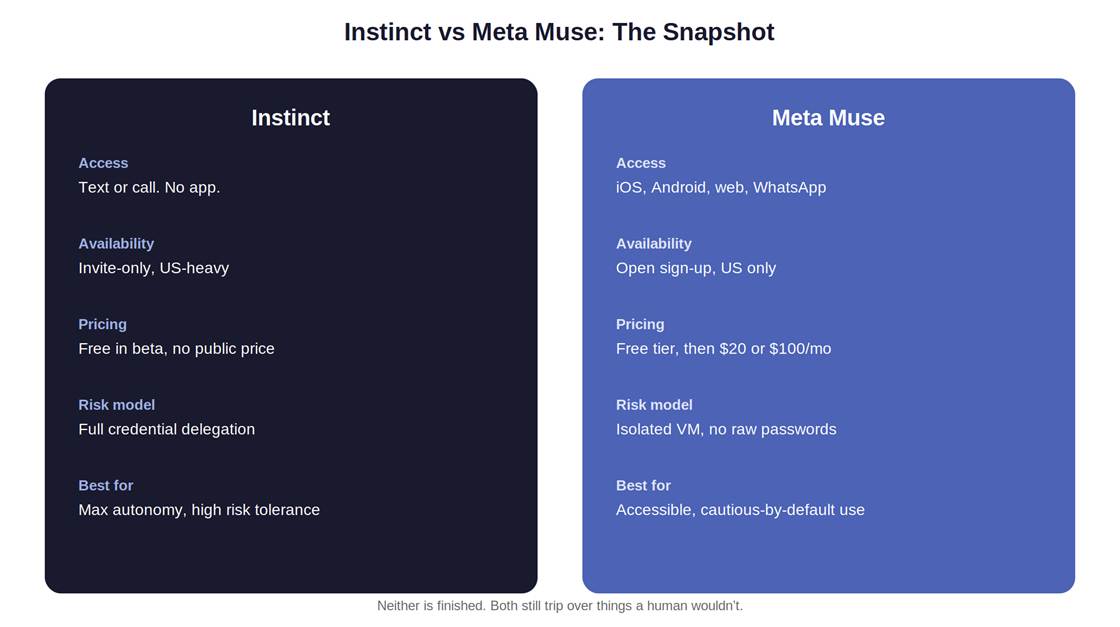
The snapshot. Full reasoning for each row is below.
Neither one is finished. Both are trying to be your personal assistant, and both still trip over things a human wouldn't.
Want something you can actually sign up for today, on a phone you already own? Go with Muse. It's live in the US on iOS, Android, the web and WhatsApp, with a free tier.
Want the most autonomous option and don't mind handing over real credentials? Instinct is built for that, but it's invite-only and the access model is not for the faint-hearted.
Outside the US? Neither is fully open to you yet. Worth knowing before you get your hopes up.
Care about privacy over raw capability? Muse runs in an isolated cloud machine and says it never sees your passwords. Instinct asks for the passwords.
Agent vs chatbot, in plain language
A chatbot answers. An agent goes and does the thing, then comes back and tells you it's done, or that it got stuck and needs your card details.
That distinction is basically the entire pitch of both Instinct and Meta's Muse. Neither is a chat window you type into and forget. What actually makes something an agent rather than a chatbot with extra steps:
• Runs persistently. Both operate on a computer somewhere in the cloud that keeps working between your messages, not just while a tab is open.
• Remembers context. Meta's own announcement describes Muse as built on a dedicated “Secure VM” with its own browser, one that can turn a saved Instagram recipe into a grocery list without being asked twice.
• Follows up unprompted. Neither waits for you to check back in; both surface progress or blockers on their own.
Instinct goes further in one specific way: instead of an app, you just text it or call it, like you would a very competent friend who happens to have access to your entire digital life. There's no separate interface to open. The conversation is the product.
Both sit on top of what's broadly called agentic AI, models that don't just generate text but plan, use tools and take multi-step actions toward a goal. If that term is new to you, it's worth understanding properly before you decide how much access to hand either of these things, and Scaler's guide on how agentic AI systems are built is a reasonable place to start.
Where they genuinely differ is philosophy, not just features. Muse is built to be cautious by default, asking permission before anything risky. Instinct leans hard into autonomy, and that's exactly what makes it powerful and slightly terrifying at the same time.
Build an AI-First Career, Master the Complete Skillset
Choose from our industry-leading programs designed for career success
Modern Software and AI Engineering Program
Master full-stack development with AI integration


 +1000 more
Modern Data Science and ML with specialisation in AI
Advanced data science techniques with AI specialization
+1000 moreAdvanced AIML with Specialisation in Agentic AI
Deep dive into AIML with focus on Agentic systems
+1000 moreDevOps, Cloud & AI Platform Engineering
Build and manage AI-powered cloud infrastructure
+1000 moreAI Engineering Advanced Certification by IIT-Roorkee
Premier AI engineering certification from IIT-Roorkee

AI Forward Deployed Engineer Program
Full-stack engineering, production AI and client-facing consulting
+1000 moreAccess: devices, regions and how you actually get in
This is where the comparison stops being about capability and starts being about whether you can even try either one.
| Instinct | Meta Muse | |
|---|---|---|
| How you reach it | Text or call, iMessage, WhatsApp, SMS. No dedicated app. | iOS app, Android app, web at muse.ai, and inside WhatsApp |
| Region | Invite-only beta, US-heavy rollout | US only, adults only, for now |
| Getting in | Waitlist at instinct.co, or invite from an existing user | Open sign-up within the US |
| Company behind it | Spear Street Technology, founded by ex-Sierra researcher Noah Shinn | Meta, folded into its broader AI push under chief AI officer Alexandr Wang |
A quick reality check for anyone reading this from India: neither product is properly available here yet.
• Muse launched US-only, with glasses support “coming soon” and no international timeline given
• Instinct is smaller and more selective still, running on limited compute while it scales, according to reporting that traced the company back to a $250 million Series B round at a $2.5 billion valuation
If you're outside the US, the honest answer is: wait, or watch from a distance for now.
Meta has at least signalled where it's headed next. At Connect 2026 the company said Muse would extend to its smart glasses line, letting people talk to their agent by speaking, and even unveiled Muse Charm, a small wearable device built purely to run the agent. That's a much bigger distribution play than anything Instinct has shown so far.
Task-by-task: what happened when people actually tested these
We don't have our own instances of either agent to run through paces (Instinct's waitlist is still a waitlist), so this is built from a stack of independently reported tests, which is honestly a more useful signal than a vendor demo anyway. Nobody films the boring failures in a keynote.
| Request | Action taken | Completion status | Elapsed time | Human intervention needed |
|---|---|---|---|---|
| Buy a pair of shoes in a specific colourway (Muse) | Searched and returned product options | Failed, incorrect results, purchase not completed | Not reported | Full manual takeover to actually find and buy the shoes |
| Buy movie tickets (Muse) | Opened a booking flow | Partially completed, wrong film opened first | Not reported | User had to correct the film before proceeding |
| Ongoing goal, sleep-training a baby (Muse) | Tracked context across turns, set a reminder, followed up | Completed, ongoing | Multi-day, ongoing goal | None reported |
| Buy a pair of shorts (Muse) | Asked for size, searched, returned priced options | Completed to point of options returned | “A couple of minutes,” per tester | User confirmed size and final purchase |
| Read inbox and draft a reply to a utility notice (Muse) | Found the email, picked an inspection date, drafted a reply | Drafted, held for approval | Not reported | Human approval required before sending |
| Book a restaurant that doesn't take online bookings (Instinct) | Placed the phone call itself | Completed | Not reported | None reported, per founder's own examples |
| Get on a dentist's cancellation list (Instinct) | Placed the phone call itself | Completed | Not reported | None reported |
| High-concurrency batch task, 33 parallel workers (Muse) | Ran 33 sub-tasks in parallel | Disputed, status showed “running” while UI showed an error | Not reported | Manual check required; one of 33 sub-tasks stayed unresolved |
Sources for the rows above: the shoes, tickets and sleep-training tests come from Lenny's Newsletter's hands-on review of Muse; the shorts purchase and inbox test come from TechRadar's hands-on test of Muse; the restaurant and dentist calls come from TechCrunch's report on Instinct Concierge; the concurrency test is from an independent technical stress test of Muse's orchestration layer.
A pattern shows up fast:
• Strong on structured asks. Draft this, call this number, remind me of that, both agents handle these well.
• Shaky on judgement calls. The moment a task needs real judgement inside a messy website, like matching an exact shoe colourway or the correct showtime, both stumble.
That's not a knock on either product specifically. Browser-based shopping is the industry's soft underbelly right now, and it shows up in independent write-ups on Muse as much as it does everywhere else in the agent category.
Worth noting too: giving either agent access was, by multiple accounts, the actually hard part. Not the task itself. Handing over your inbox to something that texts like a person takes a certain kind of nerve.
Permissions and how much human review each one asks for
This is the section to actually read before you connect anything.
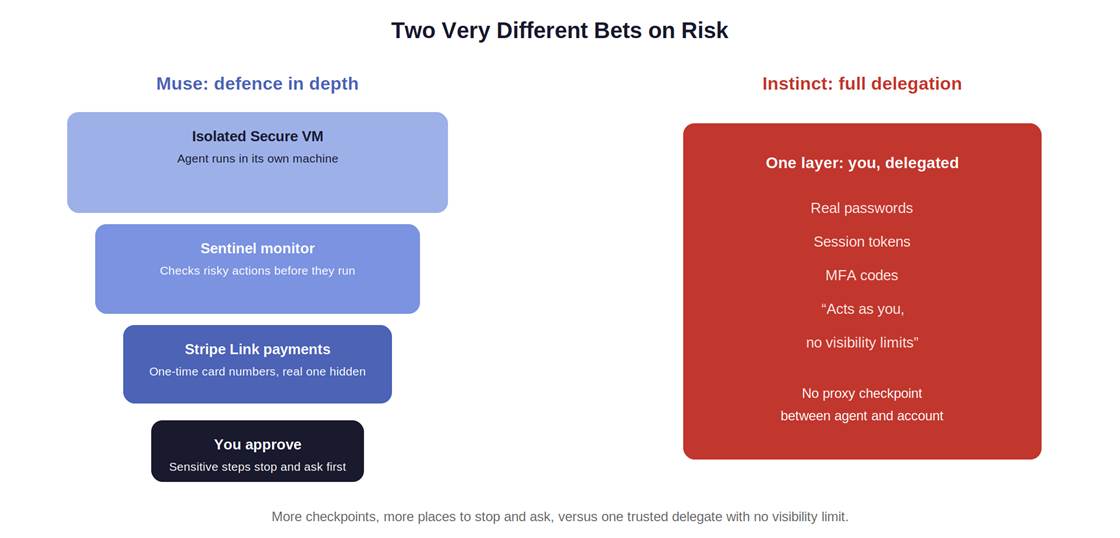
Muse stacks checkpoints. Instinct removes them and asks you to trust the delegate instead.
Muse's side, in short:
• Isolated virtual machine. Per Meta's own security writeup, the agent doesn't see raw passwords or card numbers.
• Sentinel monitoring. A separate layer meant to catch the agent before it does something it shouldn't.
• Stripe Link payments. One-time-use card numbers, so the real one stays hidden.
Instinct's side, in short:
• Full credential delegation. Its terms describe the service as your authorized agent, able to enter agreements, commitments and transactions on your behalf, full stop. That means real passwords, session tokens, MFA codes, not a proxy.
• No structural checkpoint. One reviewer summed it up as an agent that “acts as you with no visibility limits.”
• 1Password partnership. Makes handing over logins less painful, but doesn't change the risk profile underneath it.
The honest way to put it: Muse asks permission and tries to stay out of your actual accounts. Instinct becomes you, and asks you to trust that it won't mess it up. Neither approach is obviously wrong, they're just built for different comfort levels with risk.
If you're the type who reads terms of service, note that Instinct's own privacy notice and terms place responsibility for the consequences of its actions on you, the user, alongside a binding arbitration clause. Read that twice before you connect your bank.
Reliability: where each one breaks
Agentic AI as a category has gotten dramatically better at finishing tasks. Progress is real. It's just not evenly distributed across every kind of task, and it's definitely not zero-failure.
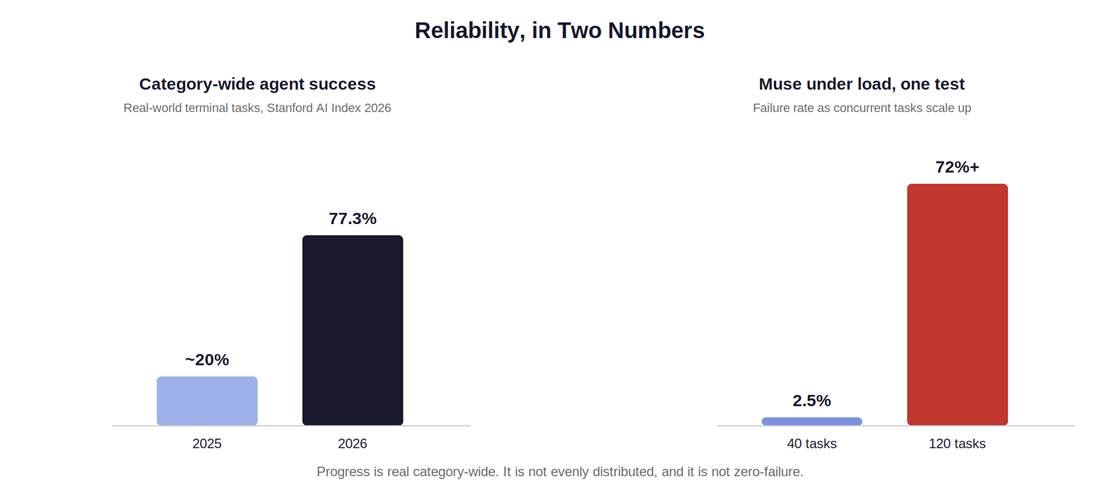
The category is improving fast. Under real load, one agent's failure rate still climbed sharply.
Meta has been unusually candid here. The company acknowledged before Muse's launch that internal testing turned up reliability issues, and independent stress testing backs that up.
One deep technical test pushed Muse's agent orchestration to 120 concurrent task spawns and recorded the failure-rate climb shown above, alongside a case where the interface, the parent process and the underlying worker records each disagreed about whether a task had actually finished. That's not a shopping-cart glitch, that's the kind of bug that makes you want a second opinion before you trust the confirmation screen.
Instinct doesn't have anywhere near that level of public technical scrutiny yet, mostly because outside access is so limited. What's public is its own Privacy Notice, which openly names unintended communications, unintended payments, disclosure of sensitive information and hidden instructions designed to manipulate the agent as known risks.
Reading a company's own risk disclosure that bluntly is either refreshingly honest or a little alarming, depending on your mood that day.
Practical takeaway: treat both as capable but unsupervised interns right now. Fine for low-stakes, reversible tasks. Worth double-checking before anything involving real money or a contract you can't easily walk back.
Pricing, as far as anyone's verified it
Muse has confirmed pricing, straight from Meta:
• Free tier. Capped at 100 million tokens a week; a payment card is required on file even to use it.
• Power, $20/month. For heavier usage.
• Maximum, $100/month. For the heaviest usage.
Free users who don't pay may have their conversation data used to improve Meta's models, with critical personal information stripped out first, according to comments from Meta VP of engineering David Singleton. Meta has also said it's exploring taking a small cut of purchases the agent makes on your behalf, so the free tier isn't quite as free as it first sounds. Somebody's paying for this eventually, and right now that somebody might be a small transaction fee tucked into your next online order.
Instinct has no official public pricing at all. It's free during the private beta, and the company hasn't announced what happens after. Industry reporting has floated planned subscription tiers somewhere between $200 and $500 a month once it scales, tied to how much cloud compute your agent actually burns through, but treat that as an estimate, not a quote. Nobody's confirmed it, including Instinct.
So the honest pricing comparison right now is: Muse has real numbers you can budget around, Instinct has a rumour and a waitlist.
How Scaler Transformed Careers in Different Fields
Scaler learners achieved 2.5x salary growth with average post-Scaler CTC reaching ₹23L.
 Google
 Amazon
 Microsoft
 Flipkart
 Adobe1200+ more
Who should actually use which
• You just want an assistant that texts and shops without much drama: Muse. It's accessible, has a real free tier, and its guardrails mean a mistake is less likely to be catastrophic.
• You're deep into automating your life and comfortable with real risk: Instinct, if you can get in. The credential delegation model means it can do things Muse structurally can't, like navigate a site with no API at all. That power comes with the terms-of-service fine print attached.
• You're outside the US: Neither, for now. Bookmark this page and check back once regional access opens up.
• You're an engineer curious about how any of this works under the hood: this is a good moment to get properly into agentic AI rather than just watching the consumer product war from the sidelines. Understanding how these systems plan, call tools and recover from failure is quickly becoming a core skill, not a niche one.
Curious what's actually running under the hood of agents like these, the planning, the tool calls, the failure recovery, rather than just using them as a black box? Scaler's Advanced AI & Machine Learning program teaches the agent-building, integration and system-design skills behind this entire category, the exact skills that separate Instinct's autonomy from Muse's caution at an engineering level.
FAQs
Is Instinct better than Meta Muse?
Depends what “better” means to you. Instinct is more autonomous and can act on sites with no API, but it demands full credential access and is invite-only. Muse is safer by design, more accessible, and has confirmed pricing, but is more constrained in what it can do.
Turn Learning into Career Growth
Can I use Instinct or Meta Muse in India?
Not properly, not yet. Muse is US-only as of its September 2026 launch, and Instinct is invite-only with a US-heavy rollout while it scales compute. Both are expected to expand, but neither has announced an India timeline.
Does Meta Muse see my passwords?
Meta says no. Muse runs in an isolated virtual machine and routes payments through Stripe's Link, which uses one-time-use card numbers instead of your real card details.
What happens if Instinct makes a mistake, like an unwanted purchase?
Instinct's own terms place responsibility for the consequences of its actions on the user, and its total liability is reportedly capped at $100 or the amount you paid for the product, whichever is lower. Read the terms before connecting a payment method.
How much does Meta Muse cost?
Free tier (100 million tokens a week, card required), plus named paid plans, Power at $20 a month and Maximum at $100 a month, depending on usage. Meta has said it may also take a small fee from purchases the agent completes for you.
Is Instinct free?
Yes, during its private beta, with no official pricing announced yet. Reports suggest future tiers could land between $200 and $500 a month, but that's unconfirmed.