

Introduction to Generative AI: A Beginner's Guide
Generative AI is a subset of artificial intelligence focused on creating new, original content—such as text, images, code, or audio—by learning patterns from existing data. It utilizes advanced machine learning architectures, particularly deep neural networks, to model underlying data distributions and synthesize novel, probabilistically likely outputs.
What is Generative AI?
To truly grasp an introduction to generative AI, one must first understand the fundamental distinction between discriminative models and generative models. Historically, the vast majority of machine learning models deployed in production were discriminative. A discriminative model is designed to draw boundaries in a data space; mathematically, it learns the conditional probability distribution P(Y|X)—the probability of a label Y given an input X. These models are highly effective for classification and regression tasks, such as determining whether an email is spam or predicting housing prices.
Generative models, conversely, learn the joint probability distribution P(X, Y), or simply the probability distribution of the data itself, P(X). Because they understand how the features of the data interact and co-occur, they can generate entirely new data points that convincingly mimic the original training distribution. While the foundational mathematics behind these probability distributions have existed for decades, recent advancements in deep learning, massive datasets, and parallelized computing have unlocked unprecedented capabilities. Mastering these gen ai basics is crucial for modern software engineers, as the paradigm of computing shifts from merely analyzing data to actively synthesizing it.
A Brief History of Generative Models
While gen ai models have recently dominated the technology sector, its roots trace back to the mid-20th century. The evolution of these models is characterized by a steady progression from simple statistical methods to massive, highly complex neural network architectures.
Early generative models relied on Hidden Markov Models (HMMs) and Gaussian Mixture Models (GMMs). These were primarily used in the 1990s and 2000s for tasks like speech recognition and time-series generation. However, they were limited by their reliance on strict Markovian assumptions and struggled to model highly complex, high-dimensional data like high-resolution images or long-form human language.
The introduction of Restricted Boltzmann Machines (RBMs) and Deep Belief Networks offered the first glimpses into using multiple layers of latent variables to generate data. The true inflection point, however, occurred in the 2010s. The invention of Variational Autoencoders (VAEs) in 2013 and Generative Adversarial Networks (GANs) in 2014 provided the deep learning community with robust frameworks for generating high-fidelity continuous data. Finally, the publication of the "Attention Is All You Need" paper in 2017 introduced the Transformer architecture, which solved the parallelization bottlenecks of Recurrent Neural Networks (RNNs) and led directly to the explosion of Large Language Models (LLMs) in the 2020s.
Stop learning AI in fragments—master a structured AI Engineering Course with hands-on GenAI systems with IIT Roorkee CEC Certification


AI Engineering Course Advanced Certification by IIT-Roorkee CEC
A hands on AI engineering program covering Machine Learning, Generative AI, and LLMs - designed for working professionals & delivered by IIT Roorkee in collaboration with Scaler.
Enrol Now
Build an AI-First Career, Master the Complete Skillset
Choose from our industry-leading programs designed for career success
Modern Software and AI Engineering Program
Master full-stack development with AI integration


 +1000 more
Modern Data Science and ML with specialisation in AI
Advanced data science techniques with AI specialization
+1000 moreAdvanced AIML with Specialisation in Agentic AI
Deep dive into AIML with focus on Agentic systems
+1000 moreDevOps, Cloud & AI Platform Engineering
Build and manage AI-powered cloud infrastructure
+1000 moreAI Engineering Advanced Certification by IIT-Roorkee
Premier AI engineering certification from IIT-Roorkee

AI Forward Deployed Engineer Program
Full-stack engineering, production AI and client-facing consulting
+1000 moreCore Architectures of Generative AI
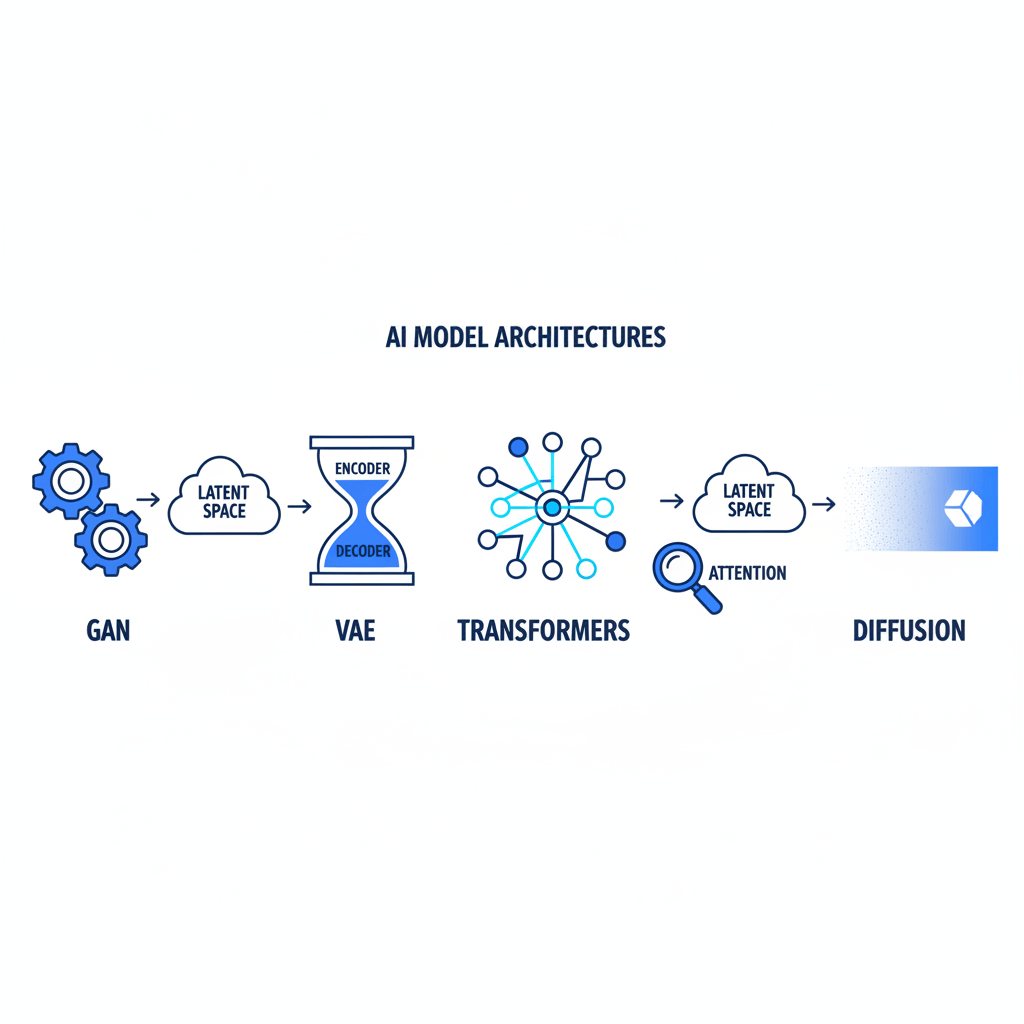
Understanding generative AI—a core focus of any modern data science program—requires peering under the hood of the neural network architectures that power it. Rather than relying on rigid, rule-based algorithms, modern generative systems utilize highly parameterized mathematical functions capable of learning intricate, non-linear relationships. The four most prominent architectures dominating the field today are Generative Adversarial Networks, Variational Autoencoders, Transformers, and Diffusion Models. Each of these architectures leverages a distinct mathematical approach to approximate the data distribution P(X) and sample from it.
Generative Adversarial Networks (GANs)
Introduced by Ian Goodfellow, a GAN consists of two distinct neural networks—the Generator (G) and the Discriminator (D)—engaged in a continuous, zero-sum game. The Generator is tasked with creating synthetic data from random noise (usually sampled from a Gaussian distribution). The Discriminator evaluates data and attempts to distinguish between real data (from the training set) and fake data (produced by the Generator).
The two networks are trained simultaneously using a minimax objective function: min_G max_D V(D, G) = E_x[log D(x)] + E_z[log(1 - D(G(z)))]
As training progresses, the Generator becomes increasingly proficient at producing realistic outputs to fool the Discriminator, while the Discriminator becomes more adept at spotting fakes. This adversarial process forces the Generator to output highly realistic data.
Below is a conceptual PyTorch snippet demonstrating the core training loop of a standard GAN:
While capable of generating exceptionally crisp images, GANs are notoriously difficult to train, often suffering from "mode collapse," where the Generator learns to output a very limited diversity of samples that happen to easily trick the Discriminator.
Variational Autoencoders (VAEs)
Variational Autoencoders are probabilistic models that learn a continuous, structured latent space. Standard autoencoders consist of an Encoder that compresses input data into a dense vector (bottleneck) and a Decoder that reconstructs the input from that vector. However, the latent space of a standard autoencoder is not continuous, making it unsuitable for generation.
VAEs solve this by enforcing a probabilistic constraint. Instead of encoding an input into a single point, the Encoder maps the input into a probability distribution defined by a mean (μ) and standard deviation (σ). To generate new data, the model samples a point from this learned distribution and passes it through the Decoder.
The loss function of a VAE consists of two parts: the Reconstruction Loss (which ensures the decoded output matches the input) and the Kullback-Leibler (KL) Divergence. Loss = Reconstruction_Loss + D_KL( q(z|x) || p(z) )
The KL Divergence acts as a regularizer, forcing the learned distributions to closely resemble a standard normal distribution. This ensures the latent space is smooth and continuous, allowing for interpolations between different data points.
Transformer Models
The Transformer architecture represents the backbone of modern text-based generative AI. Before Transformers, sequence processing relied heavily on Recurrent Neural Networks (RNNs) and Long Short-Term Memory networks (LSTMs). These models processed tokens sequentially, leading to information loss over long contexts and preventing parallelization during training.
Transformers discarded recurrence entirely in favor of a mechanism called Self-Attention. Self-attention allows the model to weigh the contextual importance of every token in a sequence simultaneously, regardless of their distance from one another. The attention function is mathematically defined as: Attention(Q, K, V) = Softmax( (Q·K^T) / √d_k ) · V
Where:
- Q (Query): Represents the token currently being processed.
- K (Key): Represents the other tokens in the sequence.
- V (Value): Represents the actual content/meaning of the tokens.
- d_k: A scaling factor based on the dimension of the keys, preventing vanishing gradients in the Softmax layer.
By stacking multiple layers of self-attention (Multi-Head Attention) and feed-forward networks, models like GPT (Generative Pre-trained Transformer) can autoregressively predict the next token in a sequence with astonishing accuracy, enabling human-like text generation, code synthesis, and logical reasoning.
Master structured AI Engineering + GenAI hands-on, earn IIT Roorkee CEC Certification at ₹40,000
AI Engineering Course Advanced Certification by IIT-Roorkee CEC
A hands on AI engineering program covering Machine Learning, Generative AI, and LLMs - designed for working professionals & delivered by IIT Roorkee in collaboration with Scaler.
Enrol NowDiffusion Models
Diffusion models are currently the state-of-the-art for image and audio generation, largely supplanting GANs due to their superior training stability and output diversity. These models operate on principles derived from non-equilibrium thermodynamics.
The architecture involves two distinct phases:
- Forward Process (Adding Noise): A clear input image is incrementally corrupted by adding Gaussian noise over hundreds or thousands of steps (T) until it becomes complete, unstructured noise.
- Reverse Process (Denoising): A neural network (often a U-Net architecture) is trained to reverse this process. It learns to predict and subtract the noise added at each step.
Once trained, the model can generate novel images by starting with pure Gaussian noise and iteratively applying the learned denoising steps until a coherent image emerges. Because diffusion models optimize a strict lower-bound on the data likelihood, they avoid the mode collapse issues prevalent in GANs, allowing them to generate a much wider variety of highly detailed outputs.
Comparing Generative AI Architectures
To summarize the technical trade-offs between the primary generative AI architectures, developers must evaluate models based on training stability, execution speed, and their ability to capture complex data distributions.
| Architecture | Primary Use Case | Core Mechanism | Pros | Cons |
|---|---|---|---|---|
| GANs | Image Generation, Video Synthesis | Adversarial minimax game (Generator vs. Discriminator) | High-fidelity, sharp outputs; fast inference time. | Difficult to train; highly susceptible to mode collapse. |
| VAEs | Anomaly Detection, Image Interpolation | Probabilistic latent space mapping via Encoder-Decoder | Stable training; smooth, continuous latent space. | Outputs often appear blurry compared to GANs/Diffusion. |
| Transformers | NLP, Code Generation, Audio (Discrete) | Self-Attention mechanism computing token relevance | Excellent at long-range dependencies; highly parallelizable training. | Quadratic time complexity relative to sequence length. |
| Diffusion Models | High-Resolution Image and Audio Synthesis | Iterative noise addition and learned denoising | Extremely high diversity and fidelity; stable mathematical training. | Slow inference due to hundreds of required denoising steps. |
Software and Hardware Requirements
Deploying and training generative AI models demands that you learn deep learning and understand its modern ecosystem. Generative models push the absolute boundaries of computational physics, necessitating specialized hardware and highly optimized software frameworks.
How Scaler Transformed Careers in Different Fields
Scaler learners achieved 2.5x salary growth with average post-Scaler CTC reaching ₹23L.
 Google
 Amazon
 Microsoft
 Flipkart
 Adobe1200+ more
Software Ecosystem
The foundational layer for building these models generally consists of Python-based libraries that support GPU acceleration and automatic differentiation:
- PyTorch: Currently the dominant framework in generative AI research and production. Its dynamic computation graph allows for flexible experimentation with complex architectures like Transformers and Diffusion models.
- TensorFlow & JAX: Developed by Google, TensorFlow remains heavily used in enterprise deployments. JAX is increasingly favored by researchers for its highly efficient XLA (Accelerated Linear Algebra) compiler and functional programming paradigm.
- Hugging Face: An essential open-source ecosystem that acts as the "GitHub for Machine Learning." It provides the transformers and diffusers libraries, allowing engineers to load pre-trained state-of-the-art models (like LLaMA or Stable Diffusion) with only a few lines of code.
Hardware Infrastructure
The primary bottleneck in generative AI is not CPU speed, but rather memory bandwidth and parallel processing capabilities.
- GPUs: NVIDIA's high-end GPUs (such as the A100 and H100) are the industry standard. They possess thousands of CUDA cores designed for the massive matrix multiplications required by neural networks, alongside immense VRAM to hold model weights.
- TPUs (Tensor Processing Units): Google's Application-Specific Integrated Circuits (ASICs) designed explicitly for deep learning operations, offering unparalleled performance for large-scale model training.
- Optimization Techniques: Because models like GPT-4 contain hundreds of billions of parameters, they cannot fit on a single GPU. Engineers utilize techniques like Model Parallelism, Tensor Parallelism, and Low-Rank Adaptation (LoRA) to train and fine-tune models efficiently. Furthermore, quantization (reducing the precision of model weights from 16-bit floats to 8-bit or 4-bit integers) is commonly used to reduce inference latency and memory footprints.
Applications of Generative AI
The commercial and technical applications of generative AI are vast, significantly altering traditional workflows in software engineering, content creation, and scientific research.
Text and Code Generation
Large Language Models have revolutionized natural language processing tasks. Beyond standard chatbots, LLMs are deeply integrated into software development. Tools like GitHub Copilot utilize ai code generation to predict boilerplate code, suggest optimized algorithms, and translate codeblocks between languages. Because code follows strict syntactic rules, autoregressive Transformers are highly proficient at modeling programming language distributions.
Turn Learning into Career Growth
Image and Video Synthesis
Architectures like Stable Diffusion and Midjourney have democratized graphic design and concept art. By utilizing cross-attention mechanisms, these diffusion models can take text prompts (e.g., "A futuristic city in cyberpunk style") and condition the denoising process to synthesize an image matching the semantic meaning of the text. This is expanding into video synthesis, where temporal consistency models are generating short clips from textual descriptions.
Audio and Voice Cloning
Generative AI models can synthesize human speech that accurately captures prosody, accent, and emotion. By processing hours of speech data, models construct an acoustic map of a voice, enabling highly realistic Text-to-Speech (TTS) systems. Additionally, generative music systems process raw waveforms or MIDI sequences to compose original scores.
Ethical Concerns and Limitations
Despite its immense potential, generative AI introduces profound technical and societal challenges. For those looking to become an ai engineer and build these systems, understanding these limitations is as critical as understanding the architecture itself.
Hallucinations and Factual Inaccuracy
Because models like LLMs are fundamentally stochastic parrots predicting the probabilistically next likely token, they do not possess a true internal model of reality. This leads to "hallucinations"—instances where the model generates highly convincing but entirely false information. In environments requiring strict determinism and factual accuracy (like medical or legal fields), unmodified generative models pose significant risks.
Intellectual Property and Copyright
Generative models are trained on internet-scale datasets, often containing copyrighted text, art, and proprietary source code. The legal landscape regarding whether training a model constitutes "fair use" remains unsettled. Furthermore, generative models have been shown to occasionally memorize and verbatim reproduce portions of their training data, leading to copyright infringement concerns for end-users.
Bias and Toxicity
Machine learning models reflect the data on which they are trained. Since training datasets are scraped from the internet, they contain historical human biases, stereotypes, and toxic language. Without rigorous alignment techniques—such as Reinforcement Learning from Human Feedback (RLHF) or Constitutional AI—generative models will naturally output biased or harmful content.
Computational Cost and Environmental Impact
Training foundation models requires immense energy. A single training run for a massive LLM can consume gigawatt-hours of electricity, generating massive carbon footprints. Additionally, the inference cost (running the model for end-users) requires vastly more compute than traditional database queries, creating significant infrastructure overhead.
FAQs
What is the difference between Generative AI and standard Machine Learning? Standard machine learning models (discriminative models) are designed to categorize or predict values based on existing data (e.g., classifying images of cats vs. dogs). Generative AI models learn the underlying patterns of the data to create entirely new, unseen data points (e.g., generating an image of a cat that has never existed).
What is Prompt Engineering? Prompt engineering is the practice of designing, structuring, and refining input text (prompts) to elicit the most accurate, relevant, and high-quality response from a generative AI model. It involves leveraging the model's in-context learning capabilities by providing clear instructions, constraints, and examples (few-shot prompting) directly within the input.
What is "temperature" in the context of LLM text generation? Temperature is a hyperparameter used to control the randomness of the model's predictions. Mathematically, it scales the logits before the Softmax function is applied. A temperature of 0 makes the model strictly deterministic (always picking the highest-probability token). A higher temperature (e.g., 0.8) flattens the probability distribution, leading to more creative, diverse, but potentially less coherent outputs.
How do I get started learning Generative AI practically? To grasp gen ai basics practically, software engineers should start by familiarizing themselves with the Hugging Face transformers library using Python. Begin by downloading an open-source model and running local inference. From there, explore concepts like fine-tuning using LoRA (Low-Rank Adaptation) and implementing basic RAG (Retrieval-Augmented Generation) architectures to ground LLM outputs in factual data.




