


Is a Forward Deployed Engineer Really "Just a Consultant"?
You've probably seen the jab, maybe on Blind, maybe from a skeptical friend: a forward deployed engineer is just a consultant with a fancier title and better stock options. It's a fair question to ask before you take the role, or defend it, seriously. Here's the honest answer, not a defensive one.
So, Is a Forward Deployed Engineer Just a Consultant?
No, a forward deployed engineer is not just a consultant. Both work on-site with customers, but an FDE writes and ships production code, embeds long-term with one customer, and owns whether the product actually works. A consultant advises and hands off; an FDE builds and stays. But the jab isn't baseless, let's settle it fairly instead of just defending the title.
| Forward Deployed Engineer | Traditional Consultant | |
|---|---|---|
| Writes production code | Yes, this is the core of the job | Rarely, mostly decks and models |
| Works with whom | One customer, deeply, for months | Rotates across many engagements |
| Engagement length | Long-term embed | Project-length, then moves on |
| What they own | Whether it actually works in production | The recommendation, not the outcome |
| How they're paid | Engineering bands, often with equity | Billable rate or services structure |
| Deliverable | Working software | A strategy, deck, or recommendation |
This table is the whole argument in one screenshot. If you want the related distinction between FDE and a standard software engineer role instead, how a forward deployed engineer differs from a software engineer, covers that specific comparison.
Where the "Consultant" Jab Is Actually Fair
This concession is what makes the rest of this page worth trusting. Three honest points, no hedging.
It's genuinely client-facing. You're in the customer's building, in their meetings, managing their expectations day to day, that's a consultant-shaped calendar, full stop.
There's real travel and on-site time. FDEs fly to customers and embed physically in their offices. The lifestyle overlaps with field consulting more than it overlaps with a normal desk-based engineering job.
It can feel billable and services-shaped. At some companies the FDE org is measured like a services function, tied to specific customer accounts, sometimes revenue-attached in ways that feel uncomfortably close to a consulting P&L.
This is exactly the frustration behind the viral Blind thread where an engineer wrote, in essence, that FDEs are just consultants dressed up with a better title. On these three specific points, they have a point. Where the argument breaks down is everywhere else.
Build an AI-First Career, Master the Complete Skillset
Choose from our industry-leading programs designed for career success
Modern Software and AI Engineering Program
Master full-stack development with AI integration


 +1000 more
Modern Data Science and ML with specialisation in AI
Advanced data science techniques with AI specialization
+1000 moreAdvanced AIML with Specialisation in Agentic AI
Deep dive into AIML with focus on Agentic systems
+1000 moreDevOps, Cloud & AI Platform Engineering
Build and manage AI-powered cloud infrastructure
+1000 moreAI Engineering Advanced Certification by IIT-Roorkee
Premier AI engineering certification from IIT-Roorkee

AI Forward Deployed Engineer Program
Full-stack engineering, production AI and client-facing consulting
+1000 moreWhere the Comparison Breaks Down: The Real Differences
An FDE Ships Production Code, Not Slide Decks
The core distinction. A consultant's deliverable is a recommendation, a deck, a strategy document. An FDE's deliverable is working software running in production, integrations, data pipelines, custom features, sometimes changes that flow back into the core product itself. If it doesn't run, the FDE hasn't finished the job, there's no equivalent deck to hand over instead.
An FDE Embeds Deeply and Stays
Consultants rotate across engagements, weeks here, a couple of months there, then on to the next client. An FDE goes deep on one customer, sometimes a small handful, for months at a stretch, learning the domain like an actual insider rather than a visiting expert. Depth over breadth is the whole model.
An FDE Owns the Outcome, Not the Advice
A consultant is done at handoff, their job ends when the recommendation lands. An FDE owns adoption, retention, and whether the customer actually succeeds, their real success metric is the product working in the wild, which loops feedback straight back into the product roadmap. Wikipedia's own entry on management consulting makes this exact distinction plainly: unlike interim management, consultants don't become part of the organisation they advise. An FDE, by contrast, functionally does become part of the customer's team for as long as the engagement runs.
These three differences are why the title exists at all. It's a product-engineering role pointed at the customer, not a services role wearing an engineering badge.
SCALER | 12 MONTH PROGRAM
AI Forward Deployed
Engineer Program
Full-stack engineering, production AI, and client-facing consulting — built around a real client engagement you run from first call to production scale.
ENROLL NOWHiring from this program





Why the Distinction Actually Matters for Your Pay and Career
Comp structure differs, and it varies by company, so this isn't universal, but product-engineering roles like a genuine FDE are typically paid on engineering bands with equity, not services or billable-rate structures. Being quietly classified as "just a consultant" internally can cap how you're paid and levelled without anyone saying so out loud. How software engineering salaries are structured gives useful context for what an engineering band actually looks like, so you know what you're comparing against.
Skill transferability is the second consequence. An FDE builds real production engineering skill plus a genuinely rare customer-facing, product-minded instinct, a combination that transfers cleanly into senior product-engineering or founding-engineer roles later. Pure advisory consulting builds a different, far less code-heavy skill set that doesn't transfer the same way.
Career ceiling and optionality follow from that. FDEs often move into product, founding-engineer, or solutions-architecture leadership, the role is a launchpad, not a dead end, if it's genuinely a build role and not services in disguise wearing an engineering job title.
So how do you actually tell which one you're being offered? Ask directly in the interview: do you commit code to the actual product repository? Do you personally deploy what you build? Is your performance measured by shipped, working software, or by billable hours and account revenue? The honest answers to those three questions settle the debate for your specific offer faster than any general definition on this page ever could.
FDE vs Consultant vs Software Engineer: A Quick Placement
A simple mental map, since all three roles get confused with each other constantly. The pure software engineer career path builds product for users at scale but rarely faces a customer directly. The consultant advises customers but rarely ships code. The FDE sits in the overlap, ships code and faces the customer, and that overlap is the entire identity of the role, which is exactly why it confuses people into calling it consulting in the first place.
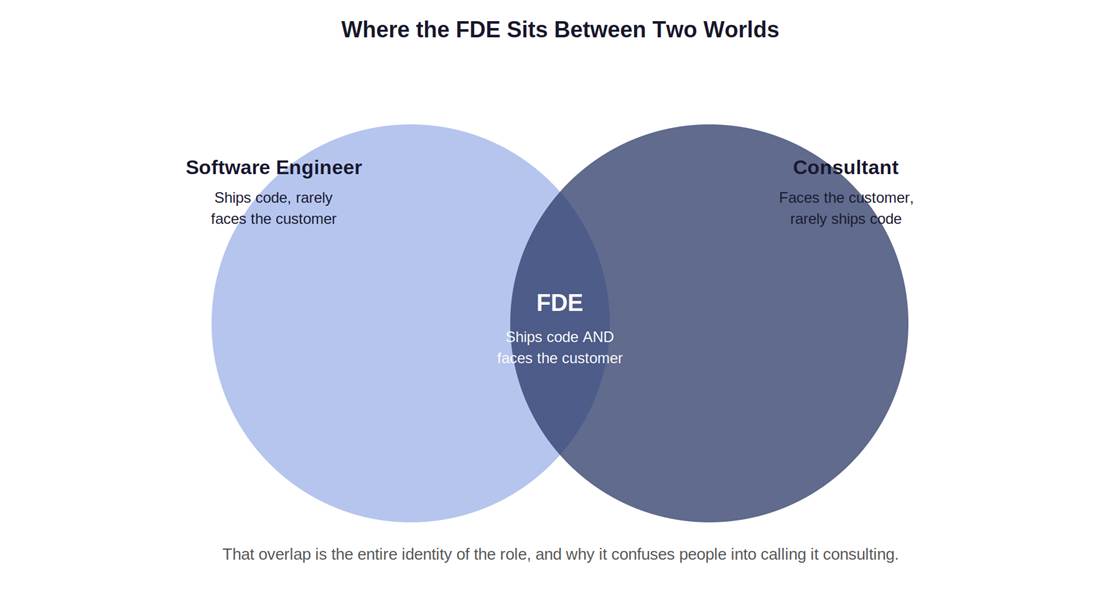
The FDE sits in the overlap between shipping code and facing the customer.
For readers who want the day-to-day version of this in more depth, [companion page: a day in the life of a forward deployed engineer, link once live] walks through the full hour-by-hour breakdown. And if you want to ground the FDE title against its actual origin, Palantir's engineering blog remains the closest thing to a primary source on what the role was originally built to do.
One honest India note: the role is still emerging here, mostly through global capability centres and a handful of AI startups, rather than being a large established local market yet. The transferable skills that matter, real production engineering plus genuine customer-facing depth, are exactly what an ambitious Indian software engineer should be optimising for regardless of which specific company or title gets you there.
How Scaler Transformed Careers in Different Fields
Scaler learners achieved 2.5x salary growth with average post-Scaler CTC reaching ₹23L.
 Google
 Amazon
 Microsoft
 Flipkart
 Adobe1200+ more
Compare More Roles With These FDE Articles
FAQs
Is a forward deployed engineer just a consultant?
No. Both work on-site with customers, but an FDE writes and ships production code, embeds long-term, and owns whether the product works. A consultant advises and hands off; an FDE builds and stays. The overlap is the customer-facing part, not the actual job.
Turn Learning into Career Growth
What is the difference between a forward deployed engineer and a consultant?
The deliverable. A consultant produces recommendations, strategy, and decks. An FDE produces working software in the customer's production environment and is measured by whether it runs and gets adopted, not by advice given.
Do forward deployed engineers actually write code?
Yes, that's the core of the role. FDEs build integrations, custom features, and data pipelines in the customer's environment, often contributing to the core product. If a role doesn't involve shipping production code, it's likely repackaged consulting, not true FDE work.
Why do people call forward deployed engineers consultants?
Because the day looks similar: client-facing, on-site, travel, and sometimes tied to specific customer accounts. That surface overlap is real. The difference is underneath it, an FDE builds and owns software outcomes rather than advising and handing off.
Is forward deployed engineer a good career move?
It can be strong, you build real production skill plus rare customer-facing instinct, a combination that transfers to senior product and founding-engineer roles. The key is confirming it's a genuine build role, not services work wearing an engineering title.
Are FDEs paid like consultants or engineers?
At most product companies, FDEs sit on engineering compensation bands with equity, not billable-rate services structures, though it varies by employer. Confirming you're paid and levelled as an engineer is one of the most important things to check before accepting an offer.
The FDE role rewards a rare mix, production engineering plus the ability to sit with a customer and own the outcome. If you're building toward customer-facing product-engineering roles, that blend is exactly what a structured, project-based CS foundation like Scaler School of Technology is built to develop.




