


Do Forward Deployed Engineers Actually Code? The Answer May Surprise You
Yes, forward deployed engineers actually code, and for most of them it's the majority of the job, not a side activity. But the honest answer isn't one number. An analysis of 1,000 real FDE job postings found the role splits into distinct types, and how much you code depends heavily on which type you land in. This page shows the real split, straight from what the job postings actually ask for, not from a vibe.
Do Forward Deployed Engineers Actually Code? The Short Answer
Yes. According to Bloomberry's analysis of 1,000 real FDE job postings, about 60 percent of jobs using the FDE title are genuine "Builder" roles where coding makes up 70 to 90 percent of the work. Another 30 percent are really sales or solutions engineering roles wearing the FDE label, with coding closer to 30 to 40 percent. The rest are internal tools roles that probably shouldn't be called FDE at all. So yes, they code, often a lot, but the title alone doesn't tell you how much.
For contrast, here's what a software engineer's day actually looks like at a typical product company, worth reading if you want a baseline to compare the FDE split against.
How Much Do FDEs Actually Code? The Real Split
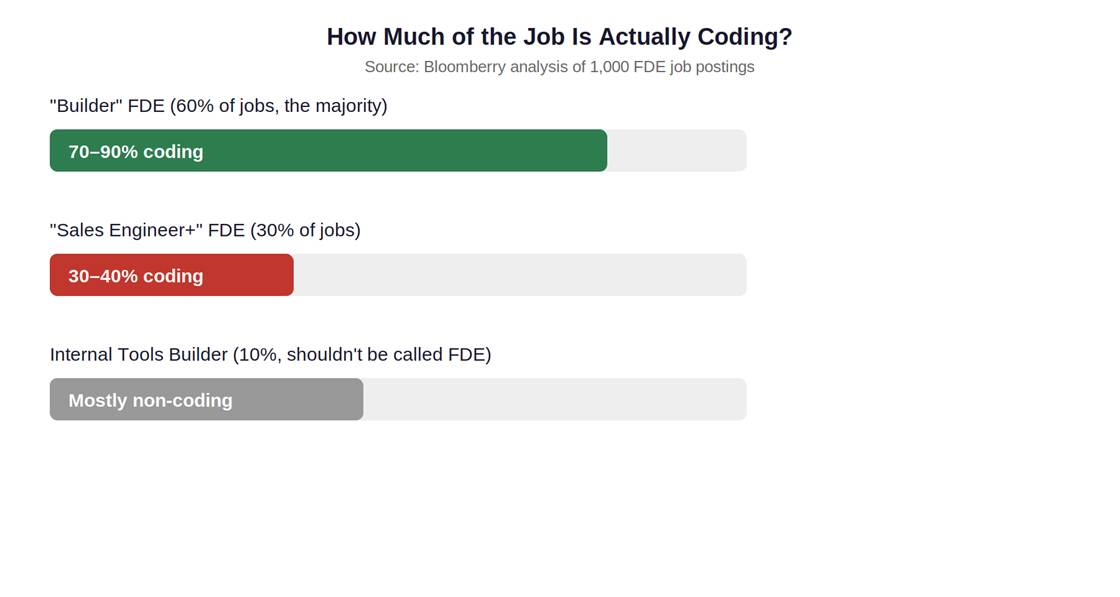
The coding share of the FDE title, by type of role, from Bloomberry's analysis of 1,000 postings.
This is the single most useful chart on this page, because it explains why the internet can't agree on whether FDEs code. People arguing "yes, obviously" are usually picturing the 60 percent majority, the Builder type, where the job posting explicitly asks for hands-on production coding across the stack. People arguing "not really, it's just sales with a fancier title" have usually met someone from the 30 percent Sales-Engineer-plus bucket, where the title got attached to a role that's mostly demos, configuration, and handoffs.
Worth noting too: the coding rarely happens in long, uninterrupted blocks the way it might for a backend engineer heads-down on a sprint. It's interleaved with client calls, discovery sessions, and on-site troubleshooting, which is exactly why some engineers find the role energizing and others find it exhausting.
The split is easiest to picture in a day in the life of a forward deployed engineer, where coding sits between client calls and on-site fixes.
Build an AI-First Career, Master the Complete Skillset
Choose from our industry-leading programs designed for career success
Modern Software and AI Engineering Program
Master full-stack development with AI integration


 +1000 more
Modern Data Science and ML with specialisation in AI
Advanced data science techniques with AI specialization
+1000 moreAdvanced AIML with Specialisation in Agentic AI
Deep dive into AIML with focus on Agentic systems
+1000 moreDevOps, Cloud & AI Platform Engineering
Build and manage AI-powered cloud infrastructure
+1000 moreAI Engineering Advanced Certification by IIT-Roorkee
Premier AI engineering certification from IIT-Roorkee

AI Forward Deployed Engineer Program
Full-stack engineering, production AI and client-facing consulting
+1000 moreWhat Kind of Code Do Forward Deployed Engineers Write?
Integration and Glue Code
The core of the job. Wiring the product into the customer's APIs, databases, auth systems, and whatever legacy software they've been running since 2014. It's undocumented and messy, which is exactly why it can't be done remotely from HQ, someone has to be on the ground reading the actual system in front of them. This is the same muscle behind the integration and backend skills this leans on, just applied to a different environment every few months instead of one company's stack.
Prototyping and Rapid Iteration
Building a quick proof-of-concept in front of the client, throwing it away, rebuilding it differently an hour later. Speed and adaptability matter far more than polish here, which is a genuinely different skill from writing code you expect to maintain for years.
Scripting and Data Work
Cleaning, transforming, and moving the customer's data so the product actually has something real to run against. Small tools and one-off automations that unblock a specific deployment, not the kind of thing that ends up in a portfolio, but the kind of thing that gets a stalled rollout moving again.
What They Mostly Don't Do
Long-lived greenfield product engineering, deep systems or infrastructure work, or owning a codebase for years at a time. That work usually lives back in the core product org. Say this plainly, because it's the honest half of the answer: an FDE is rarely the person architecting the product from scratch, they're the person making it actually work for one specific, messy customer.
SCALER | 12 MONTH PROGRAM
AI Forward Deployed
Engineer Program
Full-stack engineering, production AI, and client-facing consulting — built around a real client engagement you run from first call to production scale.
ENROLL NOWHiring from this program





Why Is There Any Doubt That FDEs Code at All?
The doubt comes from exactly the split above. The role is customer-facing by nature, some companies genuinely use "FDE" as a near-synonym for technical account management or sales engineering, and the title varies wildly between employers with zero standardisation. So someone who happened to meet a non-coding "FDE" reasonably assumes the whole role works that way. The truth is messier: at engineering-led companies, Palantir being the origin of the title, FDEs are builders, full stop, a point the Wikipedia entry on the role backs up with the same origin story. At some other vendors, the title is thinner than the name suggests. The label alone is unreliable, how it compares to a sales or solutions role is worth reading if you want to place FDE more precisely on that spectrum. The individual job description is what actually tells you the truth.
How Scaler Transformed Careers in Different Fields
Scaler learners achieved 2.5x salary growth with average post-Scaler CTC reaching ₹23L.
 Google
 Amazon
 Microsoft
 Flipkart
 Adobe1200+ more
What Do Real FDE Job Postings Ask For?
The same 1,000-posting analysis found working directly with customers mentioned in 55 percent of postings, building and deploying AI or ML systems in 37 percent, and integrating systems or APIs in 32 percent, making these the three most common responsibilities named outright. Not a single posting in the dataset listed hitting a sales quota as a core duty, which is itself a strong signal that this is treated as an engineering role, not a sales one, at the company level.
| Skill or language | Share of FDE postings mentioning it |
|---|---|
| Python | 66% |
| TypeScript | 35% |
| AWS | 32% |
| AI agents | 35% |
| LLM experience | 31% |
| GCP | 22% |
Python leads by a wide margin, unsurprising for integration-heavy work. TypeScript showing up in over a third of postings is the more interesting finding, it means a meaningful share of FDEs are building full-stack solutions and custom dashboards, not just backend plumbing. [the tech stack FDEs typically work with, link once live] goes deeper into the full toolset if you want the complete picture beyond these top few.
How Much FDEs Code Depends on the Company
The single most useful takeaway on this page: the coding share isn't fixed, it's a spectrum set by the employer, not an inherent property of the title. At one end, embedded builders write production integration code for most of the week. At the other, "FDE" is a customer-facing technical role with comparatively light coding. If you're curious about a specific opening, read the actual job description and ask what percentage of the week is writing code, that single question settles it faster than any general definition ever will. Demand for the builder-heavy version of this role is rising specifically because companies are deploying AI systems on-site, and the agentic AI boom is a big part of why that embedded, hands-on version of the role keeps growing.
A short, honest India note: the FDE title exists mostly at global companies' India offices and a handful of AI-first startups here. The same advice applies just as much, maybe more, since the title is even less standardised locally: read the actual JD rather than assuming the label tells you what the job really is.
Check Out These Related Reads on the FDE Role
FAQs
Turn Learning into Career Growth
Do forward deployed engineers actually code?
Yes. About 60 percent of FDE job postings describe genuine builder roles with 70 to 90 percent coding. Another 30 percent are lighter, sales-adjacent roles with 30 to 40 percent coding. The title alone doesn't tell you which one you're looking at.
Is forward deployed engineer a technical role?
Yes, genuinely technical at most companies, but the coding-to-client-work balance varies a lot by employer. Read the specific job description rather than assuming the title guarantees one particular split.
What kind of coding do FDEs do?
Mostly integration, prototyping, and scripting to fit a product into a customer's existing systems, rather than greenfield product engineering. It's messy, undocumented work, not clean, from-scratch architecture.
Do FDEs write production code?
Often yes, especially integration and deployment code that ends up running in the customer's live environment. How much depends on whether the employer treats the FDE title as an engineering role or a customer-facing one.
Is a forward deployed engineer just a sales engineer?
No, though the roles genuinely overlap at some companies that have relabelled sales engineering as FDE. Real FDEs build and integrate; the job description, not the title, is the reliable signal for which one you're looking at.
What programming languages do forward deployed engineers use?
Python leads by a wide margin, appearing in about two-thirds of postings, with TypeScript, SQL, and cloud platform tooling like AWS also common. See the skills table above for the full breakdown from the 1,000-posting analysis.
The coding an FDE does, integration, scripting, wiring real systems together, is ordinary strong engineering, not a secret skill. If the role sounds interesting, the useful takeaway is simple: get genuinely comfortable building and integrating real software first, and the rest of the job is learnable on top of that.




