Latent Space in Generative AI, Explained
Latent space is the compressed "map of meaning" a model learns, where every input becomes a point, and similar things end up close together. Picture a map where cities that are alike sit near each other, except the "cities" here are faces, words, or images, and "alike" means similar in meaning or appearance. This page builds that picture up from scratch and shows how the models you've already heard of actually use it, since latent space isn't some side detail, it's a core idea inside how generative AI models actually generate content.
What Is Latent Space in Generative AI?
Latent space is the compressed representation a model learns during training, a space where every possible input, a face, a sentence, an image, corresponds to a point, and points that are similar in meaning sit close together. It's the map. The model draws it by looking at huge amounts of data and figuring out what actually matters versus what's just noise.
Nobody hands the model this map. It has to build it, and the way it builds it turns out to explain almost everything interesting about how generative AI works, which is exactly what the rest of this page walks through.
Why Do Generative Models Use a Latent Space at All?
Raw Data Is Huge and Messy
An image is millions of pixels. A sentence is a sequence of words drawn from a vocabulary of tens of thousands. Most combinations of pixels are just noise, static that looks like nothing. The model needs a smaller, organised space to actually work in, one where the useful stuff isn't buried under millions of dimensions that don't matter.
Build an AI-First Career, Master the Complete Skillset
Choose from our industry-leading programs designed for career success
Modern Software and AI Engineering Program
Master full-stack development with AI integration


 +1000 more
Modern Data Science and ML with specialisation in AI
Advanced data science techniques with AI specialization
+1000 moreAdvanced AIML with Specialisation in Agentic AI
Deep dive into AIML with focus on Agentic systems
+1000 moreDevOps, Cloud & AI Platform Engineering
Build and manage AI-powered cloud infrastructure
+1000 moreAI Engineering Advanced Certification by IIT-Roorkee
Premier AI engineering certification from IIT-Roorkee

AI Forward Deployed Engineer Program
Full-stack engineering, production AI and client-facing consulting
+1000 moreCompression Forces the Model to Learn Structure
To squeeze data down into something small, the model has to keep only what matters, a face's general shape, a word's meaning, and throw the rest away. That "what matters" is exactly what ends up living in latent space. It's not a side effect of compression, it's the whole point. This is the same underlying mechanism covered in how neural networks learn to represent data, just applied specifically to the generative case here.
A Smooth, Organised Space Makes Generation Possible
Because similar things sit close together and the space is continuous, not a grid of disconnected slots, the model can pick literally any point and decode it into something new. That's generation, in one sentence. Compression is the whole trick: a latent space is what's left once you strip away everything that didn't matter.
How Is a Latent Space Actually Learned?
Encoders: Squeezing Input Down to a Point
An encoder is the part of the model that takes a big, messy input and outputs a short list of numbers, the coordinates of that input in latent space. This is the one idea worth actually sitting with: a list of numbers is a point in space. Once you see that, the rest of this topic stops feeling abstract.
Autoencoders and VAEs: Learning by Reconstruction
The model learns the space by trying to rebuild the input from the squeezed-down version: encode into a point, then decode that point back into a reconstruction. If it can rebuild the input well, the point kept the right information. The variational autoencoder, or VAE, is the version that makes this space smooth and sample-able, meaning it nudges nearby points to decode into similar things rather than leaving gaps that produce garbage. The original VAE paper by Kingma and Welling is the primary source here, worth a skim even if you skip the maths, since it's the paper that actually made this idea practical. If you want to go further and actually build one of these, the deep learning skills behind these models is the natural next stop.
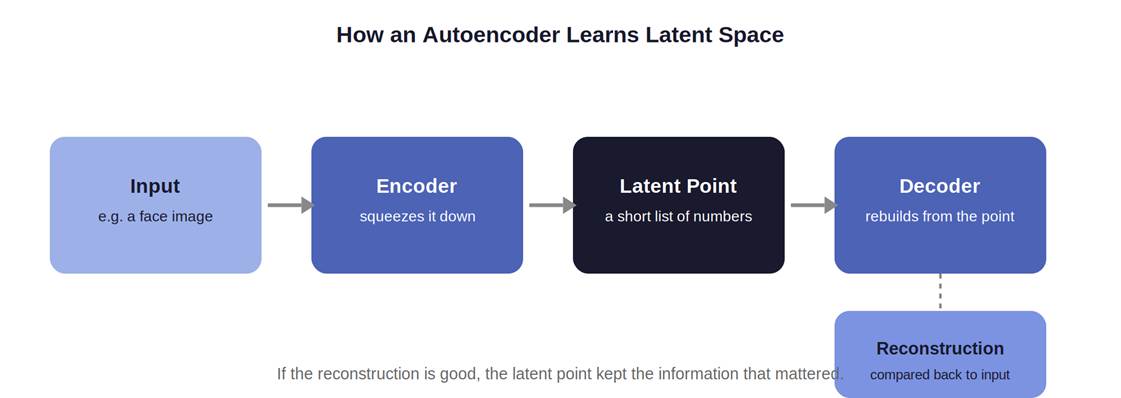
The encoder to latent point to decoder loop that autoencoders use to learn latent space.
Embeddings Are the Same Idea, for Discrete Things
A word or token gets mapped to a point too, and that learned point is its embedding. Same underlying idea as everything above, just applied to something discrete rather than continuous. There's a fuller comparison coming later on this page, so don't worry about pinning down the exact difference yet.
What Does Latent Space Look Like in the Major GenAI Models?
VAEs: The Textbook Latent Space
Encoder makes a point, decoder rebuilds it, and the space is deliberately kept smooth so you can sample new points and interpolate between existing ones. This is the cleanest, most textbook example, and it's the one worth anchoring your mental model to before the messier real-world versions.
GANs: A Latent Noise Vector In, an Image Out
Here the latent point is just a random noise vector the generator turns into an image. There's no encoder at all in the vanilla setup, you sample a random point directly and decode it. This is the cleanest possible "point in, generated thing out" example on this whole page, and honestly the easiest one to build intuition from.
How Scaler Transformed Careers in Different Fields
Scaler learners achieved 2.5x salary growth with average post-Scaler CTC reaching ₹23L.
 Google
 Amazon
 Microsoft
 Flipkart
 Adobe1200+ more
Diffusion Models: Denoising Inside Latent Space
The key modern idea, and the one most people get slightly wrong: Stable Diffusion doesn't denoise pixels directly. It denoises inside a compressed latent space, that's the "latent" in Latent Diffusion, and only decodes to a full image at the very end. This is exactly why it's fast enough to run on a consumer GPU rather than needing a data centre. The Latent Diffusion paper by Rombach and colleagues is the actual source of this idea, published in 2022, and it's the specific claim this section is making, not a simplification of it.
LLMs: The Embedding Space Words Live In
Tokens become embedding vectors, and "close together" here means "similar in meaning or usage," the classic king-queen, Paris-France kind of relationship. People often call this the model's latent space loosely, and honestly that's not wrong so much as imprecise, we untangle the exact wording in the next section. For the mechanism behind how tokens actually become vectors in the first place, how transformer-based models are structured covers it properly.
What Does "Walking" or Interpolating the Latent Space Mean?
This is the single most intuitive, most visual idea in generative AI, so it earns some room. Because the space is continuous and organised, you can start at one point and move toward another in small steps, decoding each step along the way. Do this between two faces and you get a smooth morph from one into the other, the classic example everyone's seen at least once without knowing what was actually happening underneath.
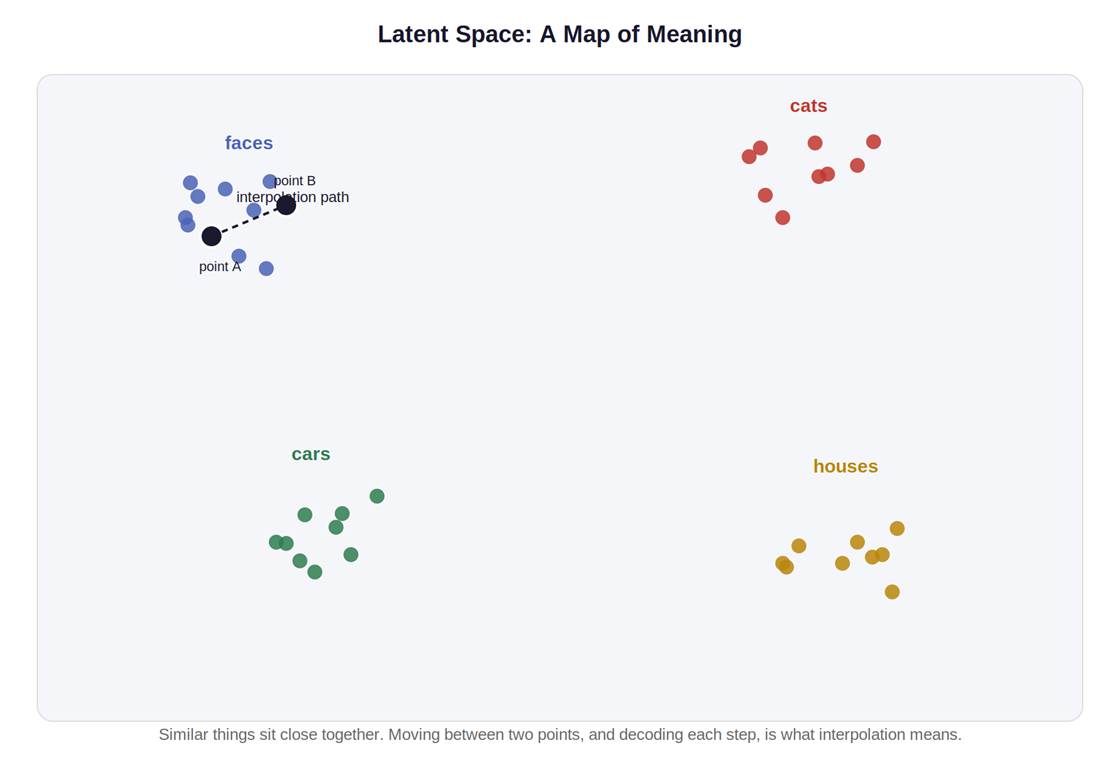
Latent space as a map of meaning. Similar things cluster together; interpolation is the path between two points.
Interpolation is the straight-line walk between two points, where each in-between point decodes into something believable, not garbage, and not a crude cross-fade either. Latent walks, or direction vectors, are the other half of this: moving along a particular direction in the space changes one specific attribute. Add a "smiling" direction to a face's point and it smiles more. Add a direction and it grows glasses, or looks older. This is exactly why latent space gives creators actual control instead of just random output.
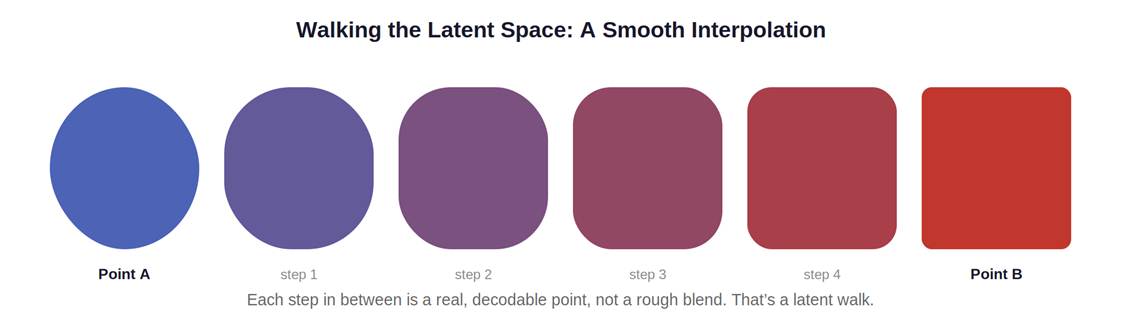
A latent walk, illustrated abstractly: each step between two points is a real, decodable state, not a rough blend.
Latent Vectors and Conditioning: How You Steer the Output
A latent vector is just the point, the list of coordinates, that you feed to the decoder or generator. Nothing more mysterious than that. Conditioning is what happens when you add extra information to that point, a text prompt, a class label, a style tag, so the model generates something specific rather than something random. A text-to-image model takes your prompt and turns it into, or alongside, a latent vector, then decodes that into the image you actually asked for. How large language models are structured internally is worth a look if you want the visual companion for how a text prompt becomes vectors in the first place.
Latent Space vs Embedding Space: Are They the Same Thing?
Mostly, and often people use the two words interchangeably without causing any real confusion. But there's a useful distinction underneath the overlap, and it's worth getting right.
What they share: both are learned vector spaces where similar things sit close together. If someone uses the two terms loosely in a conversation or a paper, that's usually fine and not worth correcting.
The useful distinction: embedding typically names the learned vector for one specific, discrete input, a word, a token, an image, often used as a lookup or representation you compare against others. Latent space names the whole continuous space a generative model samples from and moves through to create new things. Embeddings describe. Latent space generates. How embeddings and vector search work in practice is a good applied companion if you want to see embeddings doing real work outside the generative context, like similarity search.
| Term | What it usually means | Typical use |
|---|---|---|
| Embedding | The learned vector for one specific, discrete input | Lookup, comparison, similarity search |
| Latent space | The whole continuous space a generative model samples from | Generation, interpolation, conditioning |
The one-line takeaway worth remembering: every embedding lives in a latent space, but not every latent space gets called an embedding space.
Turn Learning into Career Growth
Why Latent Space Matters: Control, Creativity, and Structure
Control: you can edit specific attributes by moving along a direction in the space, rather than regenerating from scratch and hoping for the best. Creativity: sampling a genuinely new point and decoding it gives you something that never existed before, not a remix of two existing things. Structure and efficiency: working inside a small, organised space is precisely what makes modern generation fast enough to actually ship, Stable Diffusion's whole speed advantage traces back to exactly this. Once this clicks, most of what looks like magic in generative AI stops looking quite so mysterious.
FAQs
What is latent space in simple terms?
A compressed map where similar things sit close together. Every input becomes a point on that map, and a model can generate something new by picking a point and decoding it.
What is the difference between latent space and embedding space?
Embeddings usually describe the learned vector for one specific discrete input, like a word or an image. Latent space refers to the whole continuous space a generative model samples from and moves through to create new things. The terms overlap heavily and are often used interchangeably.
What is a latent vector?
The list of numbers, the point, that you feed into a generator or decoder. It's the coordinate of whatever you're generating inside the model's latent space.
How is latent space used in Stable Diffusion?
Stable Diffusion denoises inside a compressed latent space rather than working directly on pixels, then decodes the result into a full image only at the end. That's what makes it efficient enough to run on consumer hardware.
What does "walking the latent space" mean?
Moving smoothly between two points in the space and decoding each step along the way. It's the source of the classic image-morphing effect, where one generated face gradually turns into another.
Is latent space the same as dimensionality reduction?
Related, but not identical. Dimensionality reduction is the general technique of representing data with fewer numbers. Latent space is a specific case of that, one that's also structured so a model can generate new, believable outputs from it, not just compress existing data.
Why do generative models need a latent space?
Compression forces the model to keep only what actually matters and discard noise, and a smooth, continuous space is what makes generating genuinely new things possible in the first place, rather than just memorising and replaying training data.
Now that latent space makes sense, the natural next step is learning how the models that build it actually work. Scaler's free deep learning course walks you through autoencoders, representation learning, and the networks behind modern generative AI, hands-on, from the ground up.