


Recursive Relationship in DBMS
 FREE
FREE

Recursive relation in a Database Management System is a type of relationship that is between two entities of a similar type of entity type. Recursion in real life is defining a problem or an object in terms of itself, which means usually we see the relationship between two entities of different entity types but when we define the relationship forms, an entity of the same entity type to another entity of the same entity type it becomes the Recursive relation in DBMS.
Build an AI-First Career, Master the Complete Skillset
Choose from our industry-leading programs designed for career success
Modern Software and AI Engineering Program
Master full-stack development with AI integration


 +1000 more
Modern Data Science and ML with specialisation in AI
Advanced data science techniques with AI specialization
+1000 moreAdvanced AIML with Specialisation in Agentic AI
Deep dive into AIML with focus on Agentic systems
+1000 moreDevOps, Cloud & AI Platform Engineering
Build and manage AI-powered cloud infrastructure
+1000 moreAI Engineering Advanced Certification by IIT-Roorkee
Premier AI engineering certification from IIT-Roorkee

AI Forward Deployed Engineer Program
Full-stack engineering, production AI and client-facing consulting
+1000 moreRecursive Relationship in ER Diagram
ER diagram or ER model stands for the entity-relationship model and shows the complete data entities and relationships in a high-level model. It helps to visualize the entire data model in a better way, we will learn recursive relationships in DBMS through it.
In the ER diagram, the entities are represented in rectangles, the attributes of the entities are defined in circles, and the relationships are defined in the rhombus. The relationships are present between two entities defining the relationship between them and connecting to both of the entities.
Here is a recursive relationship in DBMS, the entity has a relationship with itself means the entity will be connected to the relationship two times.
Let's see the ER diagram for the Recursive Relation in DBMS:
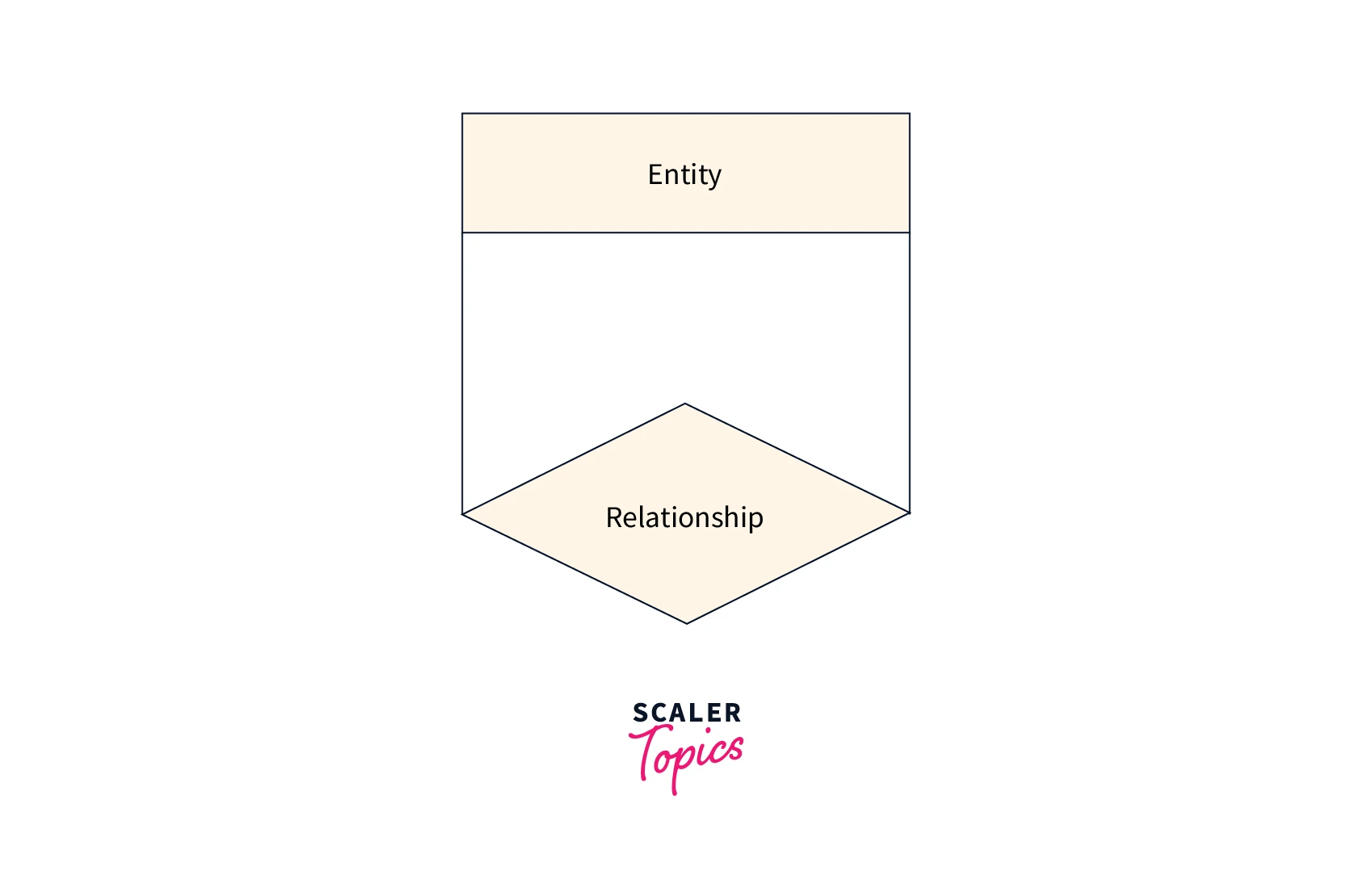
In the above image, we can see there are two connections of the entity to a single relationship, which means there is a recursive relationship in DBMS in the entity.
Examples of Recursive Relationship in DBMS
Whenever an entity shows two states related to each other, there is a recursive relationship in DBMS. Let’s see some of its examples:
In a company there are many employees, an employee can be a developer, manager, CEO, etc. All the developers (who are employees) are managed by the manager (who is also an employee) means an employee manages other employees. This means there is a recursive relationship in DBMS between the employee entity.
Let’s see its ER diagram:
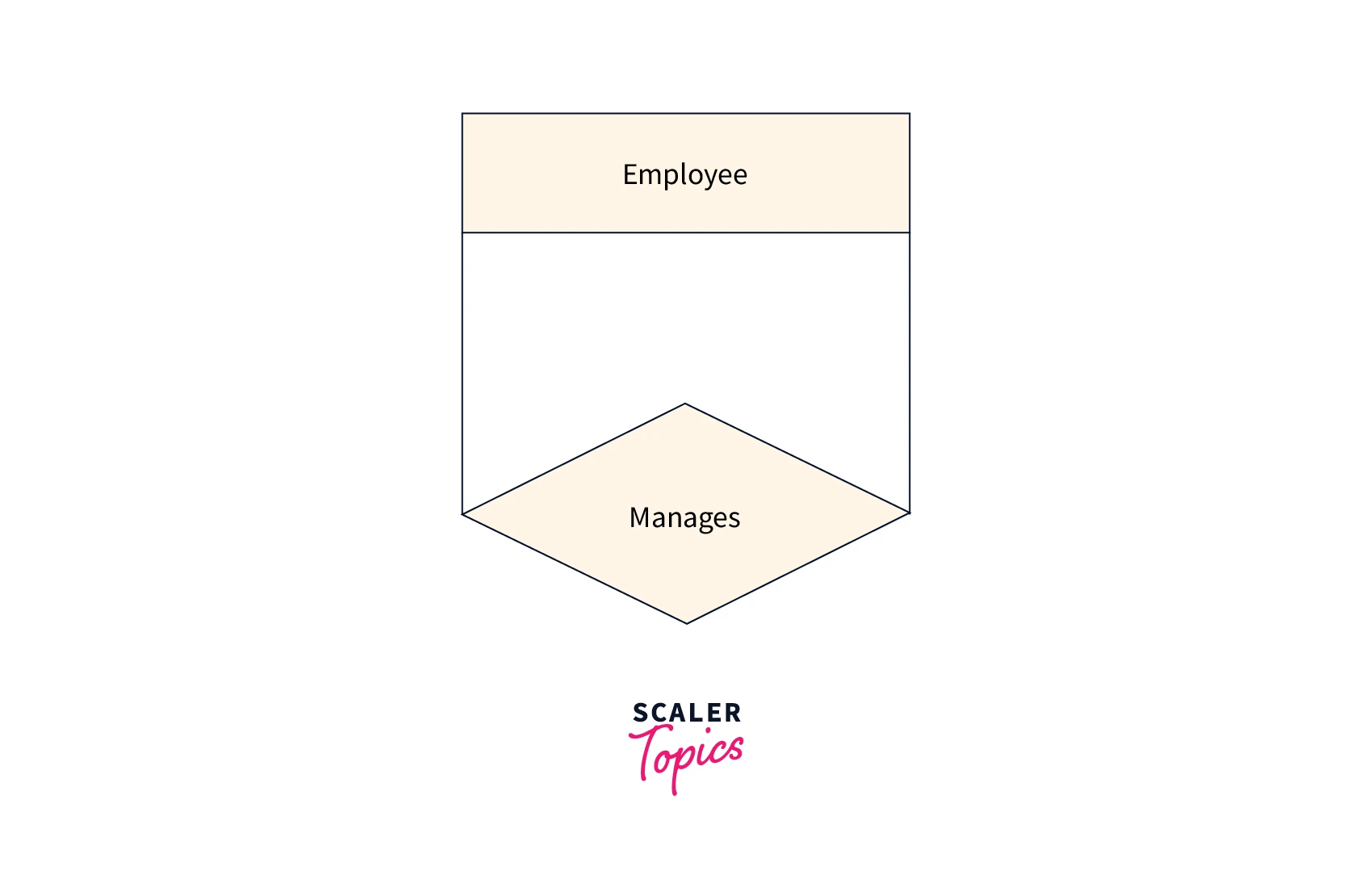
In the above diagram, the employee is connected to the relationship 'manages' two times, which indicates employees manage employees.
We can take another example, a person can be an entity in the entity set. Both father and son are the people and there could be a relationship 'parent' between them which will be from person to person and a recursive relationship in DBMS.
Let’s take one more example of a sports team or specifically a cricket team. In a cricket team, there are a total of 11 players with different roles like a batsman, bowler, wicket-keeper, and an all-arounder. Among all the players one is the captain who will manage the whole team. So, the captain is the player who manages the whole team, which is an entity from the same entity set and has a relationship with the entities of the same entity set this makes the recursive relation in dbms from a player to the player.
Conclusion
- Recursive relation in DBMS is a type of relationship between two entities of a similar type entity type.
- In recursive relation, the same entity type participates in a relationship type more than once, playing a different role in each instance. In other words, there has always been a relationship between events that occur in two distinct entities.
- An entity is a real-life object which could be either physically present in the world like a person, a place, etc or it could be logically created like a mathematical concept.
- In recursive relation in DBMS, the entity has a relationship with itself. It means the entity will be connected to the relationship two times.




