


Scaler vs Self-Learning: Which is Right for You?
We live in 2025, where aspiring tech professionals have more choices than ever before. From free YouTube tutorials and MOOCs to textbooks, coding bootcamps, and platforms like Scaler, there are various platforms available for learning today. But with so many routes, the real challenge isn’t access to content; it’s figuring out which approach works best for your goals, time commitment, and learning style. In this blog, we’ll reveal the pros and cons of self-learning vs. Scaler’s programs so you can make the best decision for yourself. Both pathways have their own merits, but your choice depends on how you prefer to learn and what outcomes you’re aiming for.
The Rise of Self-learning in Tech Careers
Self-learning has been on the rise for many years now, and especially because of the availability of free and affordable resources. Platforms like YouTube, Coursera, and GitHub allow learners to pick up skills independently at their own pace. Many successful developers today started this way of building projects, contributing to open source, and learning through trial and error. This method seems the most sustainable to many students as it allows time and is quite affordable.
Why Structured Platforms like Scaler Gained Traction
Self-learning does provide flexibility, but it has its limits. Scaler’s programs emerged to solve the biggest drawbacks of self-learning, which are a lack of direction, feedback, and accountability. With guided curricula, mentorship from industry experts, and peer learning communities, Scaler helps learners stay consistent with credible knowledge and certification. For those targeting career transitions or high-growth tech roles, such support systems often make the difference between starting and actually finishing.
Choosing the right approach based on your learning personality
At the end of the day, the choice comes down to your learning personality. If you thrive in environments with too much flexibility, can still stay disciplined, and enjoy figuring things out on your own, self-learning might suit you.
If you prefer a clear roadmap, regular feedback, and the motivation of mentors and peers, a structured program like Scaler can definitely be the smarter investment. Want to see how Scaler’s structured courses compare? Explore the Course Pages for more details.
The Case for Self-Learning Students
If you’ve ever tried to pick up coding on your own, you might already be aware of how many resources are out there: YouTube tutorials, GitHub projects, freeCodeCamp, Coursera, and even Reddit threads where people share entire roadmaps. Self-learning is all about freedom. You decide what to study, when to study, and how deep to go. For many developers, this route has worked well. But like everything else, it comes with its ups and downs.
Pros: Freedom, flexibility, affordability
- Learn at your own pace: You can binge tutorials in a week or spread them across months. There are neither deadlines nor schedules.
- Huge variety of resources: If you require crash courses for a particular skillset or require reading material for a class, all of it is available online.
- Low or no cost: You can have knowledge on various topics through free material before you ever need to pay for certifications or courses.
Cons: No mentorship, no structure, slower job-readiness
- Too much content, lacks a clear path: You might spend weeks deciding which tutorial to follow instead of actually building skills.
- No feedback loop: If you’re stuck on a bug or don’t know how to improve your code, there’s rarely a mentor to guide you (and even ChatGPT might not be able to handle the complexity of the problems).
- Job prep takes longer: You’ll need extra time to figure out interview patterns, industry standards, and placement opportunities.
For Whom Does Self-learning Work Best?
Self-learning is amazing if you’re naturally curious, disciplined, and enjoy problem-solving without much handholding. If you can stay consistent and don’t mind building your roadmap, this path can absolutely get you to a career in tech. But if accountability, structure, and guided feedback matter to you, self-learning alone might feel like a slow grind. Read Student Stories to see how different learners balanced self-learning with structured programs like Scaler.
What Learning Programs like Scaler Have to Offer
While self-learning gives you independence, it is necessary to have a path and credible proof of skill to build your steps for your career. Scaler recognized these gaps that often slow learners down. Its ecosystem is designed to move students from “just coding” to being truly job-ready.
Live mentorship and project feedback
Scaler pairs learners with industry mentors who’ve worked at top tech firms. They not only clear doubts in real-time but also review projects, pointing out what’s missing or how to optimize code. This feedback loop helps students grow and prevents the trial-and-error cycle most self-learners face.
Career Prep
Scaler’s main aim is to provide a platform for students with a clear path, mentorship, and a network. Students undergo mock interviews with experienced engineers, receive detailed resume reviews, and learn how to articulate problem-solving skills in real-world interview settings. This hands-on prep is what helps students learn coding along with becoming industry-ready.
Community & TA support
Self-learning can become too mundane and might even become still due to a lack of feedback. At Scaler, learners are surrounded by peers, teaching assistants, and coaches who keep them accountable. Regular check-ins and doubt-clearing sessions create momentum, making it harder to procrastinate and easier to stay consistent.
Job referrals, Hiring network, & a Clear roadmap
Scaler’s placement also provides placement support. With direct connections to hiring partners and a clear roadmap from basics to advanced system design, students can see clear growth in their careers.
We have also heard from many alumni who first tried self-learning, agreeing that while free content helped them explore, Scaler gave them the structure and opportunities to actually convert skills into offers.
Cost Comparison between ₹3,00,000 & ₹0: What Are You Really Paying For?
Looking at the prices, the choice seems obvious, right? But let’s take a moment to think, why would a program cost so much to begin with?
That is because we provide not just the knowledge, but methods and a path to apply your learnings to your career. You can think of Scaler’s program fees as a part of investment in your career. How so? Read along to know more!
Scaler Pricing Explained
Scaler course cost is around ₹3L+, but most students don’t have to pay upfront. We provide flexible EMI plans that are spread over months, making it accessible for working professionals.
Scholarships are also available for high-scoring students in the entrance test. And importantly, Scaler has a refund policy that is meant for learners if expectations for the program aren’t met, which will help in reducing the risk of having to pay a hefty sum.
The Hidden Cost of Self-learning
Self-learning may not require tuition fees, but it comes with invisible expenses:
- The Time lost figuring out the right resources.
- Trial and error with projects that don’t meet industry standards.
- Missed guidance that could prevent months of stagnation.
- Lost salary opportunities, taking longer to crack interviews, often delay career growth by 6-12 months. And this is exactly why Scaler’s clear roadmap, mentor reviews, and peer accountability save time by doing the “figuring-out” part and help you in every way possible.
What is the ROI after Joining Scaler?
Scaler’s placement report highlights the ROI clearly: alumni often see salary jumps of 50-200%, with many moving from ₹6–8L CTC to ₹15–20L+. When compared to the ₹3L program fee, the uplift pays for itself within the first job switch.
So while self-learning looks free, we can see that the long-term opportunity cost often outweighs Scaler program’s investment.
Which Path Leads to Better Job Outcomes?
When choosing between programs like that of Scaler Academy and self-learning, you can always ask yourself, which path actually helps you land a better job? The answer depends on time, support systems, and career goals. Let us help you find your path.
Scaler’s 2025 Placement Trends
-
Placement Rate: Over 85% of Scaler graduates report successful placement into top tech roles.
-
CTC Uplift: Average salary jumps of approximately 150%, with many moving from ₹6-8 LPA roles to ₹20+ LPA at companies like Amazon, Microsoft, and Atlassian.
-
Hiring Partners: Scaler collaborates with 600+ recruiters across startups, unicorns, and FAANG-level firms.
-
Extra Support: Interview prep, mock rounds, and referral networks add to the job-readiness advantage.
You can refer to our verified progress report for further details: Progress Report
Success Stories from Self-Learners
Self-learning has produced successful engineers too, such as developers who’ve cracked jobs through open-source contributions or consistent LeetCode practice.
- Strengths: Flexibility, zero cost, and full control over learning pace.
- Challenges: Without mentorship, many hit roadblocks in building aligned portfolios, preparing for interviews, or staying consistent.
- Case Examples: Students often share that after 6-12 months of struggling solo, they switched to Scaler to accelerate outcomes.
How Long Does Each Path Take to Show ROI?
- Scaler Path: Typically 12-18 months from enrollment to placement, backed by structured timelines and mentor support.
- Self-Learning Path: Can take 2-3 years, depending on discipline, networking, and ability to showcase projects. Here’s a summary table for your reference:
| Scaler | Self-Learning |
|---|---|
| Well-curated curriculum designed by industry experts | Self-designed, depends on individual research and resources |
| Access to mentors, teaching assistants, and industry professionals | Mostly solo learning, guidance through online forums, communities, or peers |
| It is balanced and flexible but guided to keep consistency | Completely flexible, but can lead to irregularity or burnout |
| Real-world projects with feedback from mentors | Independent projects, good ones require extra effort and discipline |
| Mock interviews, career services, referrals, and networking support | Relies on personal effort to build a strong portfolio and reach out to recruiters |
| Community of like-minded learners and peer discussions | Limited, unless actively joining communities like Reddit, Discord, or local meetups |
| Paid, with EMI and placement-linked options | Mostly free or low-cost resources (books, YouTube, MOOCs) |
| Regular deadlines, assignments, and check-ins | Self-motivation is the only driver |
| Many graduates are placed in top tech firms | Inspiring stories exist, but often involve years of persistence and self-driven grit |
At this point, you must still be a little confused. After all, it’s a huge commitment to invest in an unseen future, and we get that. For further assistance, you can always contact us at: Scaler Academy And we’ll be ever ready to guide you!
Student Stories: Why Some of Our Students Switched to Scaler from Self-Learning
Many of our students had joined Scaler after coming across great difficulties with self-learning. And honestly, it’s natural. Imagine having a source of knowledge that is accessible to everyone, even if it’s difficult, but that in turn makes you one of the many. Hence, here are some stories from our students that you can definitely check out.
“Scaler helped when it was hard to make decisions on my own.”
“I joined Scaler to upskill, and I can confidently say it was a great decision. The structured curriculum saved me from the chaos of self-study…”
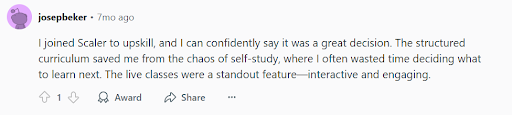
A student posted on Reddit in reply to someone’s post. This shows how we help our students build a foundation as well as help in planning ahead.
“I needed structure and feedback, that’s where Scaler helped.”
“Their dashboard is fairly well made… I buy courses and never finish them, but in Scaler, I solved problems every single day for six months. That did help me get confidence with DSA.”
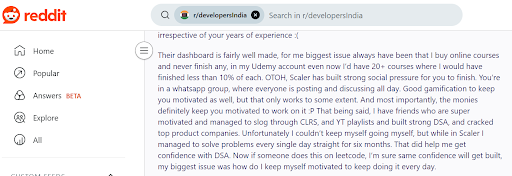
A Reddit user highlighted the impact of peer accountability and timely pacing
“Mock interviews were incredibly helpful for me.”
“I appreciate that Scaler focuses on both the technical and non-technical aspects of career growth... mentor sessions were incredibly helpful, providing personalized guidance throughout my learning.”
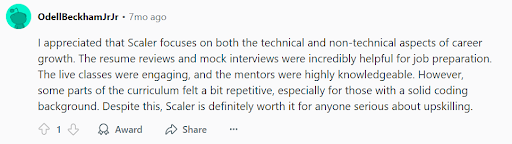
Here are our student reviews, and you can read more at: Scaler Review: What Our Students Have To Say
FAQs
We gathered some of the most common questions students ask on Reddit, Quora, and other forums. If you’re still comparing Scaler Academy reviews with self-learning, these answers may help you decide.
Is self-learning enough to get a job in data science?
Self-learning can build a strong foundation if you’re disciplined and know what to study. However, the biggest challenge is direction, things like figuring out which tools, projects, and skills employers actually expect. Many learners face difficulties during job search because they lack real-world projects or interview prep. That’s why some eventually opt for programs like Scaler’s Data Science course that align with industry demands.
Is Scaler better for beginners or experienced coders?
Scaler is designed for both. Beginners get learning paths, mentorship, and foundational support. Experienced coders use it to accelerate their growth, polish interview skills, and break into top product companies. If you’re self-motivated, you can start with self-learning and switch later.
What if I start with self-learning and then switch to Scaler?
Yes, you can always do that. Many students self-learn to test interest, but later join Scaler for accountability, mentorship, and placement support. Scaler helps you refine the basics you’ve already picked up and then helps you towards interviews and jobs.
Can Scaler guarantee me a job?
Scaler does not guarantee jobs, and you should be cautious of any institute that does. What we do offer is a dedicated placement team, company referrals, mock interviews, and a network of hiring partners. Success depends on your effort, but Scaler’s structured ecosystem significantly improves the odds compared to going solo.
Which One Should You Choose?
Choosing between Scaler and self-learning really comes down to your goals, resources, and learning style. If you’re someone who wants a clear path, accountability, and consistent feedback, Scaler can give you a clear advantage.
The mentorship, guided curriculum, and placement support make it especially useful if you’ve already tried self-learning but feel stuck or aren’t seeing results fast enough.
On the other hand, self-learning works best for those who enjoy exploring at their own pace, have strong discipline, and want to minimize costs. It’s a great path for hobbyists or learners who aren’t in a hurry to land a job. In short, if your priority is speed, career outcomes, and a proven roadmap, Scaler is the safer bet.
But if you’re confident in your ability to stay consistent without external support, self-learning can be just as rewarding. Want to see if Scaler fits your career goals? You can download the curriculum or talk to a Scaler alum to get a first-hand perspective.