ServiceNow Assist: Features, Real Changes in 2026, and Whether It's Worth It
ServiceNow Now Assist is the generative AI layer built into the Now Platform, the part that summarises incidents, drafts knowledge articles, powers conversational self-service, and generates code inside Creator Studio. It launched in the 2023 Vancouver release and has expanded every release since. This page covers what it actually does today, module by module, what's genuinely changed under the hood this year, and an honest read on whether it's worth deploying for your team.
Before anything else: the single most important thing to know about Now Assist right now is that ServiceNow announced ServiceNow Otto at Knowledge 2026 (May 5, 2026), a unified conversational front door that combines Now Assist, the acquired Moveworks product, and ServiceNow's AI Experience into one assistant. Otto is rolling out through monthly AI releases starting August 2026, with fuller availability targeted for the "Brazil" release later this year. "Now Assist" is still the name on most existing contracts and documentation as of this writing, and product entitlements reportedly carry over unchanged, but expect the name and the front-end experience to keep shifting toward Otto through the rest of 2026. Anything you read about Now Assist right now needs that context.
What Is ServiceNow Now Assist?
Now Assist is ServiceNow's generative AI suite, built directly into the Now Platform rather than bolted on as a separate tool. It combines enterprise workflow data, your knowledge base, and ticket history with large language models to summarise, draft, recommend, and generate content across ITSM, CSM, HR Service Delivery, and Creator. The idea is that the AI has direct access to your actual configuration items, your actual knowledge articles, and your actual case history, not just a generic model answering from public training data. The layered architecture behind how generative AI models actually produce output is a useful primer if you want the underlying mechanics before reading the ServiceNow-specific version below.
How Now Assist Actually Works Under the Hood
This is the part that's changed the most, and it's worth getting right. Now Assist originally ran on Now LLM, ServiceNow's own in-house model, tuned specifically on workflow data. That's no longer the default. With the July 2026 release, ServiceNow shifted third-party models, Google Gemini 3.5 Flash, OpenAI's GPT-5.1 and GPT-5.4 Mini, alongside existing support for Anthropic's Claude via AWS and Azure OpenAI, into the default position for out-of-the-box skills and AI agents. The Now LLM long-term-support SKU was formally retired in June 2026. If your org configured Now Assist before this year and never touched the model settings, it's genuinely worth checking ServiceNow's own community post on the Now LLM transition to see whether your instance quietly moved to a different model than the one you originally tested against.
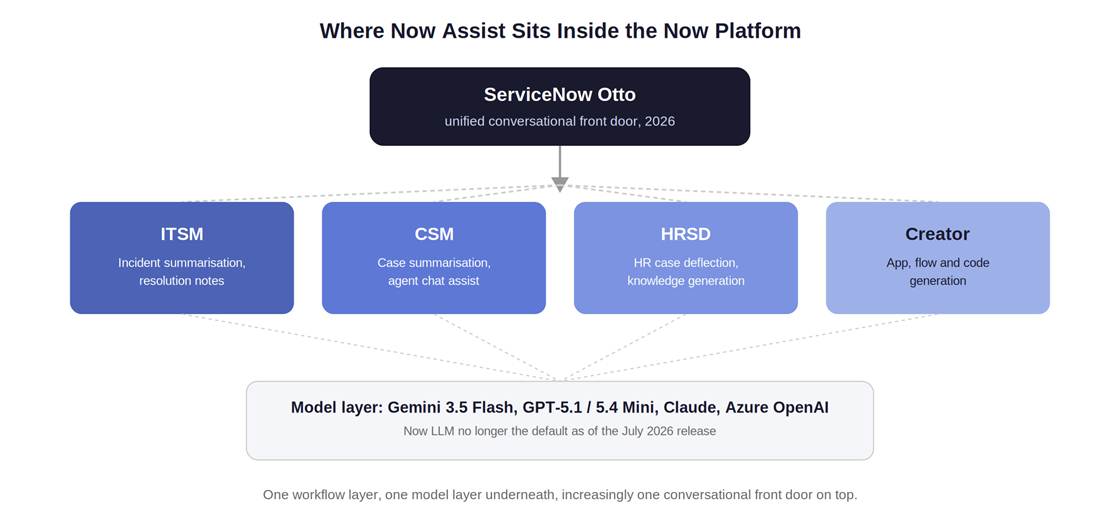
Now Assist's workflow layer sits across four modules, on top of a model layer that's shifted to third-party LLMs in 2026.
What Are the Actual Now Assist Features by Module?
Concrete, by module, since "AI features" as a phrase tells you nothing useful on its own.
| Module | Key features | What it actually does |
|---|---|---|
| ITSM | Incident summarisation, resolution notes generation, change risk assessment | Drafts a clear incident summary and resolution write-up from raw work notes, cutting the admin tax on closing a ticket |
| CSM | Case summarisation, agent chat assist, conversational self-service | Summarises long case threads for agents and lets customers self-serve through natural-language chat |
| HRSD | HR case deflection, knowledge article generation from resolved cases | Answers routine HR questions directly and turns resolved cases into reusable knowledge articles automatically |
| Creator | App generation, flow generation, code generation, catalog item generation | Drafts app scaffolding, flow logic, and code from a natural-language description inside Creator Studio |
The through-line across all four modules: draft, don't decide. Every one of these features produces a first pass that a human reviews, edits, and approves before it goes anywhere real, not an autonomous action taken without a person in the loop.
Build an AI-First Career, Master the Complete Skillset
Choose from our industry-leading programs designed for career success
Modern Software and AI Engineering Program
Master full-stack development with AI integration


 +1000 more
Modern Data Science and ML with specialisation in AI
Advanced data science techniques with AI specialization
+1000 moreAdvanced AIML with Specialisation in Agentic AI
Deep dive into AIML with focus on Agentic systems
+1000 moreDevOps, Cloud & AI Platform Engineering
Build and manage AI-powered cloud infrastructure
+1000 moreAI Engineering Advanced Certification by IIT-Roorkee
Premier AI engineering certification from IIT-Roorkee

AI Forward Deployed Engineer Program
Full-stack engineering, production AI and client-facing consulting
+1000 moreWhat Are the Real Enterprise Use Cases?
IT Operations
Faster incident resolution through auto-generated summaries, less time spent writing repetitive resolution notes, and pattern recognition across incidents that helps problem management spot recurring root causes instead of firefighting the same issue over and over.
Customer Service
Case summarisation that gets an agent up to speed on a long thread in seconds, and conversational self-service that resolves routine requests without a human touching the ticket at all.
HR Service Delivery
Employee self-service for routine HR questions, benefits, leave policy, onboarding steps, plus automatic knowledge-base growth as resolved cases get converted into articles without someone manually writing them up afterward.
App Development (Creator)
Faster prototyping for citizen developers and professional developers alike, generating a first-draft app, flow, or function from a plain-language description rather than starting from a blank canvas every time. This overlaps meaningfully with the broader skill set behind prompt engineering roles and pay in India, since getting good output from Creator's generation features is, underneath it, the same prompting discipline that role is built around.
What Are the Benefits, Honestly?
Real advantages, worth stating plainly rather than hedging into meaninglessness.
• Native integration: it's built into workflows you already run, not a separate tool that needs its own login and its own data sync.
• Faster resolution and reduced admin load: less time spent on the writing and summarising tasks that eat an agent's day without adding much value.
• Better self-service: routine requests get deflected from human queues entirely, freeing agents for the cases that actually need judgment.
• Model flexibility: choosing between Gemini, GPT, and Claude means you're not locked into one vendor's quality or pricing curve.
What Are the Limitations and Real Costs?
The part vendor pages skip, and the part that actually determines whether this is worth it for your org.
Licensing Complexity
Now Assist licensing runs across product tiers, Foundation, Advanced, and Prime, following ServiceNow's April 2026 packaging changes, plus separate assist-consumption entitlements on top. Three different things can all get called "the Now Assist SKU": the tier, the installed app, and the assist entitlement itself, and a working deployment needs all three to actually line up. Budget conversations here take real work, not a quick glance at a price sheet.
How Scaler Transformed Careers in Different Fields
Scaler learners achieved 2.5x salary growth with average post-Scaler CTC reaching ₹23L.
 Google
 Amazon
 Microsoft
 Flipkart
 Adobe1200+ more
Governance and Change Management
AI-generated content in a live ITSM or HR workflow needs review processes, not blind trust. Someone has to own what happens when a generated resolution note is subtly wrong, or when the model quietly changed underneath a skill you configured a year ago and nobody re-tested it.
Rename and Roadmap Uncertainty
The Otto transition genuinely means documentation, contracts, and product names won't fully match for a while. If you're evaluating Now Assist for a new deployment right now, ask your account team directly which name, tier structure, and roadmap commitments apply to what you're actually signing, rather than assuming last year's collateral is current.
Model Dependency
Since the shift away from Now LLM, output quality and behaviour now depend on which third-party model your instance is configured to use, and that's a variable worth actively managing rather than a one-time setup you can forget about. ServiceNow's own FAQ on Now Assist is the most reliable source for licensing and model-provider specifics, since this is exactly the kind of detail that shifts release to release.
Is Now Assist Worth It for Your Team?
Genuinely worth it for orgs already deep in the ServiceNow ecosystem with real ticket and case volume, since the value compounds on infrastructure you're already paying for. Worth a careful pilot, not a full rollout, for teams still deciding, given the governance overhead and the ongoing Otto transition adding real uncertainty to the roadmap right now. Probably not worth prioritising yet for orgs with light ServiceNow usage, where a lighter, more general AI tool might solve the same problem for less licensing complexity.
Whoever owns this evaluation internally is going to need genuine AI literacy, not just platform admin skills, to make the call well. That's a real, hireable, valuable skill set right now, one that the career essentials behind generative AI roles breaks down if this evaluation is the kind of work you want to keep doing.
If you're evaluating build-vs-buy more broadly, not just for this platform, low-code and no-code approaches to generative AI is a useful wider frame for that decision, since Now Assist is itself a platform-native example of exactly this trade-off.
How Does Now Assist Compare to Other Enterprise AI Copilots?
Now Assist's real differentiator is native workflow integration, the AI already has your configuration items, your case history, and your knowledge base in context, rather than needing a separate integration layer bolted on afterward. That's the same broader pattern showing up across enterprise software right now, Salesforce Agentforce, Microsoft Copilot, and SAP Joule are all making the identical bet that AI embedded in the platform beats AI bolted onto it. Real-world applications of machine learning across industries is worth a look if you want the wider context on why every major enterprise platform is racing toward the same architecture right now.
Turn Learning into Career Growth
FAQs
What is ServiceNow Now Assist?
Now Assist is ServiceNow's generative AI suite built into the Now Platform, combining workflow data, knowledge bases, and large language models to summarise, draft, and generate content across ITSM, CSM, HRSD, and Creator.
Is Now Assist being renamed to Otto?
Effectively, yes. ServiceNow announced Otto at Knowledge 2026 as a unified AI experience combining Now Assist, Moveworks, and AI Experience. Rollout is ongoing through 2026, and product entitlements are reported to carry over unchanged.
What LLM does Now Assist use?
As of the July 2026 release, third-party models, Google Gemini 3.5 Flash, OpenAI GPT-5.1 and GPT-5.4 Mini, Anthropic Claude, and Azure OpenAI, are the default, replacing ServiceNow's own in-house Now LLM, whose long-term-support SKU was retired in June 2026.
What does Now Assist do for ITSM?
It summarises incidents, drafts resolution notes from work-note history, and assists with change risk assessment, reducing the manual writing and documentation load on IT agents closing tickets.
How much does Now Assist cost?
Licensing runs across ServiceNow's Foundation, Advanced, and Prime product tiers plus separate assist-consumption entitlements, following the April 2026 packaging changes. Contact your ServiceNow account representative for current pricing, since public list pricing isn't published.
Is Now Assist worth it for a small ServiceNow deployment?
Not always. The value scales with ticket and case volume and how deeply your org already relies on the Now Platform. Lighter ServiceNow deployments may find the licensing complexity outweighs the benefit versus a simpler, more general AI tool.
Does Now Assist replace IT and HR staff?
No. It's built to reduce manual, repetitive work, summarising, drafting, deflecting routine requests, not to replace the judgment calls and escalations that still need a person. Every generated output is designed to be reviewed, not auto-approved.
Evaluating enterprise AI copilots like Now Assist is one part of a much bigger generative AI skill set. If you want to understand how these systems are actually built rather than just how to configure one, Scaler's generative AI roadmap is the structured place to start.