


Compliance Testing
Build an AI-First Career, Master the Complete Skillset
Choose from our industry-leading programs designed for career success
Modern Software and AI Engineering Program
Master full-stack development with AI integration


 +1000 more
Modern Data Science and ML with specialisation in AI
Advanced data science techniques with AI specialization
+1000 moreAdvanced AIML with Specialisation in Agentic AI
Deep dive into AIML with focus on Agentic systems
+1000 moreDevOps, Cloud & AI Platform Engineering
Build and manage AI-powered cloud infrastructure
+1000 moreAI Engineering Advanced Certification by IIT-Roorkee
Premier AI engineering certification from IIT-Roorkee

AI Forward Deployed Engineer Program
Full-stack engineering, production AI and client-facing consulting
+1000 moreOverview
Compliance testing, also known as conformance testing, is done to validate that the software is being built as per the standards given by the organizations like IEEE, W3C (World Wide Web Consortium), or ETSI (European Telecommunications Standards Institute). Compliance is essential as standards ensure defined product quality is always maintained.
What is Compliance Testing?
Compliance testing or Conformance testing is a software testing technique where the product is certified to follow the practices and guidelines under regulations set by the organizations like IEEE, W3C, etc. The certifications ensure the product follows the institution's functional and non-functional testing guidelines.
Why do we need Conformance Testing?
- Conformance testing ensures the system is being designed following best practices.
- Best practices themselves ensure reliable software is being developed.
- The certifications assure the client that the product of high quality is being developed.
- Conformance testing gives the team direction on building scalable products.
How Scaler Transformed Careers in Different Fields
Scaler learners achieved 2.5x salary growth with average post-Scaler CTC reaching ₹23L.
 Google
 Amazon
 Microsoft
 Flipkart
 Adobe1200+ more
Checklists for Compliance Testing
- Entire process and parameters to validate must be documented.
- A deeper knowledge of good coding practices and risk analysis is necessary.
- Finding new strategies to enhance performance is necessary.
- Constant code auditing to ensure all the standards are met.
How to do a compliance check?
1. Getting a deeper sense of requirements: Understanding the requirements is paramount. A test plan has to be developed around that. Certifications are made to ensure the requirements are met following the standardizations. Completeness in the requirements set is crucial.
2. Risk analysis: Finding loopholes and risk parameters are important. The majority of the bugs are in 10% of the modules. The security and robustness of these modules have become a subject of high priority.
3. Profile: Profile is a requirement specification where a set of users have been assigned the system's functionality. Examples are login profile, payment profile, etc. It makes it easier to identify the major component sections of the application.
4. Levels: Requirments are further specified based on levels. The basic requirements are -- Level 1 example can be UI, blog section, Level 2 can be Login, and Payment Integration being Level 3.
5. Modules: Modules are collective standardizations and specifications, i.e., signup and sign-in together come under the authentication module. User profile, his activity is part of the user module, and so on.
Turn Learning into Career Growth
Conformance/Compliance Testing Process
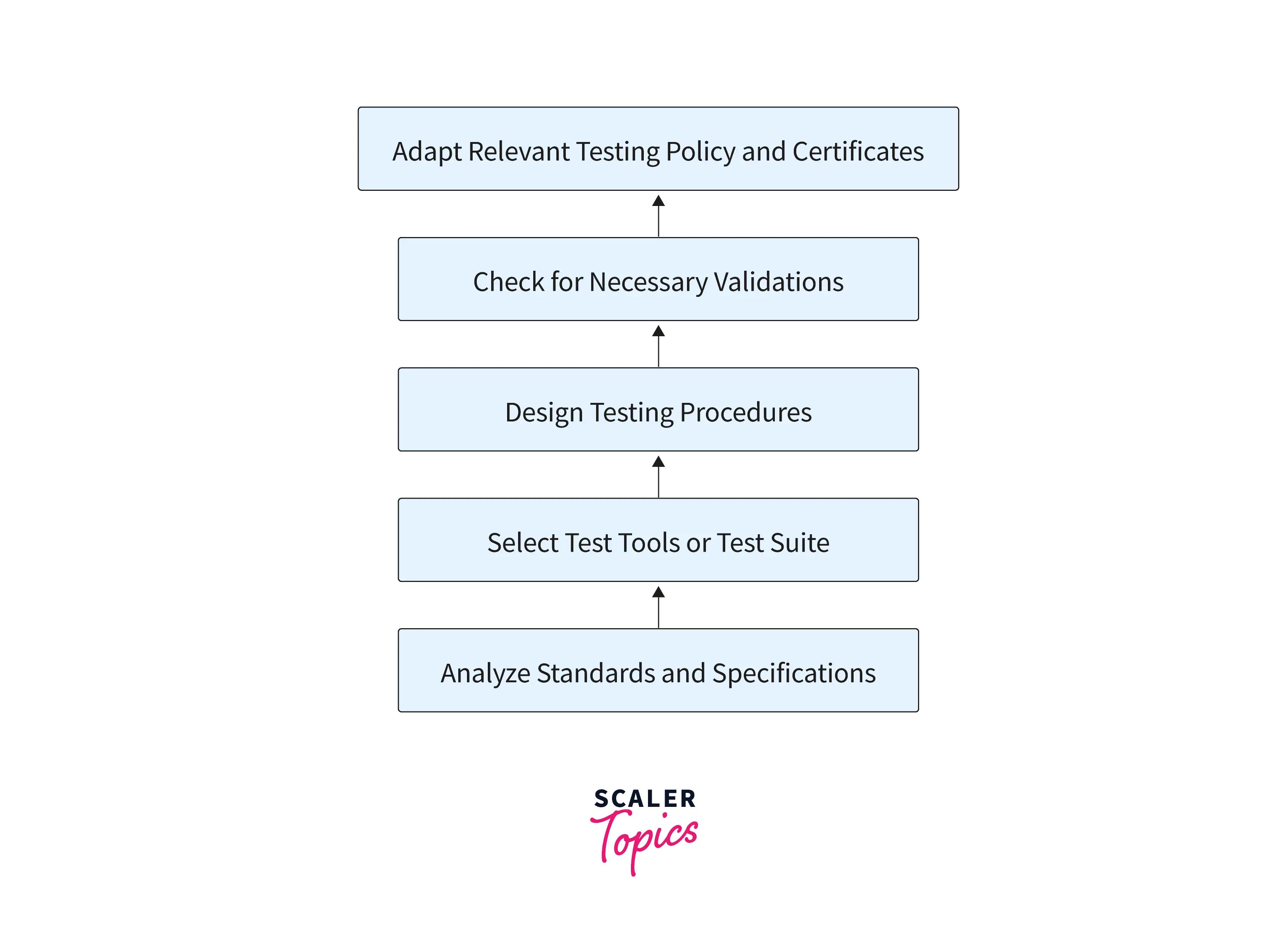 1. Standards and Specifications are analyzed: Standards and specifications are as per the requirements and system design. The goal is to analyze the risk areas and ensure those are protected and kept secure.
2. Tool Selection: Tool selection differs for every test scenario. UI testing requires tools like Selenium, Appium, API testing, Rest Assured library, postman, etc.
3. Testing Process Development: Test case development here is done to validate the quality standards are met. The standards are the test case scenarios. In test case failure, code is redone to ensure those are met. Here white box testing is given the primary significance.
4. Specifications validations: Once the conformance testing is passed. Another round of validations is done before the certification is provided.
5. Certifications: The certification is provided based on level. The higher the level, the more specified and in-depth the testing is done.
Conformance/Compliance Testing for Mobile System
Conformance testing for mobile systems is for the type of networks. Test cases include:
- Sim Card Testing
- Network Protocol Testing
- Camera Quality Testing
- Audio Testing
- Temperature Resistance Testing
Conclusion
- Conformance testing is also known as Compliance testing. It is done to get certifications from standardized organizations.
- Conformance testing ensures the product built is as per the organization's guidelines.
- Certifications keep the developers on track and bring a lot of credibility to the client.
- The only disadvantage of the process is that it is costly.




