


Performance Testing
Overview
In today's fast-paced digital landscape, ensuring optimal performance of software applications is of utter importance. Performance testing plays a critical role in assessing and enhancing the efficiency, scalability, and stability of software systems. This comprehensive process involves measuring, analyzing, and fine-tuning various aspects of an application's performance, ultimately aiming to provide an exceptional user experience under real-world conditions.
What is Performance Testing?
In software testing, we can define performance testing as a procedure that is used to test the speed, response time, stability, dependability, scalability, as well as resource utilization of a software application under a certain workload.
The primary goal of performance testing is to identify and eliminate performance bottlenecks in software systems. Performance testing is known to be a subset of performance engineering. We can also refer to Performance testing as “Perf Testing.”
One of the main goals of Performance Testing is to evaluate the speed of a software program or an application.
- Speed – The speed of a programme refers to how rapidly the programme reacts
- Scalability – The greatest number of users that a software application can support is known as scalability
- Stability – Under varying loads, if the application can handle a huge number of users without undue strain then the application is scalable
What is the Purpose of Performance Testing?
- Performance testing aids in the removal of performance bottlenecks
- It aids in determining what needs to be improved prior to sharing the product with stakeholders or the company
- It helps make the desired software work speedily
- It also helps to ensure that the software is stable as well as reliable
Build an AI-First Career, Master the Complete Skillset
Choose from our industry-leading programs designed for career success
Modern Software and AI Engineering Program
Master full-stack development with AI integration


 +1000 more
Modern Data Science and ML with specialisation in AI
Advanced data science techniques with AI specialization
+1000 moreAdvanced AIML with Specialisation in Agentic AI
Deep dive into AIML with focus on Agentic systems
+1000 moreDevOps, Cloud & AI Platform Engineering
Build and manage AI-powered cloud infrastructure
+1000 moreAI Engineering Advanced Certification by IIT-Roorkee
Premier AI engineering certification from IIT-Roorkee

AI Forward Deployed Engineer Program
Full-stack engineering, production AI and client-facing consulting
+1000 moreHow to Conduct Performance Testing?
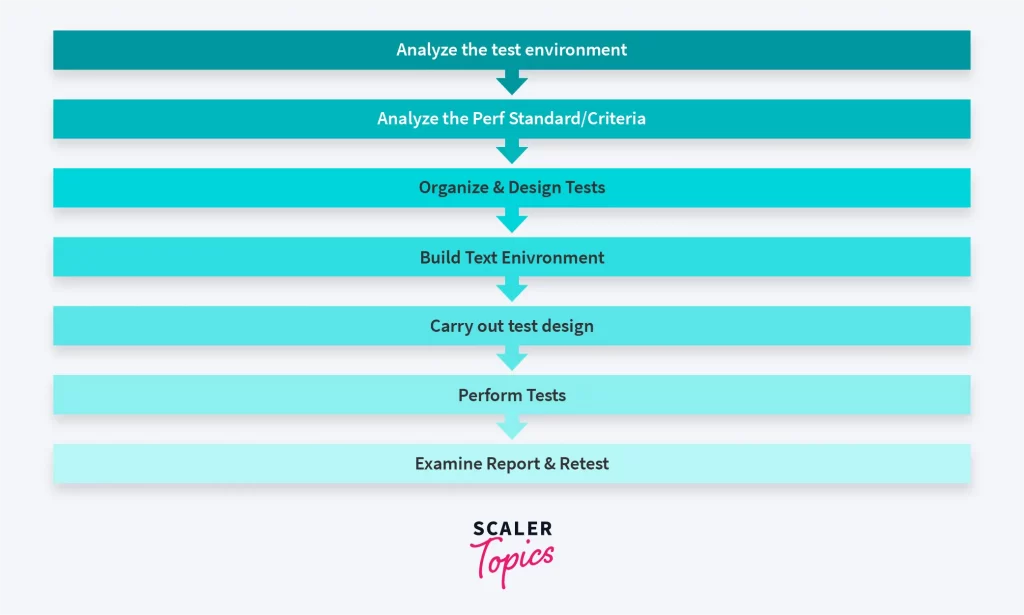
The following diagram given below shows the steps to conduct performance testing or the performance testing process –
Types of Performance Testing
Let’s have a look at the many forms of performance testing.
1. Load Testing
Load testing is one of the types of performance testing. It determines the application’s ability to execute under expected user loads.
Load testing is used to discover performance bottlenecks before a software program goes live
2. Stress Testing
Stress testing is done to ensure that the system will not crash in a time of crisis. Endurance testing is another name for stress testing.
Stress testing examines the system’s behavior following a failure. Stress testing ensures that the system will recover after a failure
3. Endurance Testing
It is performed to ensure that the software can withstand the projected load for an extended length of time
4. Spike Testing
Spike testing examines the software’s response to sudden huge increases in user load
5. Volume Testing
A significant amount of data is populated in a database during Volume Testing, and the overall behaviour of the software system is observed.
The goal is to test the software application’s performance on various database volumes
6. Scalability Testing
The primary goal of scalability testing is to assess the efficiency of a software programme in “scaling up” to handle an increase in user load. Scalability testing also aids in the planning of capacity expansions to your software system
7. Soak Testing
A type of performance test that checks whether the program under test (AUT) can withstand continuous stress for a specified period of time. This is a non-functional test. Soak testing is also called & “stress test” or “endurance test” or ‘Longevity Testing’
How Scaler Transformed Careers in Different Fields
Scaler learners achieved 2.5x salary growth with average post-Scaler CTC reaching ₹23L.
 Google
 Amazon
 Microsoft
 Flipkart
 Adobe1200+ more
8. Capacity Testing
Capacity testing determines if a program and its environment can manage the amount of traffic that it was planned to handle.
It may be used during the design phase to determine how many users or transactions the system can handle under a particular set of conditions
Common Performance Testing Problems in Software Testing
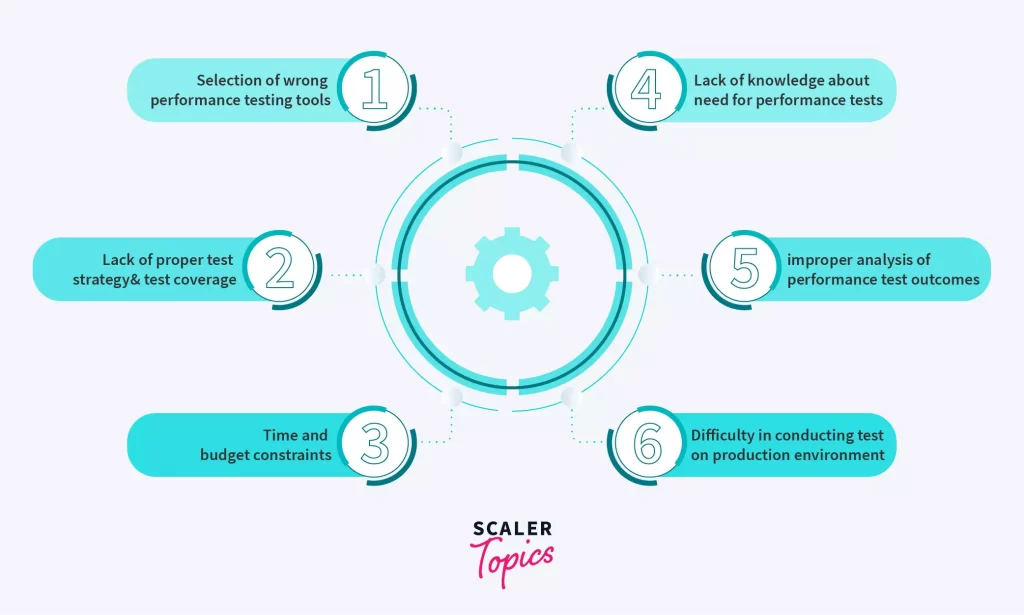
Let’s go through a few common problems in performance testing
- Choosing the incorrect performance testing tools
- Inadequate test approach and coverage
- Time and financial limitations
- Inadequate performance test result analysis
- Difficulty in carrying out testing in a production environment
Performance Testing Metrics
Metrics for software testing are a method of measuring and monitoring your testing activities. More importantly, they provide insights into your team’s test progress, productivity, and the system under test’s quality.
A variety of performance measures, often known as key performance indicators (KPIs), can assist a company in evaluating its present performance. Performance indicators that are widely used include –
1. Throughput
The number of information units a system processes in a given amount of time is known as Throughput
2. Memory
This metric provides information on free disc space and memory used during scenario execution. Disk Space displays the amount of disc space that has been used
Turn Learning into Career Growth
3. Latency
It is a term used to describe the amount of time it takes for a response to occur. Latency is defined as the time elapsed between sending the request and receiving the first byte of the response
4. Bandwidth
Bandwidth is the quantity of data per second that can be delivered across workloads, often through a connection or a network
5. Interrupts per second on the CPU
The number of hardware interrupts received by a process per second on the CPU
Performance Testing Tools
Depending on the aims and preferences of an IT organization, a number of performance testing tools may be used. The following are examples of performance testing tools:
- JMeter – A performance testing tool from Apache, can generate load tests for web and application services.
Graphs, thread groups, timers, functions, and logic controllers are just a few of the domains covered by JMeter plugins for load testing.
An IDE is provided by the tool which records test results for browsers or online applications. It also records the test results for command-line mode for load testing Java-based operating systems

- LoadRunner – This tool is developed by the software development center Micro Focus, assesses and tests the performance of programmes under stress. This testing tool is recognised for its ability to imitate thousands of potential customers, as well as record and analyse load tests. As part of the simulation, the software generates communications between application components and end-user actions, which is identical to key presses or mouse movements. The tool is also available in cloud-optimized versions

- NeoLoad – A Neotys testing tool, offers stress as well as tests which are built for mobile and web applications. It is particularly built to test apps before release for DevOps and continuous delivery. An IT department might use the software to monitor database, web, and application servers. NeoLoad is capable of simulating millions of users and doing testing on-premises or in the cloud

Examples
- For example, let’s take 1000 people use the website at the same time, and ensure that the response time is no more than 4 seconds.
- When network connectivity is slow, make sure that the Application Under Load’s response time is within an acceptable range.
- Examine the maximum number of users that the programme can support before crashing.
- Check the database execution time when 500 records are read/written at the same time.
- Under high demand circumstances of the application, examine the CPU and memory use of the application and the database server.
- Check the application’s reaction time under low, medium, moderate, and heavy load levels
Conclusion
Performance testing is a sort of non-functional testing that is used to determine how the system operates under various load circumstances. This form of testing evaluates the program or application’s speed, scalability, dependability, and resource use.
It is critical for commercial websites, particularly eCommerce sites and mobile applications, to have their performance evaluated to guarantee that they scale up when several people access them at the same time.
Last but not least, performance testing is critical for organizations, and it is advantageous to use performance testing service providers to ensure scalable, reliable, and high-performing software.
During sales and other such events, e-commerce companies have to maintain their performance even on heavy loads.
FAQs
Q. When is Performance Testing done?
A. We generally need to wait till the conclusion of development to begin testing this method. Performance tests are similar to acceptance tests, and if the requirements are fulfilled, the system is ready for production. This entails modeling the anticipated load scenario.
Q. What is a Performance Testing Tool?
A. Performance testing tools aid in assessing the system’s, computer’s, network’s, program’s, or application’s speed, effectiveness, dependability, scalability, and interoperability.




