

What is Agentic AI Characteristics? Definition & Key Concepts
Agentic AI refers to artificial intelligence systems designed to pursue complex, multi-step goals autonomously. Unlike traditional AI that waits for specific prompts, agentic AI actively plans, reasons, utilizes external tools, and adapts to environmental changes to achieve a predefined objective without constant human intervention.
Introduction to Agentic AI and Intelligent Agents
The evolution of artificial intelligence has historically been defined by a transition from static, rule-based systems to highly dynamic, learning-capable architectures. Early machine learning models functioned primarily as reactive function approximators—taking a specific input, performing a predefined computation, and generating a direct output. While the advent of Large Language Models (LLMs) and generative AI brought unprecedented natural language understanding and generation capabilities, these models fundamentally remained passive. They operated strictly within a conversational or prompt-response paradigm, lacking the intrinsic capability to initiate actions, retain long-term state across disjointed sessions, or iteratively solve problems in a dynamic environment.
Agentic AI represents a fundamental paradigm shift from this passive computation to proactive, goal-directed behavior. Rooted in the classical computer science concepts of intelligent agents and control systems, agentic AI introduces the dimension of "agency"—the capacity of a system to perceive its environment, formulate a sequence of actions, execute those actions using external tools, and evaluate the outcomes to refine its future behavior. By coupling the semantic reasoning power of LLMs with autonomous control loops and persistent memory architectures, agentic systems are transforming AI from mere digital assistants into autonomous digital workers capable of executing complex engineering, analytical, and operational workflows.
Stop learning AI in fragments—master a structured AI Engineering Course with hands-on GenAI systems with IIT Roorkee CEC Certification


AI Engineering Course Advanced Certification by IIT-Roorkee CEC
A hands on AI engineering program covering Machine Learning, Generative AI, and LLMs - designed for working professionals & delivered by IIT Roorkee in collaboration with Scaler.
Enrol Now
Agentic AI Definition: What Makes an AI "Agentic"?
To formulate a mathematically and computationally precise agentic ai definition characteristics, one must examine the intersection of cognitive architectures and reinforcement learning. In computer science, an "agent" is an entity that exists within an environment, observes the state of that environment, and takes actions that alter the state to maximize a specific performance measure or objective function.
When we apply this to modern deep learning and foundation models, Agentic AI is defined as an artificial intelligence system that possesses the capability to translate a high-level, abstract objective into a concrete, executable plan. It does not merely generate text or code; it actively executes that code, parses the resulting output, identifies errors or state changes, and recursively corrects its path until the termination condition (the goal) is satisfied.
This requires the system to maintain an internal state, manage context windows effectively over prolonged execution periods, and interface directly with programmatic tools—such as REST APIs, command-line interfaces, compilers, and databases. Therefore, the definition of agentic AI is inherently tied to its operational autonomy and its ability to construct its own prompt-and-response feedback loops, breaking free from the dependency on human-in-the-loop micro-management.
Core Features of Agentic AI
Understanding the features of agentic ai requires examining the systemic capabilities that elevate a model from a reactive text generator to an autonomous task executor. These features define the operational boundaries and architectural requirements of an agentic system.
Build an AI-First Career, Master the Complete Skillset
Choose from our industry-leading programs designed for career success
Modern Software and AI Engineering Program
Master full-stack development with AI integration


 +1000 more
Modern Data Science and ML with specialisation in AI
Advanced data science techniques with AI specialization
+1000 moreAdvanced AIML with Specialisation in Agentic AI
Deep dive into AIML with focus on Agentic systems
+1000 moreDevOps, Cloud & AI Platform Engineering
Build and manage AI-powered cloud infrastructure
+1000 moreAI Engineering Advanced Certification by IIT-Roorkee
Premier AI engineering certification from IIT-Roorkee

AI Forward Deployed Engineer Program
Full-stack engineering, production AI and client-facing consulting
+1000 more1. Autonomy and Goal-Directed Behavior
Traditional AI models optimize for the next-token prediction based on an immediate context window. Agentic AI, conversely, optimizes for task completion. Given a macroscopic goal (e.g., "Analyze this dataset, train a regression model, and deploy it to a designated AWS endpoint"), the agentic system decomposes the overarching goal into a Directed Acyclic Graph (DAG) of sub-tasks. It traverses this graph autonomously, initiating the required computational steps without requiring a human to prompt it for every sequential action.
2. Environmental Perception and Grounding
An agentic system does not operate in a vacuum; it perceives an "environment." In software engineering and digital tasks, this environment consists of the operating system, file directories, web search results, or API responses. The agent interprets these environmental signals to ground its reasoning. If an API returns a 404 Not Found error, the agent perceives this state change and dynamically routes its execution path to troubleshoot the endpoint, rather than blindly continuing its initial plan.
3. Advanced Tool Utilization
The defining hallmark of an agentic system is its ability to manipulate its environment through tool use. While a standard LLM can output Python code, an agentic AI can write the Python code, execute it in a secure Docker sandbox, read the standard output (stdout) or standard error (stderr), and modify the code if a SyntaxError is caught. This involves interacting with compilers, web browsers, database drivers, and third-party APIs as extensions of its own cognitive capabilities.
4. Robust Memory Architectures
To function autonomously over extended horizons, agentic AI requires complex memory management.
- Short-Term Memory: Utilizes the model's immediate context window to track the current step, recent tool outputs, and immediate reasoning traces.
- Long-Term Memory: Employs external vector databases to store semantic representations of past experiences, user preferences, or historical codebase context, allowing the agent to retrieve relevant information using approximate nearest neighbor (ANN) search algorithms.
The Architecture of Agentic AI Systems
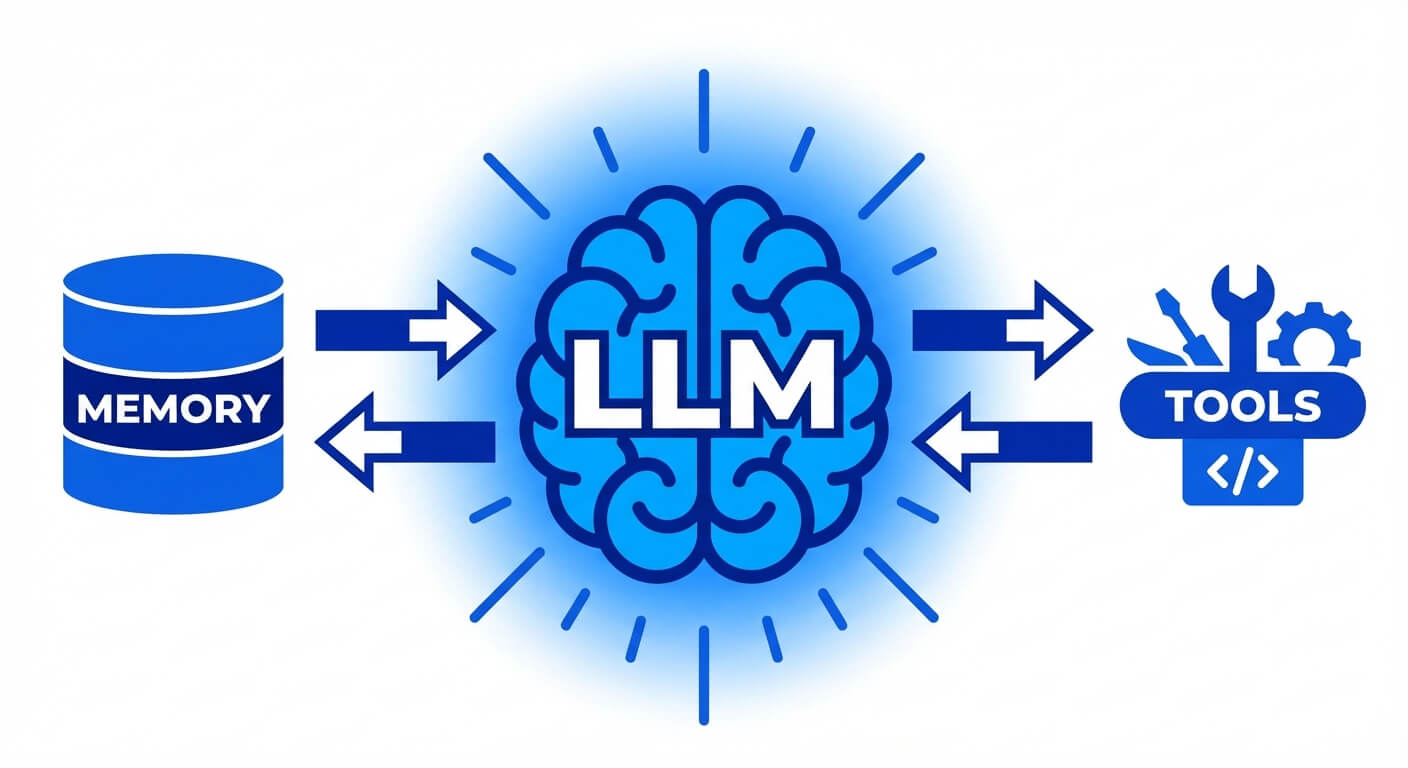
The architectural design of an agentic AI system borrows heavily from classical reinforcement learning frameworks and control theory, while replacing traditional policy networks with Large Language Models acting as the central reasoning engine. Designing such a system requires a rigorous implementation of state tracking, decision orchestration, and feedback processing.
The Agent Function and Objective Function
At its core, an intelligent agent can be mathematically modeled using a Markov Decision Process (MDP), represented as the tuple M = ⟨S, A, P, R, γ⟩, where:
- S: A set of states representing the environment.
- A: A set of actions the agent can take (e.g., API calls, bash commands).
- P: A transition probability function P(s' | s, a) dictating the environment's response to an action.
- R: A reward function R(s, a) that the agent seeks to maximize.
- γ: A discount factor γ ∈ [0, 1].
The agent's behavior is guided by an objective function that evaluates how close the current state s is to the terminal goal state. The LLM acts as the policy π(a | s), determining the optimal action a given the current context s.
The ReAct (Reasoning and Acting) Framework
Modern agentic architectures heavily utilize the ReAct framework, which interleaves reasoning traces with actionable commands. This allows the model to internally debate its next move, execute the move, and observe the result in a continuous loop.
Below is a Python abstraction demonstrating the core execution loop of an agentic system using the ReAct paradigm:
Cognitive Memory Modules
Agentic AI architectures decouple memory from the neural network's weights. Because LLMs suffer from context window constraints and quadratic scaling of attention mechanisms, agents utilize Retrieval-Augmented Generation (RAG) paradigms for memory. When an agent encounters a problem, it generates an embedding vector v of the current context. It computes the cosine similarity against historical vectors u in a vector space to recall past solutions: Cosine_Similarity(v, u) = (v · u) / (||v|| ||u||)
This allows the agent to maintain continuous context across days or weeks of autonomous operation, selectively retrieving only the most semantically relevant memories to insert into its current active reasoning window.
Master structured AI Engineering + GenAI hands-on, earn IIT Roorkee CEC Certification at ₹40,000
AI Engineering Course Advanced Certification by IIT-Roorkee CEC
A hands on AI engineering program covering Machine Learning, Generative AI, and LLMs - designed for working professionals & delivered by IIT Roorkee in collaboration with Scaler.
Enrol NowHow Agentic AI Differs from Generative AI
To accurately conceptualize agentic AI, it is critical to distinguish it from standard Generative AI. While generative models are the foundational building blocks of modern agents, they do not inherently possess agency. Generative AI is optimized for semantic coherence and statistical likelihood based on training data. Agentic AI is optimized for state-space navigation and objective realization.
The following table outlines the fundamental technical distinctions between these two paradigms:
| Technical Characteristic | Standard Generative AI | Agentic AI |
|---|---|---|
| Execution Paradigm | Reactive / Stateless prompt-completion. | Proactive / Stateful continuous loops. |
| Task Complexity | Single-step generation (e.g., write an essay, generate a script). | Multi-step orchestration (e.g., plan, execute, verify, debug). |
| Environmental Grounding | Confined entirely to the model's pre-trained parametric knowledge. | Interacts with real-world environments via APIs, terminals, and live databases. |
| Error Handling | Requires a human to review the output, identify errors, and re-prompt. | Self-correcting. Detects stack traces or API errors and dynamically adjusts its plan. |
| State Management | Limited to the current session's context window. Memory is ephemeral. | Persistent. Utilizes external memory stores (Vector DBs) to remember cross-session context. |
| Output Determinism | High variance. Primarily outputs text, code, or media directly to the user. | Outputs are often structural actions (HTTP requests, database writes) rather than direct text. |
Classes and Hierarchies of Agentic AI
Agentic AI systems are not monolithic; they are categorized into hierarchies based on their cognitive complexity, memory utilization, and decision-making capabilities. In artificial intelligence theory, primarily formalized by Stuart Russell and Peter Norvig, intelligent agents are classified into several distinct architectures. Modern LLM-based agents map directly onto these theoretical classes, with each level representing a significant leap in computational capability.
How Scaler Transformed Careers in Different Fields
Scaler learners achieved 2.5x salary growth with average post-Scaler CTC reaching ₹23L.
 Google
 Amazon
 Microsoft
 Flipkart
 Adobe1200+ more
1. Simple Reflex Agents
Simple reflex agents operate strictly on a condition-action rule base. They do not maintain internal state or memory of past observations. They perceive the current environment and trigger a predefined response based on the immediate input. In the context of modern development, a simple webhook-triggered bot that reads an incoming Jira ticket and automatically assigns a label based on keyword matching is a simple reflex agent. It has no capacity to plan or understand the broader context of the project.
2. Model-Based Reflex Agents
These agents maintain an internal state that depends on the history of percepts, allowing them to handle environments that are only partially observable. They contain a "model" of how the world evolves independently of the agent and how the agent's actions affect the world. An LLM agent that reads a codebase, maintains an abstract syntax tree (AST) representation of the code in memory, and tracks variable state changes as it debugs a script operates as a model-based reflex agent.
3. Goal-Based Agents
Goal-based agents expand upon the model-based architecture by integrating explicit goal information. They utilize search algorithms and automated planning to project future states and choose actions that guarantee the achievement of their goal. AutoGPT and similar architectures are goal-based agents. If tasked with building a web scraper, the agent generates a multi-step plan, considers the prerequisites (e.g., installing BeautifulSoup or Selenium), and sequentially acts to achieve the final state.
4. Utility-Based Agents
While goal-based agents care only about achieving a binary state (success or failure), utility-based agents optimize for a continuous utility function. They evaluate different paths to a goal and select the one that maximizes efficiency, safety, or computational speed. An advanced financial trading agent does not just aim to execute a trade (the goal); it calculates the expected utility of various trades considering slippage, market volatility, and risk tolerance, mathematically maximizing its internal utility metric U(s).
5. Multi-Agent Systems (Hierarchies)
The most advanced implementation of agentic AI involves Multi-Agent Systems (MAS). Instead of relying on a single monolithic LLM prompt to handle all reasoning, MAS architectures instantiate multiple specialized agents that communicate with one another using standardized protocols. For example, a software engineering MAS might consist of:
- A Product Manager Agent that breaks user requirements into technical specifications.
- A Coder Agent that writes the source code based on the specifications.
- A QA Agent that runs unit tests and sends failure logs back to the Coder Agent.
These hierarchical systems utilize message-passing paradigms, frequently serializing data in JSON structures to ensure strict type adherence and clear communication channels between the distinct agent nodes.
Underlying Technologies Powering Agentic AI
To transition theoretical agentic concepts into production-grade engineering tools, several distinct technology stacks must be integrated. The foundational intelligence relies on large-scale models, but the agentic wrapping requires specialized infrastructure designed for state retention, execution safety, and semantic orchestration.
Turn Learning into Career Growth
Large Language Models (LLMs) and Reasoning Engines
The cognitive engine of an agentic AI is typically an advanced LLM trained heavily on code and logic (such as GPT-4, Claude 3 Opus, or Llama 3). Crucially, these models undergo specific post-training alignment techniques—such as Reinforcement Learning from Human Feedback (RLHF) and Proximal Policy Optimization (PPO)—to optimize them for tool use and structured JSON output rather than mere conversational fluency.
Orchestration Frameworks (LangChain and LlamaIndex)
Building an agent from scratch involves significant boilerplate code for prompt routing, memory chunking, and API management. Frameworks like LangChain and LlamaIndex provide the middleware required to rapidly construct agentic systems. They offer pre-built abstractions for the AgentExecutor loop, allowing developers to define custom tools (functions wrapped with standard metadata) and bind them directly to the LLM's reasoning engine.
Execution Sandboxes and Secure Environments
Because agentic AI systems are designed to write and execute code autonomously, they introduce severe security vectors. If an agent hallucinates a malicious bash command (e.g., rm -rf /), executing it on the host machine would be catastrophic. Therefore, agentic AI heavily relies on ephemeral, containerized execution environments. Technologies like Docker and WebAssembly (Wasm) are utilized to spin up isolated, restricted compute environments where the agent can securely test its code, read the stdout/stderr, and self-correct without risking host system integrity.
Applications and Implications of Agentic AI
The deployment of agentic AI is driving a shift from human-executed workflows to human-supervised autonomous workflows. This transition fundamentally impacts how enterprise systems, software engineering lifecycles, and data operations are structured.
Autonomous Software Engineering
Agentic AI systems, such as Devin or open-source equivalents like OpenDevin and SWE-agent, represent a massive leap in development automation. These systems can ingest a GitHub issue, autonomously navigate the repository, write the required patch, execute the test suite, and submit a pull request. They utilize advanced graph-based representations of codebases to understand dependencies and execute refactoring tasks that previously required senior engineering oversight.
Data Analysis and DevOps Automation
In data science, agentic AI can interface directly with SQL databases and cloud data warehouses. Instead of a data engineer writing complex ETL pipelines manually, an agentic system can be given the schema and the business objective. It will write the SQL queries, extract the data, run statistical analyses using Pandas or NumPy in an isolated Python environment, and generate comprehensive HTML/PDF reports.
In DevOps, agents act as autonomous site reliability engineers (SREs). When a monitoring tool like Datadog triggers an alert for high latency, an agentic system can automatically SSH into the server, read the system logs, identify a memory leak, restart the offending microservice, and document the incident—drastically reducing the Mean Time to Recovery (MTTR).
Common Misconceptions About Agentic AI
Despite the rapid integration of agentic systems into enterprise architectures, significant misunderstandings regarding their capabilities, limitations, and theoretical boundaries persist. Clearing up these misconceptions is vital for engineers seeking to implement these architectures reliably.
Misconception 1: Agentic AI is synonymous with AGI (Artificial General Intelligence)
A widespread fallacy is equating agentic capabilities with AGI. While agentic systems exhibit high degrees of autonomy and reasoning, they remain narrow systems tightly bound by their underlying pre-trained models. They do not possess sentience, self-awareness, or the ability to seamlessly transfer learning across entirely unrelated domains outside their training distribution. Agentic AI is a structural architecture applied to existing narrow AI, not a leap into general intelligence.
Misconception 2: Agentic systems are fully deterministic
Because agentic AI leverages probabilistic foundation models, their execution paths are non-deterministic. Running the exact same goal through an agentic loop multiple times may result in different sequences of tool usage or code implementation, especially if the model's temperature parameter is set above zero. Engineers must design agentic systems with robust error-handling, fallback mechanisms, and strict validation checks to account for this inherent stochasticity.
Misconception 3: Human-in-the-loop is no longer necessary
While autonomy is the defining characteristic of agentic AI, deploying these systems in production without human oversight is technically hazardous. Due to phenomena like model hallucination, agents can enter infinite loops, misinterpret API documentation, or inadvertently mutate database records. Production-grade agentic architectures strictly enforce "Human-in-the-Loop" (HITL) or "Human-on-the-Loop" (HOTL) paradigms, where the agent requires explicit cryptographic or manual authorization before executing destructive actions (e.g., dropping database tables or merging code into the main branch).
Frequently Asked Questions (FAQ)
Q: What is the primary difference between a simple API script and an Agentic AI? A: A simple API script executes a hardcoded sequence of instructions deterministically. If an unexpected error occurs, the script crashes. An agentic AI perceives the error, dynamically reasons about the cause using its LLM engine, and generates a new sequence of actions to bypass or fix the error autonomously.
Q: How do agentic AI systems prevent infinite loops during task execution? A: System architects implement strict guardrails within the AgentExecutor loop. This typically involves enforcing a max_iterations limit, setting budget constraints (e.g., maximum token usage per task), and utilizing secondary LLMs as "evaluators" to monitor the primary agent and forcefully terminate execution if it detects circular reasoning or repetitive failed actions.
Q: Can agentic AI operate locally without cloud-based LLMs? A: Yes. While early agentic frameworks relied on massive, proprietary cloud models, the advancement of optimized, quantized open-weights models (like Llama 3 8B or Mistral) allows developers to run complete agentic AI loops locally. Utilizing inference engines like Ollama or vLLM paired with local vector stores enables fully private, offline agentic capabilities.
Q: What role does an objective function play in modern Agentic AI? A: The objective function serves as the termination condition and the heuristic for success. While classical AI explicitly programmed utility metrics, modern LLM-based agents encode the objective function as a semantic prompt. The agent uses this semantic objective to evaluate its own sub-tasks, continuously asking, "Does the result of my last action bring me closer to satisfying this prompt?"




